1000 dinara 1941
Market Prices
48 salesAbout This Note
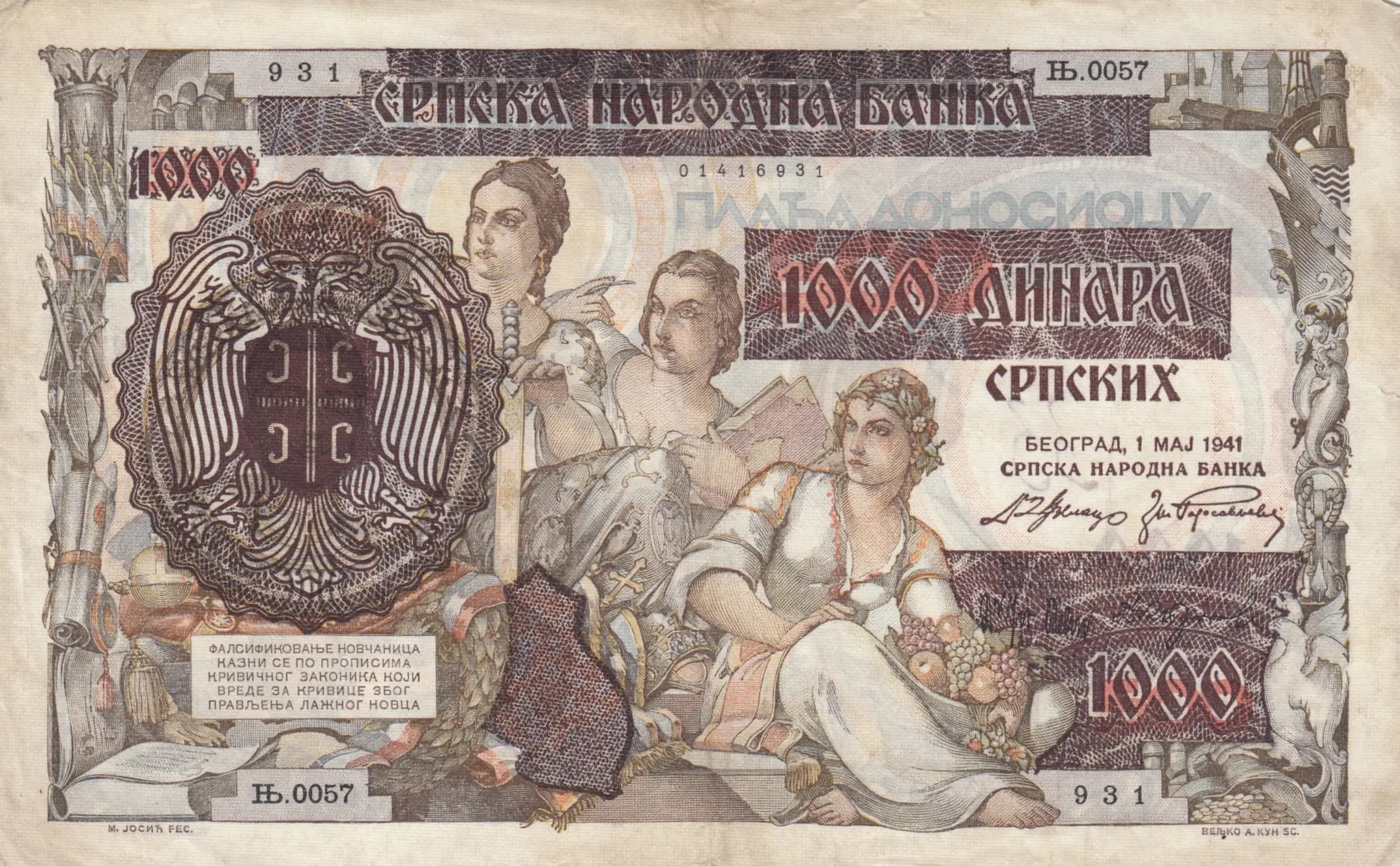
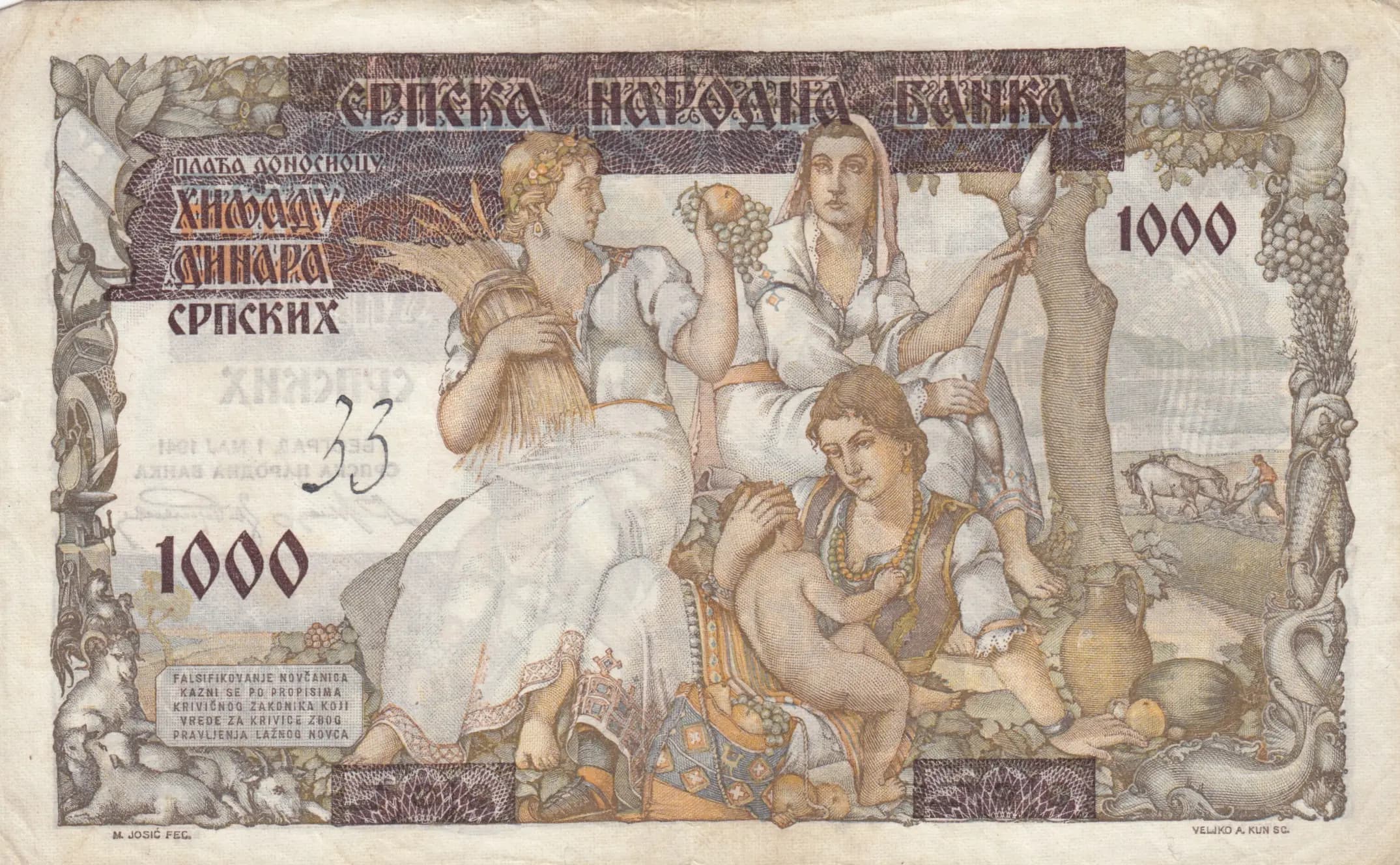
A 1941 Serbian 1000 dinara note issued by Srpska Narodna Banka on May 1st, graded Fair condition, featuring allegorical female figures in classical Renaissance dress on both sides. The note displays visible age and handling wear including creasing and foxing consistent with its 80+ year history, yet remains well-preserved with distinguishable design elements including the double-headed eagle coat of arms, ornamental borders, and agricultural/grape vine motifs on the reverse.
Common. Secondary market data shows consistent eBay auction activity spanning from 2010 to 2025 with regular sales at modest prices ($2.61–$19 for circulated examples in Fair to About Uncirculated condition). The median price for Fair graded examples is approximately $4–$6, with only premium grades (PMG 64+) commanding $60–$97. The consistent availability across multiple decades indicates substantial print run and ongoing collector supply. This is a standard issue from a functional national bank during a critical historical period, not a short-lived or recalled issue.
Issued during the tumultuous period of May 1941, this banknote represents Serbian currency during the early months of Axis occupation following the German invasion of Yugoslavia in April 1941. The classical allegorical imagery—featuring idealized female figures representing prosperity and agricultural abundance with grape motifs—reflects pre-war Serbian national identity and economic themes, while the issuer Srpska Narodna Banka (Serbian National Bank) was functioning under increasingly constrained circumstances. This denomination and issue date mark a transitional moment in Serbian monetary history, as the occupation would soon lead to currency reorganization and the introduction of puppet state currencies.
The obverse features three allegorical female figures in classical/Renaissance dress positioned in the center-right portion of the note, representing ideals of Serbian culture and prosperity. A prominent double-headed eagle coat of arms with shield containing Cyrillic letters occupies the left side, serving as the emblem of Serbian sovereignty. Architectural elements depicting buildings and fortifications appear in the upper left corner. The reverse depicts multiple female allegorical figures in flowing white garments, integrated with grape vines, grape clusters, and agricultural motifs symbolizing fertility, harvest, and national abundance. A rural landscape scene showing agricultural workers appears in the lower right. The entire design is framed by ornamental borders featuring floral, fruit, and architectural elements in the classical tradition. The note employs a beige/cream ground with brown and purple/dark plum printing, creating a dignified, formal appearance typical of Serbian interwar currency design.
FRONT SIDE: 'СРПСКА НАРОДНА БАНКА' (Serbian National Bank) / '1000 ДИНАРА / СРПСКИХ' (1000 Serbian Dinars) / 'БЕОГРАД, 1 МАЈ 1941' (Belgrade, 1 May 1941) / 'М. ЈОСИЋ ГЕЛ.' (M. Josić gel. [gelatin/engraver]) / 'ФАЛСИФИКОВАЊЕ НОВЧАНИЦА КАЗНИ СЕ ПО ПРОПИСИМА КРИВИЧНОГ ЗАКОНИКА КОЈИ ВРЕДЕ ЗА КРИВИЦЕ ПРОТИВ ПРАВНОГ СТАЊА НОВЦА' (Counterfeiting banknotes is punished according to criminal law provisions for crimes against currency rights) / Serial numbers visible: 'Ђ.0057', '01416931' / Designer credit and signatures present. BACK SIDE: 'СРПСКА НАРОДНА БАНКА' (Serbian National Bank) / '1000 ДИНАРА / СРПСКИХ' (1000 Serbian Dinars) / 'БЛАГЕ ПОПОШИЛОЈ' (For the blessing of bounty) / 'М. ЈОСИЋ ГЕЛ.' (M. Josić gel.) / 'ВЕЛИКО А. КУН & С' (Veliko A. Kun & Co. [printer]) / Counterfeiting warning repeated / Reference number '35' marked in handwriting
Intaglio engraving (steel plate engraving) with fine-line guilloche patterns and intricate engraved details throughout, as evidenced by the precision of the fine lines, complex border work, and detailed allegorical figure rendering visible in the images. The printer Veliko A. Kun & Co. (visible on the reverse) was a prominent Austro-Hungarian security printer known for high-quality banknote production. The 'M. Josić gel.' credit indicates the primary engraver/gelatine artist. This represents classical security printing of the 1930s-40s period, utilizing multiple impression passes and specialized security inks to prevent counterfeiting.
The note displays a handwritten notation '35' and the printer identification 'ВЕЛИКО А. КУН & С' (Veliko A. Kun & Co.). Serial number prefix observed: 'Ђ.0057' with serial number '01416931'. The May 1, 1941 date is the standard issue date for P-24. PMG population data indicates one catalogued variant noted as 'P-24: 1000 Dinara on 500 Dinara', suggesting this denomination may have involved overprinting or successive denominations, though visual analysis shows this as a primary 1000 dinara note. No visible overprint evidence in the inspected images; this variety designation likely refers to printing plate configurations or design evolution rather than a post-production overprint.