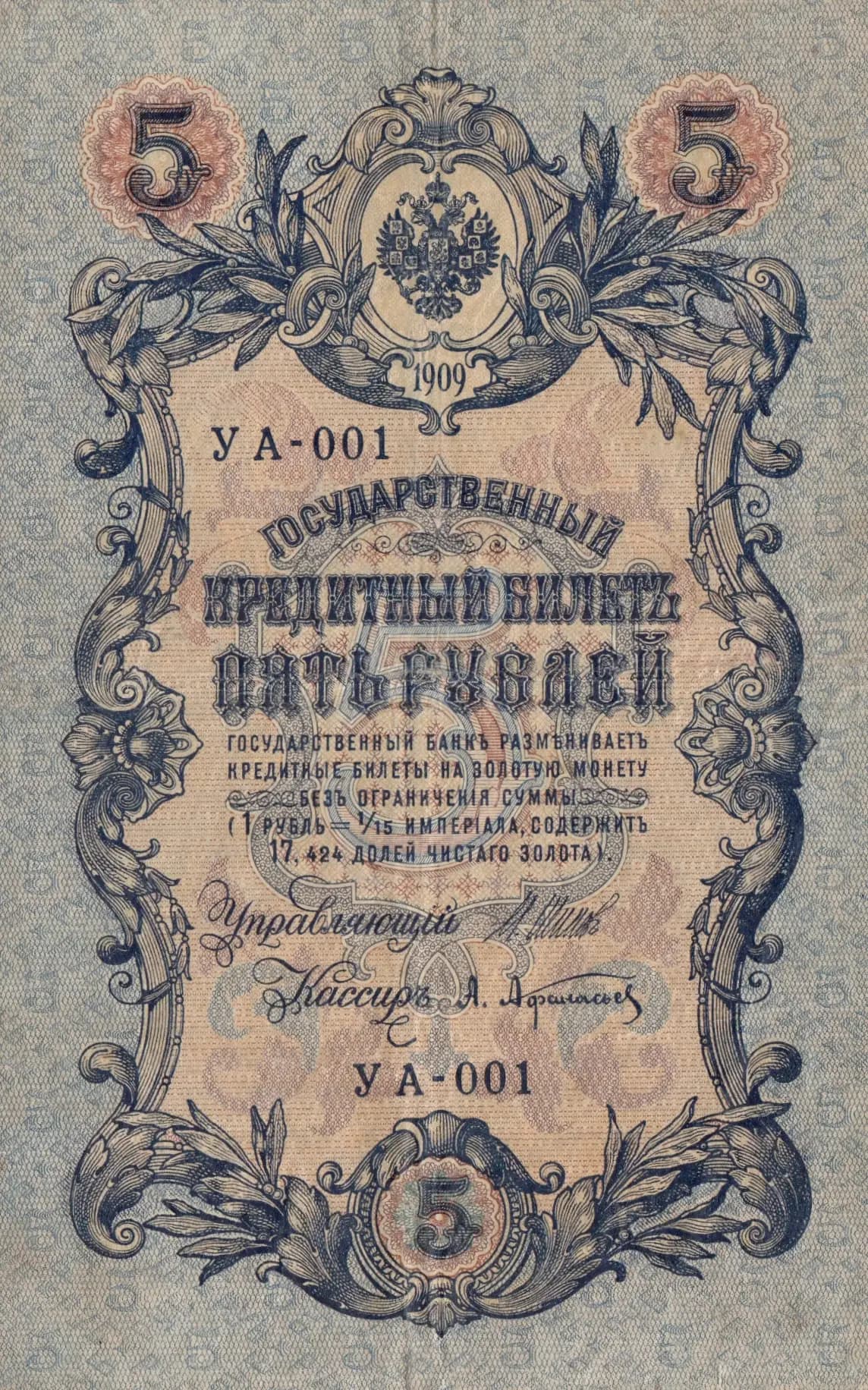
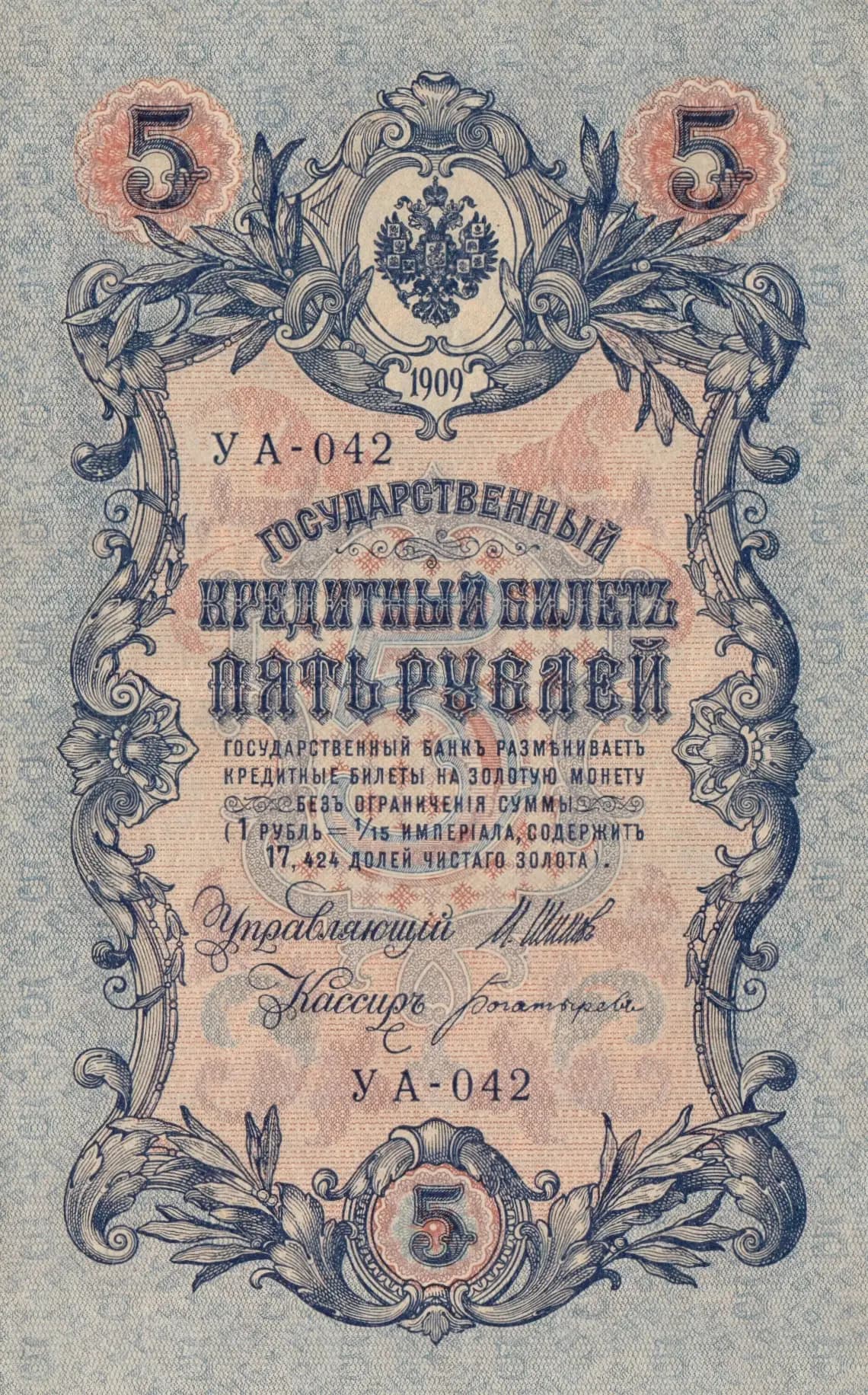
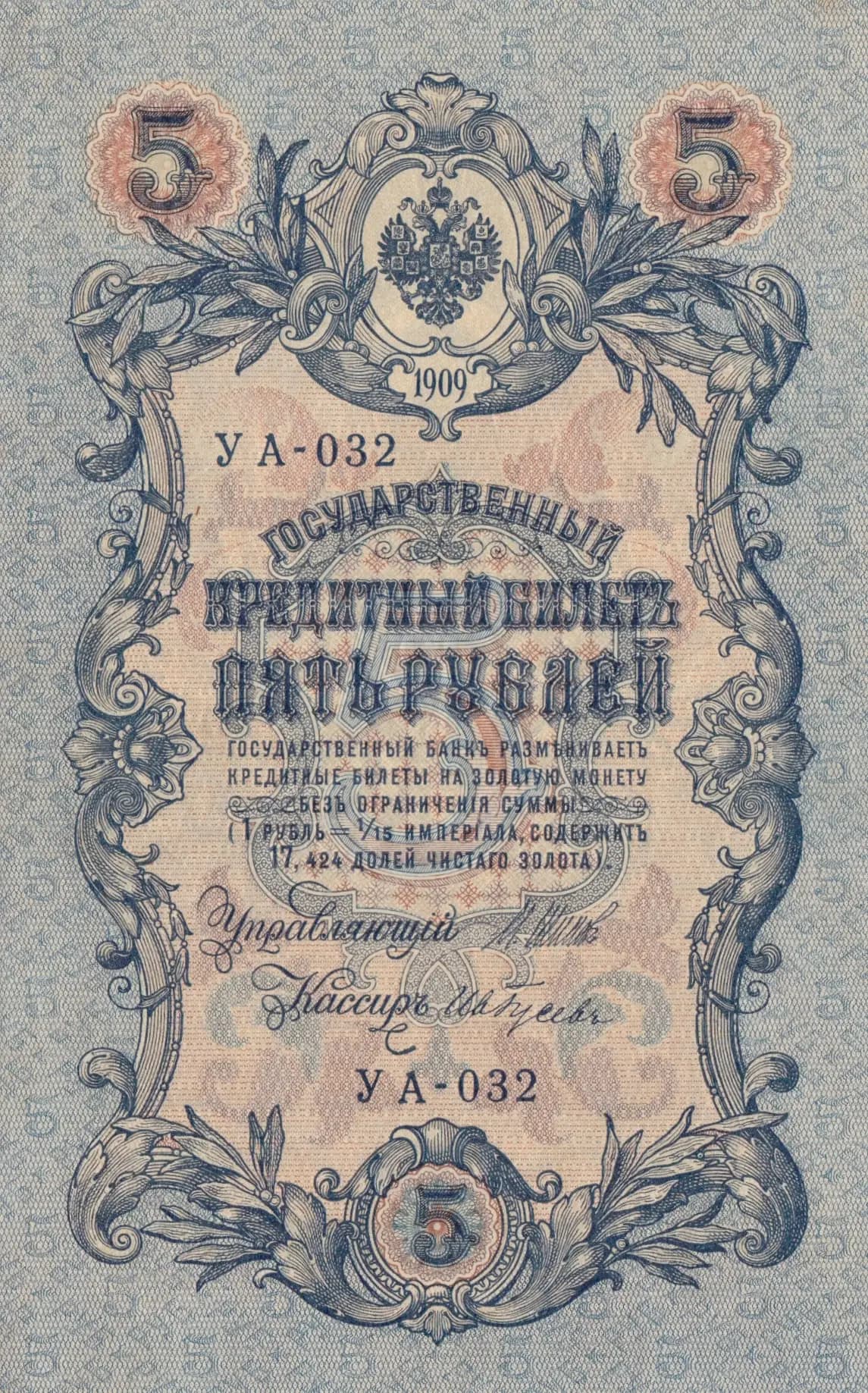
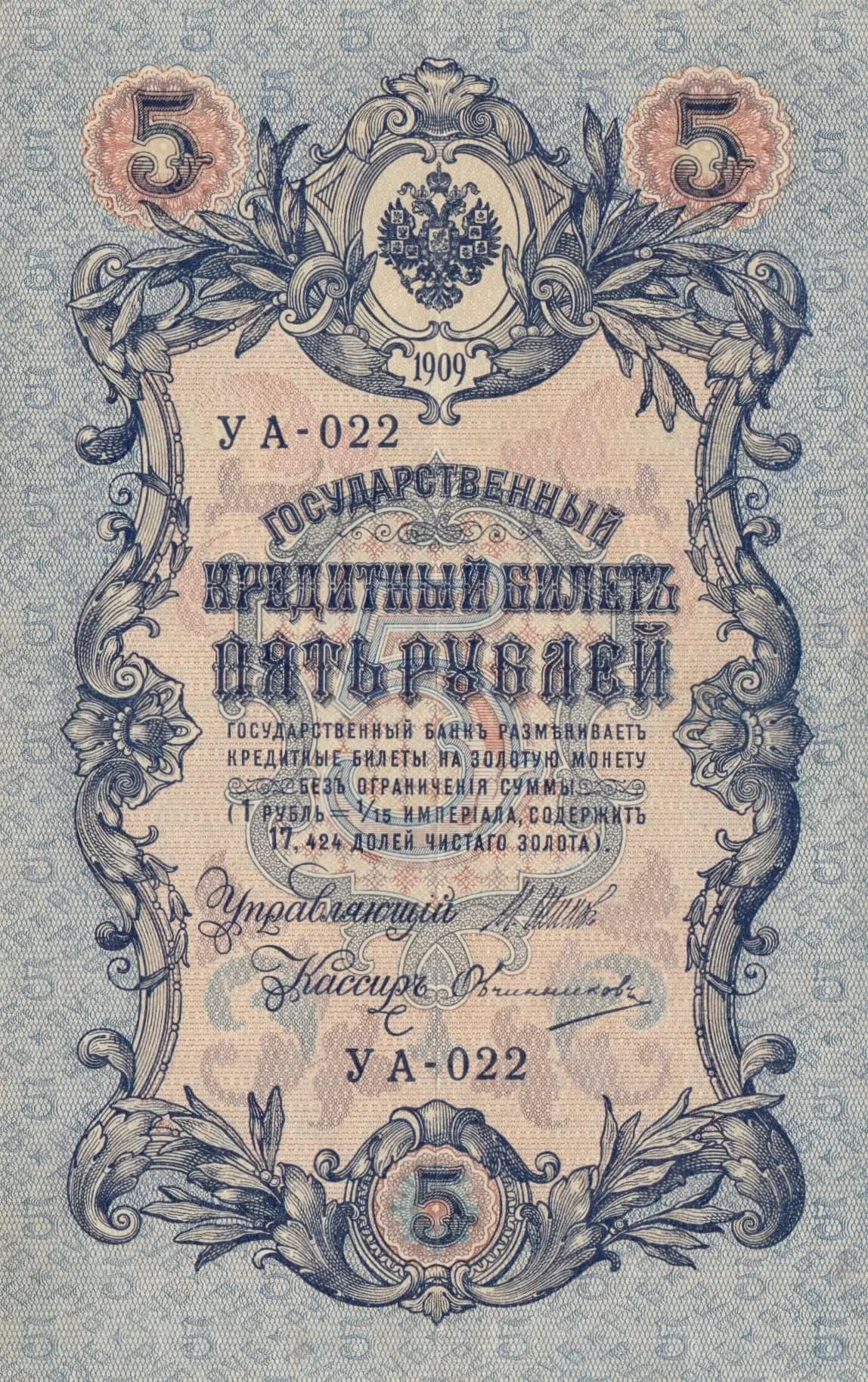
5 rublei 1917
“Sig.Afanasev”
About This Note
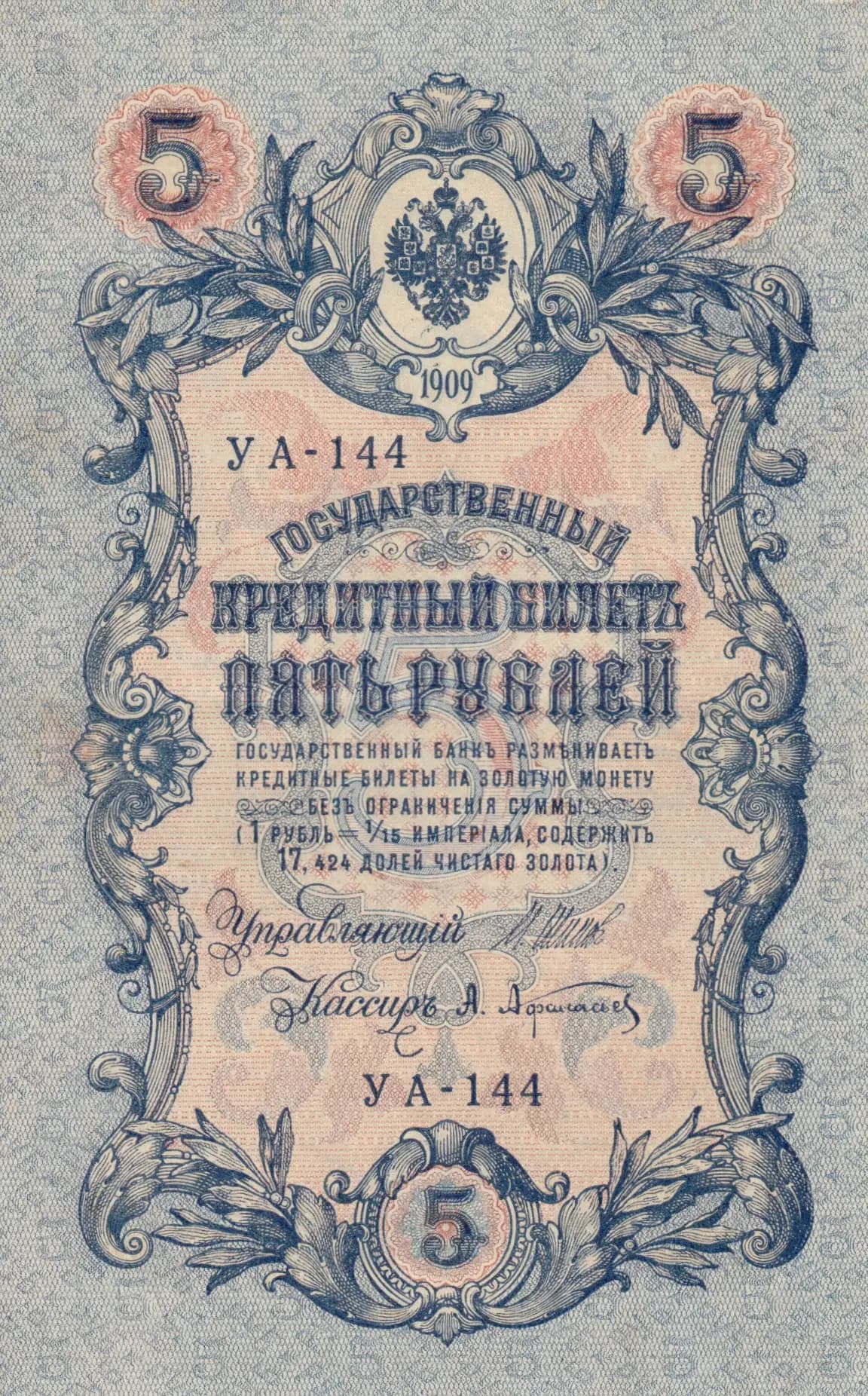
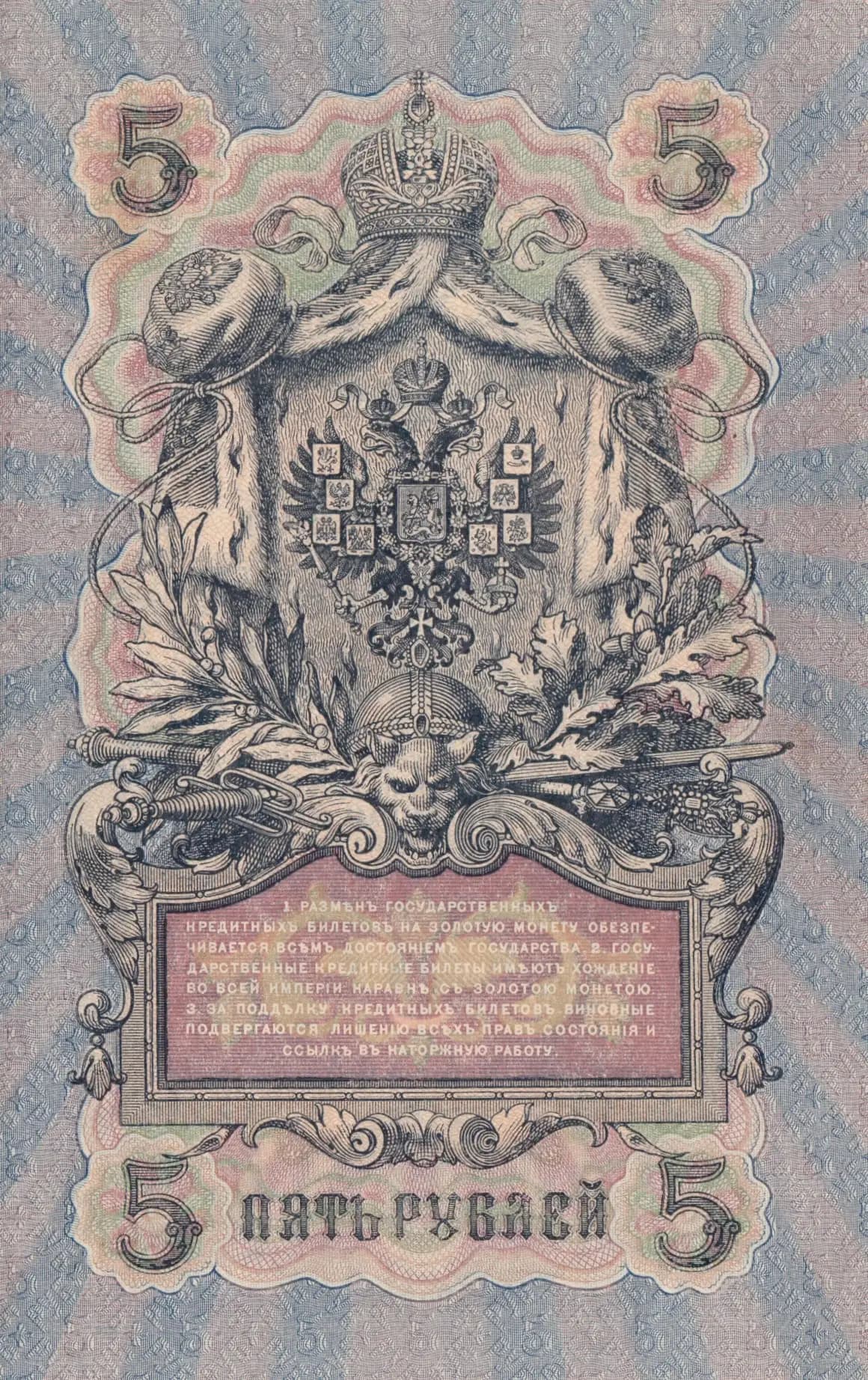
This is a striking example of a Russian Imperial 5 Ruble State Credit Note from 1917, presented in AU condition with excellent preservation. The note features the classic Imperial design with the double-headed eagle emblem dated 1900 on the front and an elaborate heraldic coat of arms on the reverse, both rendered in blue, pink, and cream with exceptional engraving detail. The serial number UA-144 and signature of Afanasev are clearly visible, representing the final days of Imperial Russian currency before the Revolution.
Common. The 5 Ruble 1917 issue (Pick 35) from the Russian Imperial period has a substantial surviving population. While these notes represent the final Imperial currency before the Revolution, they were produced in large quantities before the Soviet takeover rendered them obsolete. The AU condition grade is desirable but not unusual for these notes, as many survived in institutional holdings and collections. Serial numbers in the UA range fall within the normal circulation range for this denomination. There is no evidence of a limited print run or special rarity factors for this specific variety.
This 5 ruble note was issued during the twilight of the Russian Empire, just months before the October Revolution would end centuries of Romanov rule. The design prominently features Imperial symbols—the crowned double-headed eagle and the complex Imperial coat of arms with multiple heraldic shields—which represented the authority of the Russian state and its commitment to the gold standard. The inscriptions emphasize the State Bank's guarantee to exchange notes for gold coin, reflecting the monetary stability that would soon collapse with the Revolution and the advent of the Soviet Union.
The front of this note showcases a symmetrical Imperial design centered on an ornate oval cartouche framing the Russian Imperial double-headed eagle with imperial crown, dated 1900. The eagle is flanked by elaborate Baroque-style scrollwork, floral motifs, and acanthus leaf designs in blue and pink. Large denomination numerals '5' in salmon-colored circles occupy both top corners. The back presents an even more elaborate heraldic composition, dominated by the full Russian Imperial coat of arms—a complex arrangement of multiple shields representing the various territories and domains of the Russian Empire. Two crowned Imperial eagles serve as heraldic supporters on either side of the central shield, with an Imperial crown positioned above. The entire composition is framed by ornamental Baroque scrollwork. Large numeral '5's appear in all four corners within scalloped pink circles. The color palette throughout consists of blue, pink/salmon, cream/beige, and black inks on a finely-lined background pattern.
{"front":{"denominations":"5 (numerals in corners); ПЯТЬ РУБЛЕЙ (Five Rubles)","mainTitle":"ГОСУДАРСТВЕННЫЙ КРЕДИТНЫЙ БИЛЕТ ПЯТЬ РУБЛЕЙ (State Credit Note Five Rubles)","goldStandardClause":"ГОСУДАРСТВЕННЫЙ БАНК РАЗМЕНИВАЕТЬ КРЕДИТНЫЕ БИЛЕТЫ НА ЗОЛОТУЮ МОНЕТУ РОССИЙСКОГО ГОСУДАРСТВА В ЗОЛОТОЙ МОНЕТЕ (I РУБЛЬ = 1/15 ИМПЕРИАЛА, СОДЕРЖАТЬ 17,424 ДОЛЕЙ ЧИСТОГО ЗОЛОТА) (The State Bank exchanges credit notes for gold coin of the Russian State in gold coins; 1 ruble = 1/15 of an Imperial, containing 17.424 parts of pure gold)","signatureLines":"Управляющий (Managing Director); Кассир (Cashier)","serialNumber":"УА-144"},"back":{"denomination":"ПЯТЬ РУБЛЕЙ (Five Rubles); 5 (numerals in all four corners)","legalClause":"РАЗМЕН ГОСУДАРСТВЕННЫХ КРЕДИТНЫХ БИЛЕТОВ НА ЗОЛОТУЮ МОНЕТУ ОБЕСПЕЧИВАЕТСЯ ВСЕМИ СРЕДСТВАМИ ГОСУДАРСТВА В ЗОЛОТОЙ МОНЕТЕ И ГОСУДАРСТВЕННЫЙ КРЕДИТНЫЙ БИЛЕТЫ МОГУТ СЛУЖЕНИЕ ВО ВСЕЙ ИМПЕРИИ НАРАВНЕ СО ЗОЛОТОЙ МОНЕТОЮ... (The exchange of state credit notes for gold coin is secured by all means of the state in gold coin and state credit notes may serve throughout the entire empire on a par with gold coin under the security of credit notes...)"}}
This note was produced using engraved intaglio (line-engraved) printing, the standard security printing method for Imperial Russian currency of the period. The fine line background patterns, intricate engraved borders, detailed heraldic imagery, and the sharp clarity of the ornamental work visible in both images are characteristic of high-quality intaglio production. The Imperial State Printing Works (Goznak) in St. Petersburg was responsible for producing Imperial Russian banknotes of this era. The multi-color printing required separate plates for the blue, pink, and black inks, with precise registration visible in the quality of the finished product.
This note bears the signature of Afanasev (Афанасев), who served as one of the Managing Directors or authorized officials of the Imperial State Bank during this period. The serial number UA-144 places it within the standard series for 1917 issuance. The date '1900' visible on the eagle emblem reflects the design's origin from earlier Imperial currency rather than the actual issuance date of 1917. No overprints or other distinguishing varieties are apparent on this example. This represents the standard circulation type for the 5 Ruble Imperial note from the final year of issuance.