5 rublei 1917
“Sig.Bogatyryov”
About This Note
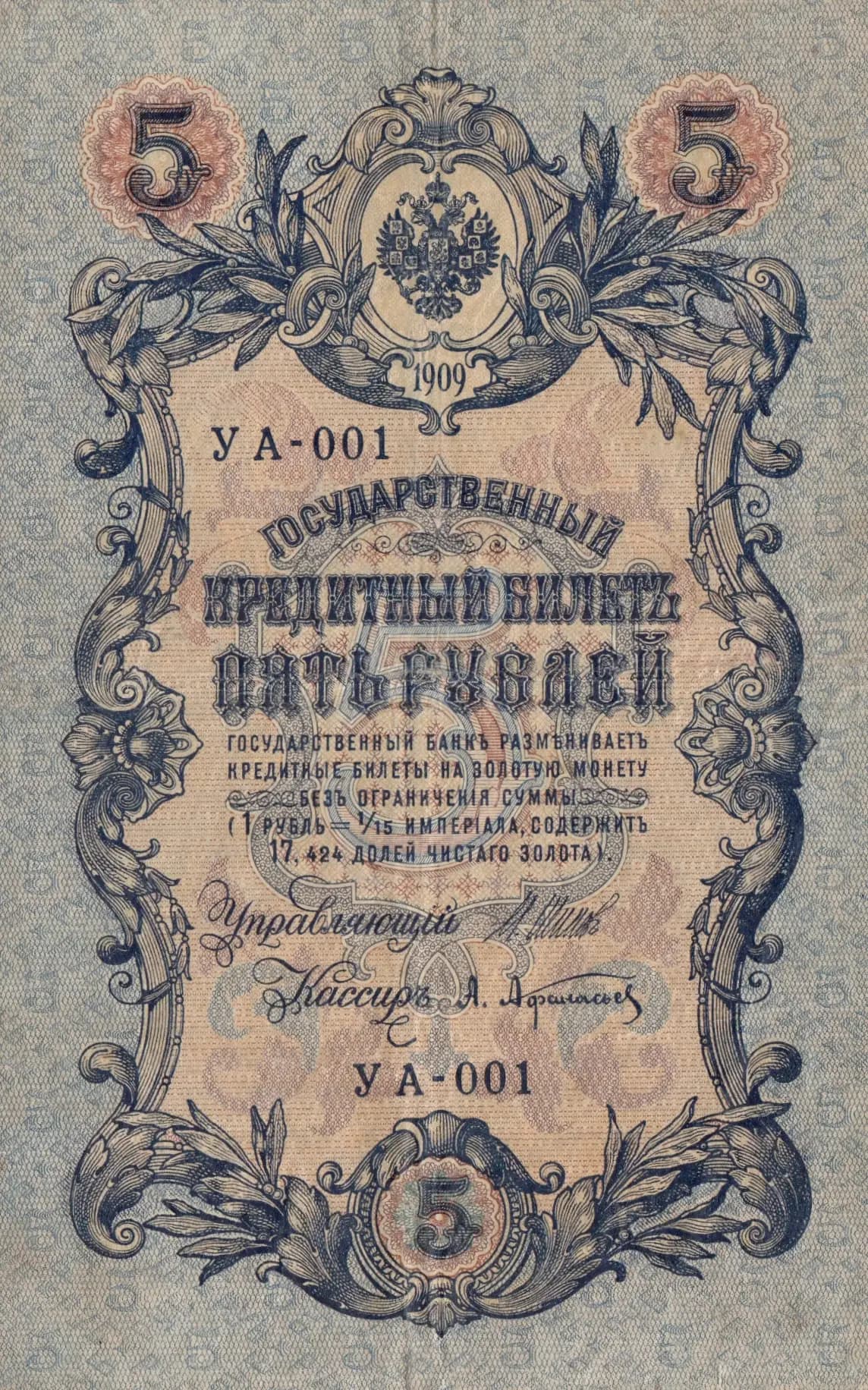
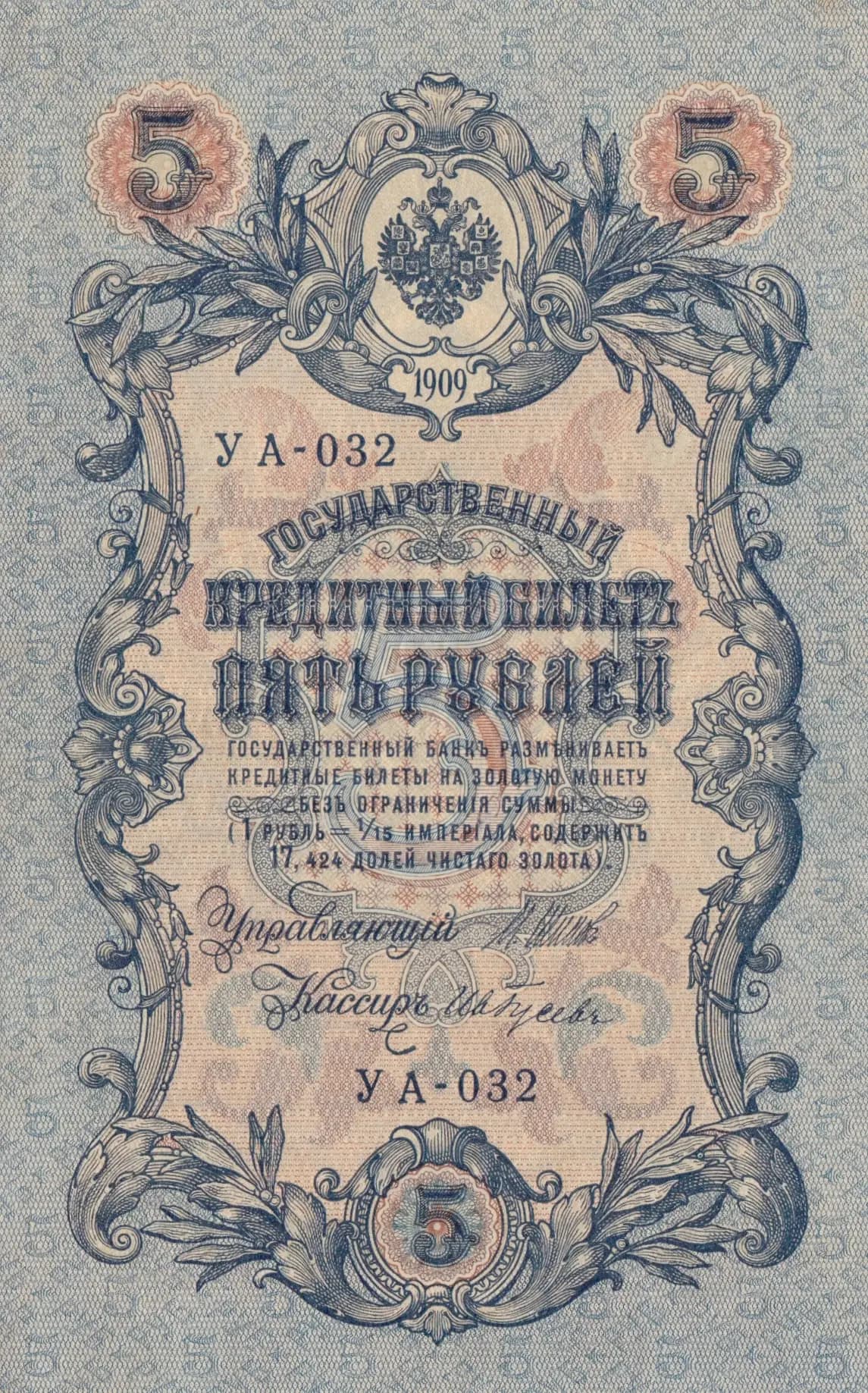
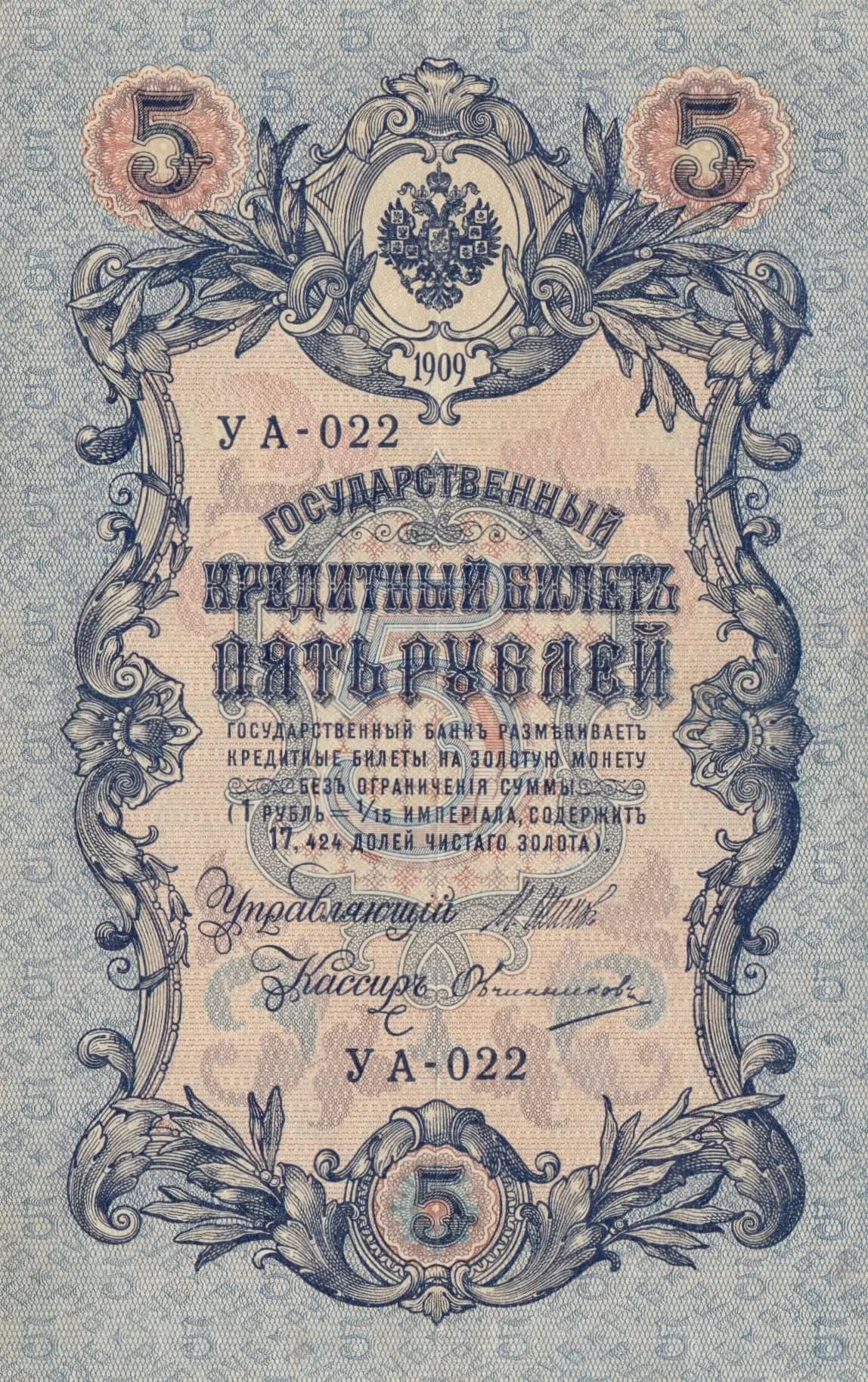
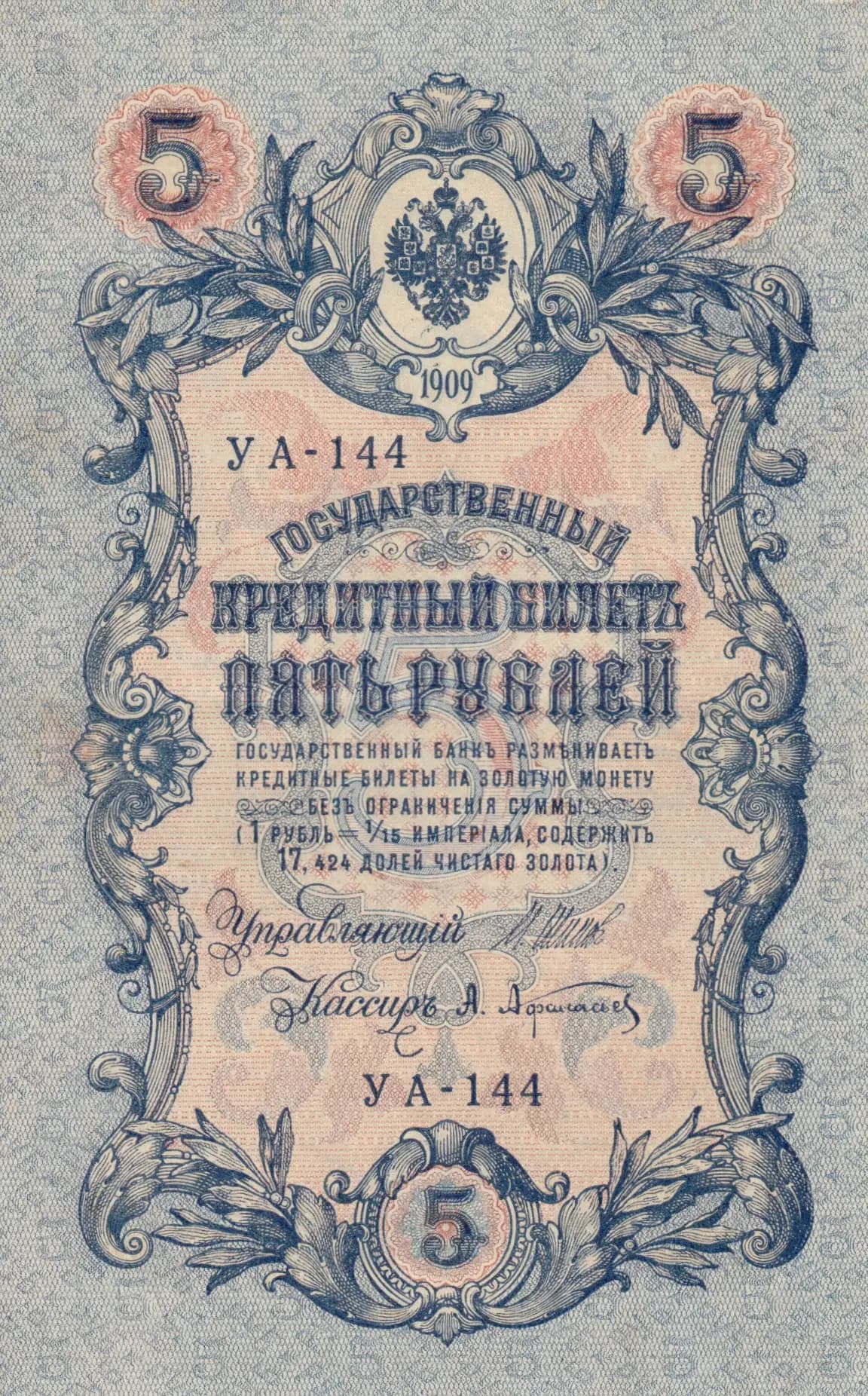
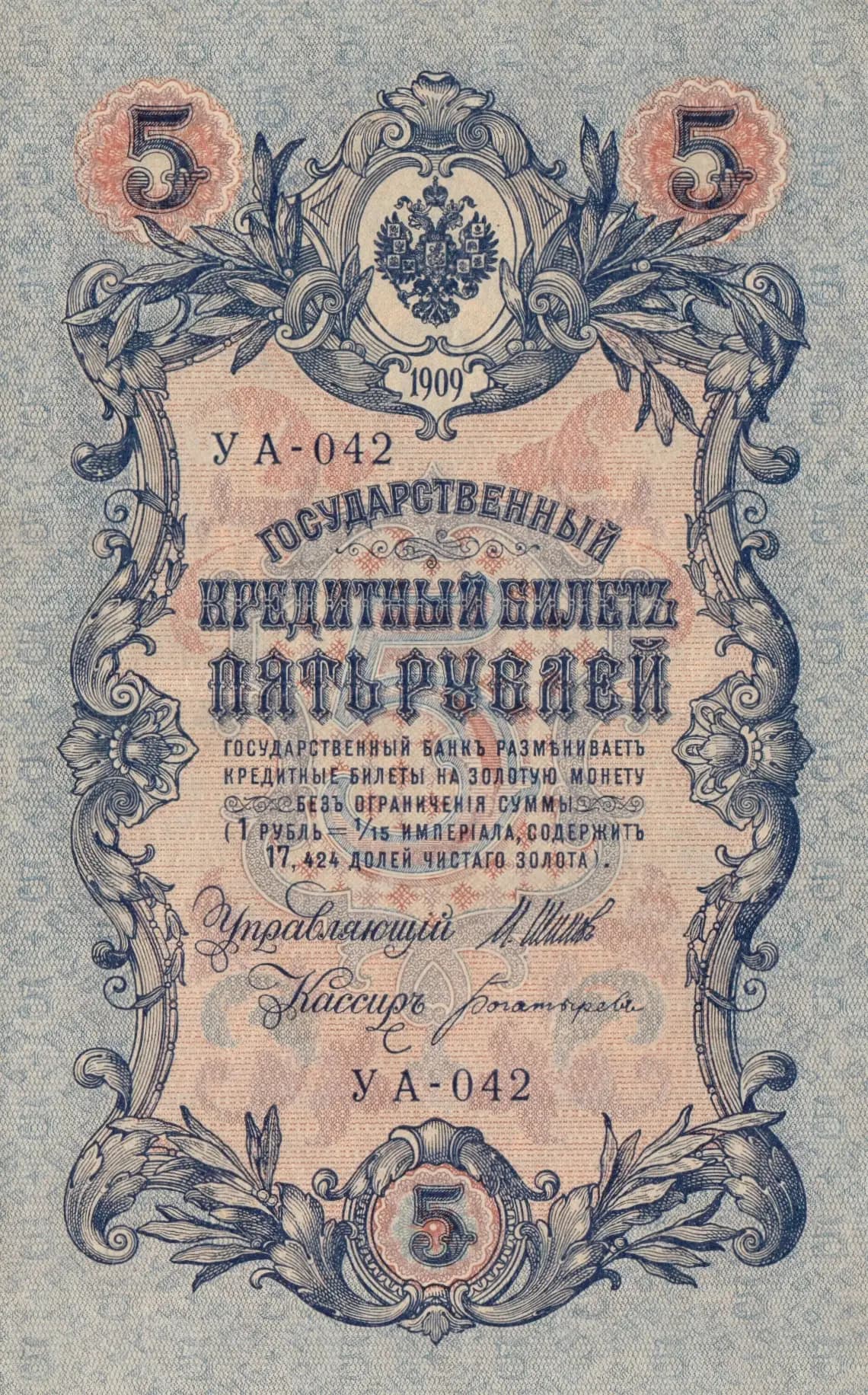
This is a 5 Rublei note from the Russian Imperial period, issued by the State Bank and dated 1909, though the catalog identifies it as a 1917 Provisional Government issue (Pick P-35). The note is in exceptional Extremely Fine condition, displaying crisp, uncirculated characteristics with vibrant color preservation in the pink, blue, and cream palette. The intricate baroque engraving and the prominent Imperial double-headed eagle make this a visually striking example of Russian pre-revolutionary currency, with the specimen bearing serial number УА-042 and signed by Bogatyryov.
common. The 5 Rublei denomination was issued in substantial quantities by the Russian Imperial State Bank, and this particular issue (dated 1909, though cataloged as 1917 Provisional Government) represents standard circulation notes that survive in relatively high numbers. The EF condition grade is notable but does not significantly increase rarity, as Imperial-era Russian banknotes are well-represented in collections. The specimen's condition and provenance (signed by Bogatyryov) may add collector interest but do not elevate the underlying rarity classification. Most Russian Imperial 5 Rublei notes trade at modest valuations reflecting their common status.
This note represents a transitional period in Russian monetary history, issued under the Imperial State Bank's gold standard guarantee system. The elaborate decorative elements and the Imperial double-headed eagle with crown, scepter, and orb reflect the authority and legitimacy the Russian state sought to project during a period of significant political upheaval. The inscriptions detailing gold coin redemption and state backing demonstrate the currency's foundation in the gold standard, which would soon become obsolete following the October Revolution and the subsequent monetary reforms of the Soviet period.
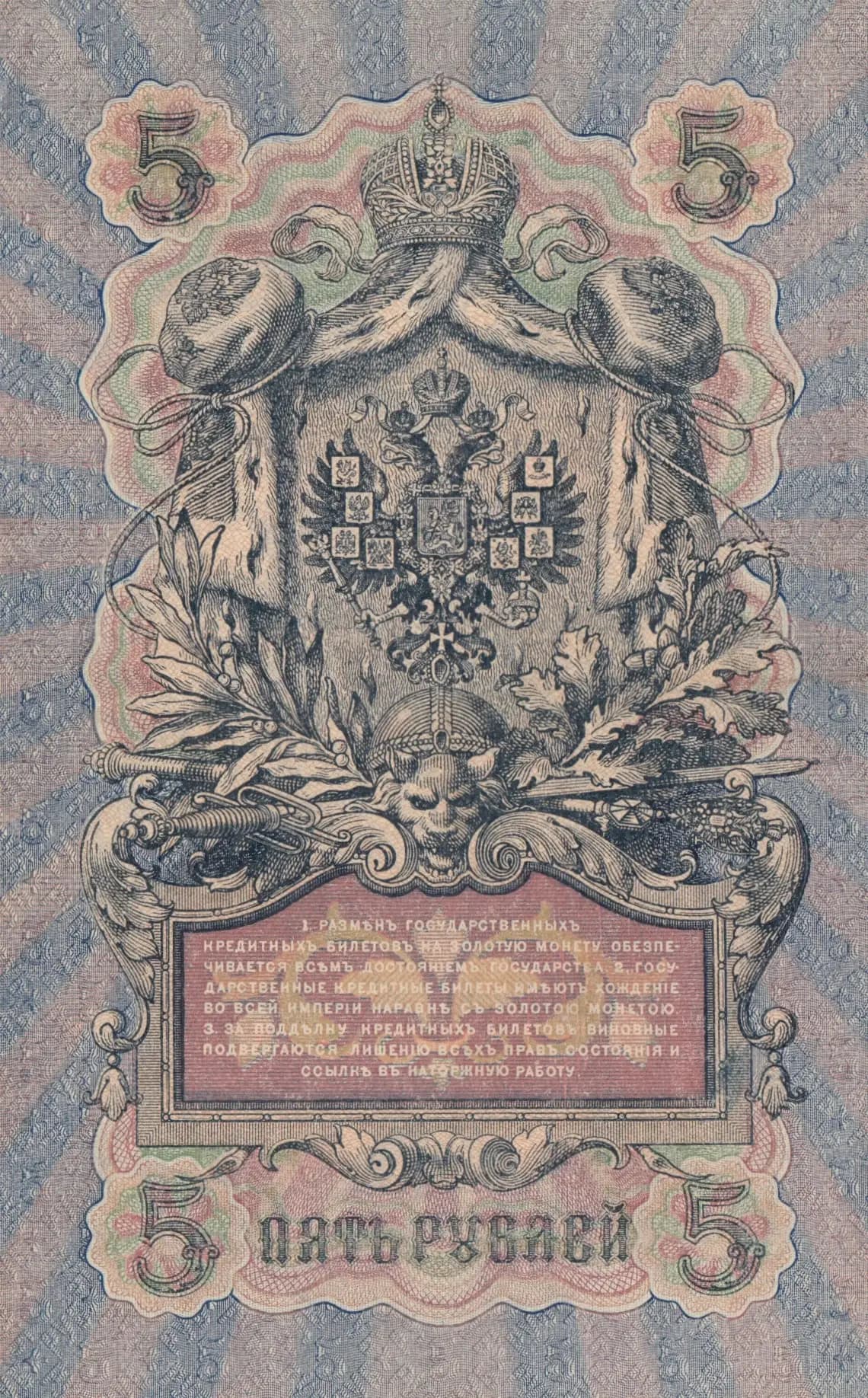
The obverse features the Russian Imperial coat of arms—a double-headed eagle displaying the crown, scepter, and orb of state authority—enclosed within a large central oval medallion. The eagle is flanked by ornate baroque scrollwork with elaborate floral and botanical motifs rendered in fine-line engraving. Denomination numerals '5' appear in decorative circular pink frames positioned at the corners and center base. The reverse presents a similar aesthetic with the Imperial eagle as the central focal point, surrounded by mirrored baroque ornamental borders and repeated denomination markings in all four corners. Both sides employ a sophisticated color palette of light blue-grey fields with pink/salmon and dark blue accents. The note measures the standard Imperial banknote dimensions and reflects the high-security printing standards of the State Bank's currency production.
FRONT SIDE: Государственный Кредитный Билет (State Credit Note) / Пять Рублей (Five Rubles) / Государственный Банк размещивает кредитные билеты на золотую монету без ограничения суммы (The State Bank exchanges credit notes for gold coin without limit of sum) / (1 рубль = 1/15 империала, содержит 17.424 долей чистаго золота) - (1 ruble = 1/15 Imperial, contains 17.424 parts pure gold) / Управляющий Банк (Managing Bank) / Кассир (Cashier) / Serial: УА-042 (UA-042). BACK SIDE: Пять Рублей (Five Rubles) / Размен государственных кредитных билетов на золото монету обезпечивается всеми достояниями государства в году (Exchange of State credit notes for gold coin is guaranteed by all the property of the state in the year) / Государственные кредитные билеты имеют хождение во всей Империи наравне с золотою монетою (State credit notes have circulation throughout the Empire equal with gold coin) / И земельных кредитных билетов всех учреждений (And land credit notes of all institutions) / Поддерживаются лишению всех прав состояния и ссылка вб наружную работу (are supported by deprivation of all rights of status and exile to hard labor).
Intaglio engraving (recess printing), executed with fine-line detail characteristic of high-security banknote production by the Imperial State Bank's printing facilities. The intricate baroque border work, detailed eagle rendering, and precise ornamental elements demonstrate the multi-plate engraved production method typical of Russian Imperial credit notes. The color separation between the base field (light blue-grey), decorative elements (pink and dark blue), and security design suggests multiple-pass printing, likely using the taille-douce (copperplate) intaglio process combined with chromolithography for background coloring. Serial number application appears to be printed as part of the security features.
Serial number УА-042 (UA-042) indicates this specimen belongs to the UA series of Imperial State Bank issuances. The signature of Bogatyryov as noted in the collector notes represents the official authorization variant for this particular batch. The 1909 date visible on the note contrasts with the catalog's 1917 attribution, suggesting this may be a late-period printing of the Imperial design carried forward into the Provisional Government era before the Soviet monetary reform. Varieties of the 5 Rublei exist with different serial number prefixes and signature combinations; the specific combination present here (UA prefix, Bogatyryov signature) should be documented to distinguish it from other contemporary issues.