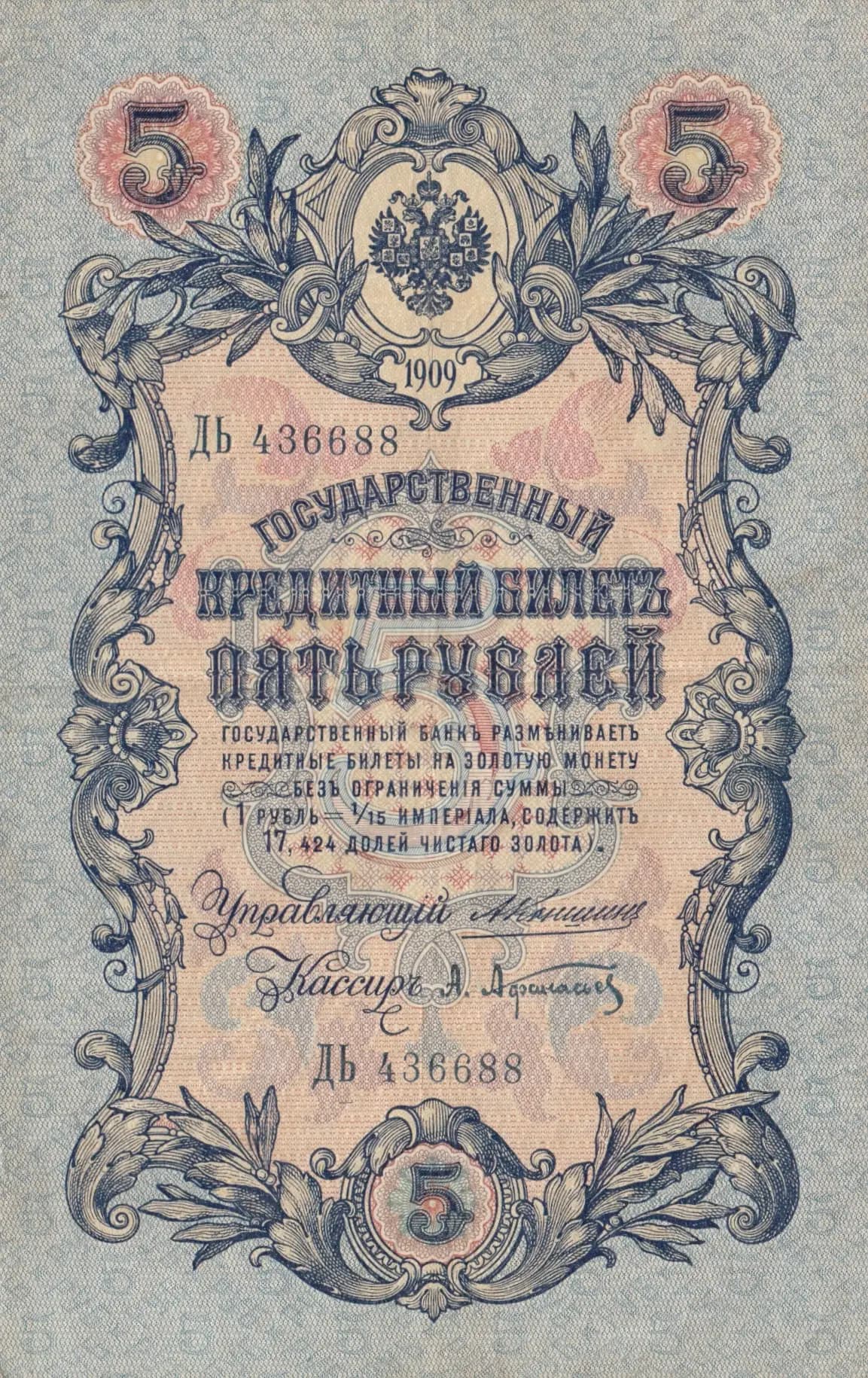
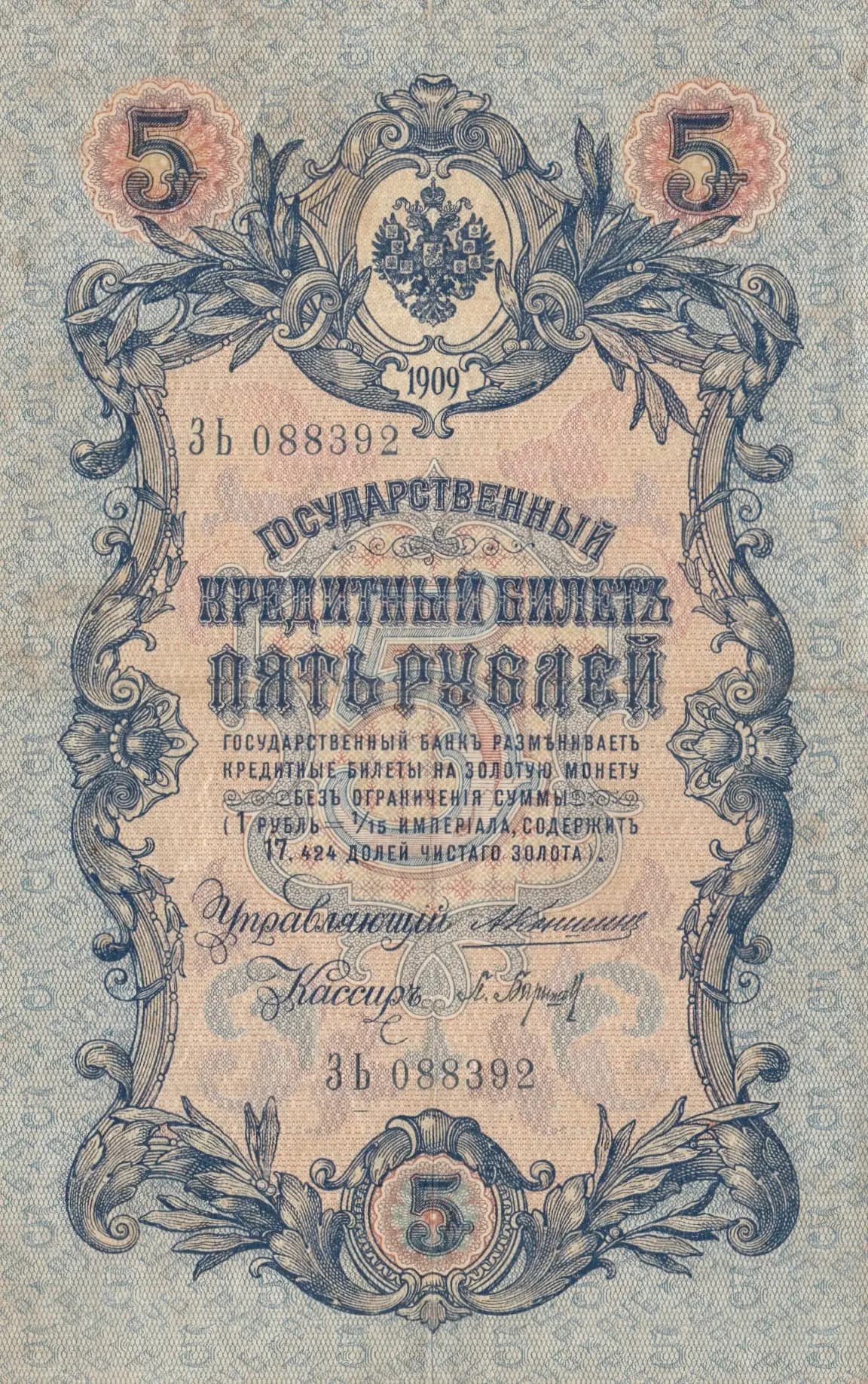
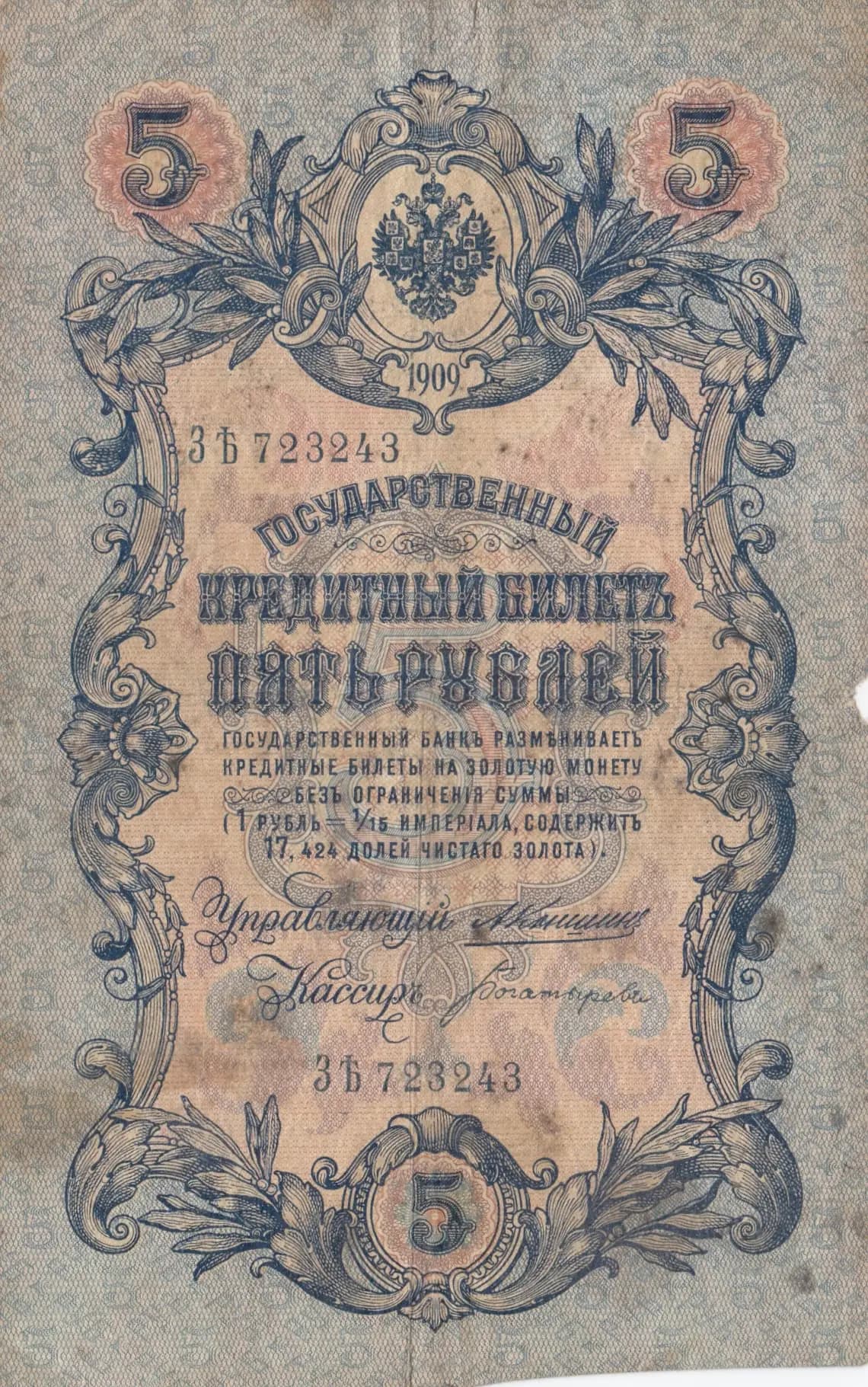
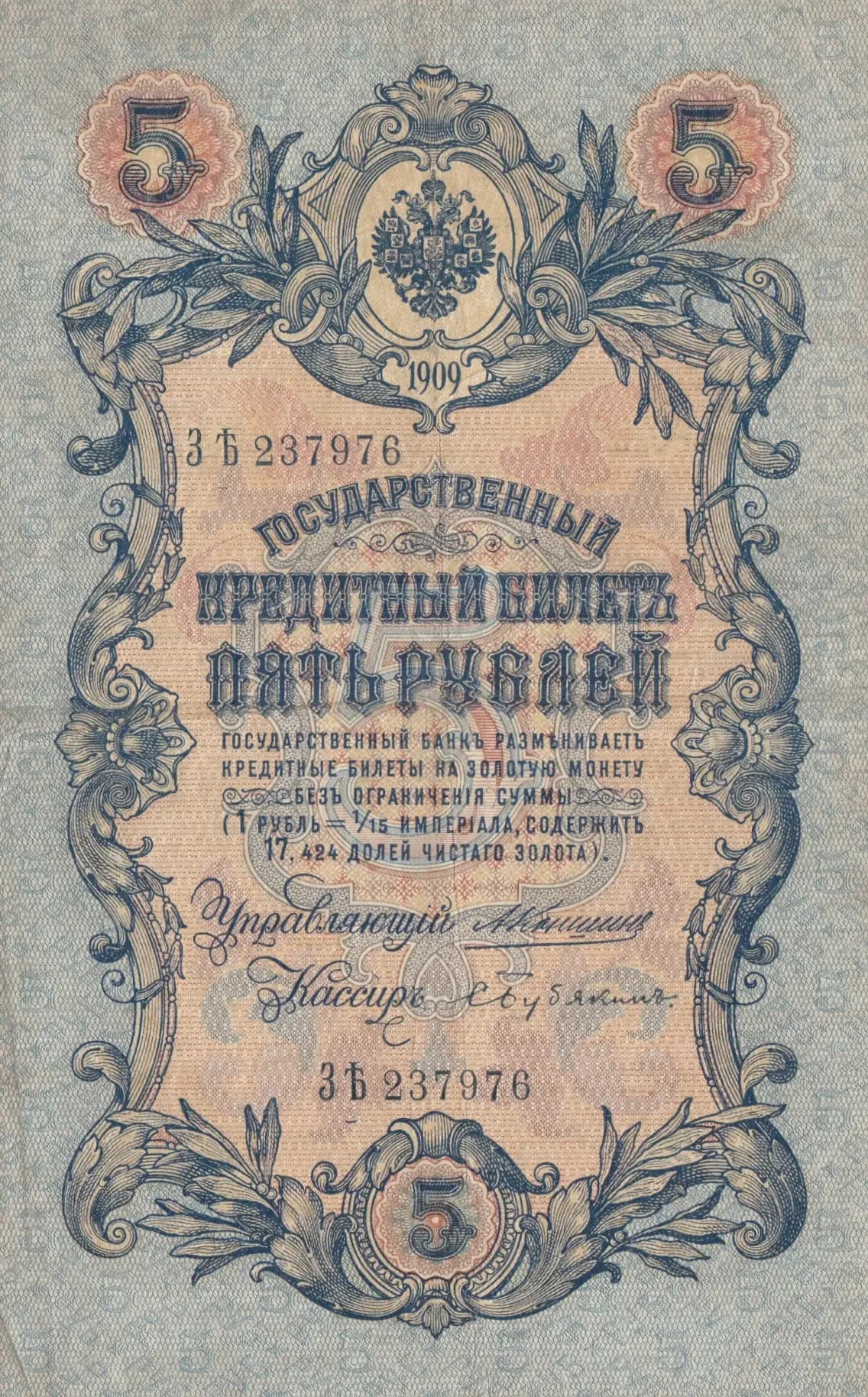
5 rublei 1909
“Sig.Ivanov”
About This Note
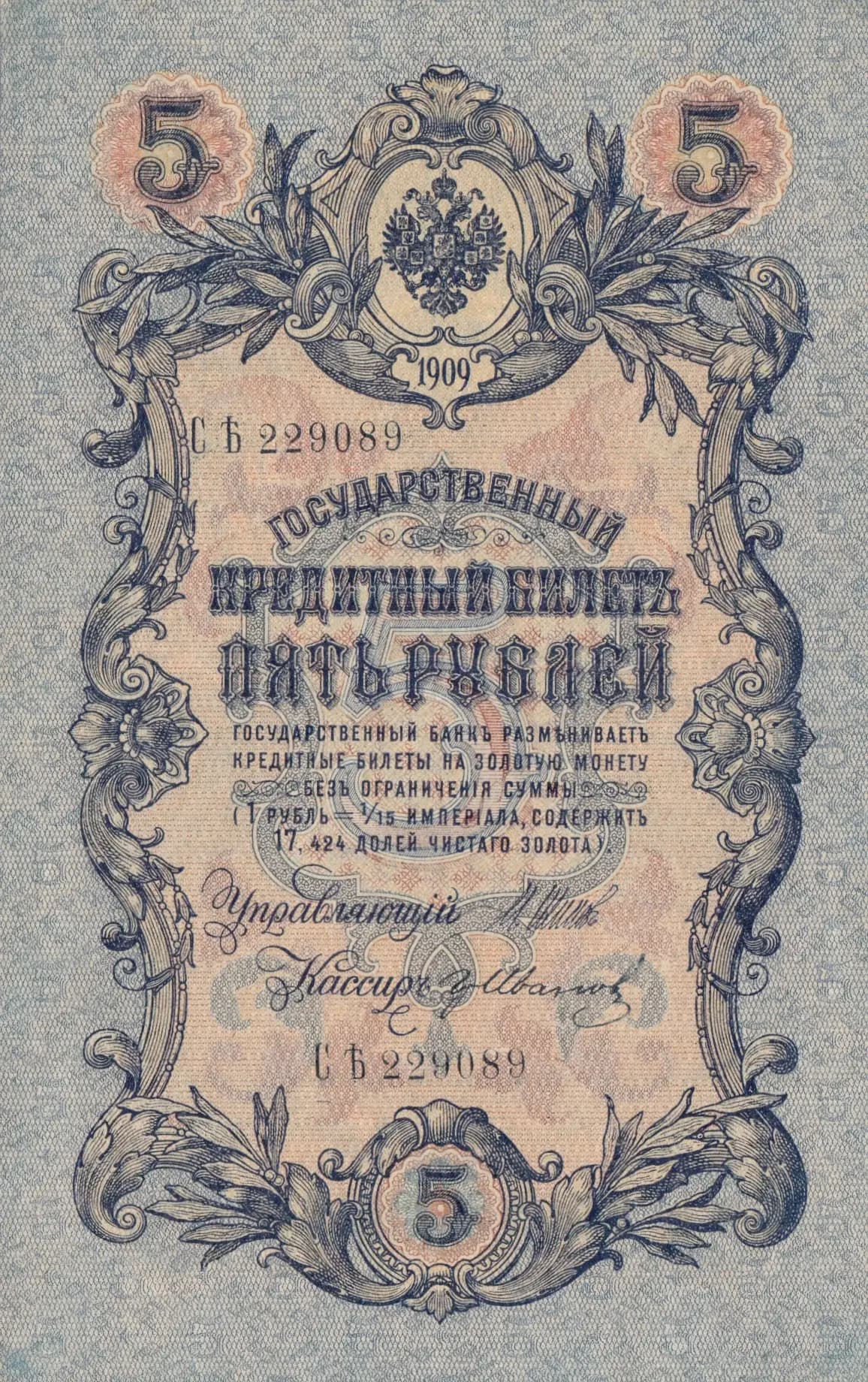
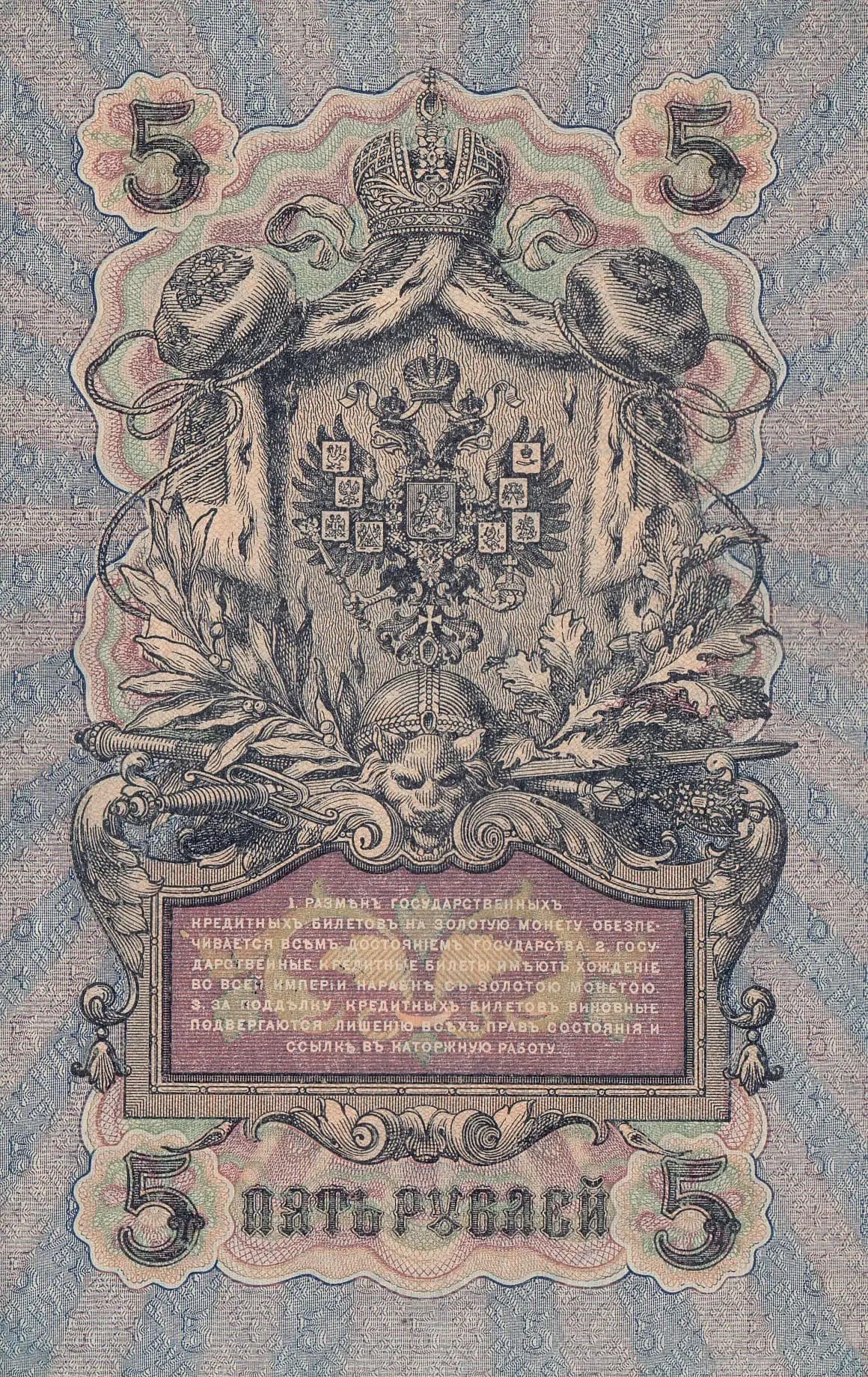
This is an EF-graded 5 Rublei note from 1909, representing the Russian Empire's State Credit Note system during the gold standard era. The note displays the characteristic ornate design of early 20th-century Russian currency, featuring the Imperial double-headed eagle coat of arms prominently on both sides, intricate floral and scrollwork borders, and multi-color printing in tan, blue, and salmon tones. While showing age-appropriate patina with foxing and yellowing consistent with a circulated note from this period, the EF grade indicates it retains excellent eye appeal and structural integrity, making it a desirable example of Russian Imperial currency from the final years before the 1917 Revolution.
Common. The 5 Rublei denomination was a standard mid-value note in circulation throughout the Russian Empire during the 1909-1917 period. Production runs of this denomination were substantial given its regular use in commercial and retail transactions. While the note's EF condition grade is pleasing, and while all pre-revolutionary Russian currency has acquired collector interest due to the historical significance of the 1917 Revolution, the 5 Rublei Pick P-10b(7) variant remains widely available in the collector market. Surviving examples are not scarce, particularly in circulated grades, and market pricing typically ranges from $15-40 USD depending on condition and serial number appeal. The absence of any notation about rarity in the catalog data, combined with the straightforward design and standard circulation status, confirms this is a common date and denomination.
This 5 Rublei note was issued by the Russian Empire's State Bank during the final years of the Tsarist regime, when the Russian currency was backed by the gold standard (as explicitly stated on the note: 1 Ruble = 1/15 Imperiala, containing 17.424 parts pure gold). The elaborate heraldic imagery—the Imperial crown, double-headed eagles, and ornamental shields—reflects the authority and legitimacy the Romanov state sought to project through its currency design. This note type would be recalled and demonetized within a decade of issue following the Russian Revolution, making surviving examples historically significant witnesses to the final era of Imperial Russian finance.
The 5 Rublei features a sophisticated baroque-influenced design centered on Imperial Russian heraldry. The obverse (front) presents a formal composition with the Imperial coat of arms—the double-headed eagle wearing a crown—positioned within a central oval medallion, dated 1909 above. Ornamental cartouches in the upper left and lower right display the numeral 5 in elaborate frames. Flanking botanical elements (ivy or similar foliage) provide lateral framing, while the entire composition is surrounded by intricate scrollwork and floral borders. The reverse (back) displays an even more elaborate heraldic composition, featuring a large ornamental shield topped with the Imperial crown and flanked by two eagles. Below sits a shield subdivided with heraldic elements and surrounded by military implements and staffs. The denomination 5 appears again in decorative cartouches. Both sides employ symmetrical, rococo-influenced ornamental work typical of high-value Imperial Russian notes. The multi-color printing (tan, navy blue, pink/salmon, cream, and green accents) creates depth and visual hierarchy while serving as a security measure against counterfeiting.
FRONT SIDE: Title text reads 'ГОСУДАРСТВЕННЫЙ КРЕДИТНЫЙ БИЛЕТ' (State Credit Note) with the denomination 'ПЯТЬ РУБЛЕЙ' (Five Rubles). The note states 'ГОСУДАРСТВЕННЫЙ БАНК РАЗМЕНИВАЕТ КРЕДИТНЫЕ БИЛЕТЫ НА ЗОЛОТУЮ МОНЕТУ БЕЗ ОГРАНИЧЕНИЯ СУММЫ' (The State Bank exchanges credit notes for gold coins without limit of sum). Gold content specification: '1 РУБЛЬ = 1/15 ИМПЕРИАЛА, СОДЕРЖИТ 17,424 ДОЛЕЙ ЧИСТОГО ЗОЛОТА' (1 Ruble = 1/15 Imperiala, contains 17.424 parts of pure gold). Administrative signatures are labeled 'Управляющий Банк' (Managing Bank) and 'Кассир' (Cashier). Serial number: 'СБ 229089' (SB 229089). BACK SIDE: Text reads 'РАЗМЕННЫЕ ГОСУДАРСТВЕННЫХ КРЕДИТНЫХ БИЛЕТОВ НА ЗОЛОТУЮ МОНЕТУ ОБЕСПЕЧИВАЮТСЯ ВСЕМИ ГОСУДАРСТВЕННЫМИ И ДАРОГОСУДАРСТВЕННЫЕ ДОХОДЫ И ИМУЩЕСТВО ВО ВСЕЙ ИМПЕРИИ НАРЕШЕ СЬ ЗОЛОТОЮ МОНЕТОЮ' (The exchange of state credit notes for gold coins is secured by all state revenues and property throughout the entire empire in gold coins) and 'ГОСУДАРСТВЕННЫЕ КРЕДИТНЫЕ БИЛЕТЫ НАДЛЕЖАЩИЕ ПОДЧИНЯЮТСЯ СВОЕМУ ЗОЛОТОМУ ХОЖДЕНИЮ' (State credit notes subject to their own gold circulation).
This note was produced using multi-color lithographic printing, the standard technique for Russian Imperial banknotes of this era. The complex ornamental borders, fine line work, and precise color registration visible in the analyzed images demonstrate the sophisticated capabilities of Russian security printers of the period. The State Bank of Russia employed state-controlled security printing facilities for these notes; this 1909 issue was likely printed by the St. Petersburg Printing Works (Санкт-Петербургская типография) or similar imperial facility. The multiple color layers (visible as distinct tan, navy, pink, and green separations) and the fine detail in scrollwork and heraldic elements are characteristic of lithographic security printing, which provided security features through design complexity rather than modern security threads or holograms.
The Pick catalog notation P-10b(7) indicates this is the 7th identified variety of the P-10b type. Varieties of Russian 1909 5 Rublei notes are differentiated primarily by signature combinations ('Управляющий Банк' and 'Кассир' positions show different official signatures across printings) and serial number prefixes (the observed 'СБ' prefix indicating one state printing). The notation '(7)' suggests this specific note corresponds to the seventh documented signature/serial combination recognized in the Pick catalog system for this denomination. Without access to comparative signature reference materials in the current context, the specific officials whose signatures appear on this note cannot be definitively identified, but collectors researching this Pick number variant should consult detailed Russian Imperial banknote catalogs for the precise signature identifications corresponding to variety (7).