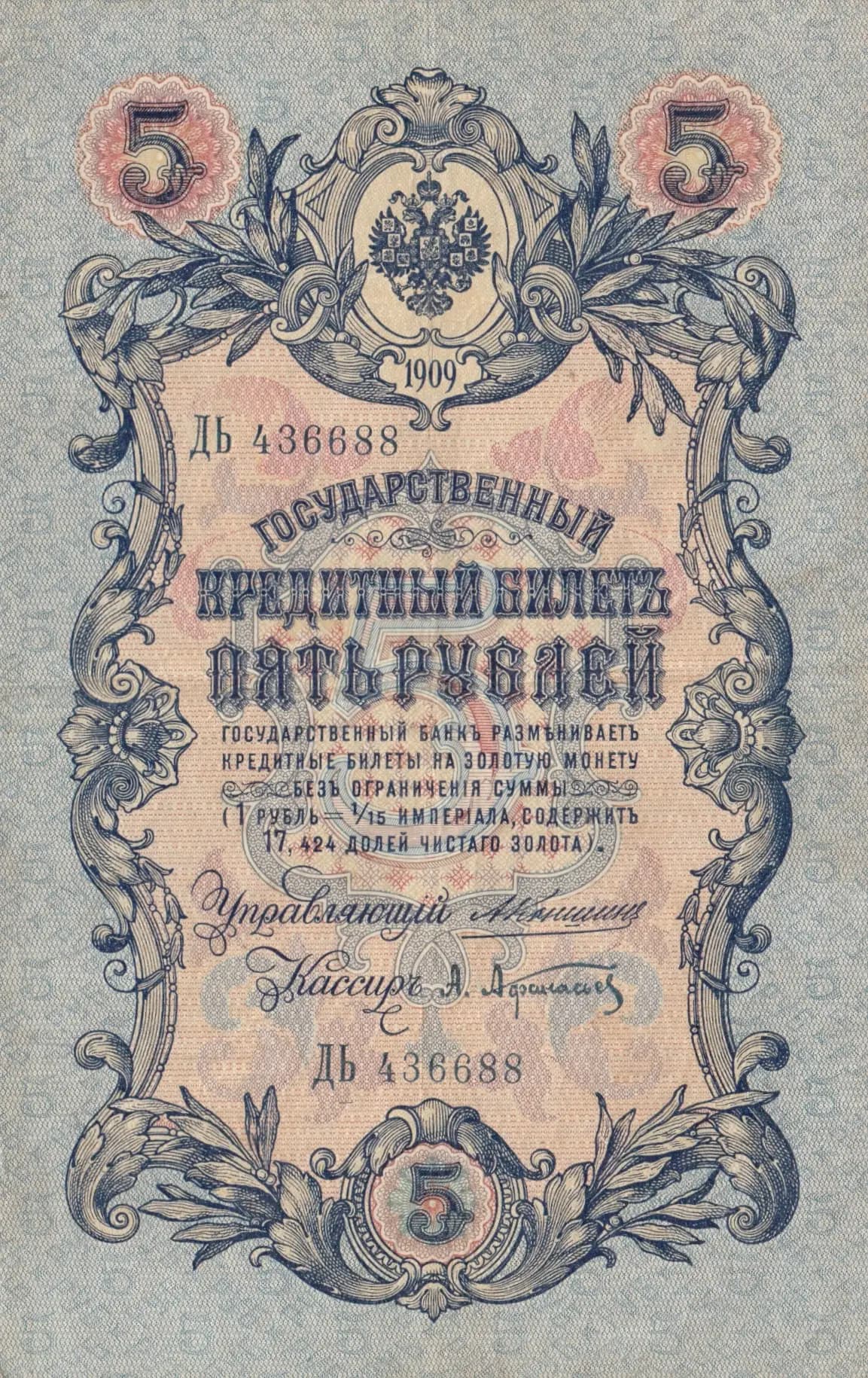
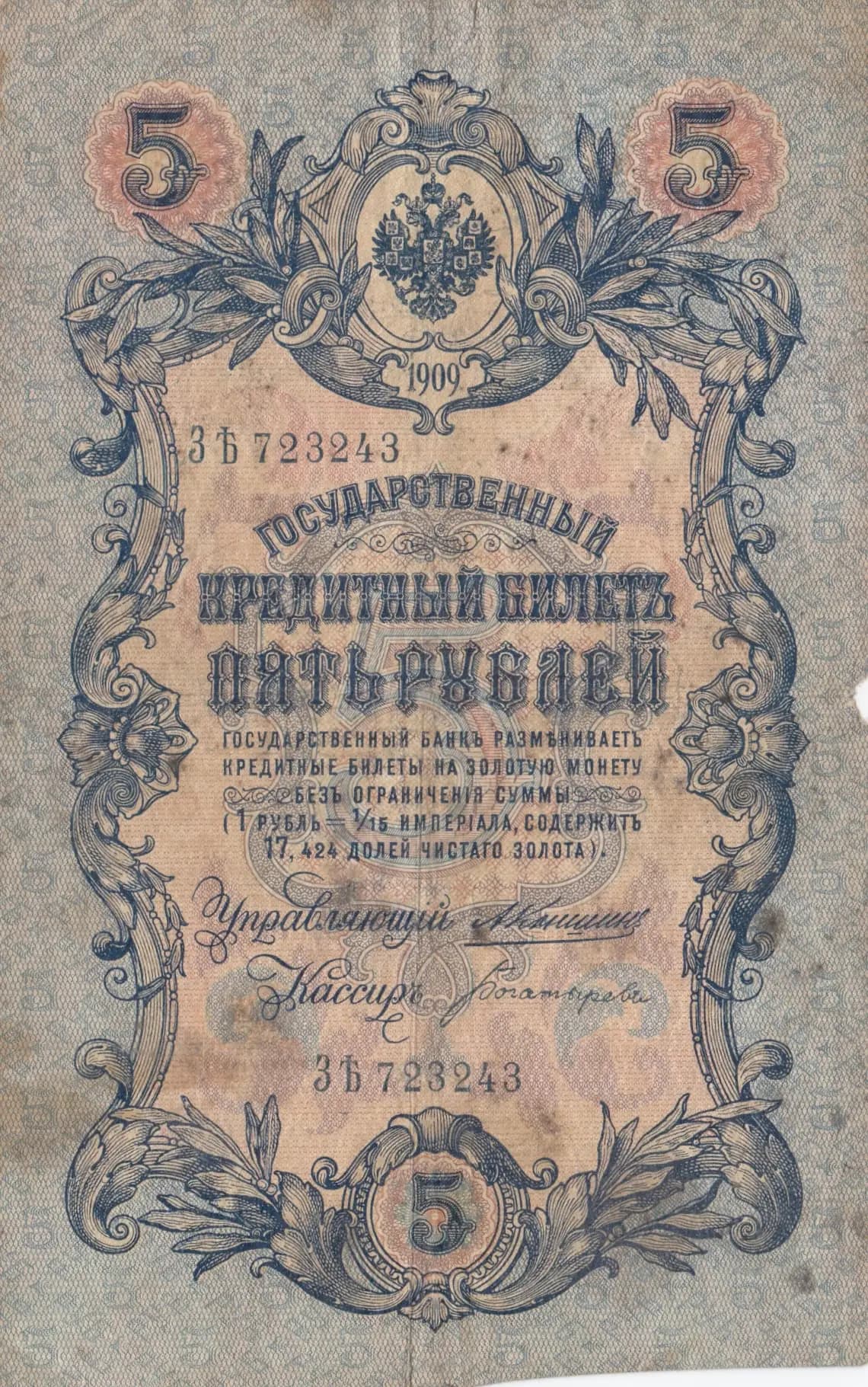
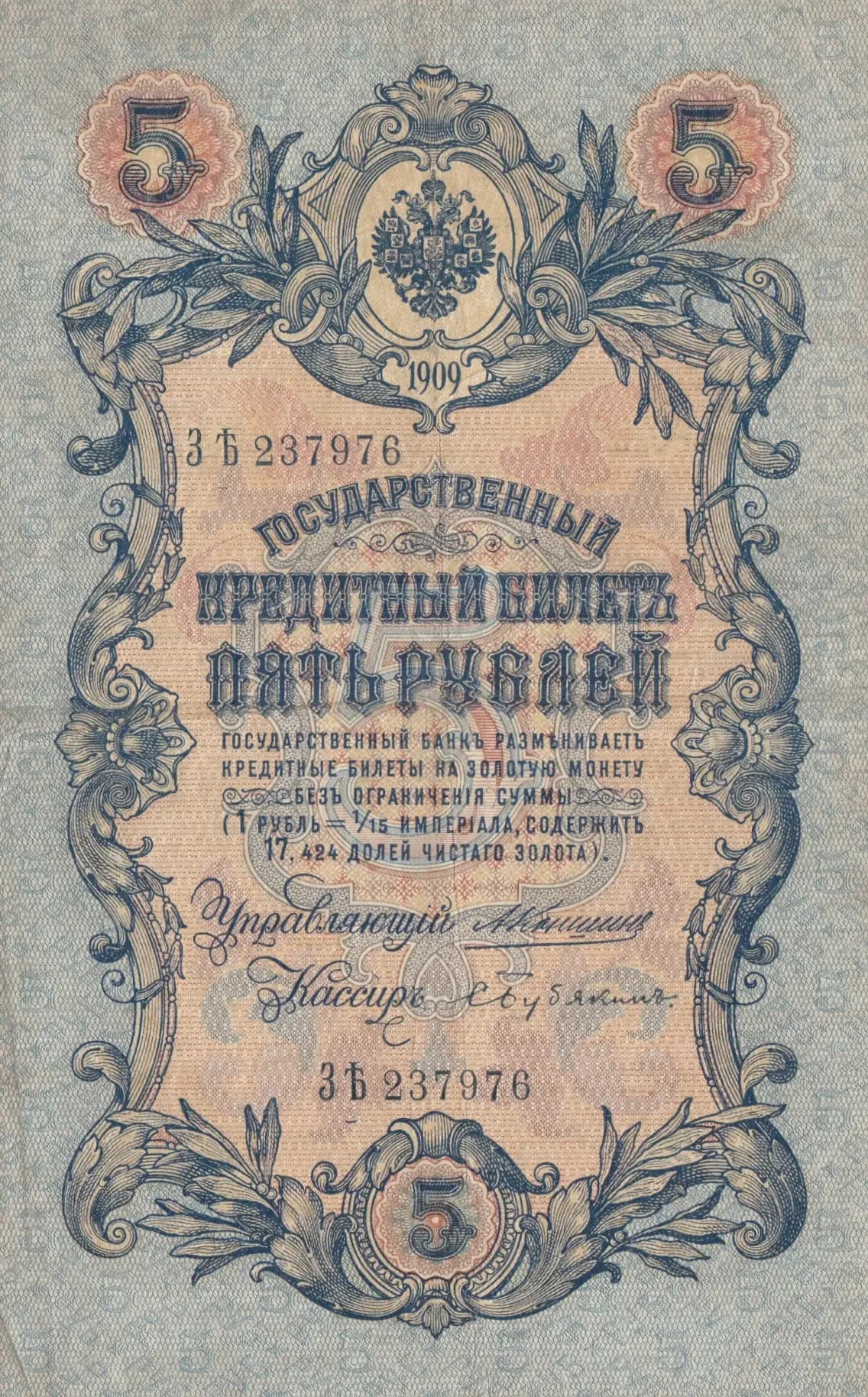
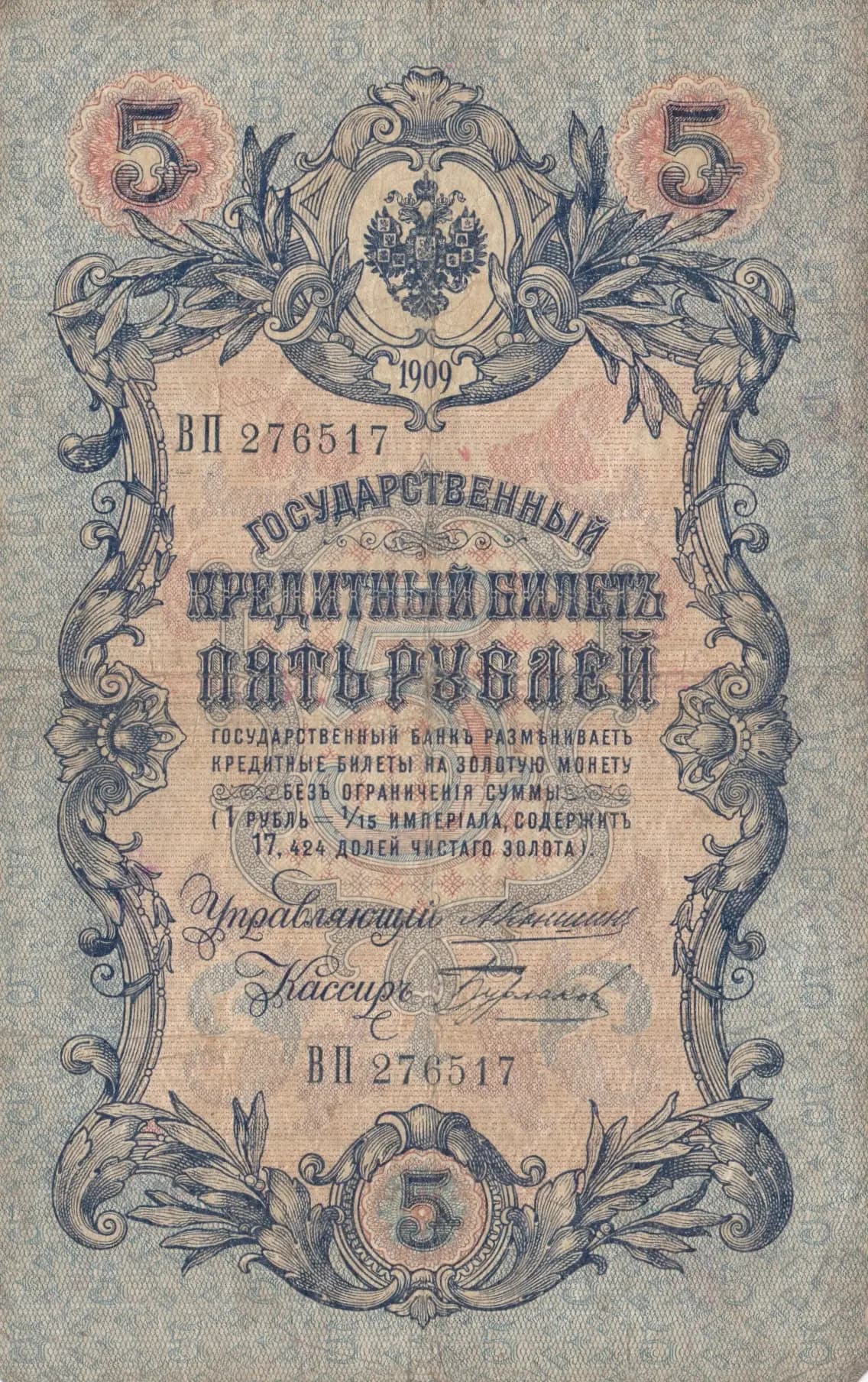
5 rublei 1909
“Sig.Baryshev”
About This Note
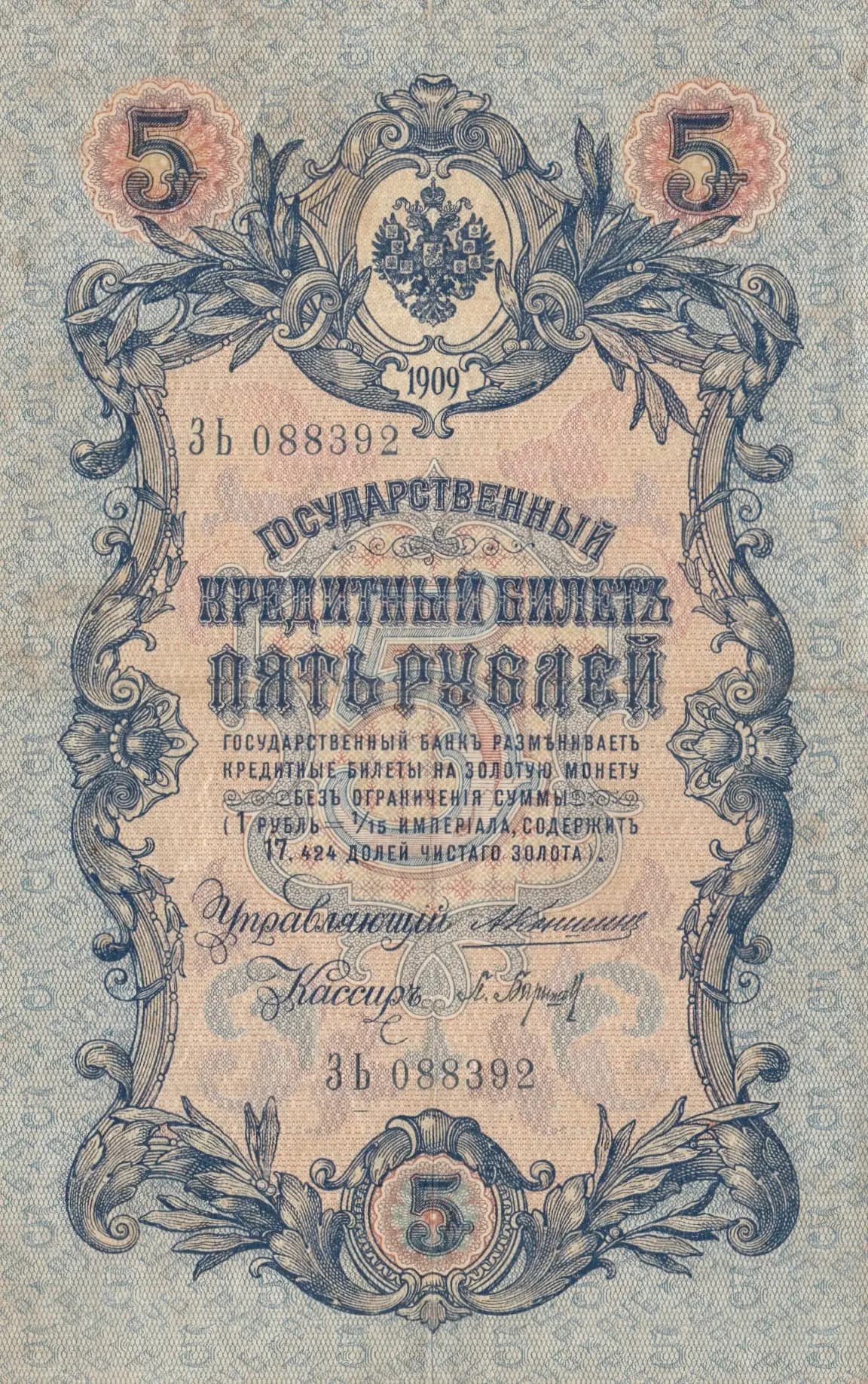
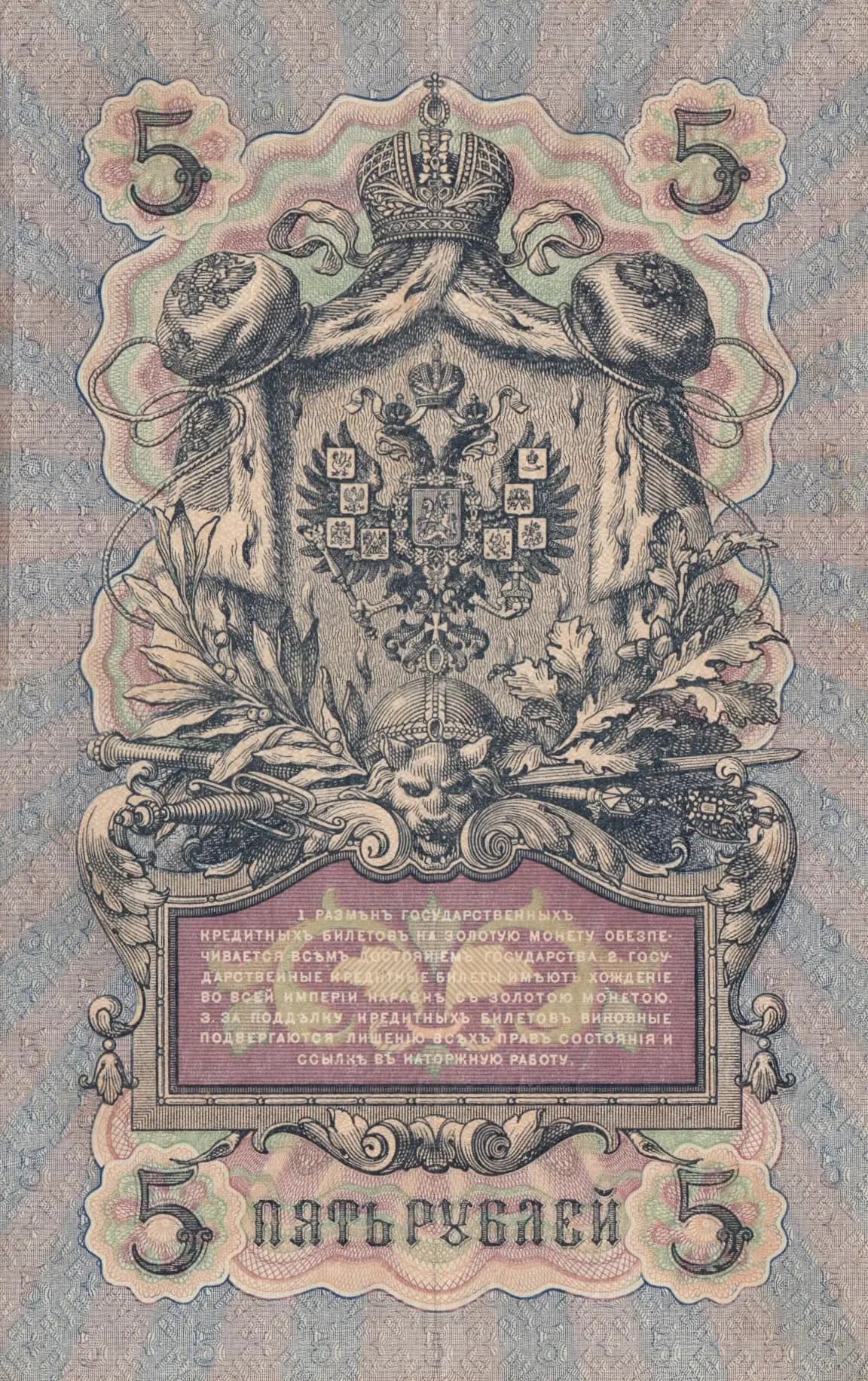
This 1909 Russian Imperial 5 rublei note (Pick P-10a(2)) presents an exceptional example of Tsarist-era currency design, featuring the elaborate baroque ornamentation characteristic of early 20th-century Russian state credit notes. The note displays a VF condition grade with well-preserved colors, sharp engraving detail, and no significant wear, making it a desirable specimen for collectors of Russian Imperial currency. The double-headed eagle coat of arms dominates both sides, underscoring the note's official imperial authority and gold-backed status during the Witte monetary reform era.
Common. The 1909 5 rublei note was issued in substantial quantities during the stable monetary period of the Witte reforms and circulated widely throughout the Russian Empire until 1917. Multiple catalog varieties exist (P-10a variants), indicating sustained printing runs. The VF condition grade is neither exceptional nor particularly scarce for notes from this series that were produced before widespread circulation damage from World War I and the revolutionary period. Notes of this type and denomination typically command modest collector prices reflective of their common status in the numismatic market.
This note was issued during the final decade of the Russian Empire under the gold standard system established by Finance Minister Sergei Witte, as evidenced by the prominent inscriptions detailing the gold content backing (1 ruble = 1/15 Imperial, containing 17.424 parts pure gold). The ornate baroque design and explicit text stating 'THE STATE BANK ISSUES CREDIT NOTES FOR GOLD COIN WITHOUT LIMIT OF SUM' reflect the government's commitment to maintaining confidence in the ruble's convertibility during a period of relative economic stability preceding World War I and the revolutionary upheaval. The complex provincial coat of arms shield on the reverse symbolized the unity of the Russian Empire's diverse territorial holdings.
The note exemplifies the formal classical-baroque aesthetic of Russian Imperial currency production. The obverse features a large oval cartouche centered on the Imperial double-headed eagle coat of arms, crowned and bearing orb and scepter, symbolizing supreme state authority. The design is framed by elaborate scrolling foliate borders with rococo flourishes, typical of security printing of the era. The denomination '5' appears in ornamental shields at top left, top right, and center bottom in rust-orange tones against the cream background. The reverse presents an even more elaborate composition, with the expanded Imperial coat of arms occupying the central position, featuring the provincial shield arrangement demonstrating the multi-national character of the empire. Both sides employ fine guilloche patterning as background security elements. The color palette—predominantly cream and beige with dark blue-black primary engraving, accented by pink and mauve tones in secondary panels—is consistent with St. Petersburg State Bank note production standards of this period.
FRONT SIDE: 'ГОСУДАРСТВЕННЫЙ КРЕДИТНЫЙ БИЛЕТ' (State Credit Note); 'ПЯТЬ РУБЛЕЙ' (Five Rubles); '1909' (year of issue); 'ГОСУДАРСТВЕННЫЙ БАНК РАЗМЕЩИВАЕТ КРЕДИТНЫЕ БИЛЕТЫ НА ЗОЛОТУЮ МОНЕТУ БЕЗ ОГРАНИЧЕНИЯ СУММЫ' (The State Bank issues credit notes for gold coin without limit of sum); '1 РУБЛЬ = 1/15 ИМПЕРИАЛА, СОДЕРЖИТ (17.424 ДОЛЕЙ ЧИСТОГО ЗОЛОТА)' (1 Ruble = 1/15 Imperial, contains 17.424 parts pure gold); Serial designation '3b 088392'; Signature line 'Управляющий Кассир' (Managing Cashier). BACK SIDE: 'ПЯТЬ РУБЛЕЙ' (Five Rubles); 'Denominational shield marked '5' in all four corners; Extended text regarding exchange guarantee: 'THE EXCHANGE OF STATE CREDIT NOTES FOR GOLD COIN IS SECURED BY ALL GOLD RESERVES OF THE STATE AND STATE PROPERTIES.'
Steel plate engraving (intaglio/recess printing) was the primary technique, as evidenced by the exceptional clarity and fine detail of the guilloche patterns, ornamental cartouches, and filigree borders visible in the image analysis. Multiple color printing from separate plates indicates polychromatic intaglio production, a hallmark of high-security currency printing. The note was produced by the State Printing Works (Государственный Печатный Двор) in St. Petersburg, the official Russian Imperial currency producer. The complexity of the engraved design and the multiple color layers suggest the use of advanced security measures standard for gold-backed state credit notes of this denomination and era.
This example is cataloged as Pick P-10a(2), indicating it belongs to the 1909 5 rublei second variety classification. The serial number prefix '3b' and the specific signature authorization by the Managing Cashier ('Управляющий Кассир') are consistent with mid-to-late production run notes from the 1909-1917 period. Varieties within the P-10a designation typically relate to signature changes, serial number series, and minor design revisions across the note's production span. The collector attribution to Sig. Baryshev (likely a signature or administrative identifier) may indicate a particular cashier or verification authority's variant, though specific variety cataloging would require cross-reference with specialized Russian Imperial currency references.