5 rublei 1909
“Sig.Bogatyryov”
About This Note
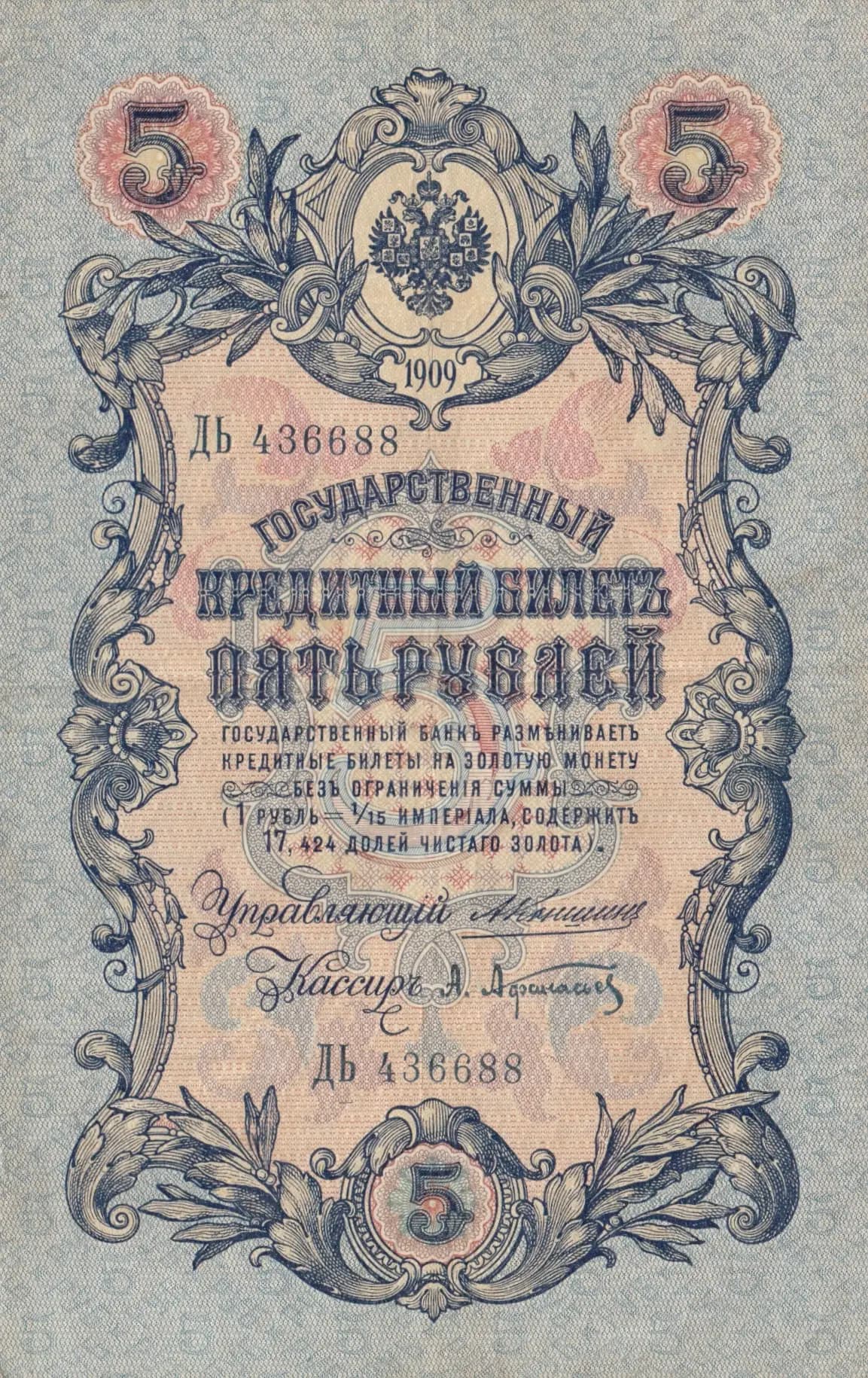
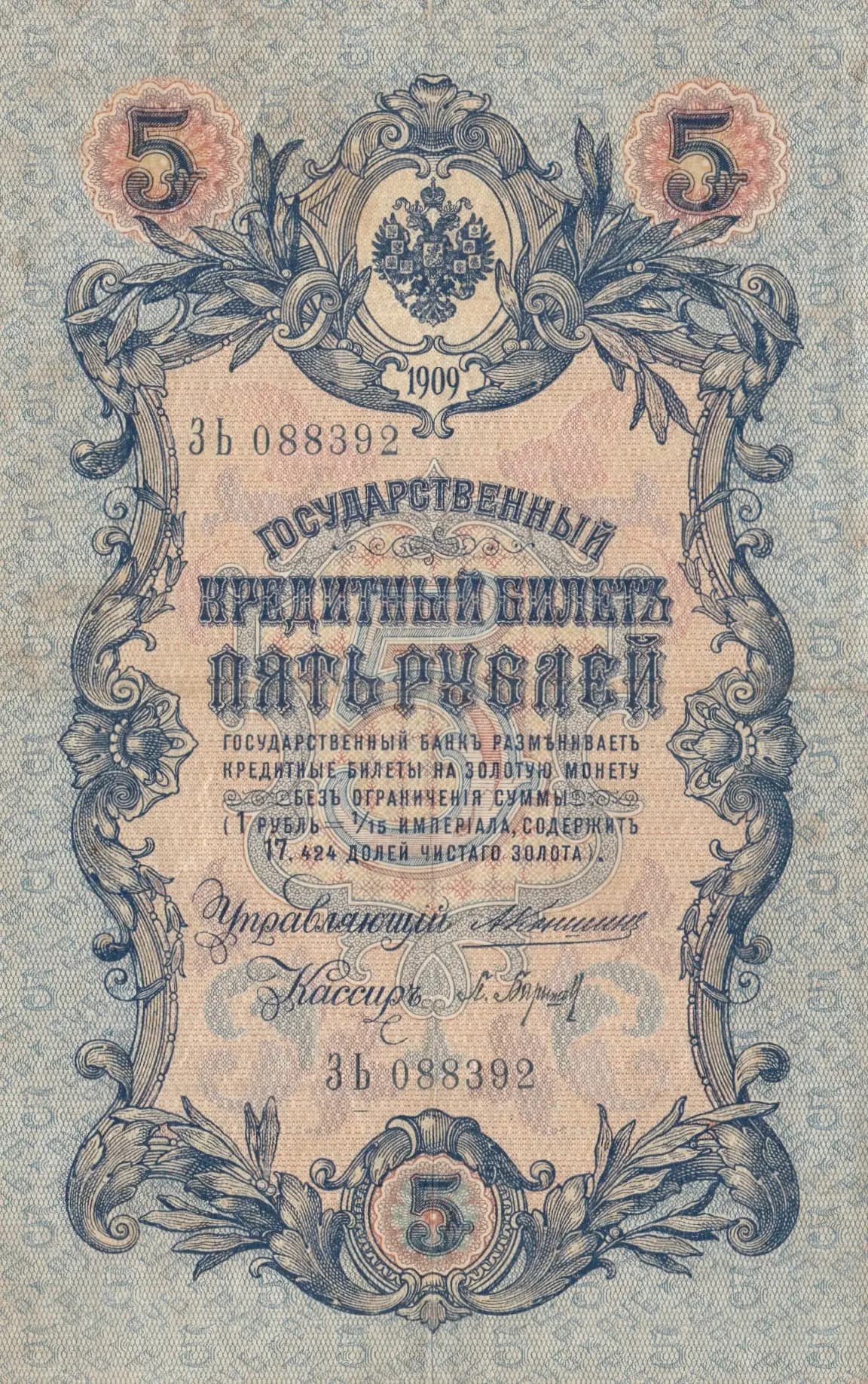
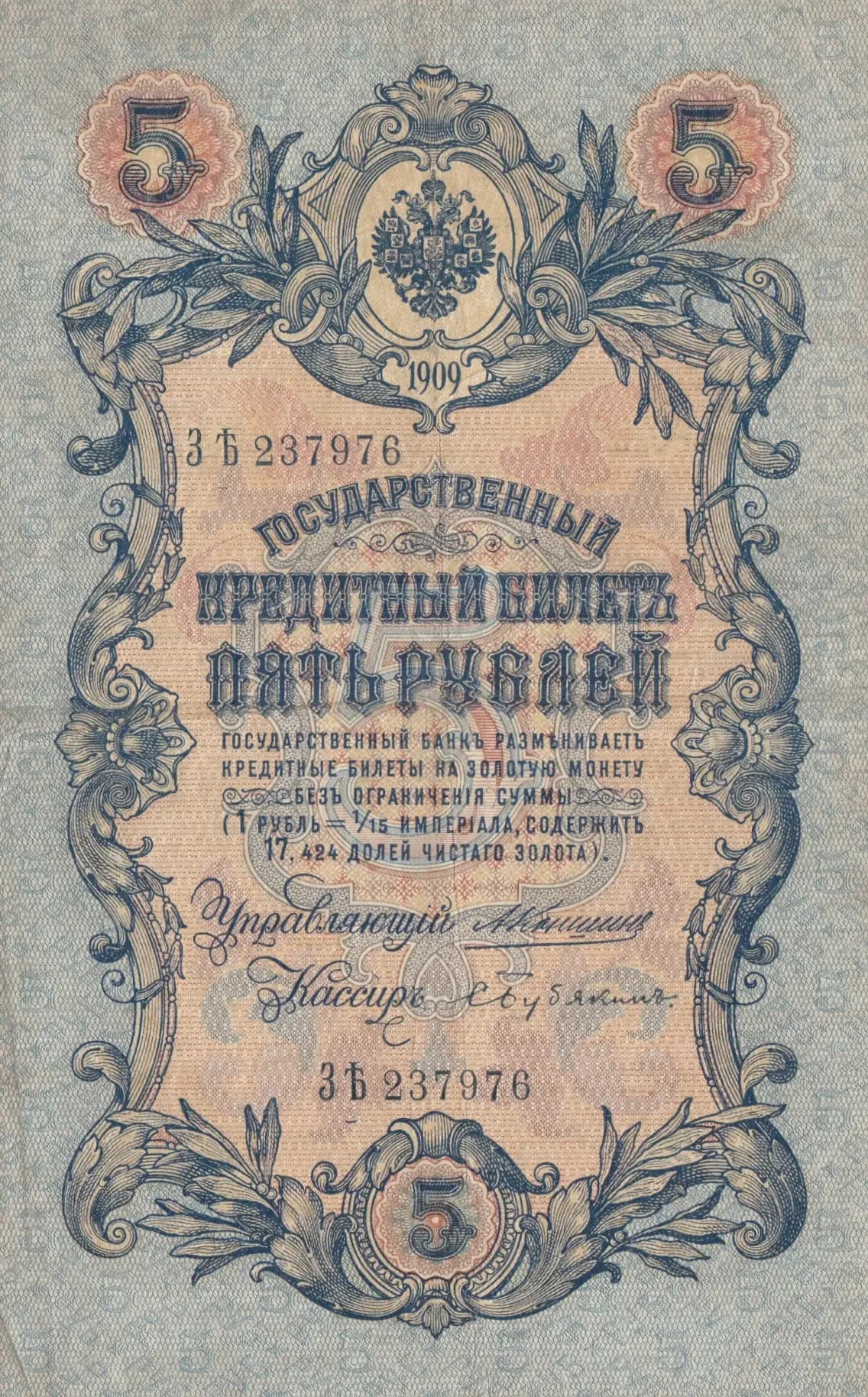
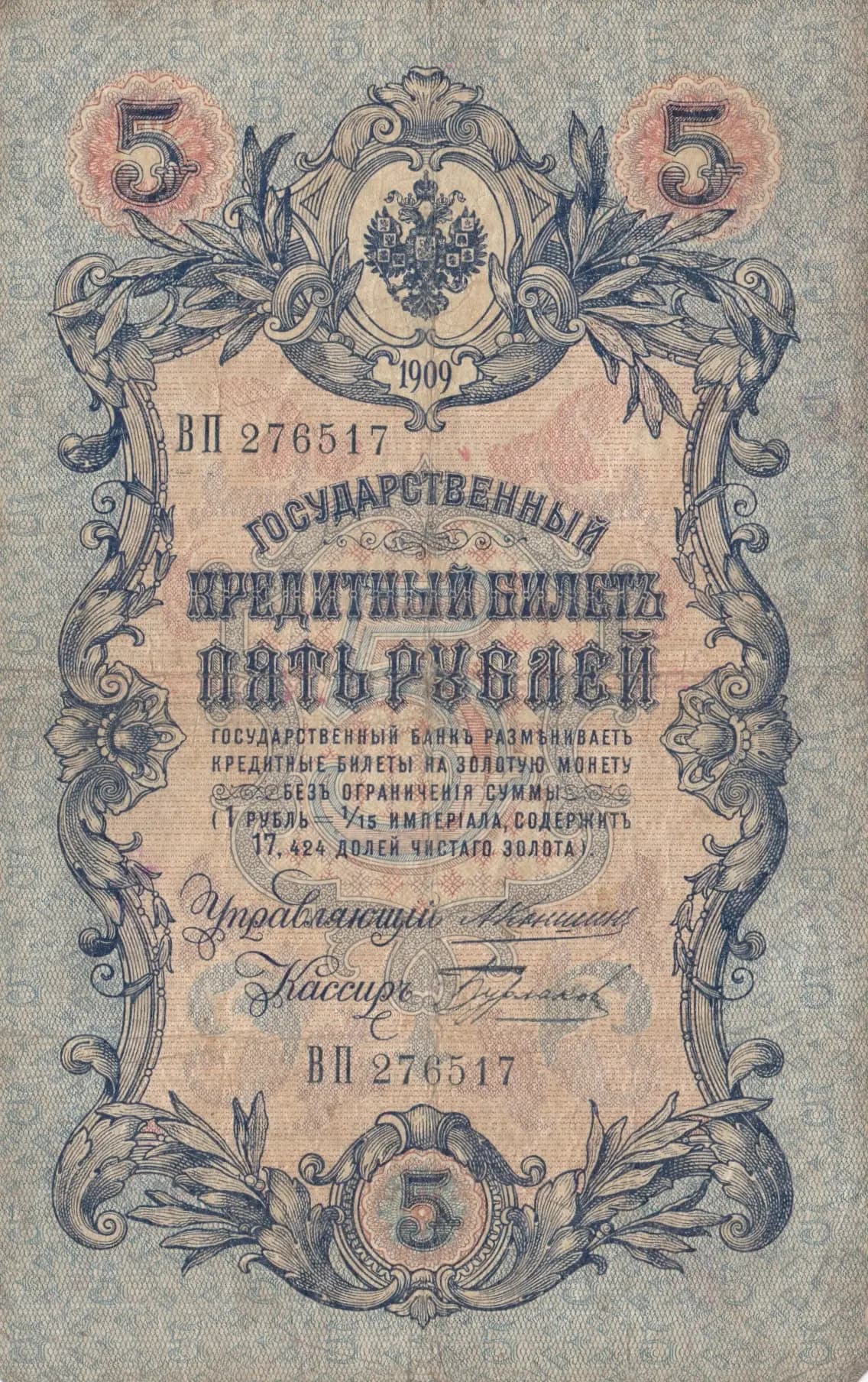
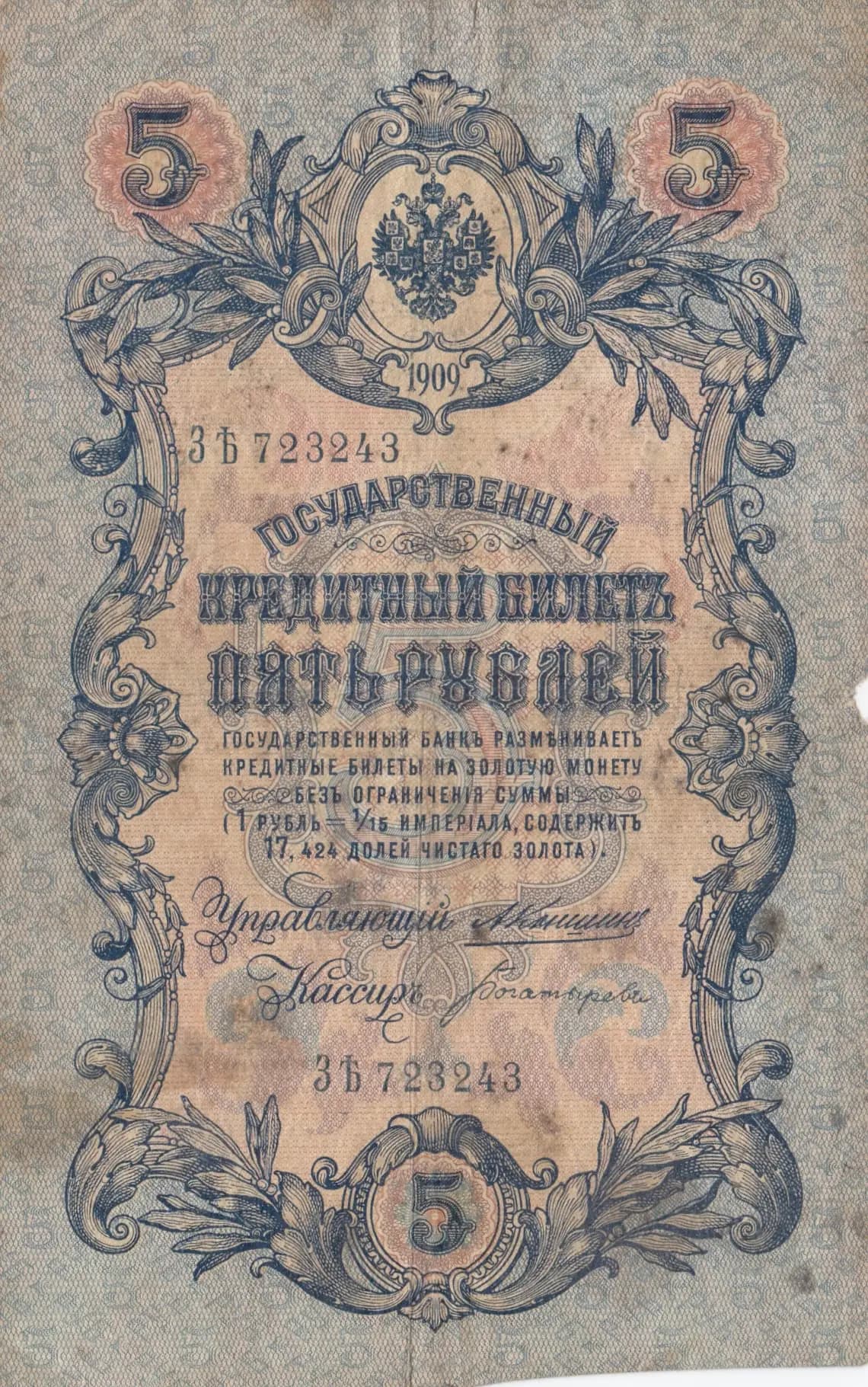
This 1909 Russian Imperial 5 ruble note (Pick P-10a(3)) presents a fine example of late Imperial Russian banknote design, featuring the iconic double-headed eagle with crown set within an ornate baroque-style border executed in dark blue ink on a pink/beige background. The note exhibits moderate wear consistent with its age and circulation history, with visible foxing, creasing, and color fading throughout, placing it solidly in the Fair condition grade. The signature of Bogatyryov and the detailed engraved security features make this a notable piece of early 20th-century Russian monetary history.
Common. The 1909 5 ruble Shipov-Bogatyryov series (Pick P-10a(3)) represents a standard issue of the Imperial Russian gold standard period with substantial print runs. This denomination and series circulated widely throughout the Russian Empire until 1917 and remains readily available to collectors today. Examples in Fair condition are frequently encountered in the numismatic market at modest prices, typically ranging from $15–40 USD depending on exact condition and serial number characteristics. The age and historical significance provide collector interest, but the note is not scarce by any definition. The Fair condition grade and standard signature combination do not elevate rarity.
Issued during the twilight years of Tsarist Russia, this 5 ruble note reflects the Russian Empire's gold standard monetary system established under the 1899 monetary reform, as explicitly referenced in the exchange guarantee text on the reverse. The prominent double-headed imperial eagle—both in the central shield and as flanking symbols—served as the primary symbol of Imperial authority and sovereignty during this period. The note's inscriptions regarding convertibility to gold (at a rate of 1 ruble = 1/15 Imperial, containing 17.424 grains of pure gold) demonstrate the gold-backed credibility the Russian state sought to project before the empire's collapse in 1917.
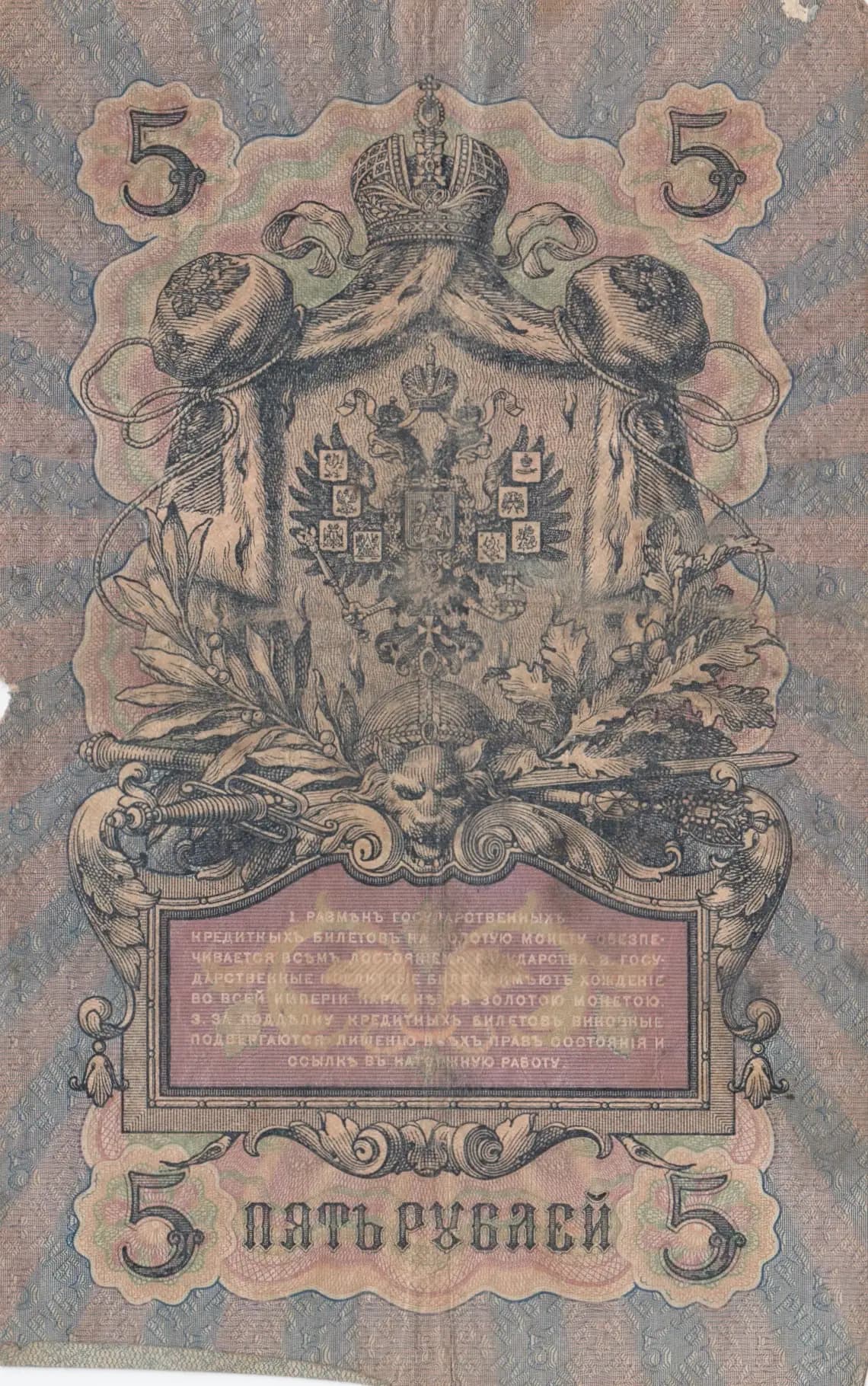
This banknote features the classic Imperial Russian design scheme of the Shipov-Bogatyryov signature series. The obverse (front) is dominated by the Imperial coat of arms—the double-headed eagle crowned with the Imperial crown, depicted within an ornate shield and surrounded by elaborate scrollwork, floral, and botanical border elements in typical baroque styling. The denomination circles containing '5' appear symmetrically in the upper left and right corners. The reverse (back) presents an even more heraldically elaborate composition, with a massive central Imperial eagle coat of arms flanked by two additional crowned eagles with spread wings, all surrounded by intricate ornamental framing. The entire design employs fine linear engraving work to create complex anti-counterfeiting patterns throughout. The color scheme of dark navy blue ink on pink/salmon and cream backgrounds is characteristic of Russian Imperial credit notes of this era. No individual portrait appears on this note, as the Imperial symbolism takes precedence.
FRONT SIDE: Title text reads 'ГОСУДАРСТВЕННЫЙ КРЕДИТНЫЙ БИЛЕТ' (State Credit Note) and 'ПЯТИ РУБЛЕЙ' (Five Rubles), with the date 1909. The lower portion contains the guarantee text: 'ГОСУДАРСТВЕННЫЙ БАНК РАЗМЕЩАЕТ КРЕДИТНЫЕ БИЛЕТЫ НА ЗОЛОТУЮ МОНЕТУ БЕЗ ОГРАНИЧЕНИЯ СУММЫ' (The State Bank Exchanges Credit Notes for Gold Coins Without Sum Limitation), followed by the gold content specification: '(1 РУБЛЬ = 1/15 ИМПЕРИАЛК, СОДЕРЖИТ 17.424 ДОЛЕЙ ЧИСТОГО ЗОЛОТА))' (1 Ruble = 1/15 Imperial, Contains 17.424 Parts Pure Gold). Serial number: 3б572324з. BACK SIDE: Large central text 'ПЯТЬ РУБЛЕЙ' (Five Rubles), with lengthy legal text in archaic Russian spelling beginning 'РАЗМЕНЪ ГОСУДАРСТВЕННЫХЪ КРЕДИТНЫХЪ БИЛЕТОВЪ НА ЗОЛОТУЮ МОНЕТУ СОВЕРШАЕТСЯ ВСЕМИ ОТДЕЛЕНИЯМИ ГОСУДАРСТВА...' (Exchange of State Credit Notes for Gold Coins is Performed by All State Departments...), referencing the regulatory framework of June 30, 1899. The denomination '5' appears in all four corners.
This note was produced using intaglio engraving (line engraving) on a steel plate, the standard security printing method for Russian Imperial banknotes. The intricate detail visible in the ornamental borders, the precision of the fine line work throughout the design, and the three-color printing (dark blue, light blue/grey, and pink on cream paper) are all consistent with high-security intaglio production. Russian Imperial notes of this period were typically produced by the State Printing Works (Государственный печатный двор) in St. Petersburg, though some production also occurred at the Moscow Printing Works. The complexity of the heraldic imagery and the fine engraving technique served as primary anti-counterfeiting measures before modern security features became standard.
This note is identified as Pick P-10a(3), indicating it belongs to the Shipov-Bogatyryov signature series—specifically the third known variety within this designation. The signature of Bogatyryov noted in the collector notes confirms the Bogatyryov signature variant. Serial number 3б572324з follows standard Russian Imperial numbering conventions with a Cyrillic letter prefix (3б) followed by numerals. Variations within this Pick number are primarily distinguished by signature combinations (Shipov as State Bank Director paired with various Finance Minister signatures including Bogatyryov, Kokovtsov, and Bark). No overprints, date variations, or other distinguishing marks beyond the signature are apparent on this example.