5 rublei 1909
“Sig.Gavrilov”
About This Note
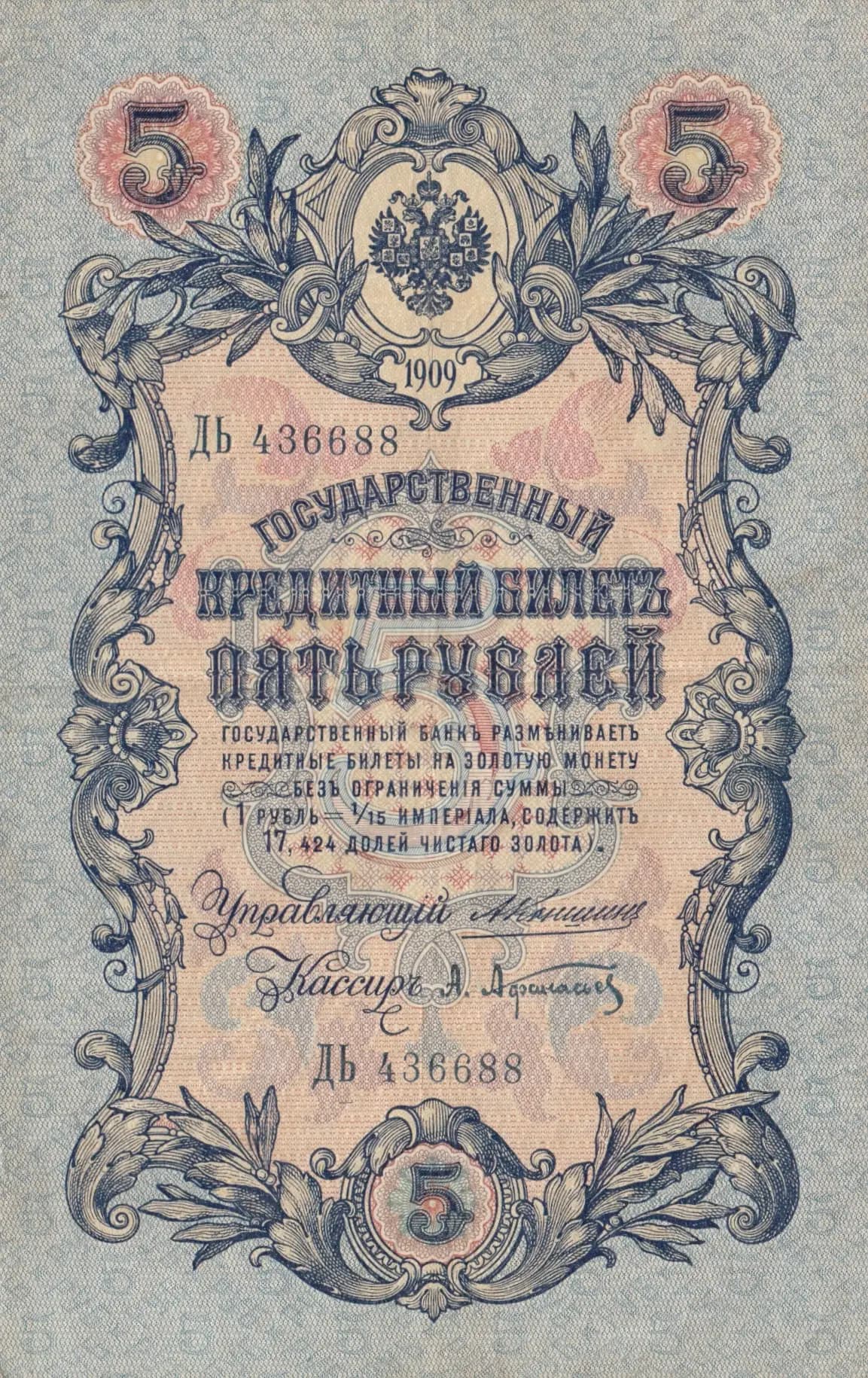
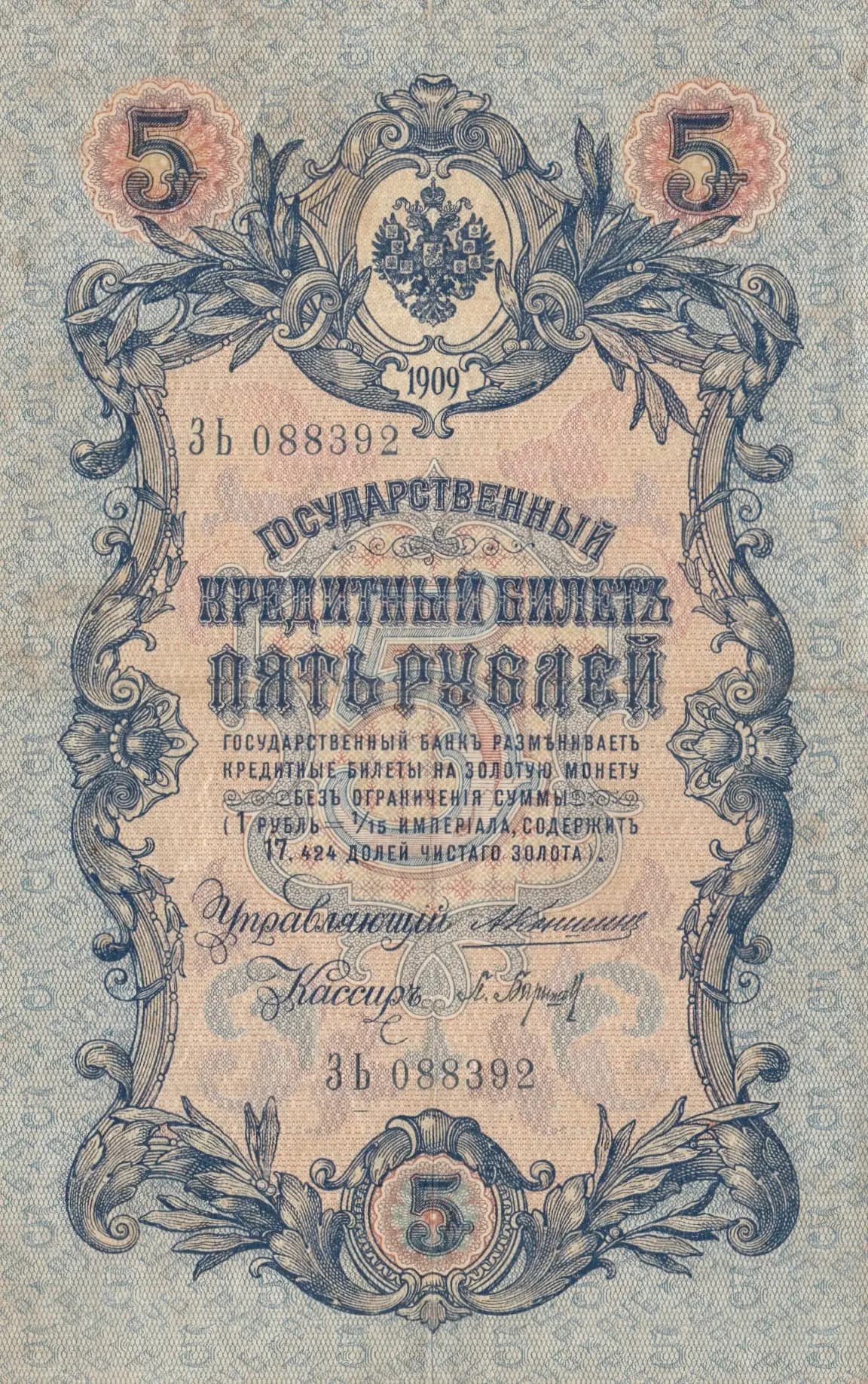
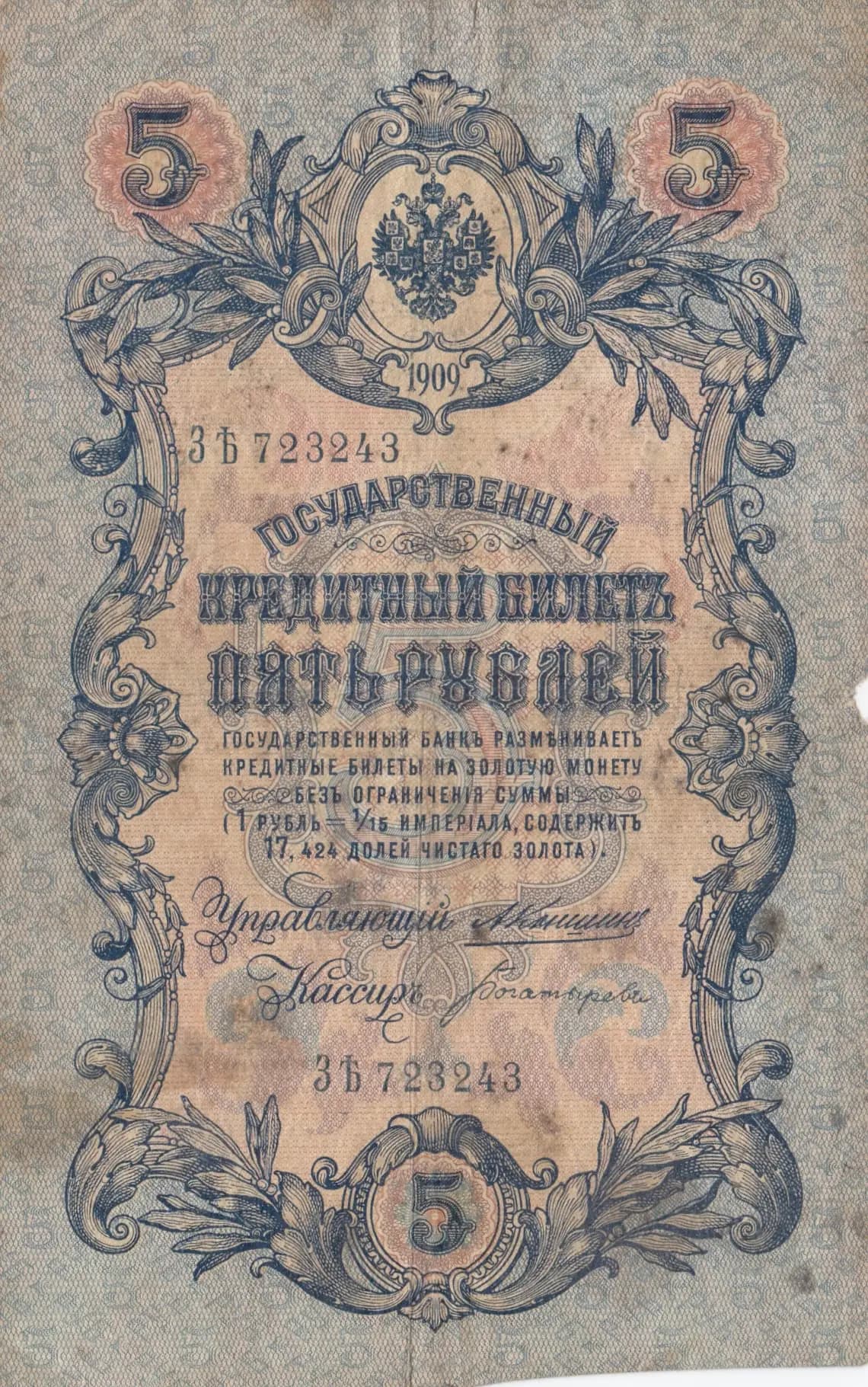
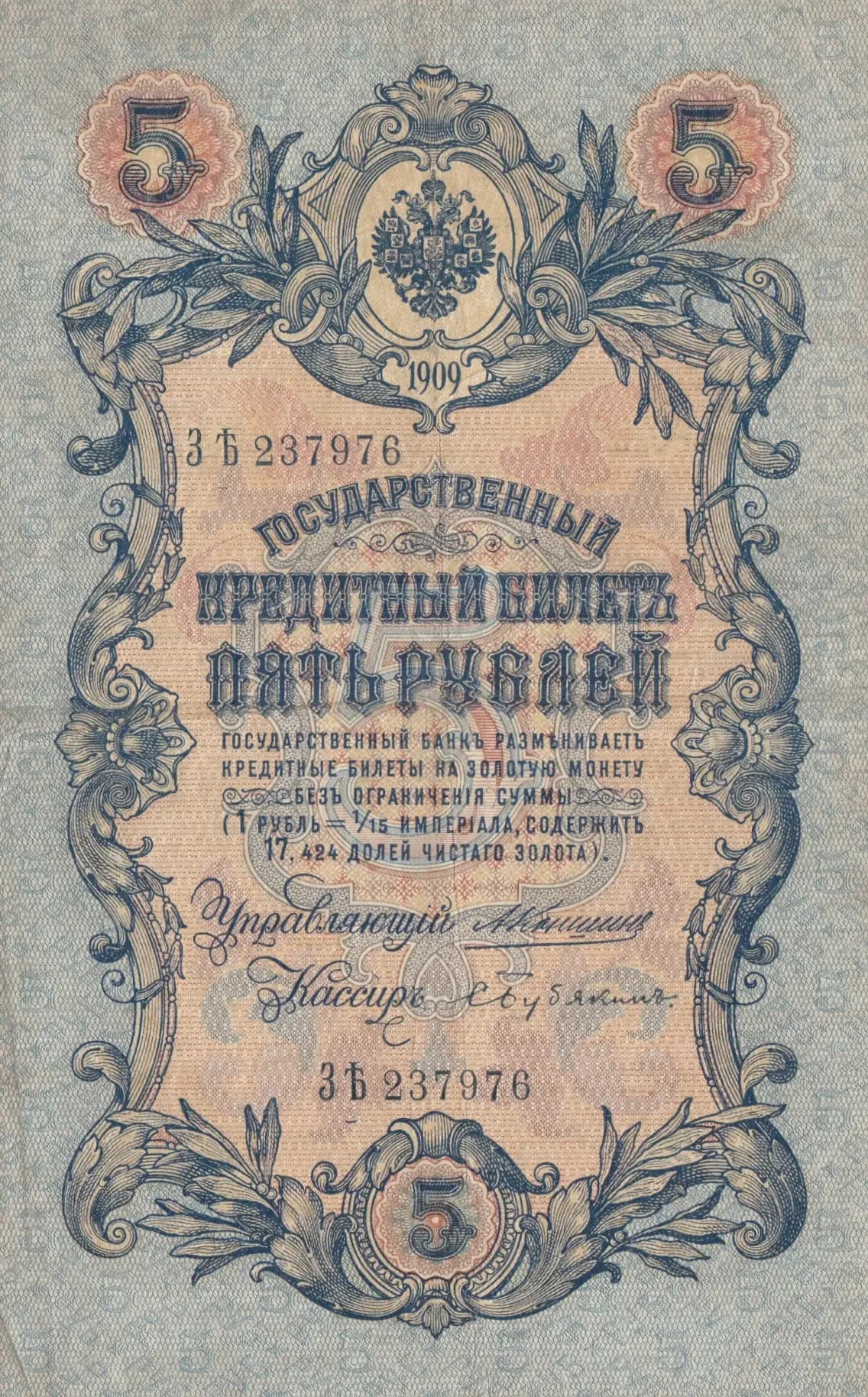
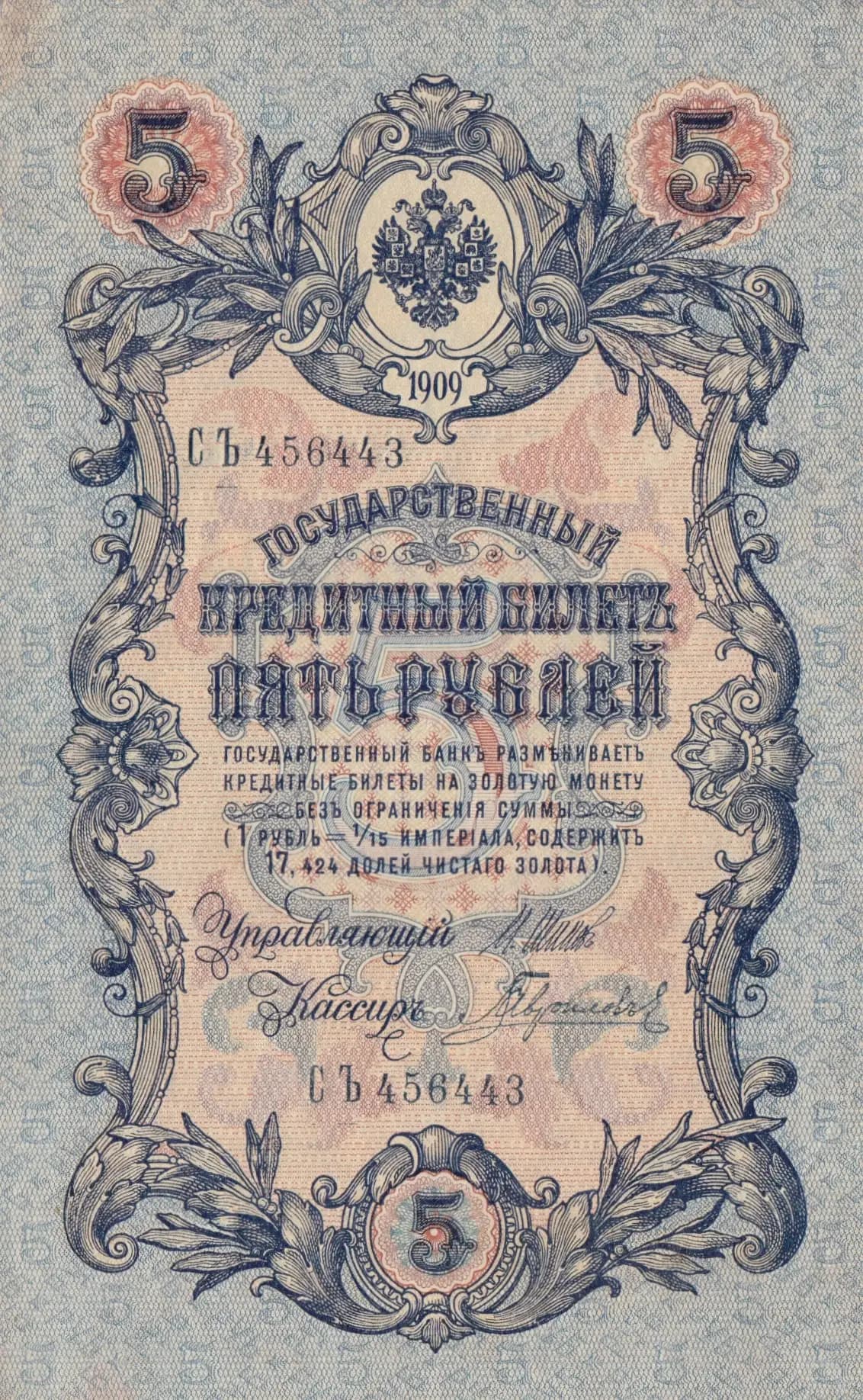
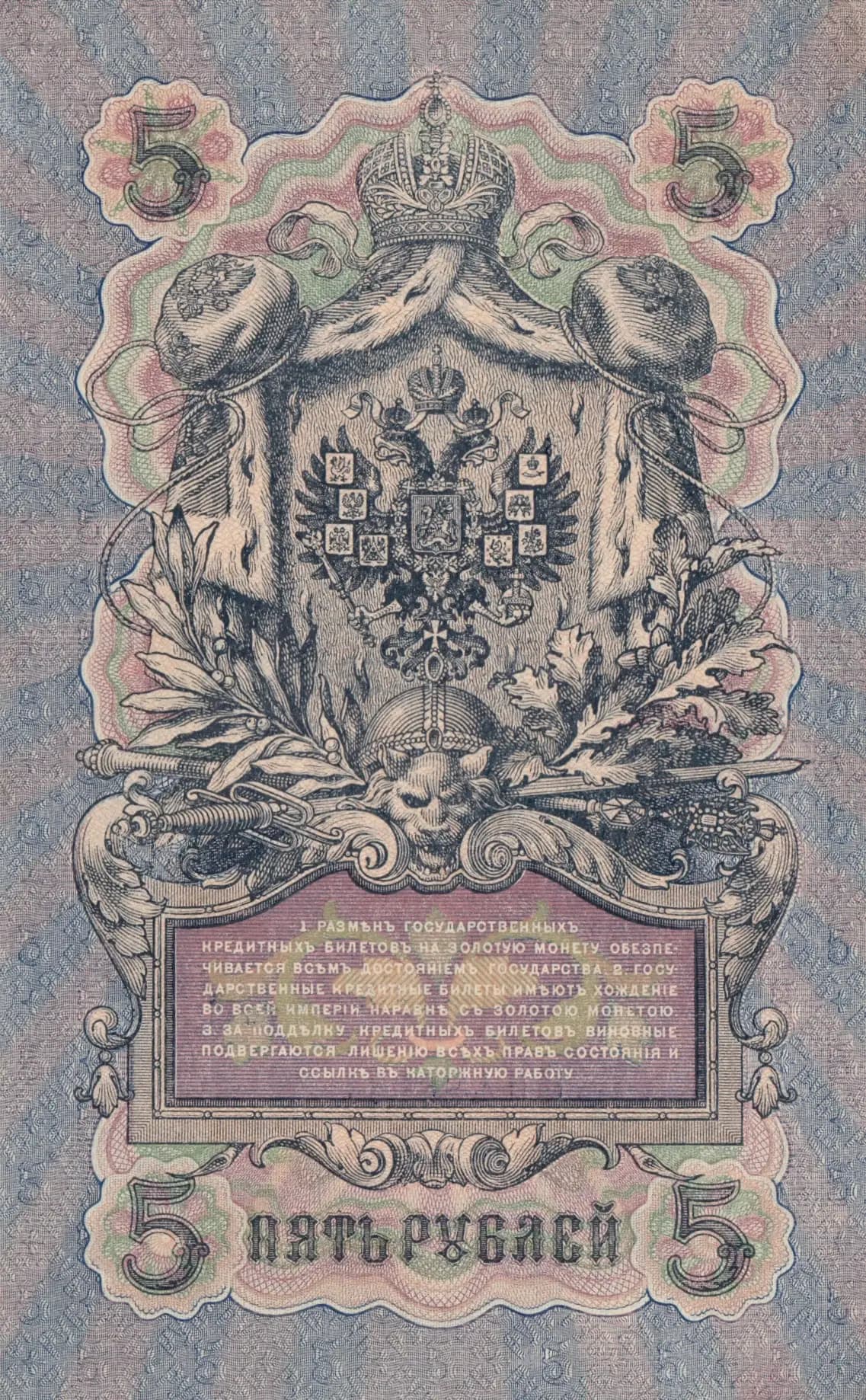
This is an attractive AU-graded example of the Russian Imperial 5 Ruble banknote from 1909, featuring the classic design with the double-headed eagle and ornate baroque borders characteristic of Tsarist-era currency. The note displays the typical aging patina of early 20th-century paper stock with visible creasing and foxing throughout, yet retains excellent clarity in the fine engraved details and multi-color printing. As part of the State Bank's gold-backed credit note series, this denomination represents an important transitional period in Russian monetary history before the revolutionary upheavals of 1917.
Common. The 5 Ruble note from 1909 (Pick P-10b) was produced in substantial quantities as a standard denomination of the Russian Imperial State Bank's regular circulation issue during the decade preceding the 1917 Revolution. While these notes have survived in moderate quantities, well-preserved examples in AU condition are not uncommon in the market. The Pick catalog designation of P-10b(6) indicates this is a known variety within the standard series, rather than a scarce or limited variant. Most imperial 5 Ruble notes from this period trade at accessible price points reflecting their common status.
This 1909 issue represents the mature design of Russian Imperial credit notes established under the 1897 monetary reform, when Finance Minister Sergei Witte introduced the gold standard and stabilized the ruble. The imperial double-headed eagle, laurel and oak wreaths, and elaborate heraldic coat of arms depicted on both sides symbolized the autocratic state's authority and the note's guarantee as being backed by gold held by the State Bank. The prominent inscriptions detailing the gold content (17.424 parts pure gold per ruble) and the severe warning of exile to hard labor for counterfeiting reflect the high security concerns and centralized control of currency in the Russian Empire during this period.
The note features a fully symmetrical baroque design centered on the Imperial Russian double-headed eagle crowned, which serves as the primary symbol of state authority on both obverse and reverse. The front face displays the eagle within an elaborate frame of laurel branches, symbolizing victory and imperial power, while the reverse shows the eagle surrounded by both laurel and oak wreaths, with the complex imperial coat of arms beneath featuring multiple heraldic shields representing the various regions and dominions of the Russian Empire. The design is enclosed by an intricate ornamental border of scrollwork, floral elements, and geometric patterns executed in the characteristic blue/navy ink. Denomination circles marked '5' appear in all four corners of both sides in ornamental medallion frames. The overall composition emphasizes imperial grandeur and the official nature of the currency, with no portraits of individuals present—typical of Russian Imperial credit notes which focused on state symbols rather than personal imagery. The color scheme combines blue for primary designs, pink/salmon for secondary elements, and cream/beige background tones, creating visual depth and security through color separation.
FRONT: 'ГОСУДАРСТВЕННЫЙ КРЕДИТНЫЙ БИЛЕТ ПЯТЬ РУБЛЕЙ' translates to 'State Credit Note, Five Rubles.' The year '1909' appears at top center. Serial number 'СЪ456443' is positioned at top and bottom. The extended text reads: 'ГОСУДАРСТВЕННЫЙ БАНК РАЗМЕЩИВАЕТ КРЕДИТНЫЕ БИЛЕТЫ НА ЗОЛОТУЮ МОНЕТУ БЕЗ ОГРАНИЧЕНИЯ СУММЫ РУБЛЬ = 1/15 ИМПЕРИАЛ, СОДЕРЖИТ 17,424 ДОЛЕЙ ЧИСТАГО ЗОЛОТА' meaning 'The State Bank issues credit notes for gold coin without limit of amount. One ruble equals 1/15 of an Imperial and contains 17.424 parts pure gold.' Signature lines for 'Управляющий' (Director) and 'Кассир' (Cashier) appear at bottom. BACK: 'ПЯТЬ РУБЛЕЙ' (Five Rubles) appears in denominal medallions. The main text block contains legal language guaranteeing the notes' convertibility to gold and threatening severe penalties: 'В РАЗМЕНЬ ГОСУДАРСТВЕННЫХ КРЕДИТНЫХ БИЛЕТОВ НА ЗОЛОТУЮ МОНЕТУ ОБЯЗУЕТ СЧИТАЕТСЯ ВСЕМ ДОСТОЯНИЕМ ГОСУДАРСТВА. ГОСУДАРСТВЕННЫЕ КРЕДИТНЫЕ БИЛЕТЫ ИМЕЮТ ХОЖДЕНИЕ ВО ВСЕЙ ИМПЕРИИ, НАРЯДНЕ СЕ ЗОЛОТОЮ МОНЕТОЮ. ОБЪЯВЛЯЮ НИЖЕСЛЕДУЮЩИЕ БИЛЕТЫ ВЫПУЩЕННЫЕ ПОДВЕРГАЮТСЯ ЛИШЕНИЮ ВСЕХ ПРАВ СОСТОЯНИЯ И ССЫЛКА ВЪ КАТОРЖНУЮ РАБОТУ' translating to 'The exchange of government credit notes for gold coin is guaranteed by all the wealth of the State. These government credit notes are legal tender throughout the entire empire equally with gold money. I hereby declare that the following issued notes are subject to deprivation of all civil rights and exile to hard labor.'
This note was produced using steel engraving combined with lithography for the multi-color printing characteristic of Russian Imperial banknotes of this period. The fine line work visible in the ornamental borders, the precise detail in the eagle and heraldic elements, and the sharp reproduction of small text indicate high-quality engraved plates. The security printer for Russian Imperial credit notes of this era was the State Bank's own printing facilities in Saint Petersburg, working under strict government control. The multi-color printing—employing blue, pink, and neutral tones—was achieved through successive passes of different colored inks, a technique that also served security purposes by requiring multiple plates that would be difficult to counterfeit. The aged foxing and yellowing visible in the images reflect the use of period-appropriate rag-based paper stock rather than modern wood-pulp paper.
The Pick designation P-10b(6) indicates this specific note belongs to the sixth identified variety within the P-10b series of 1909 issues. The serial number 'СЪ456443' is visible, with the Cyrillic prefix 'СЪ' being characteristic of notes from the 1909 period. The signatures on the note represent the standard 'Управляющий' (Director) and 'Кассир' (Cashier) lines typical of this series; specific signature varieties exist depending on which bank officials were in office at the time of printing. The collector notation indicates signature by Gavrilov, likely referring to one of the officials whose signature appears on this particular specimen. No overprints or special markings are evident in the visual analysis, suggesting this is an unmodified example from the standard circulation printing.