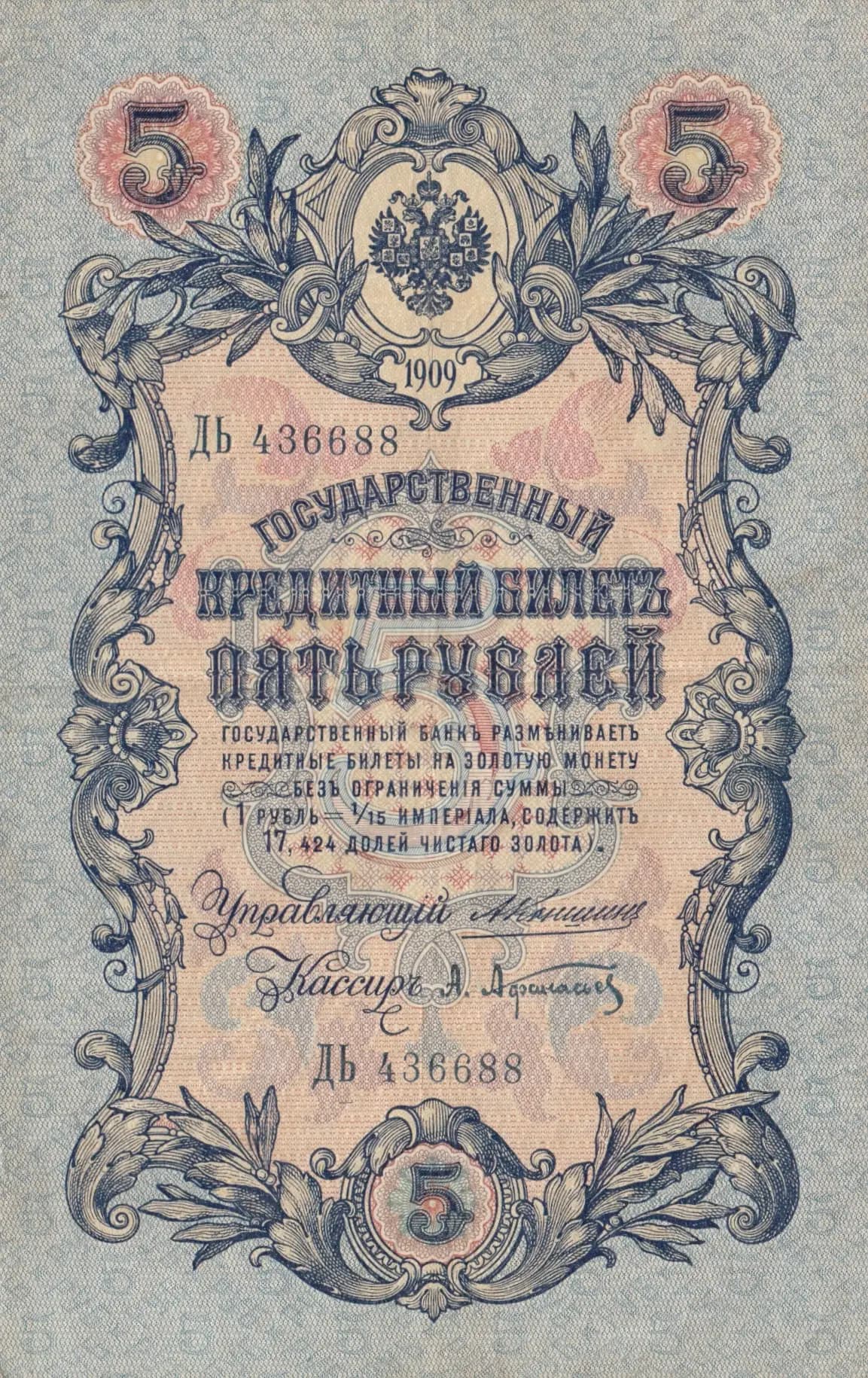
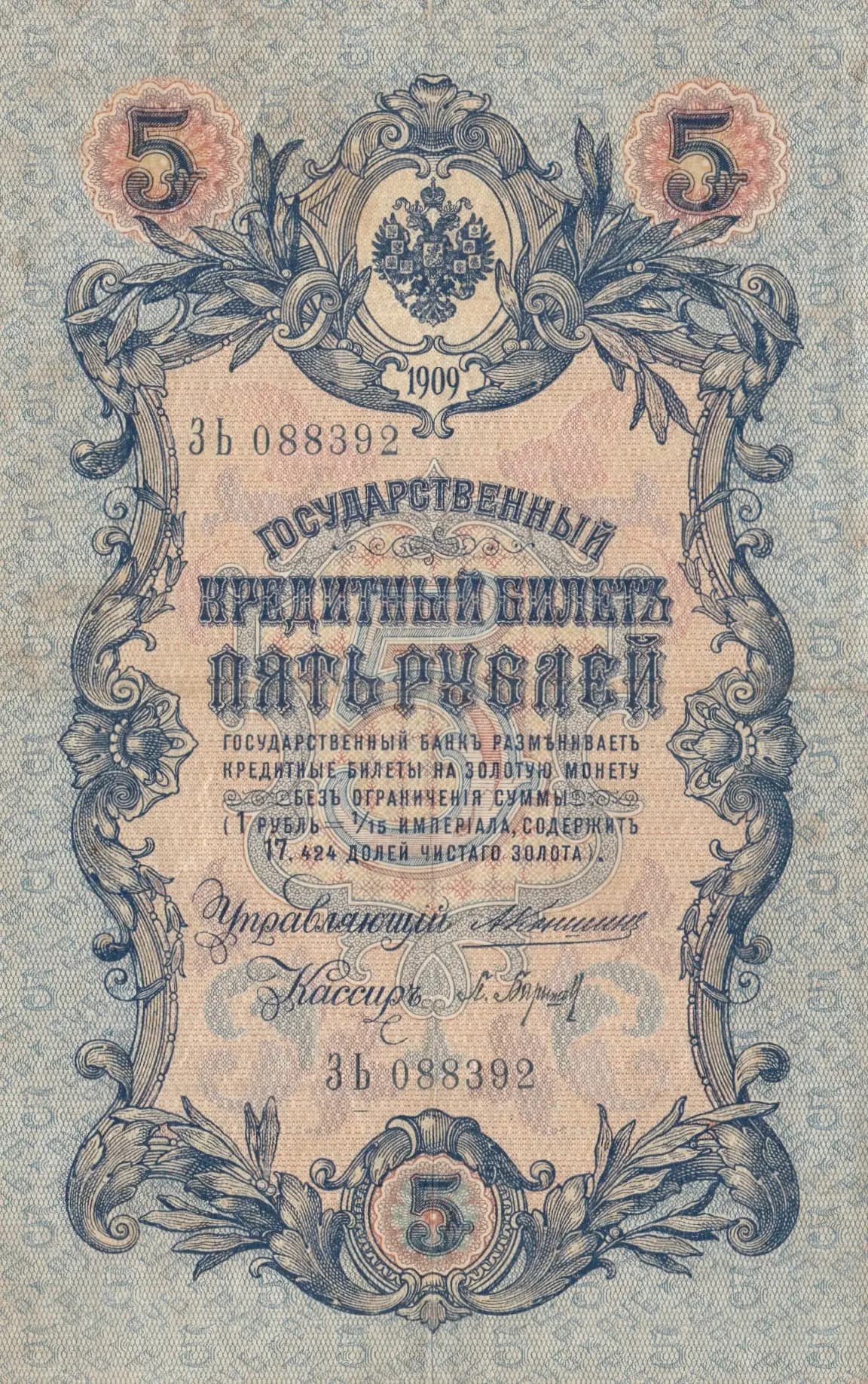
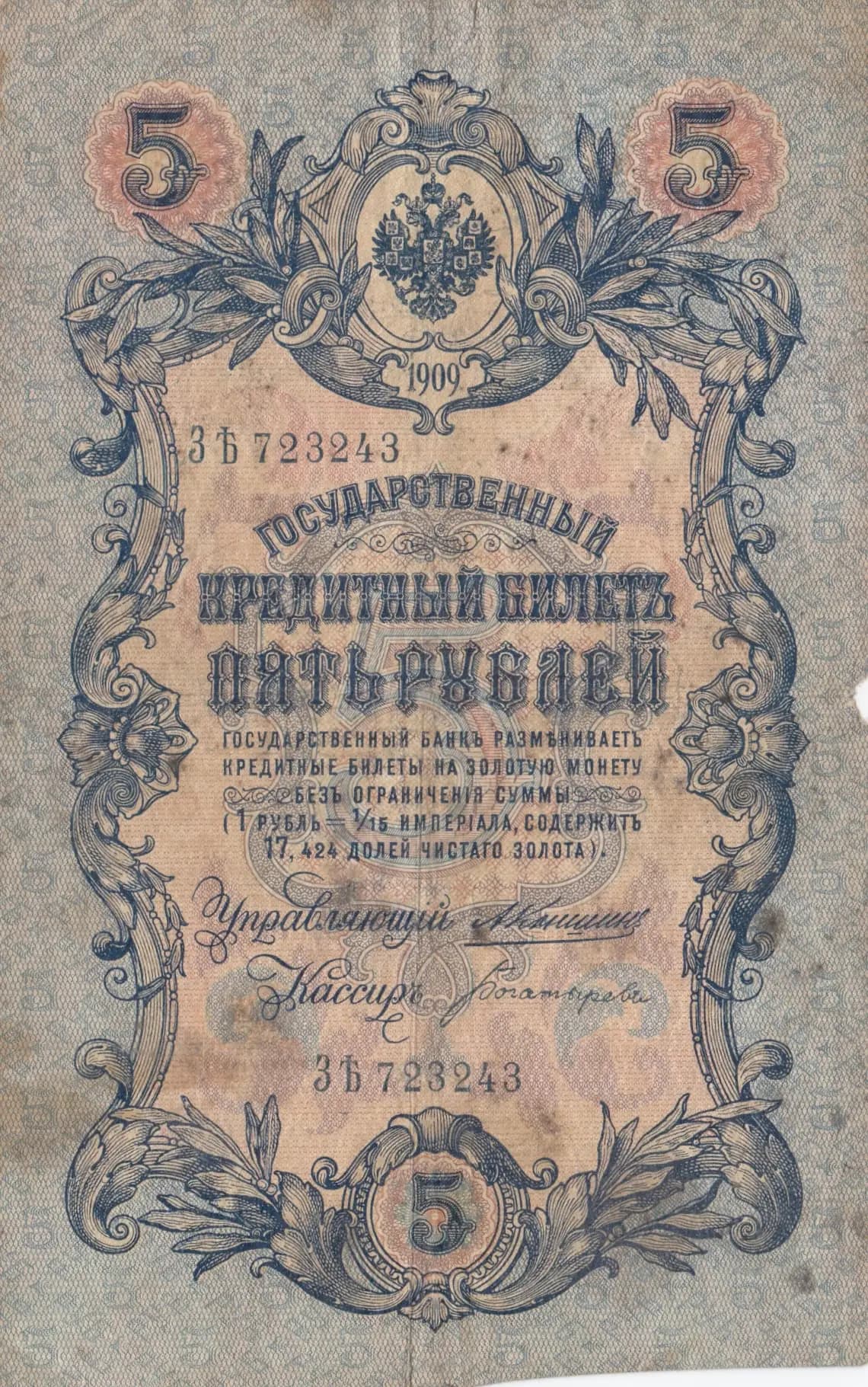
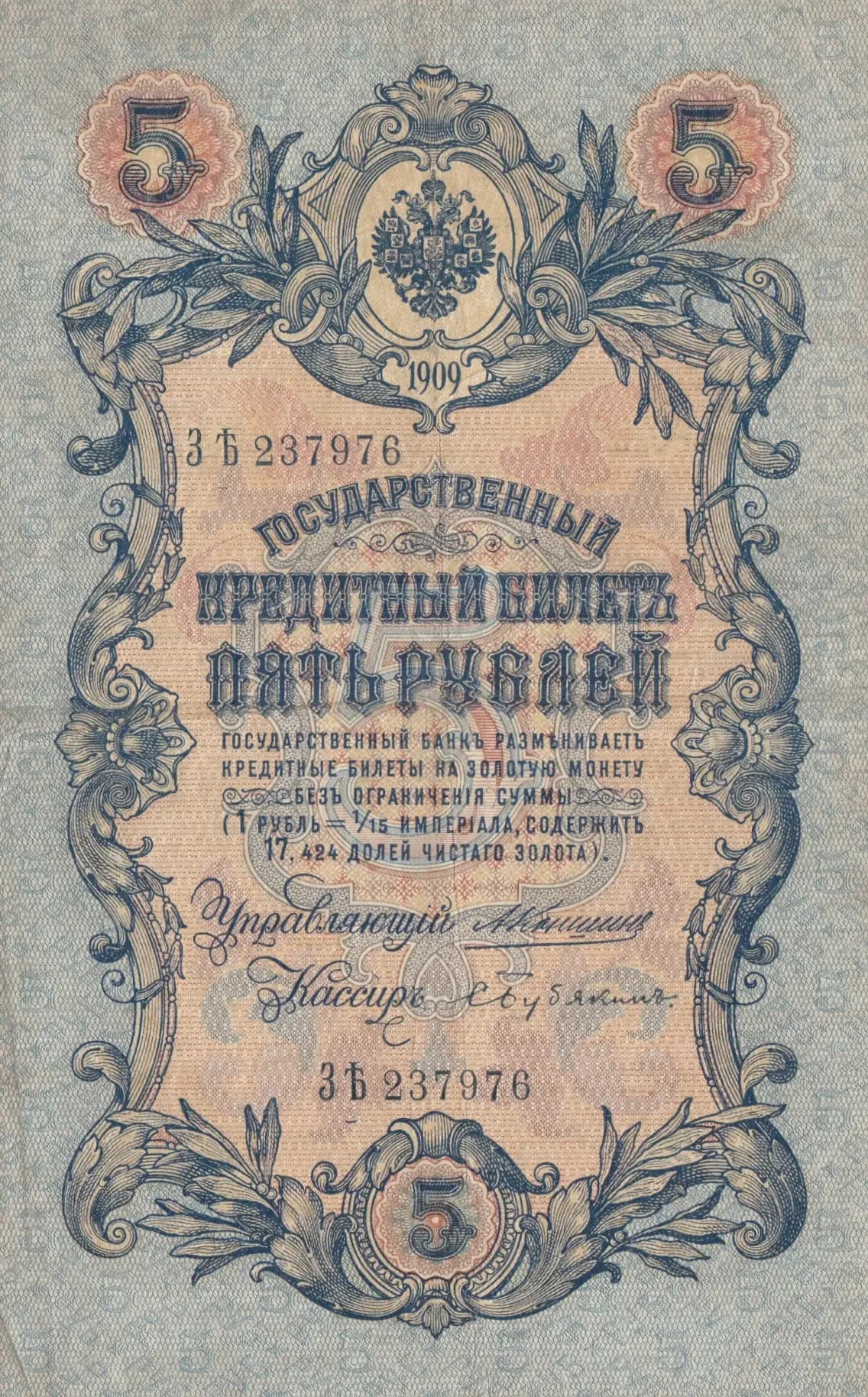
5 rublei 1909
“Sig.Bylinsky”
About This Note
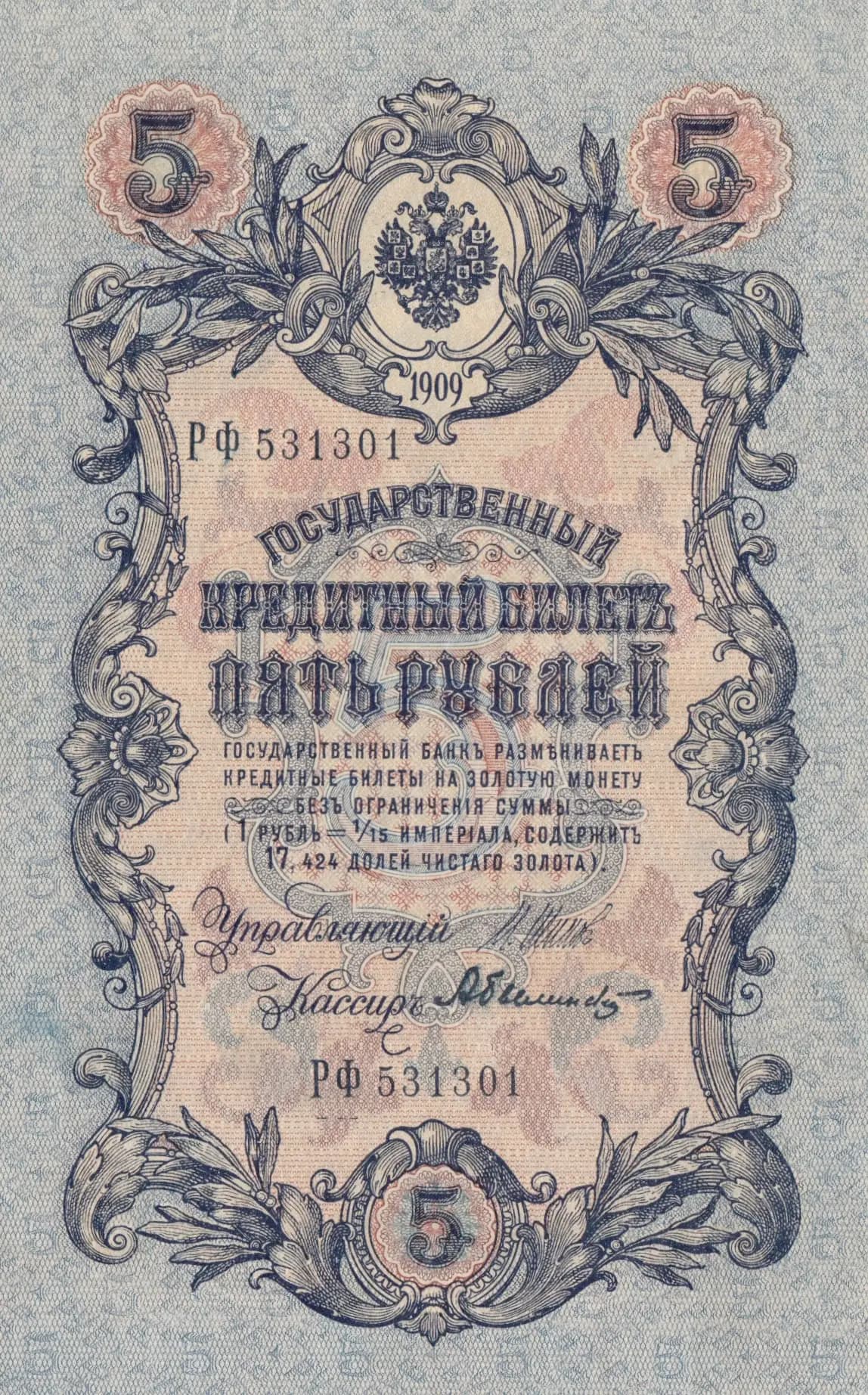
This is an exceptionally well-preserved 5 Rublei note from 1909, graded AU, representing the Imperial Russian State Credit Note system during the final years of Tsarist Russia. The note displays crisp, vibrant printing with the characteristic pale blue-gray and pink/salmon color scheme of this series, featuring an ornate engraved Imperial double-headed eagle coat of arms and intricate scrollwork borders that remain sharp and clear. The excellent condition and clear serial number (РФ 531301) make this an attractive example of late Imperial Russian currency for collectors of Tsarist-era banknotes.
Common. The 1909 5 Rublei (Pick 10b) was issued in substantial quantities as part of Russia's standard circulating currency during the final years of the Tsarist Empire. While many notes from this period were lost, damaged, or destroyed during the Russian Revolution and subsequent decades of Soviet rule, sufficient examples survive that this denomination and year remain readily available to collectors in the numismatic market. The AU grade specimen noted here is desirable for its condition but not rare; many survivors exist in varying states of preservation. This note does not represent a short print run, recall issue, or limited-distribution variant.
Issued in 1909 during the reign of Tsar Nicholas II, this State Credit Note represents Russia's post-1897 gold-backed currency reform implemented under Finance Minister Sergei Witte. The inscriptions prominently reference the exchange of credit notes for gold coins at fixed rates (1 Ruble = 17.424 parts pure gold), reflecting Russia's adherence to the gold standard and the Imperial state's commitment to monetary stability. The elaborate heraldic design, featuring the crowned double-headed eagle with ornamental foliage, symbolizes the power and legitimacy of the Russian Empire during the final decade before the 1917 revolution.
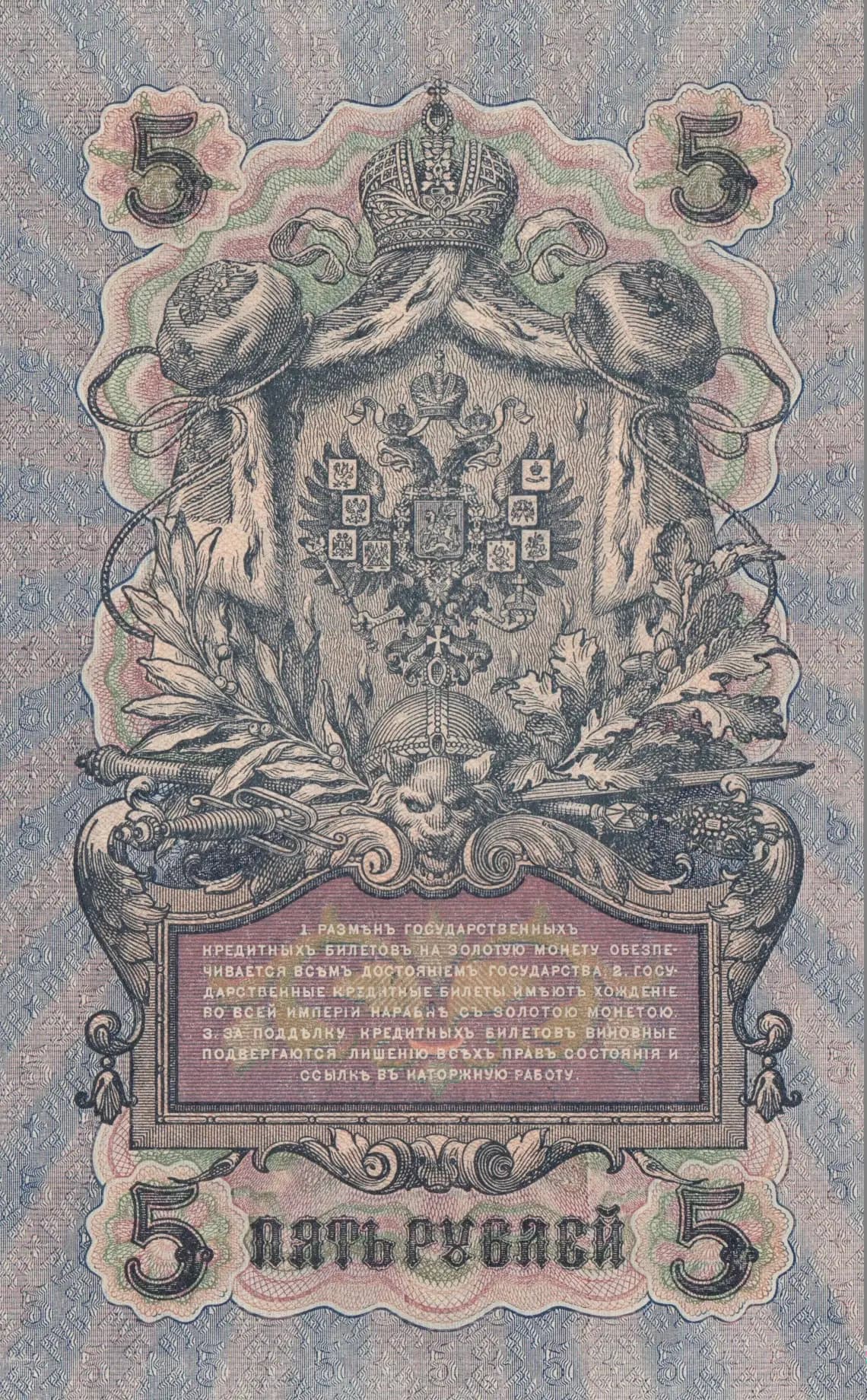
The 5 Rublei of 1909 features the Imperial Russian double-headed eagle as its central heraldic symbol, crowned and flanked by decorative laurel or oak branches on the reverse, representing imperial authority and prosperity. The obverse displays the coat of arms within an elaborate ornamental frame at top center, with the denomination '5' in decorative cartouches positioned symmetrically on left and right sides, and again in all four corners on the reverse. The entire design is executed in fine-line engraved work with intricate scrollwork borders, floral elements, and ornamental flourishes characteristic of high-security banknote design of the period. The color palette—pale blue-gray field with pink/salmon corner medallions and dark navy blue engraving—was standard for Imperial Russian credit notes of this denomination and series. The text areas include statements of the State Bank's obligation to exchange notes for gold and legal warnings against defacement, reflecting the quasi-constitutional nature of Russia's late-Imperial monetary system.
FRONT SIDE: 'ГОСУДАРСТВЕННЫЙ КРЕДИТНЫЙ БИЛЕТ' (State Credit Note) / 'ПЯТЬ РУБЛЕЙ' (Five Rubles) / 'ГОСУДАРСТВЕННЫЙ БАНК РАЗМЕЩИВАЕТ КРЕДИТНЫЕ БИЛЕТЫ НА ЗОЛОТУЮ МОНЕТУ ПО УКАЗАННОМУ ОГРАНИЧЕНИЮ СУММЫ: 1 РУБЛЬ - УЖ ИМПЕРИАЛЬН, СОДЕРЖИТ 17,424 ДОЛЕЙ ЧИСТАГО ЗОЛОТА' (The State Bank exchanges Credit Notes for gold coins at the indicated limit: 1 Ruble - Imperial, contains 17.424 parts pure gold) / 'Управляющий Банк' (Bank Manager) / 'Кассир' (Cashier) / Serial number: РФ 531301 / Date: 1909. BACK SIDE: 'ПЯТЬ РУБЛЕЙ' (Five Rubles) / 'РАЗМЕН ГОСУДАРСТВЕННЫХ КРЕДИТНЫХ БИЛЕТОВ НА ЗОЛОТУЮ МОНЕТУ ОБЕСПЕЧИВАЕТСЯ ВСЕМИ ДОСТОИНСТВАМИ ГОСУДАРСТВЕННЫХ ДАРСТВЕННЫЕ АССИГНАЦИИ И БИЛЕТЫ КОМАНДОВАНИЕ ВО ВСЕЙ ИМПЕРИИ НАРАВНЕ СО ЗОЛОТОЮ МОНЕТОЮ' (The exchange of State Credit Notes for gold coins is ensured by all values of state treasury notes and bills circulating throughout the entire empire on equal terms with gold coins) / Legal notice regarding penalties for damage to banknotes.
Intaglio engraving (copperplate engraving), the standard security printing method for Russian Imperial banknotes of this era. The crisp, clear impression of fine lines, the dimensional quality of the engraved details visible in both the ornamental borders and heraldic elements, and the precise color registration all indicate professional engraved production. Russian Imperial notes of this period were typically produced by the State Printing Works (Государственная Печатня) in St. Petersburg, which maintained the highest standards of engraved security printing. The multiple color application (blue-gray background, pink overprints, navy engraving) suggests chromolithographic or multi-pass printing techniques in combination with intaglio for the primary design elements.
Pick 10b(5) designation indicates this is a signed variety of the 5 Rublei 1909 issue. The Bylinsky signature noted in the collector notes ('Sig.Bylinsky') likely corresponds to one of the authorized signatories (Bank Manager or Cashier) whose facsimile signature appears on the note. Serial number РФ 531301 reflects the Russian Imperial serial numbering system. Specific signature varieties of this issue exist and can be cataloged by collector preference, though none are particularly scarce. No notable overprints, color variations, or other distinguishing varieties are evident from the visual analysis of this example.