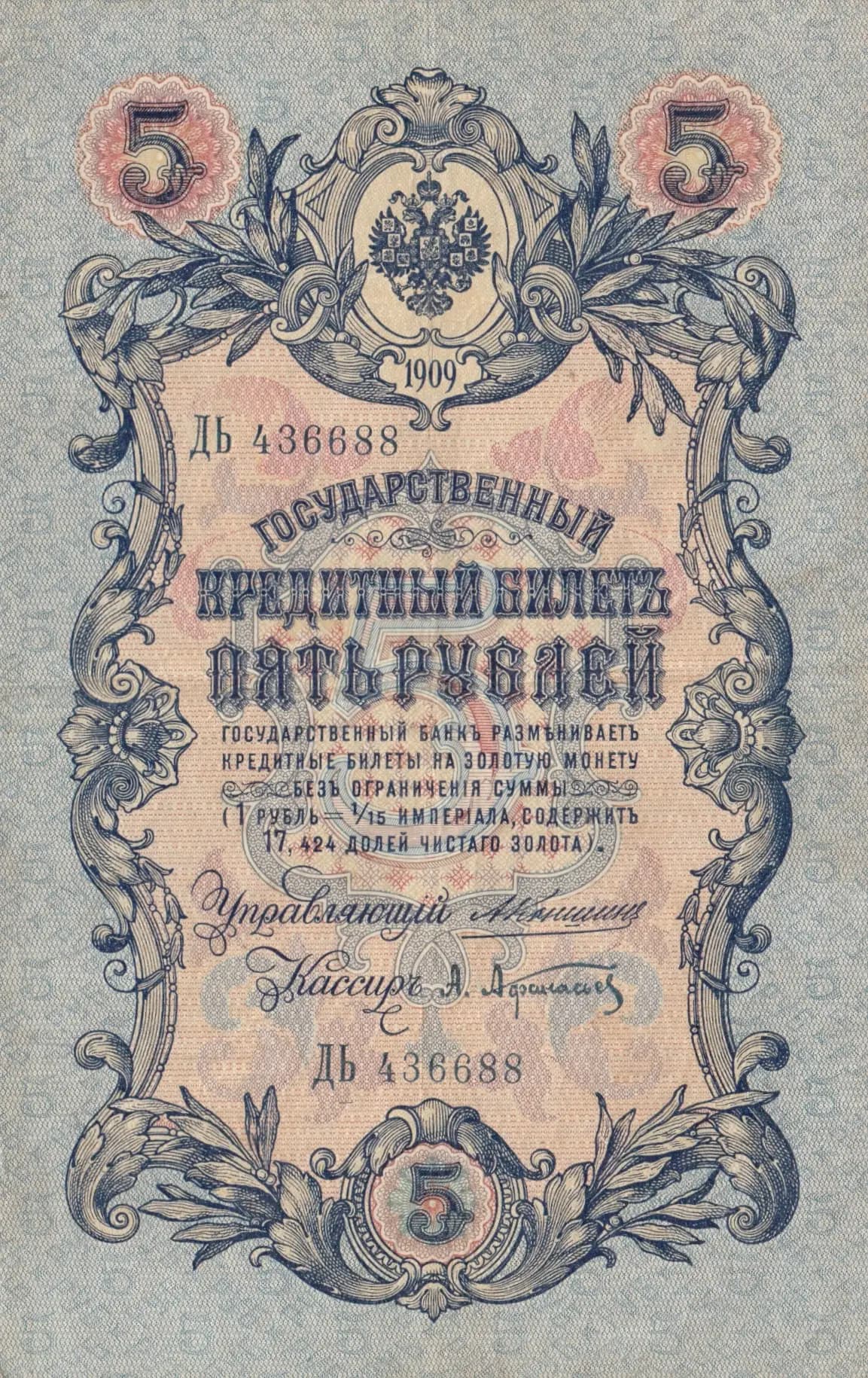
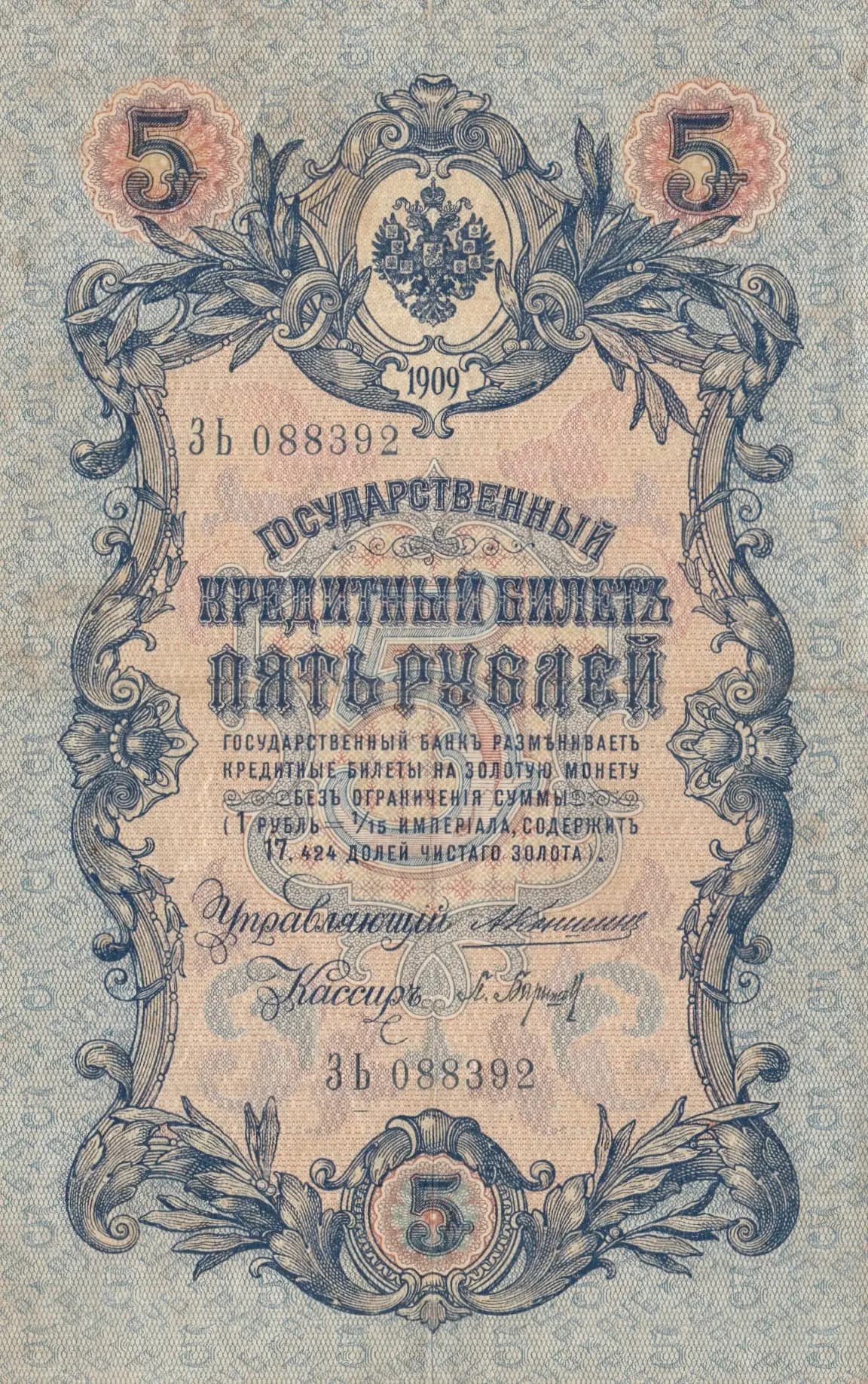
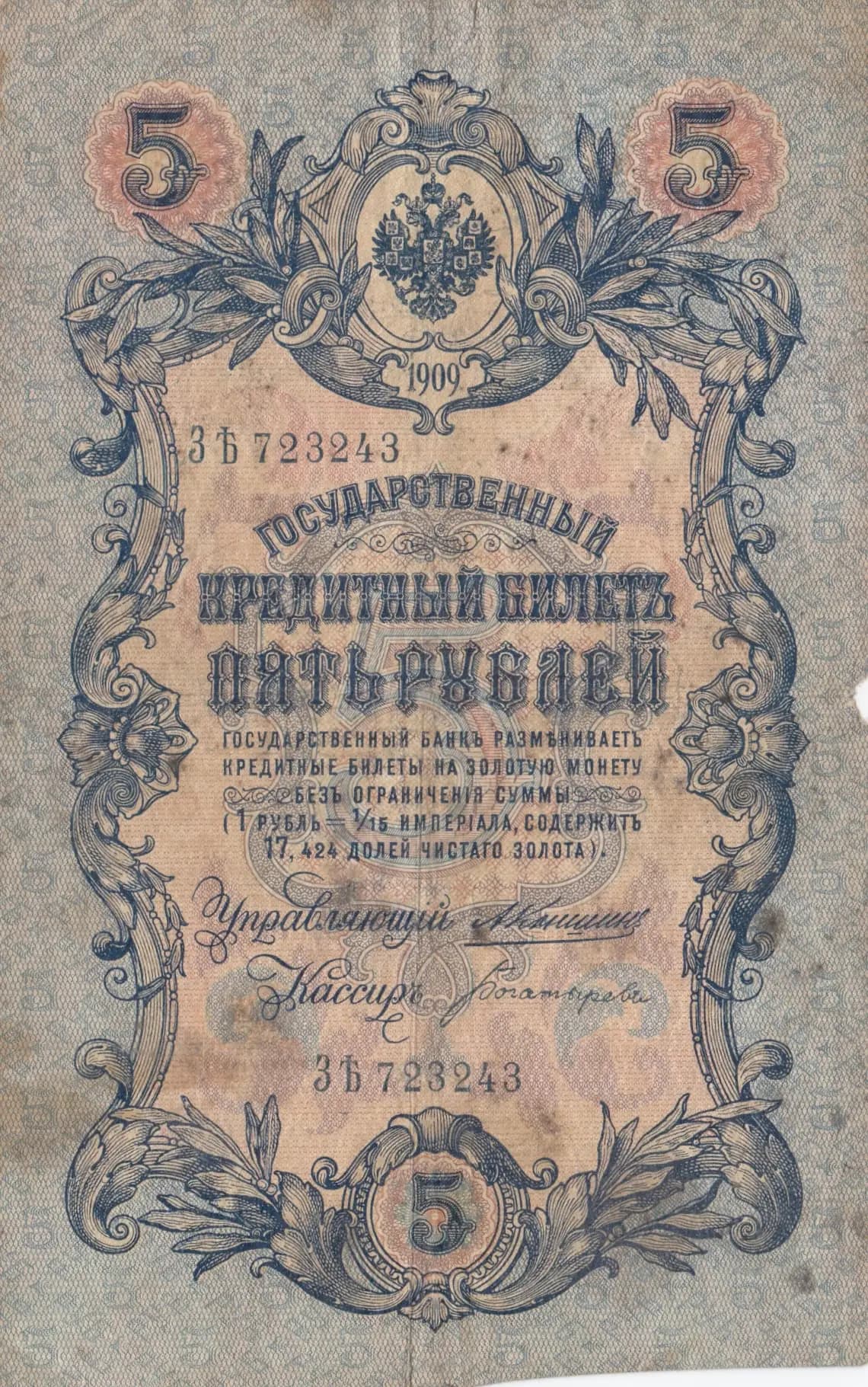
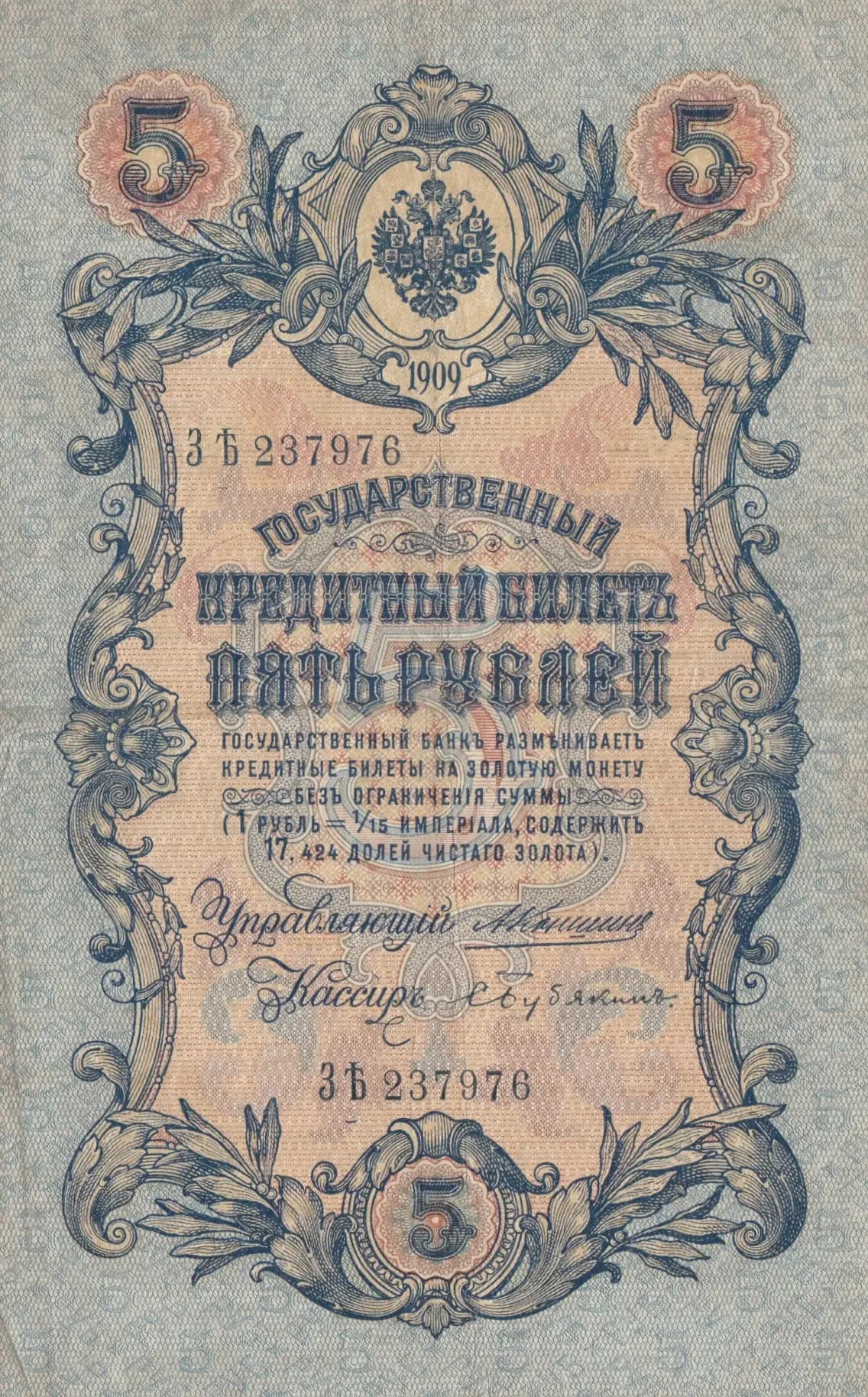
5 rublei 1909
“Sig.Baryshev”
About This Note
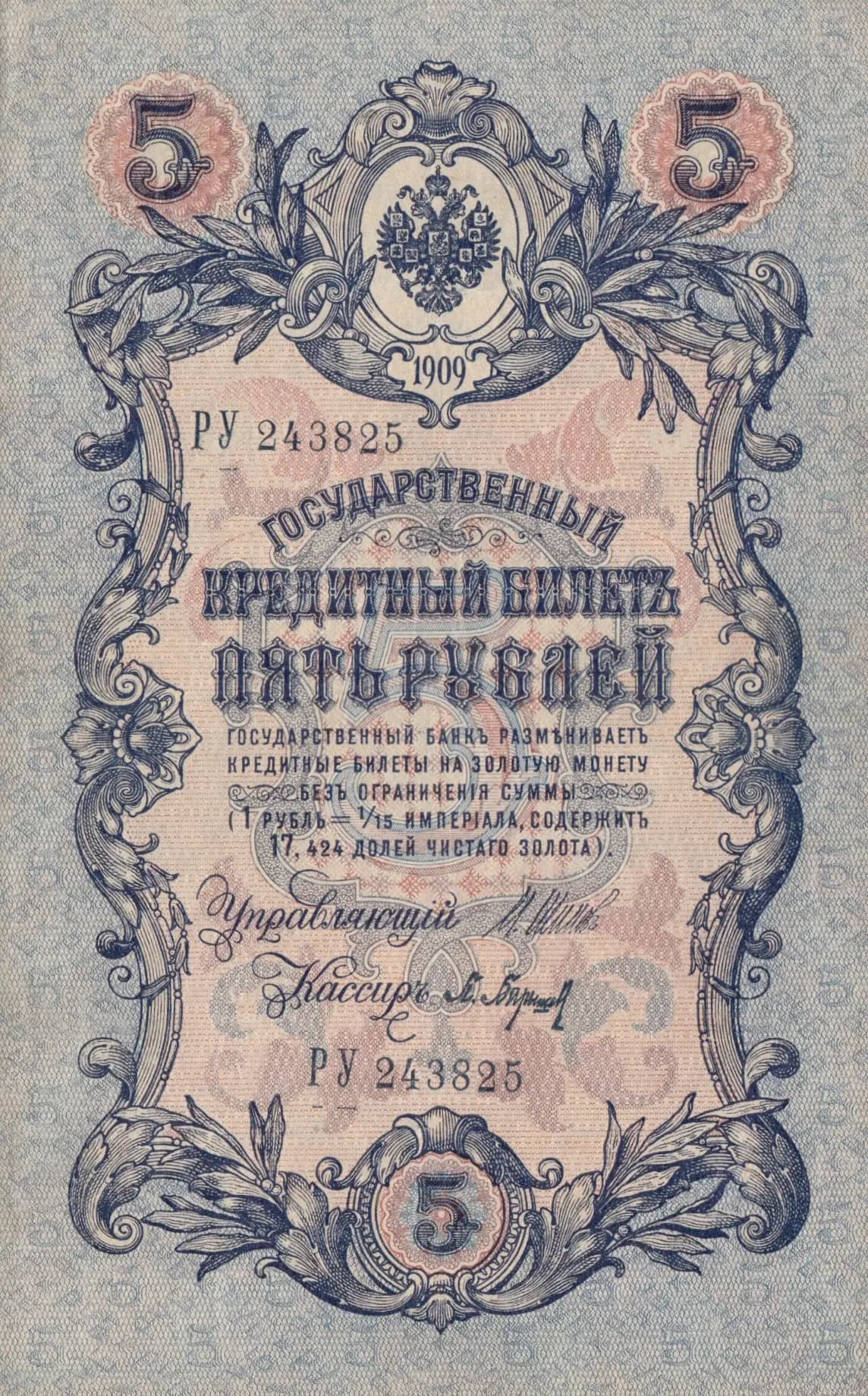
This is a well-preserved example of the 1909 Russian Imperial 5 Rublei credit note (Pick P-10b(2)), displaying the characteristic ornate design of the late Tsarist period with exceptional clarity. The note exhibits VF condition with sharp printing, consistent coloring in pale pink and light blue-gray tones, and no visible wear, creasing, or foxing. The elaborate heraldic imagery featuring the double-headed eagle and complex ornamental borders, combined with the collector provenance signature of Baryshev, makes this a notable specimen of Russian Imperial currency from the final years before the 1917 Revolution.
Common. The 1909 5 Rublei issue under Pick P-10b(2) was produced in substantial quantities during a period of relative monetary stability in the Russian Empire, prior to the major disruptions of World War I and the Revolution. While the specific variety with this serial number and signature combination (Baryshev) may be individually unique, the denomination and issue date are well-represented in collector markets. VF specimens are readily available in the numismatic market at modest price points, typically ranging from $15-50 USD depending on exact variety and condition. The signature of collector Baryshev adds minor provenance interest but does not substantially increase rarity. No evidence suggests restricted print runs, early recall, or limited distribution for this Pick number.
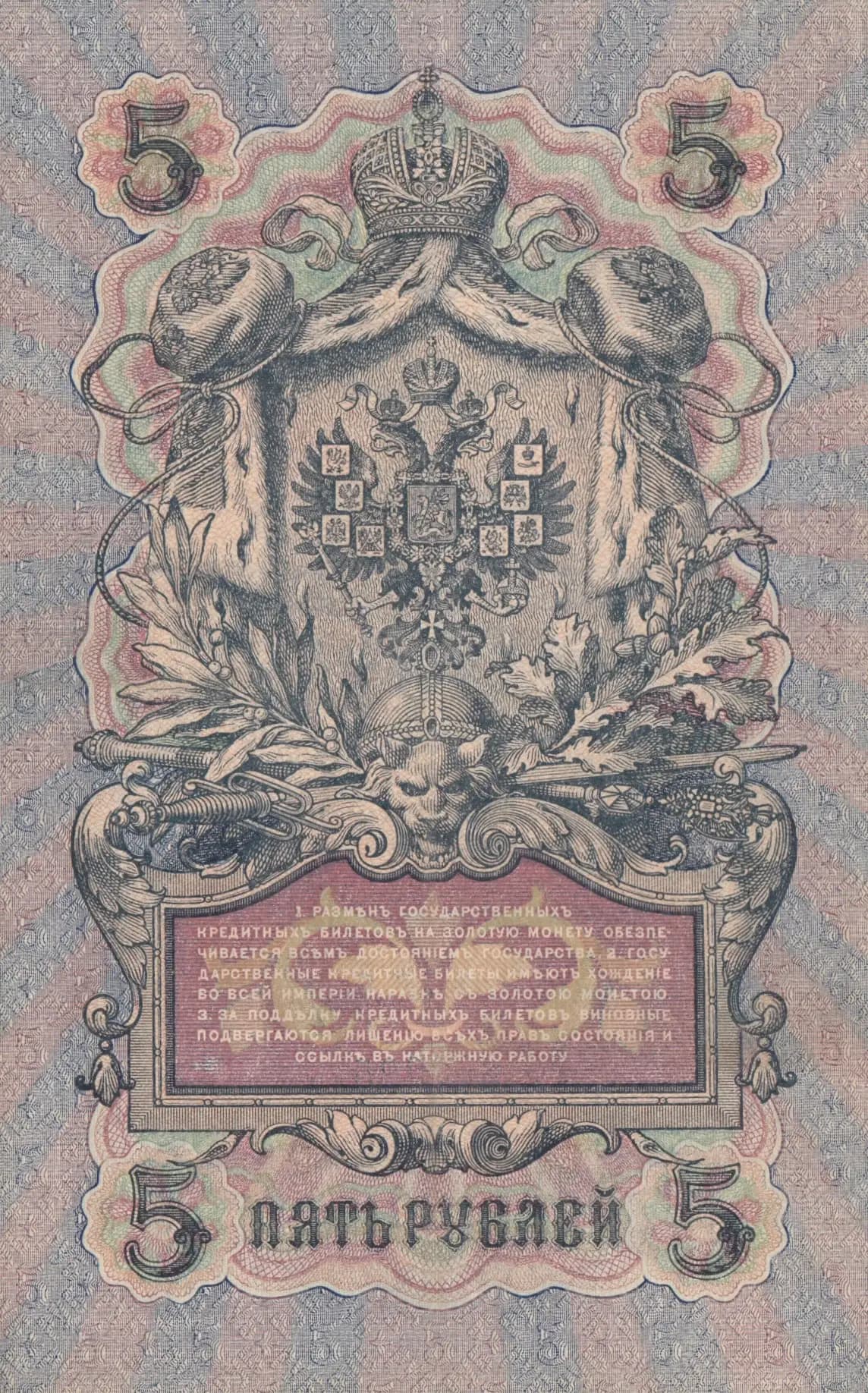
Issued during the final decade of the Russian Empire under Tsar Nicholas II, this 5 Rublei note represents the state's commitment to the gold standard, as explicitly stated in its inscriptions regarding the convertibility of credit notes into gold coins at a fixed rate of 1 Ruble = 1/15 Imperiala containing 17.424 parts of pure gold. The note's design prominently features the imperial coat of arms—the double-headed eagle with crown and orb flanked by heraldic eagles holding laurel wreaths—symbolizing the autocratic state's financial authority and territorial sovereignty. Issued just eight years before the Bolshevik Revolution would overturn this monetary system, this note represents the final iteration of Tsarist financial instruments, backed by the "all possessions of the state" as inscribed on the reverse.
The 1909 5 Rublei features a symmetrical, highly ornamental design characteristic of late Imperial Russian banknotes. The obverse (front) presents an elaborate oval cartouche centered on the page, topped by the Russian Imperial double-headed eagle wearing a crown and holding orb and scepter, surrounded by decorative scrollwork and botanical flourishes including leaves and stems rendered in fine line engraving. Circular denomination badges displaying '5' occupy the upper left and lower right corners. The reverse (back) displays a more elaborate heraldic composition, with the complete Russian Imperial coat of arms as the central element—the double-headed eagle crowned and bearing orb and scepter, flanked symmetrically by two full-bodied heraldic eagles in profile, each holding a laurel wreath. This heraldic composition is surrounded by an intricate ornamental border of scrollwork and floral motifs. Denomination elements displaying '5' appear in all four corners within decorative circular frames. Both sides employ a pale pink/salmon ground with light blue-gray accents, while fine detail work is executed in dark blue/navy ink. The serial number RU 243825 appears on both front and lower reverse sections. The design language emphasizes imperial authority through heraldic symbolism and technical sophistication through meticulous line engraving.
{"front":{"heading":"ГОСУДАРСТВЕННЫЙ КРЕДИТНЫЙ БИЛЕТ - State Credit Note","denomination":"5 (Five Rubles)","mainText":"ГОСУДАРСТВЕННЫЙ КРЕДИТНЫЙ БИЛЕТ ДОСТОИНСТВОМ - State Credit Note of the denomination [5 Rublei]","exchangeClause":"ГОСУДАРСТВЕННЫЙ БАНК РАЗМНИВАЕТ КРЕДИТНЫЕ БИЛЕТЫ НА ЗОЛОТУ МОНЕТУ БЕЗ ОГРАНИЧЕНИЯ СУММЫ - The State Bank exchanges Credit Notes for gold coins without limit of sum","goldStandardClause":"1 РУБЛЬ = 1/15 ИМПЕРИАЛА, СОДЕРЖИТ 17,424 ДОЛЕЙ ЧИСТОГО ЗОЛОТА - 1 Ruble = 1/15 Imperiala, contains 17,424 parts of pure gold","signatures":"Управляющий (Director/Manager) and Кассир (Cashier)","serialNumber":"РУ 243825"},"back":{"denomination":"ПЯТЬ РУБЛЕЙ - Five Rubles","clause1":"РАЗМЕН ГОСУДАРСТВЕННЫХ КРЕДИТНЫХ БИЛЕТОВ НА ЗОЛОТУЮ МОНЕТУ ОБЕСПЕЧИВАЕТСЯ ВСЕМИ ДОСТОЯНИЯХ ГОСУДАРСТВА - Exchange of State Credit Notes for gold coins is ensured by all possessions of the State","clause2":"ГОСУДАРСТВЕННЫЕ И КРЕДИТНЫЕ БИЛЕТЫ НА ВСЕ ИМУЩЕСТВО ВО ВСЕЙ ИМПЕРИИ НАРА В ОБ ЗОЛОТОМ И МОНЕТОЮ - State and Credit Notes are backed by all property throughout the entire Empire in gold and currency","clause3":"ЗА ПОДДЕРЖКУ КРЕДИТНЫХ БИЛЕТОВ ОТВЕТСТВЕННЫ ПОДВЕРГАЮТСЯ ЛИЦЕНИЮ ВСЕХ ПРАВОСТОЯНИЯ И ОСУЦУЮТ В НАЦИОНАЛЬНОМ РАБОТЕ - Those responsible for the maintenance of Credit Notes are subject to penalties according to all legitimate persons and participate in national work"}}
Intaglio engraving (line engraving/copperplate printing), the standard security printing method for Russian Imperial banknotes of this period. The exceptional clarity of fine line detail, uniform ink density, and the complex multi-layered heraldic and ornamental designs visible in both visual analyses are consistent with high-quality intaglio production. The color separation between the pale pink/salmon base, light blue-gray background areas, and dark blue/navy engraved details suggests the use of multiple printing plates or passes. This note was produced by the Russian Imperial State Printing Office (Ekspeditsiia zagotovleniia gosudarstvennykh bumag), which was responsible for official currency production.
This specimen is cataloged as Pick P-10b(2), indicating it is the second listed variety of the P-10b type. The presence of the signature 'Baryshev' as noted in the catalog data may identify the specific signatory (Director or Cashier) and could correspond to a specific printing period or sub-variety. The serial number format 'РУ 243825' (Cyrillic 'RU' prefix followed by six digits) is consistent with 1909-era Russian State Bank issuance. To definitively establish the specific variety, comparison with other cataloged examples showing different signature combinations or serial number prefixes would be required, but this represents a documented example of the P-10b(2) variety as cataloged.