5 rublei 1909
“Sig.Terentev”
About This Note
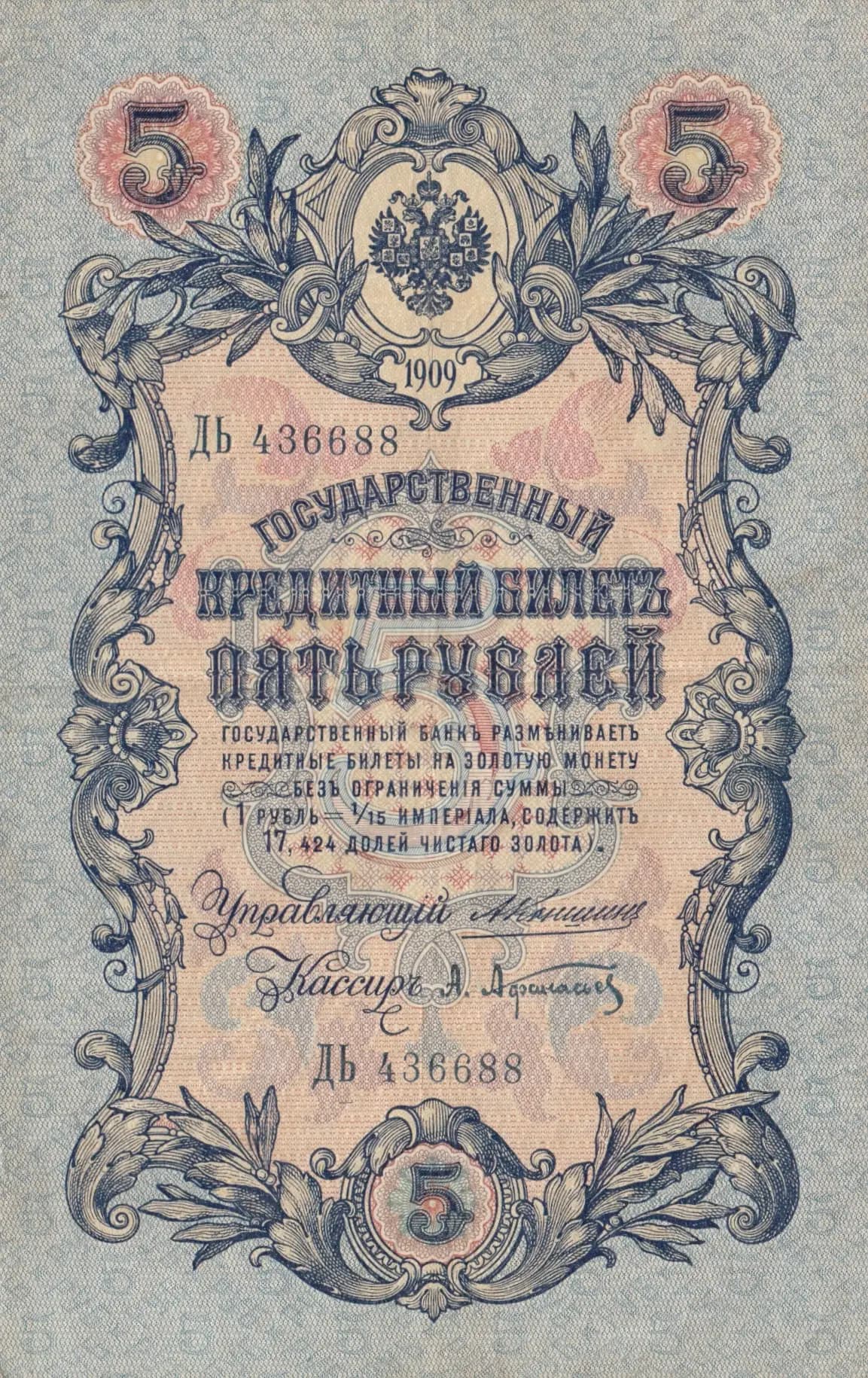
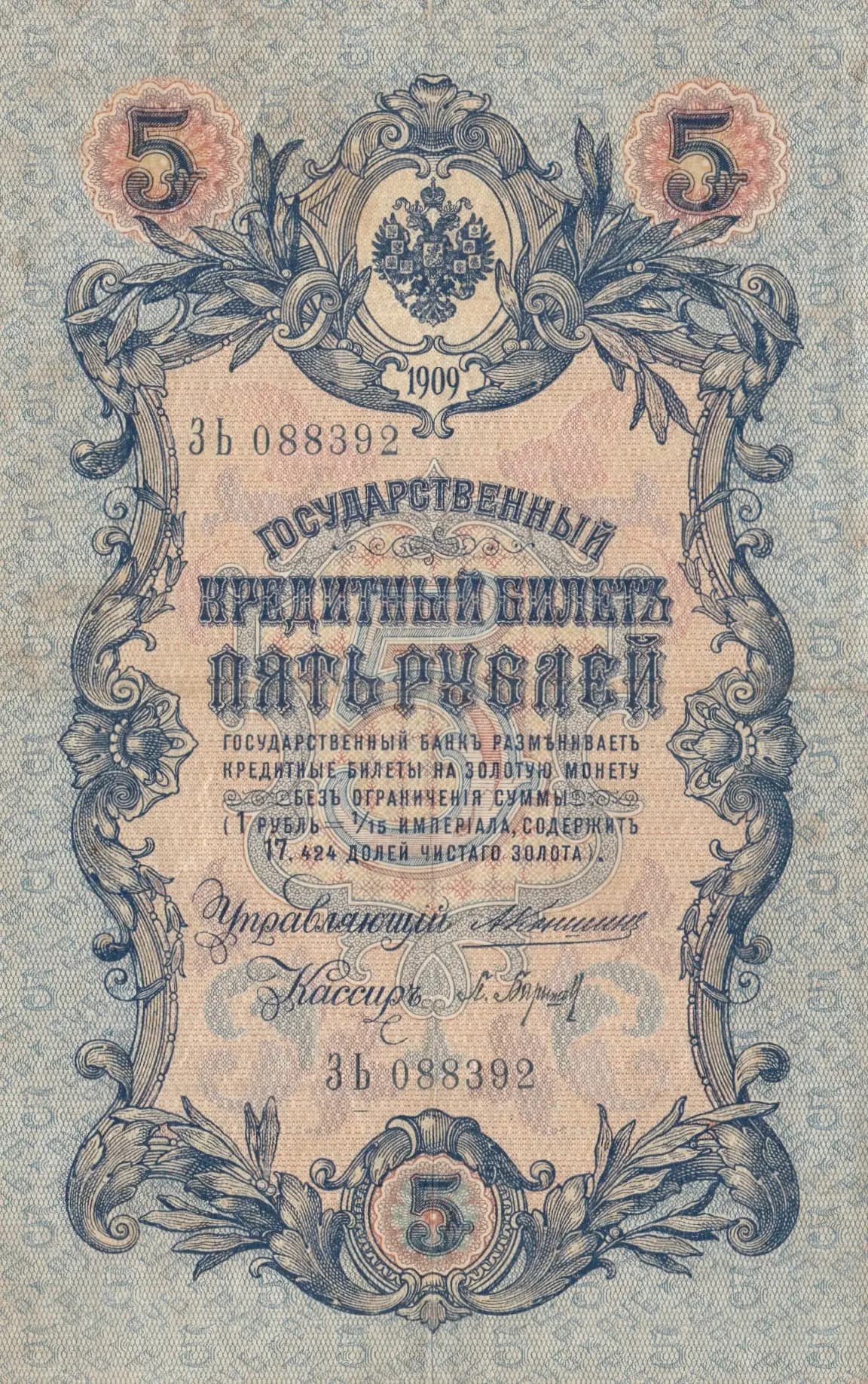
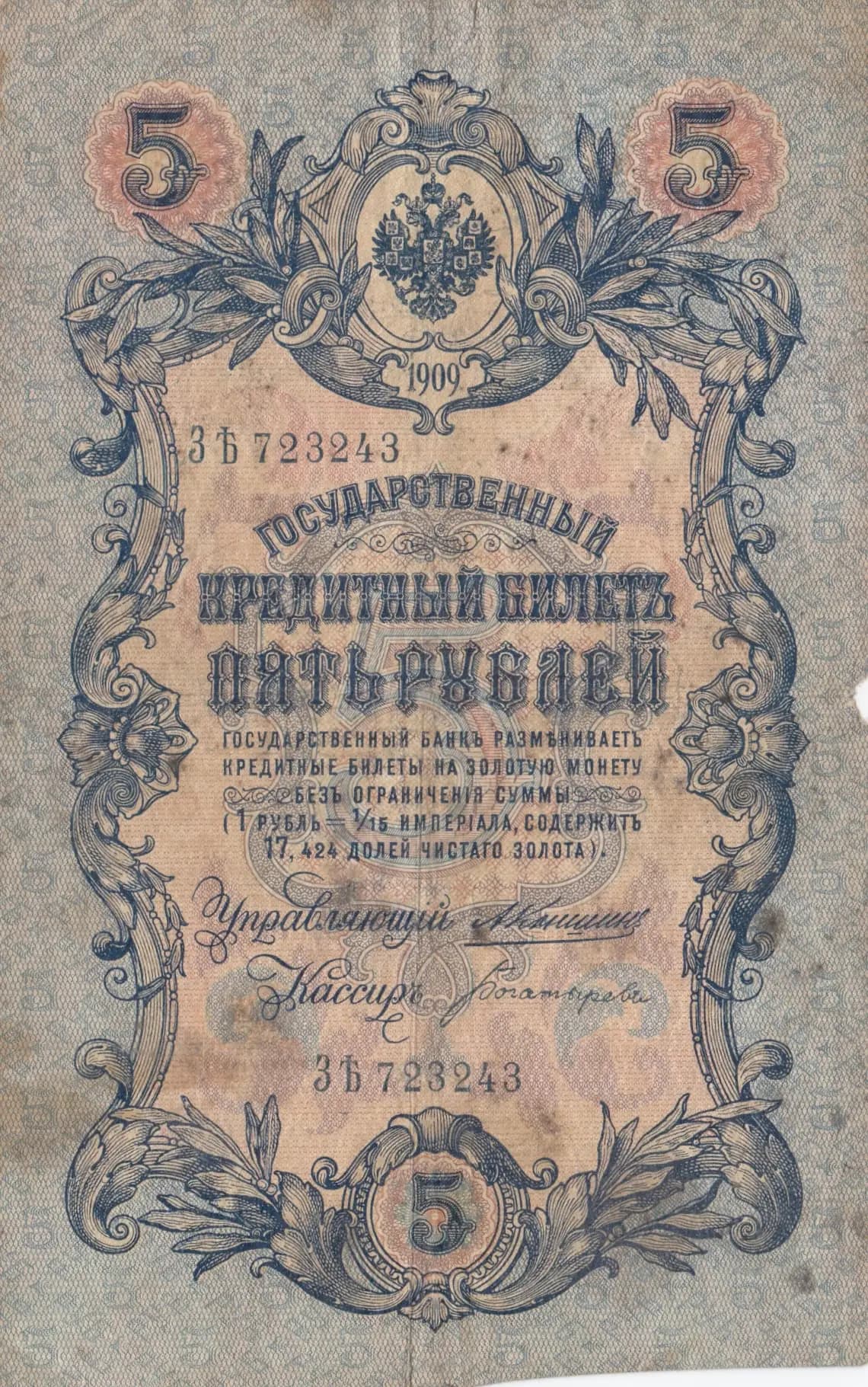
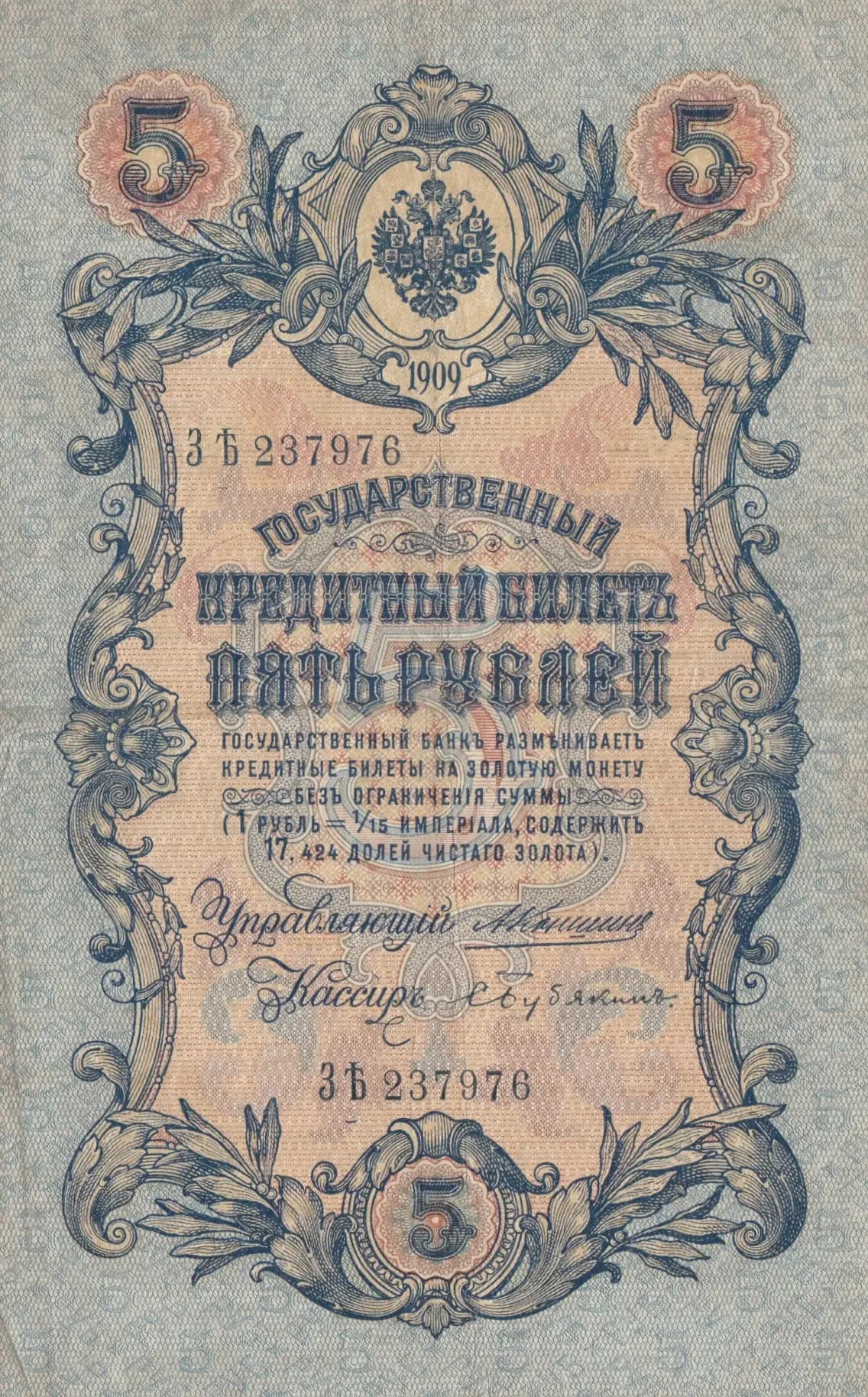
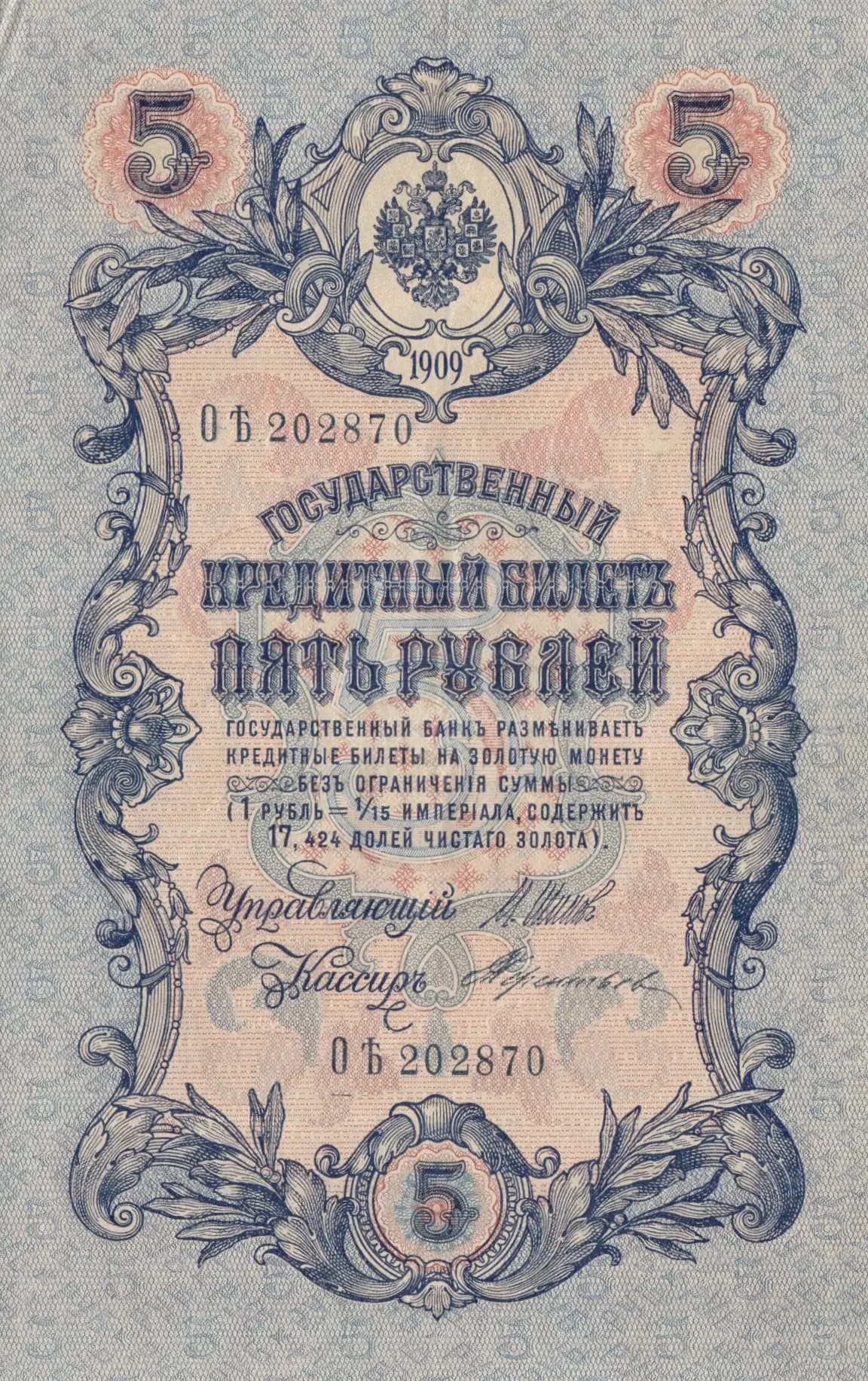
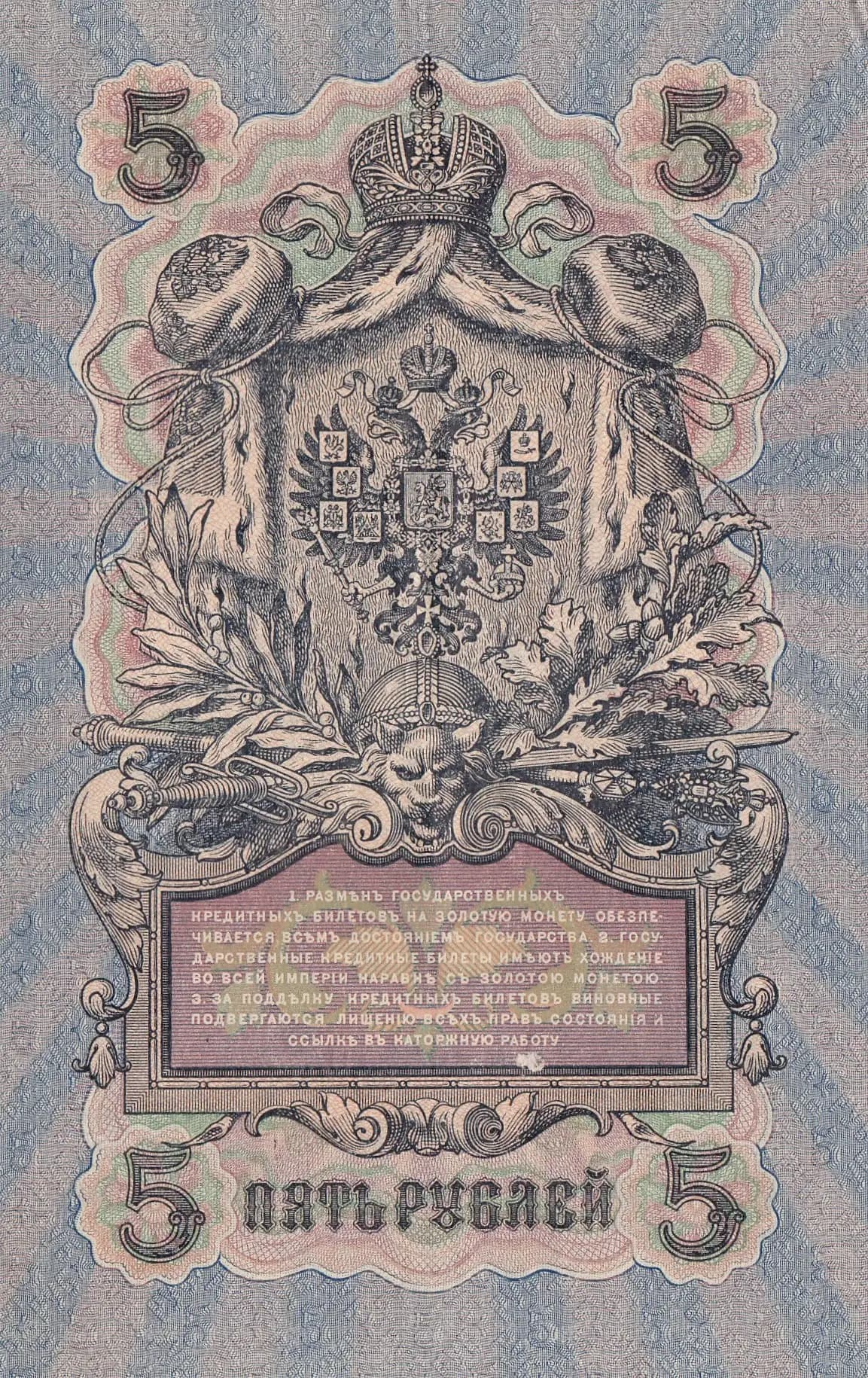
A handsome example of the 1909 Russian Imperial 5 Rublei note (Pick P-10b(13)) in Very Fine condition, featuring the distinctive ornate rococo design characteristic of this issue. The note displays crisp, sharp engraving throughout with well-preserved multi-color printing in navy blue and pink/salmon tones on both obverse and reverse, and the serial number Обб028870 is clearly legible. The elaborate Imperial double-headed eagle coat of arms and intricate scrollwork remain well-defined, making this a visually appealing example of early 20th-century Russian imperial currency with solid collector appeal.
Common. The 1909 issue of Russian Imperial credit notes of 5 Rublei denomination represents a standard circulating currency with substantial print runs during the years preceding the Russian Revolution. While condition examples in VF grade are always more desirable than circulated examples, this Pick number and denomination do not exhibit rarity characteristics such as minimal print runs, early recall, or short-lived issuance. The note was produced in significant quantities as part of the empire-wide monetary system and examples remain readily available to collectors.
This banknote represents the monetary system of the Russian Empire during the final years before the 1917 Revolution, issued under the gold standard regime where State Credit Notes were backed by and exchangeable for gold coins without limitation. The prominent Imperial Russian double-headed eagle coat of arms with its complex quartered heraldic shield and crown symbolized the authority and legitimacy of the Romanov dynasty's State Bank, while the text promising gold redemption at a fixed rate (1 ruble = 1/15 of an Imperial containing 17.424 parts pure gold) reflects the financial stability the Empire sought to project. The rococo aesthetic and fine engraved detail exemplify the security printing standards and artistic ambitions of Russian imperial finance during this period.
The front features a centrally-positioned Imperial Russian coat of arms—the double-headed eagle—set within an elaborate rococo frame topped with an ornamental crown. The eagle is flanked by decorative plant and scroll elements in the characteristic rococo style. Large ornamental numeral '5' circles anchor the top left and right corners. The background palette of pale pink/salmon with navy blue engraved detailing creates a sophisticated aesthetic. The back presents an even more elaborate version of the Imperial double-headed eagle coat of arms, displaying the complex quartered heraldic shield with multiple subdivisions representing the various territories and principalities of the Russian Empire, again crowned and flanked by extensive rococo scrollwork and botanical ornaments. Four corner positions feature the large denomination numerals '5' in ornamental frames. The border work throughout is intricate with fine line engraving demonstrating high-level security printing craftsmanship. This note showcases the artistic and technical standards of Russian imperial banknote production under the reign of Nicholas II.
FRONT: Denomination numerals '5' appear in ornamental circles at top left and right. Central text reads: ГОСУДАРСТВЕННЫЙ КРЕДИТНЫЙ БИЛЕТ (State Credit Note) and ПЯТЬ РУБЛЕЙ (Five Rubles). Authority text states: ГОСУДАРСТВЕННЫЙ БАНК РАЗМЕНИВАЕМЪ КРЕДИТНЫЕ БИЛЕТЫ НА ЗОЛОТУЮ МОНЕТУ БЕЗ ОГРАНИЧЕНИЯ СУММЫ (1 РУБЛЬ = 1/15-ИМПЕРИАЛА, СОДЕРЖИТ 17,424 ДОЛЕЙ ЧИСТАГО ЗОЛОТА) (State Bank exchanges credit notes for gold coins without sum limitation: 1 Ruble = 1/15 of an Imperial, contains 17.424 parts of pure gold). Signature lines marked: Отвѣтствующий (Authorized) and Кассиръ (Cashier). Serial number Обб028870 appears at top and bottom. BACK: Denomination '5' and ПЯТЬ РУБЛЕЙ (Five Rubles) appear in four corners. Central legal text regarding status of State Credit Notes: Their backing by state assets, circulation throughout the empire equal to gold coins, and severe penalties (hard labor and exile) for counterfeiting or fraudulent handling of genuine notes.
Steel engraving and intaglio printing (relief printing with hand-engraved plates), characteristic of high-security banknote production of the Russian Empire. The multi-color printing in navy blue and pink/salmon tones on cream/off-white paper with subtle green undertones was achieved through sequential plate passes. The State Bank of Russia employed premier engravers for these designs, with the intricate line work, fine detail resolution, and complex ornamental borders serving as anti-counterfeiting measures typical of the period. The sharp impression quality visible in the visual analysis indicates professional security printing standards.
Pick P-10b(13) designates this as part of the 1909 issue series of 5 Rublei notes. The notation '(13)' in the Pick classification typically indicates a specific signature or printer combination variety. The observed serial number Обб028870 with the 'Обб' prefix follows standard Russian serial numbering protocols of the period. The collector notation 'Sig.Terentev' suggests this example may bear the signature of V. Terentev, who served in an authorized capacity on Russian Imperial notes during this era. Specific signature varieties and exact date variants within the 1909 issue represent the primary variety distinctions for this Pick number, with multiple authorized officials signing notes throughout the issuing period.