5 rublei 1909
“Sig.Heilman”
About This Note
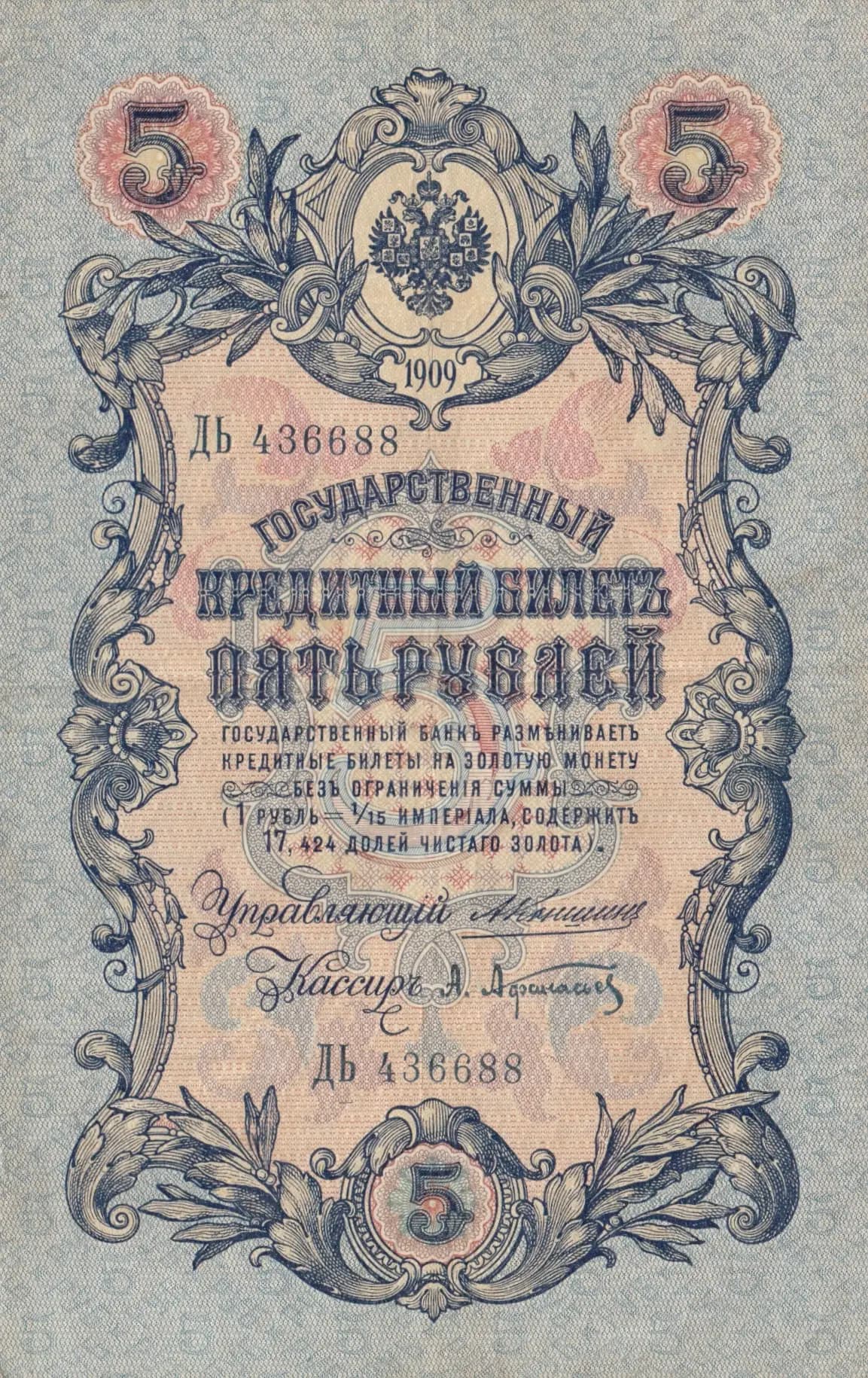
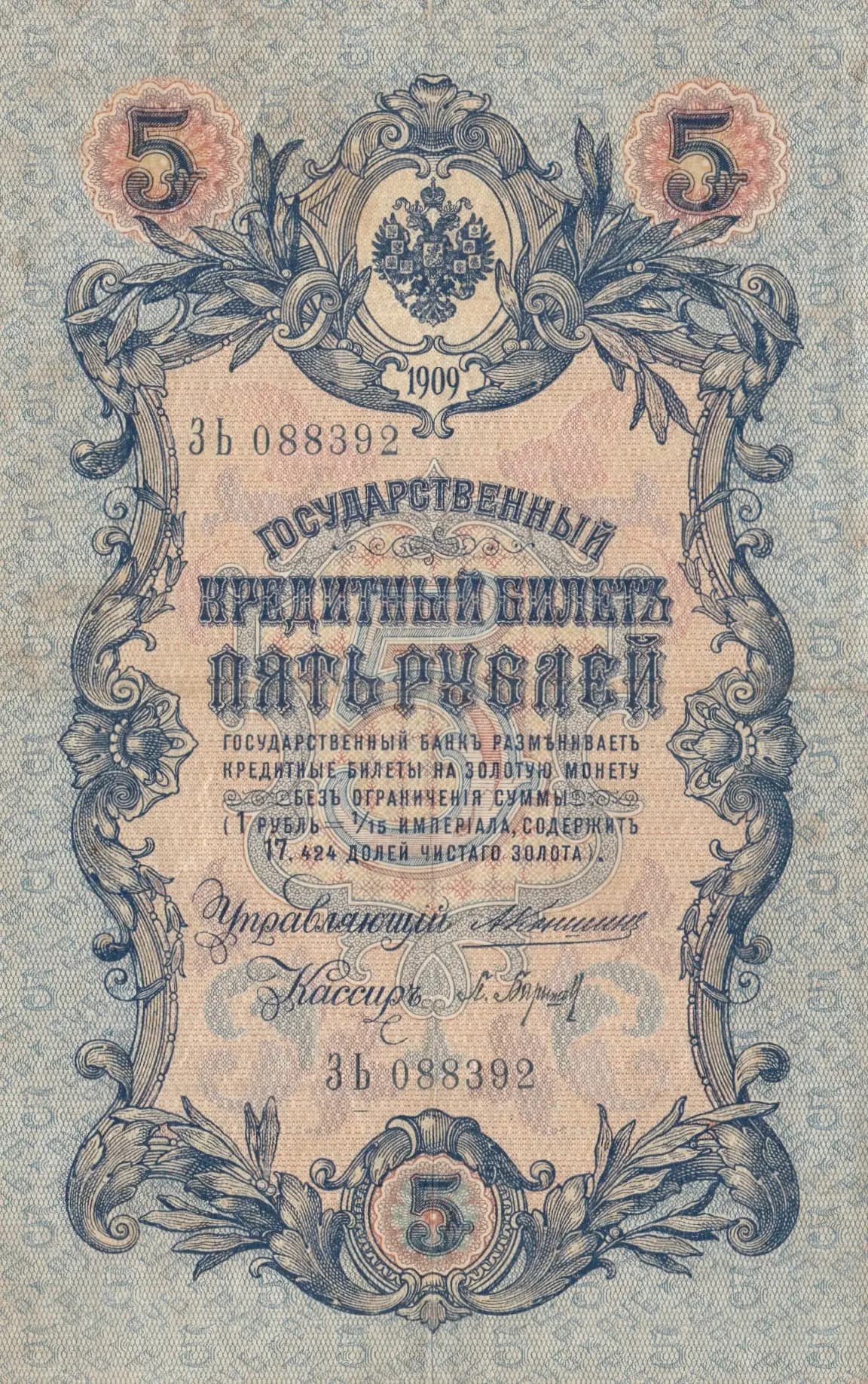
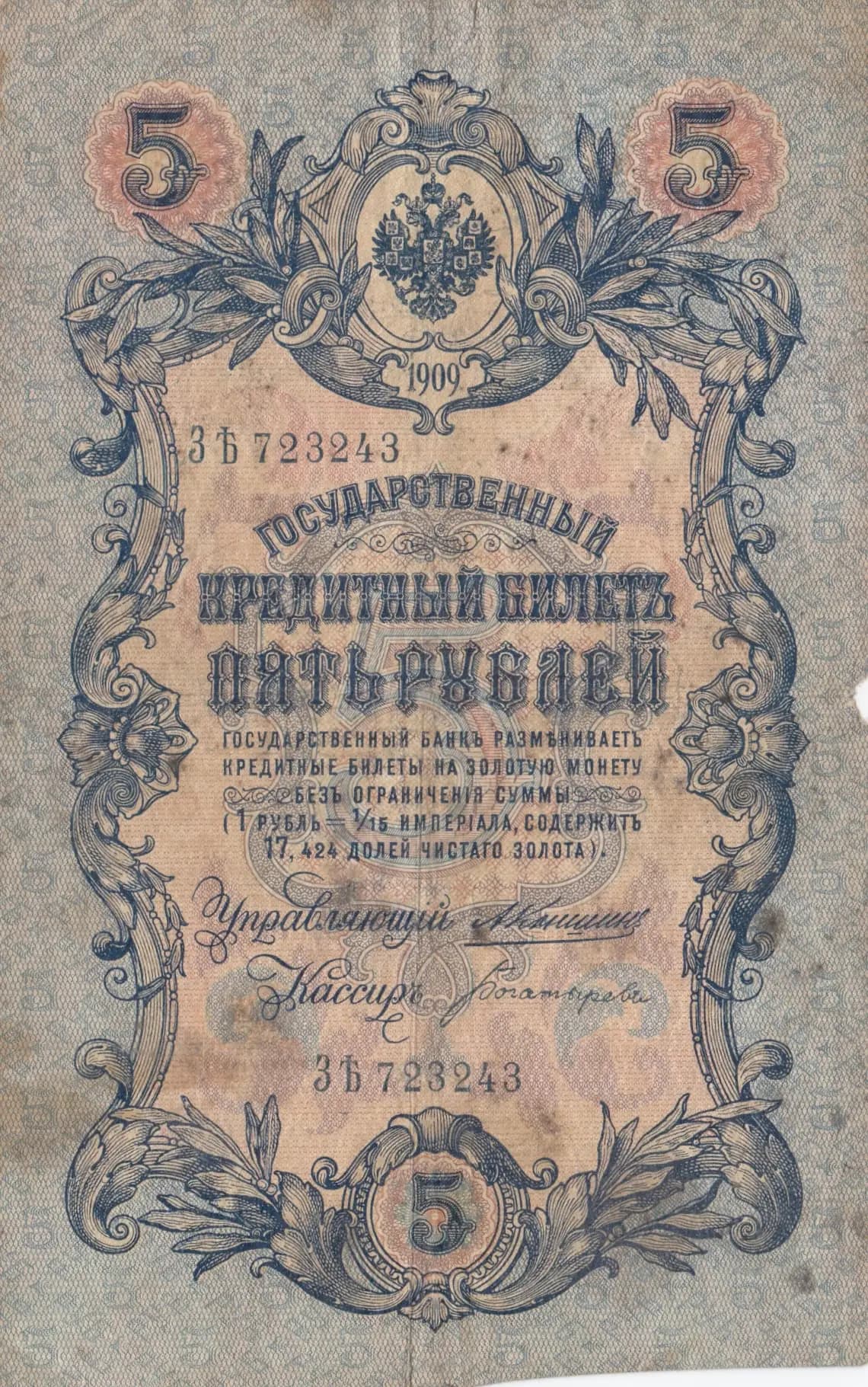
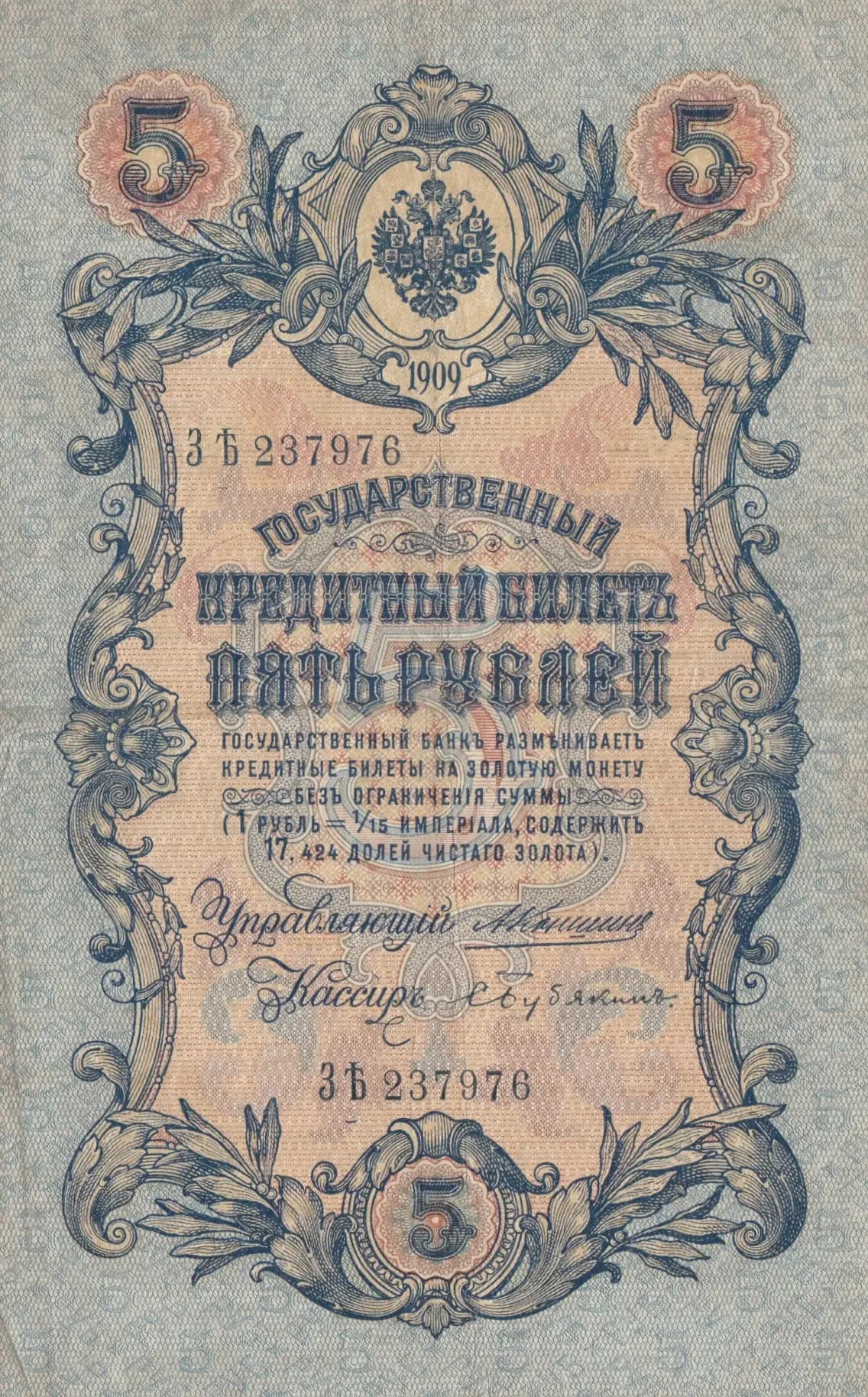
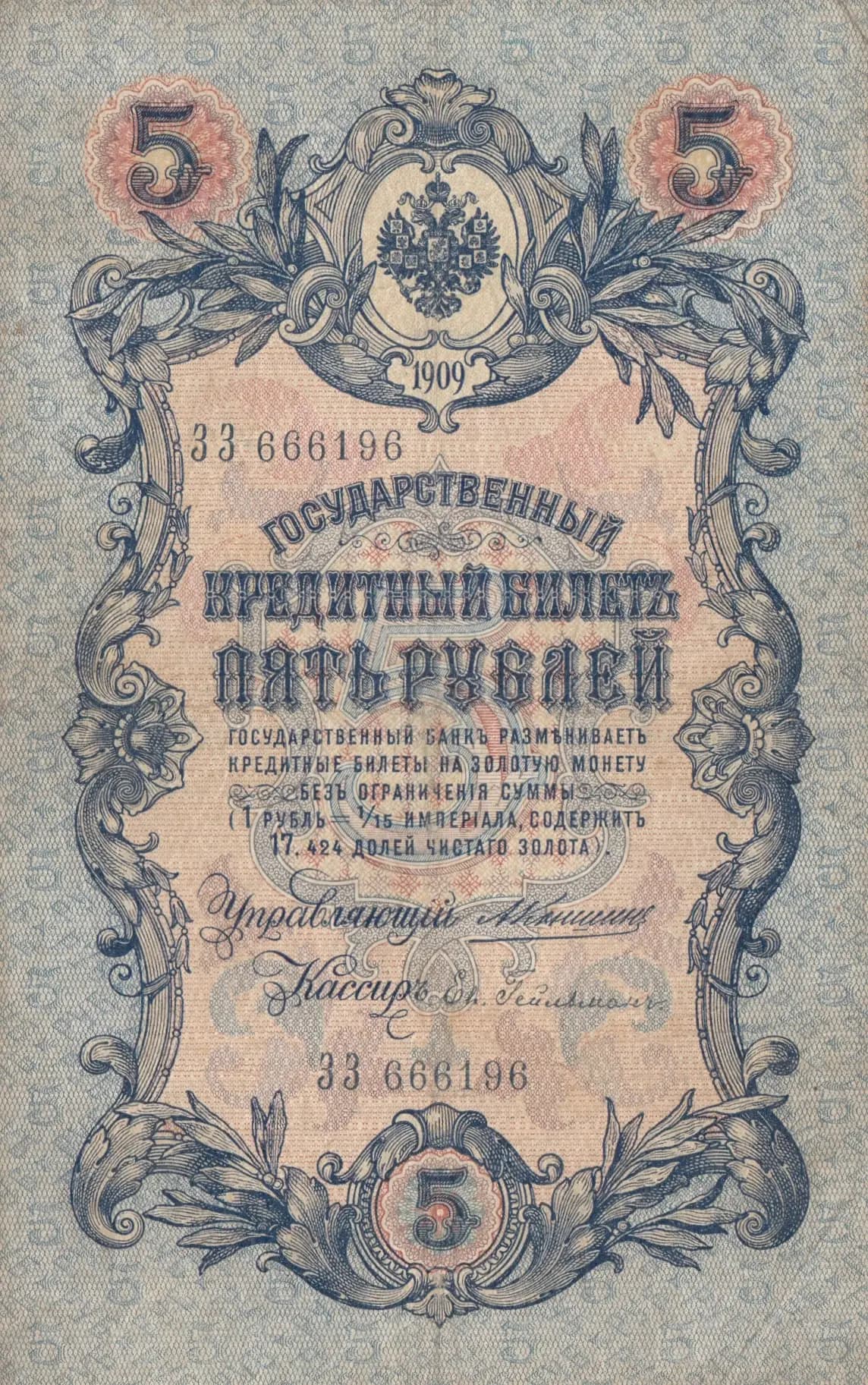
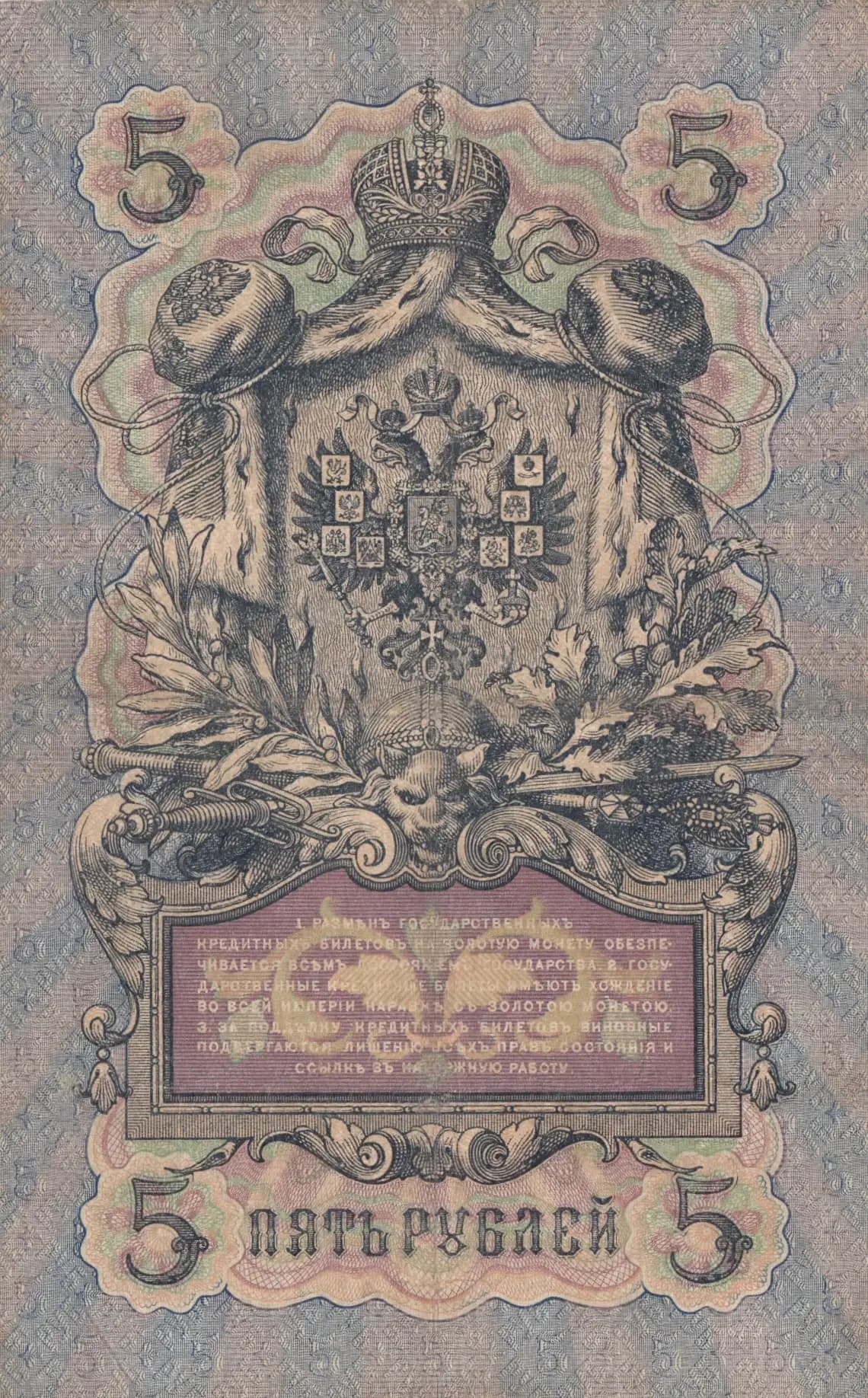
This is a well-preserved example of a Russian Imperial 5 rublei credit note from 1909, graded VF, featuring the characteristic ornate design elements of early 20th-century Russian currency. The note displays sharp printing throughout with vibrant blue, pink, and cream coloring, and exhibits no visible circulation wear, creases, or damage. The prominent Imperial double-headed eagle on both sides and the detailed engraving of floral and scrollwork elements showcase the sophisticated security printing techniques employed by the Russian State Bank during this transitional period in Imperial finance.
Common. The 1909 5 rublei note (Pick 10a) was issued in substantial quantities as a standard denomination credit note during the final years of Imperial Russian currency circulation. While the note remained in use through the 1917 Revolution and into the Soviet period, vast quantities were printed and circulated. The specific Pick 10a(9) variety designation indicates this is one of several known signature and design variations of the base note type, but none of these variations are particularly scarce. Notes in VF condition are regularly encountered in numismatic commerce at moderate prices, confirming its common status despite its historical significance.
Issued during the reign of Tsar Nicholas II, this 1909 credit note represents the Russian State Bank's gold-backed currency system established after the 1898 monetary reform. The prominent display of the Imperial double-headed eagle with crown and regalia symbolized the authority of the Russian autocracy, while the inscriptions detailing the gold standard backing (1 ruble = 1/15 imperial, containing 17.424 parts pure gold) reflected the international confidence in commodity-backed currency during the pre-World War I era. These state credit notes were intended to facilitate commerce within the Russian Empire while maintaining the appearance of fiscal stability and Imperial legitimacy.
This note exemplifies the Imperial Russian credit note design standard of the Shipov-Gellshwin signature era. The obverse features the Imperial Russian double-headed eagle coat of arms centered within an ornamental oval cartouche, crowned with Imperial regalia (crown visible above). The eagle is flanked by elaborate baroque-style floral and scrollwork borders rendered in navy blue against a cream and light blue-gray background. Large denomination numerals '5' are positioned in the upper corners within pink rosette-shaped medallions. The reverse presents a more elaborate composition with the eagle more prominently displayed, wings spread, holding the Imperial orb and scepter, surrounded by nationalist symbolism including laurel wreaths and oak leaves with acorns, emphasizing themes of Imperial power and Russian natural wealth. Both sides employ the characteristic five-color printing scheme of Russian Imperial banknotes: light blue-gray, navy blue, pink/salmon, cream, and beige. Text panels are systematically positioned at the bottom of each side containing the issuing authority's declarations and legal backing information.
FRONT: The main text reads 'ГОСУДАРСТВЕННЫЙ КРЕДИТНЫЙ БИЛЕТ ПЯТИРУБЛЕЙ' (State Credit Note Five Rubles). Below the eagle cartouche: 'ГОСУДАРСТВЕННЫЙ БАНК РАЗМЕЩАЕТ КРЕДИТНЫЕ БИЛЕТЫ НА ЗОЛОТО МОНЕТУ БЕЗ ОГРАНИЧЕНИЯ СУММЫ (1 РУБЛЬ = 1/15 ИМПЕРИАЛА, СОДЕРЖАТЬ 17.424 ДОЛЕЙ ЧИСТОГО ЗОЛОТА)' (The State Bank issues credit notes backed by gold coin without limit of amount - 1 ruble equals 1/15 imperial, containing 17.424 parts of pure gold). Signature block: 'Кассир С. Гельшшин' (Cashier S. Gelshin). BACK: Large text 'ПЯТЬ РУБЛЕЙ' (Five Rubles). Extended legal text: 'Сим государственный кредитный билет подлежит обмену всеми кассами государственного и государственных учреждений на золотую монету в государстве...' (This state credit note is subject to exchange by all cashiers of state and state institutions for gold coin in the state. The Treasury is obligated to accept these notes in gold...). Serial number: 33 666196. Denomination numerals '5' appear in corner rosettes on both sides.
Multiple color intaglio engraving (likely 5-color process). The intricate detail of the decorative borders, scrollwork, floral designs, and the complex eagle composition indicate steel plate engraving, the standard security printing method for Imperial Russian banknotes. The crisp, well-defined lines visible in the visual analysis and the precise color separation are consistent with the St. Petersburg State Printing Works' (Экспедиция Заготовления Государственных Бумаг) production standards. The sharp printing and lack of wear suggest this note was produced using well-maintained engraved plates.
This note is identified as Pick 10a(9), indicating it belongs to the 10a classification with the '(9)' denoting a specific signature variety. The signature of Cashier S. Gelshin (Гельшшин) visible on this example represents one of the documented signature variations for this Pick number. The serial number 33 666196 suggests mid-range production sequencing. The 1909 date confirms this as part of the post-1898 reform series gold-backed notes, distinct from earlier 1898-dated examples or later Russo-Japanese War period variants. The color scheme and design elements are consistent with the standard Shipov-era design specifications used from 1905-1912.