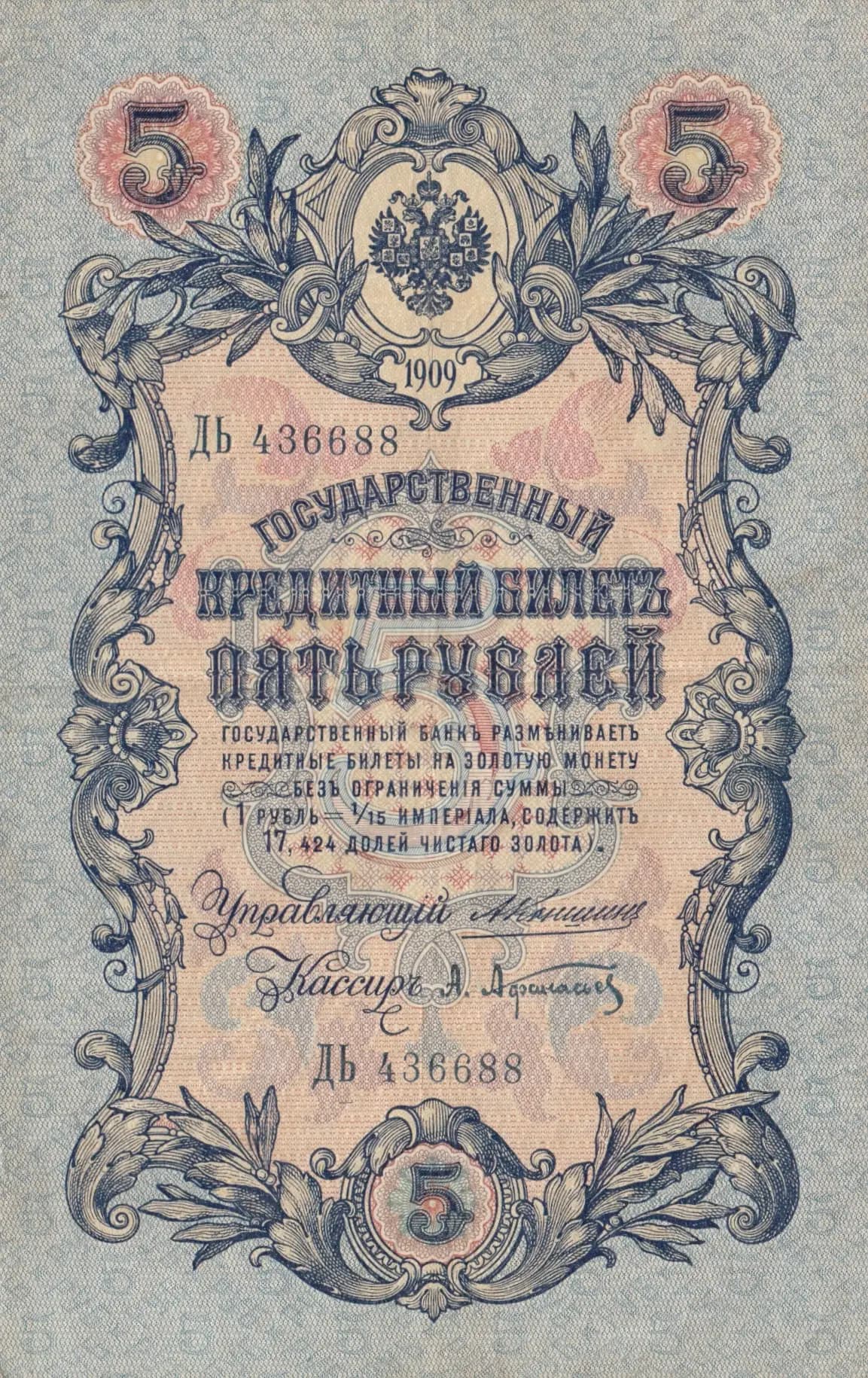
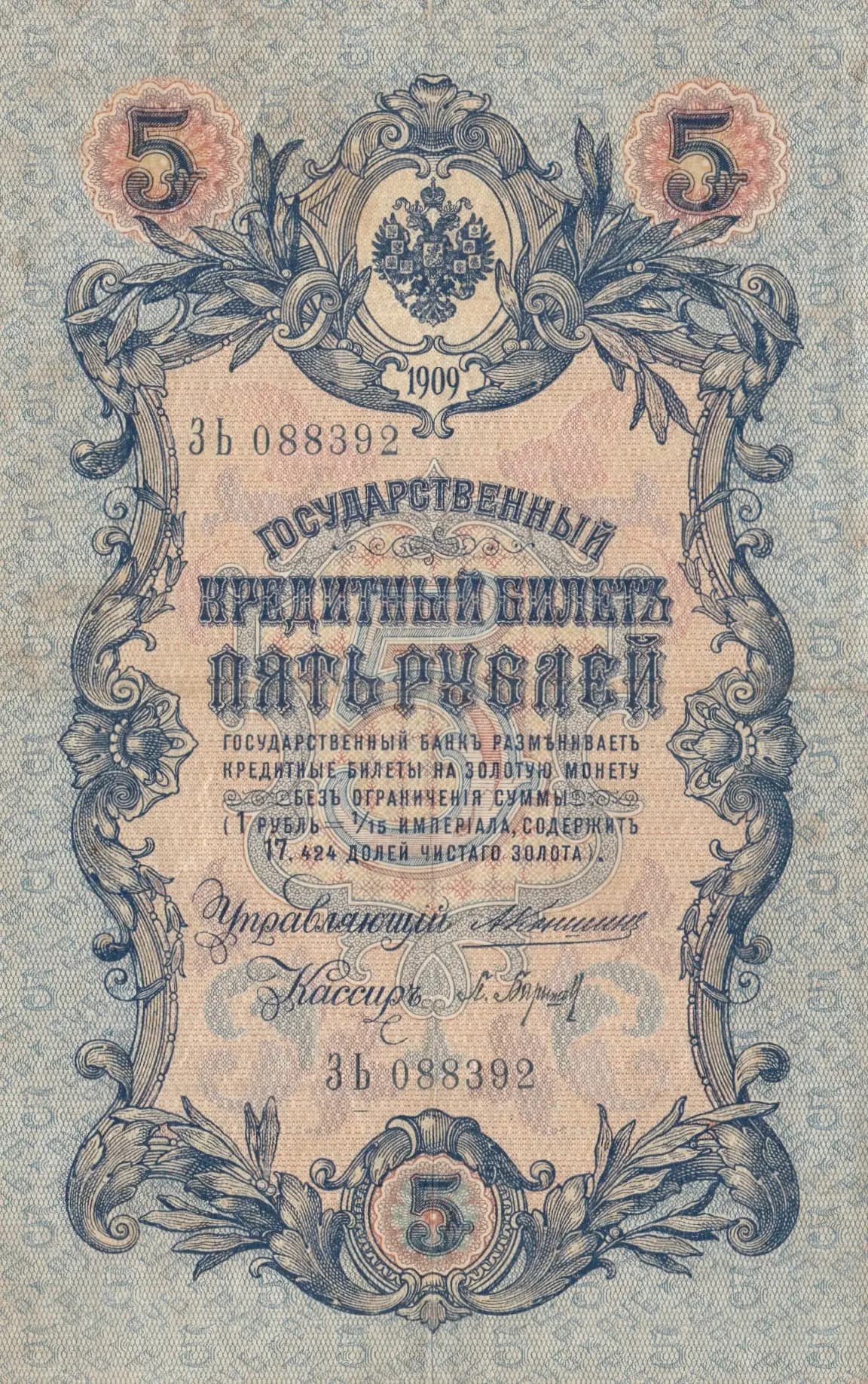
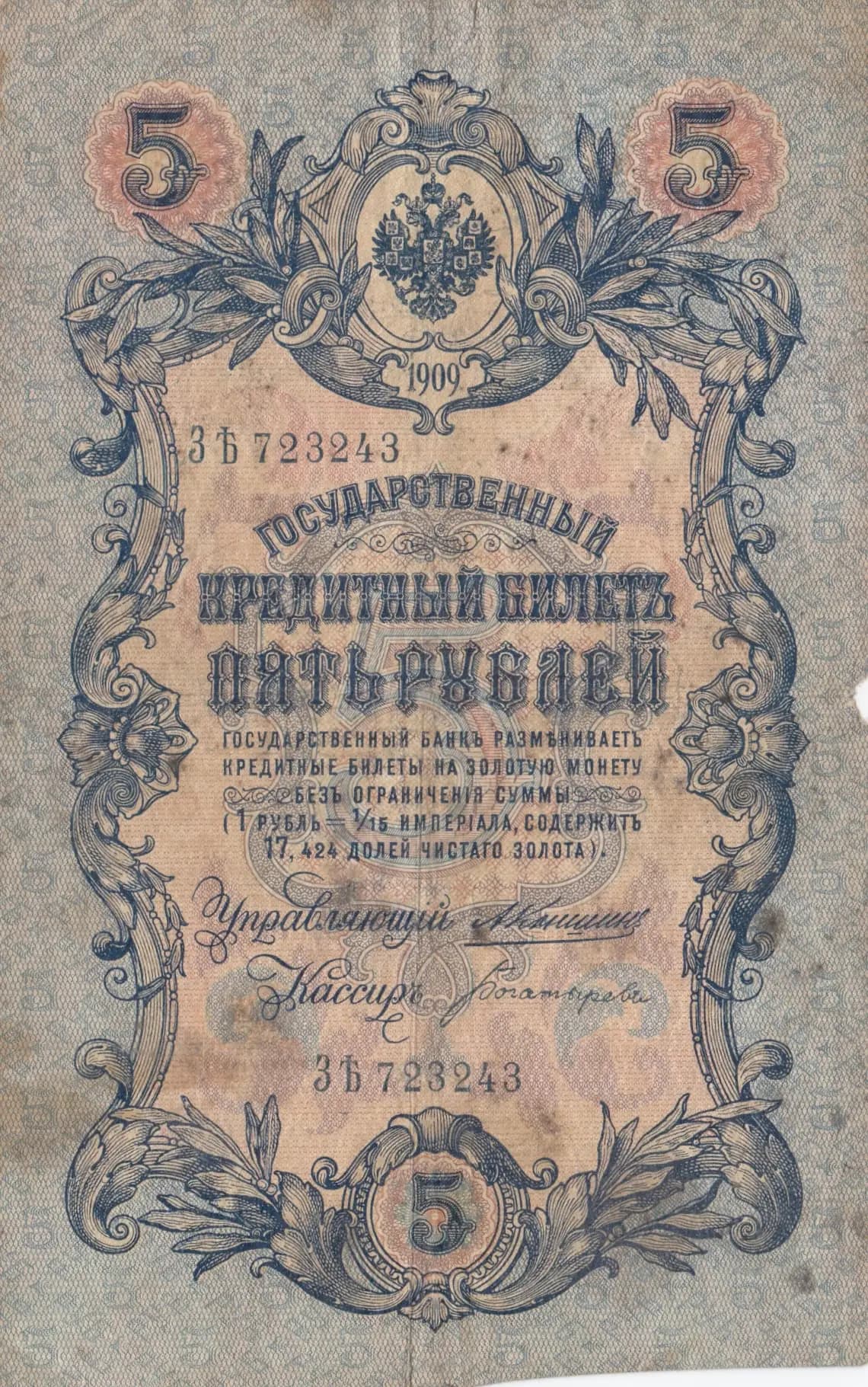
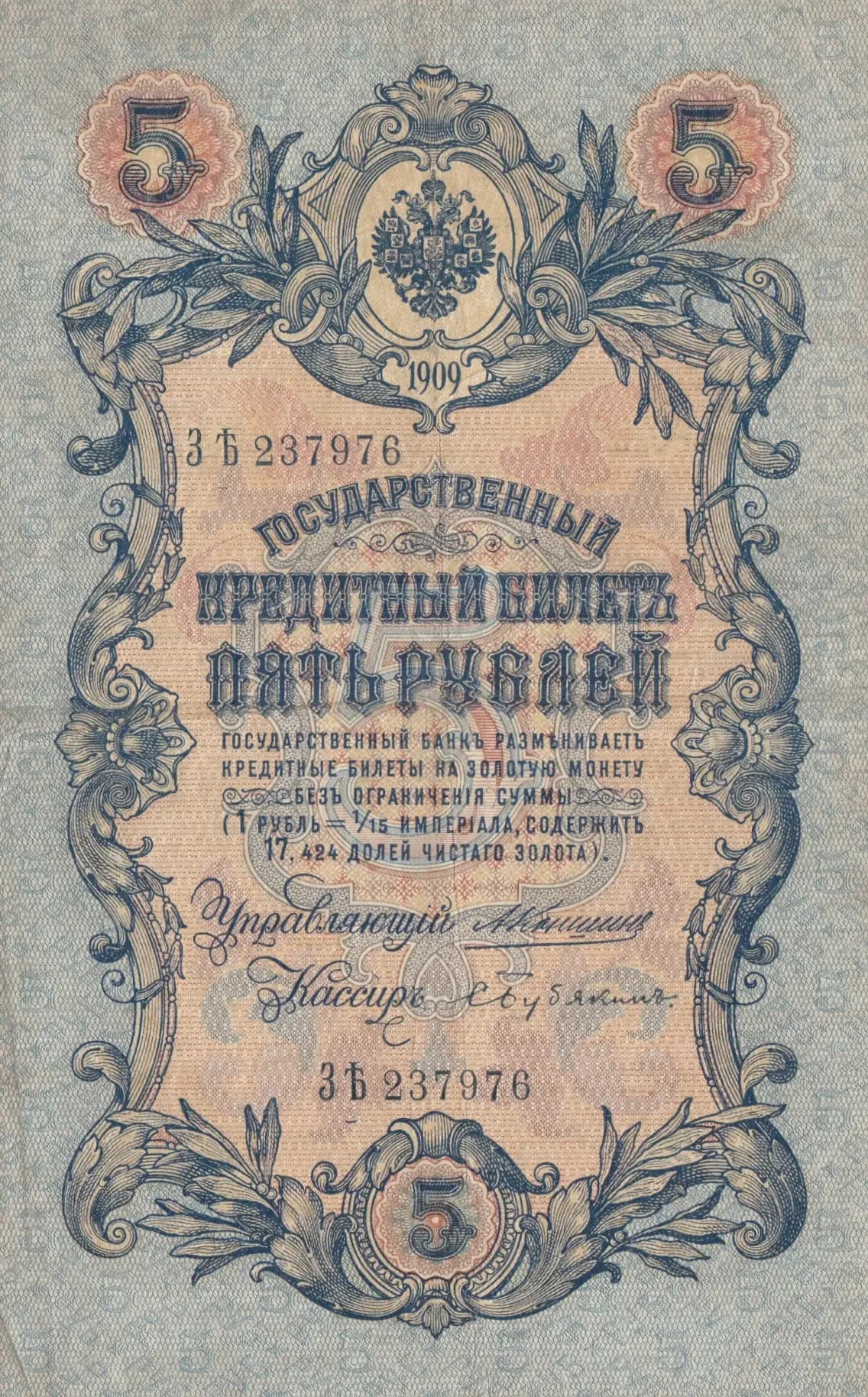
5 rublei 1909
“Sig.Chikhirzin”
About This Note
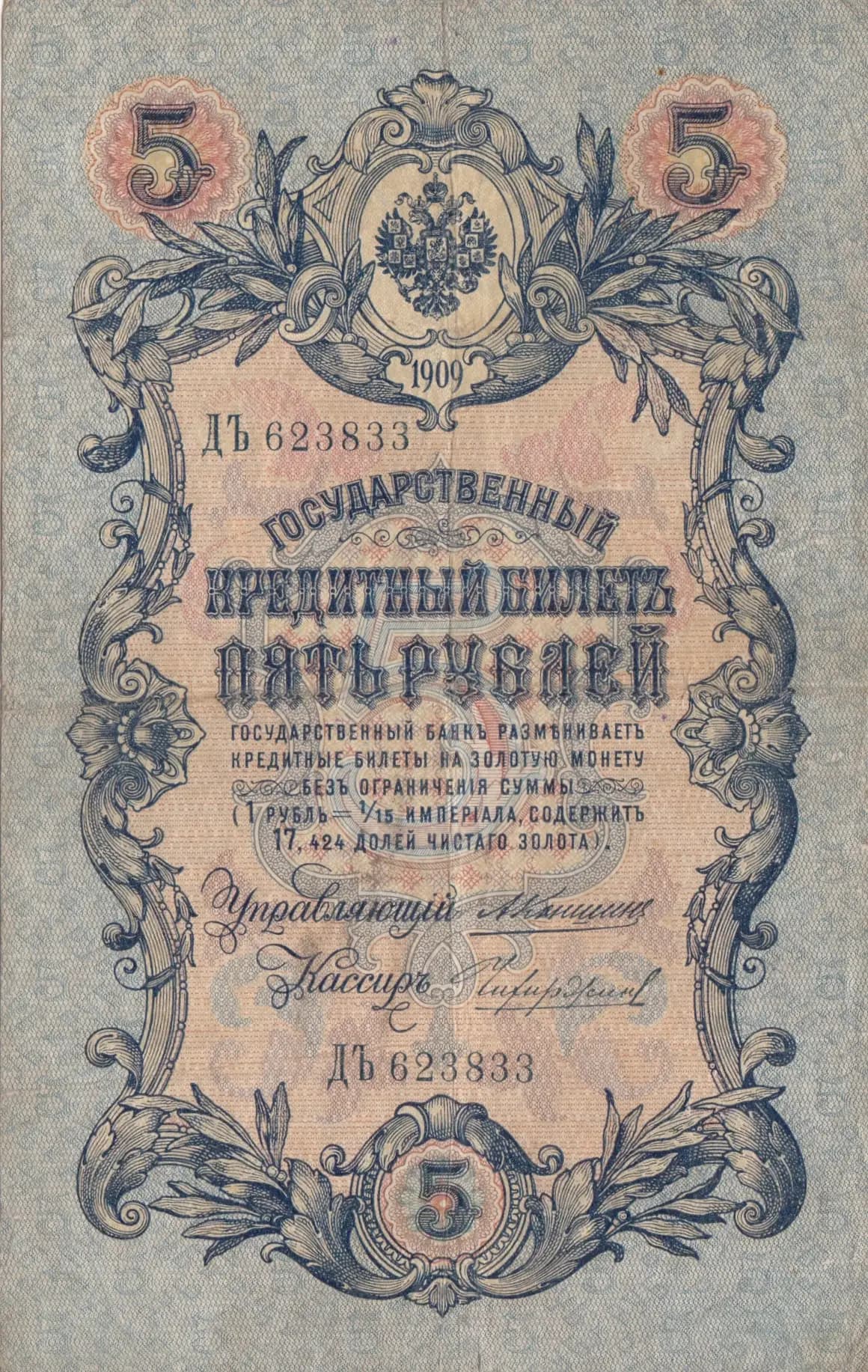
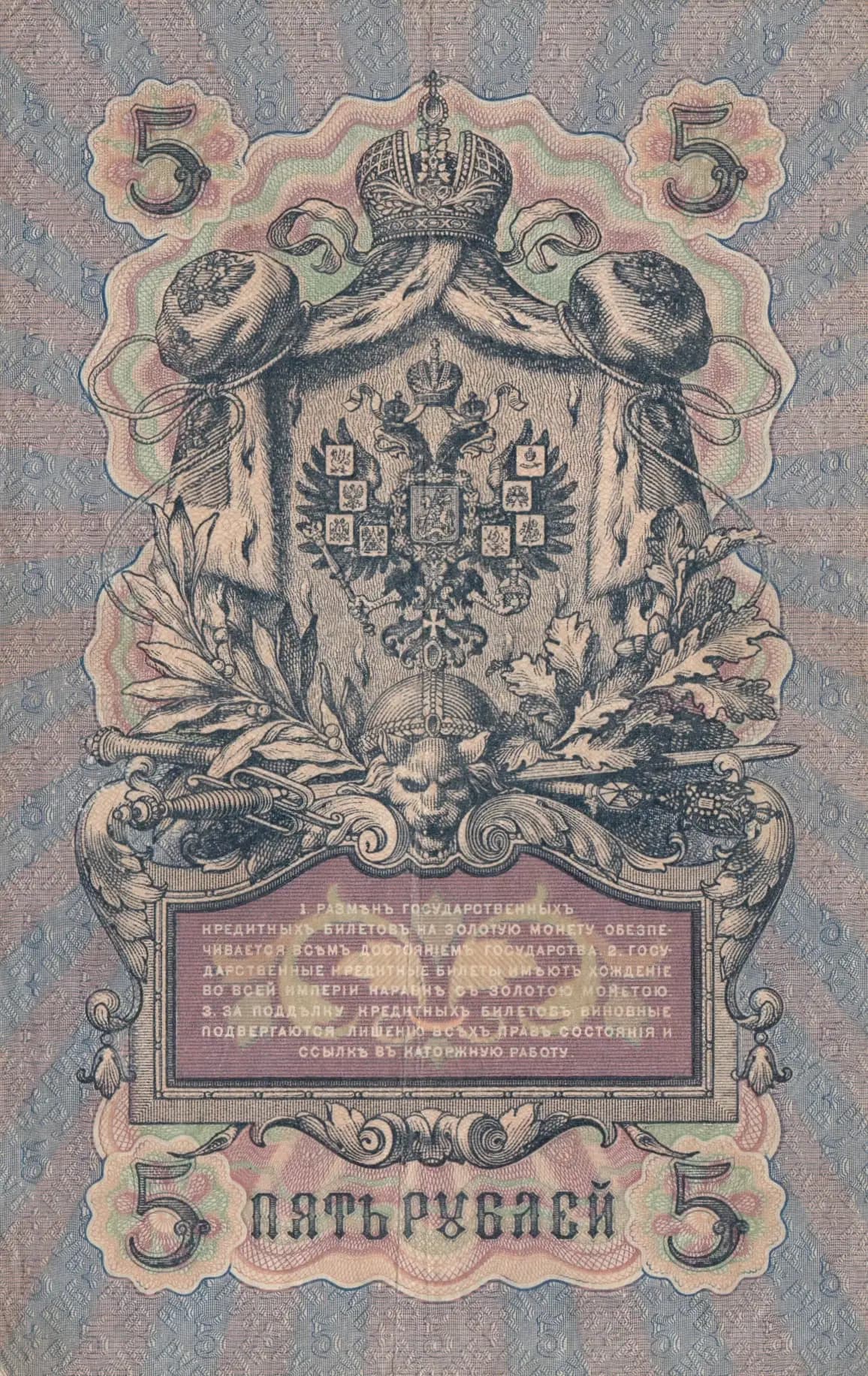
This is a VF-graded 5 rublei note from 1909, the final year of Imperial Russian credit notes before the 1917 revolution. The note displays the characteristic ornate design of Russian Imperial currency with the double-headed eagle prominently featured on both sides, surrounded by elaborate guilloche patterns and floral scrollwork in blue, green, and rose tones. Despite visible aging including foxing, creasing, and patina consistent with over a century of circulation, the note remains structurally sound with clear inscriptions and signature of Chikhirzin, making it a solid example of pre-revolutionary Russian currency.
Common. The 5 rublei denomination was one of the most frequently issued Imperial Russian notes, with large print runs throughout the 1909 issue. No specific variety designation or rarity marker appears in the Pick catalog number P-10a(25), indicating a standard printing variant. The VF condition grade is standard for surviving examples from this issue, as thousands remain in circulation and private collections today. No specific scarcity data suggests this note commands anything more than modest collector value above face value equivalent.
Issued during the final years of Tsar Nicholas II's reign, this 5 rublei note represents the Russian Empire's last generation of Imperial credit notes backed by the gold standard. The prominent double-headed eagle, coat of arms with flanking lions, and text declaring the State Bank's obligation to exchange notes for gold at a fixed rate (1 Ruble = 1/15 Imperiale) reflect the stability and prestige of Russian currency in the pre-WWI era. The note's 1909 date places it in the final decade before the 1917 Revolution would render the entire Imperial monetary system obsolete.
The 5 rublei features the Imperial Russian double-headed eagle (Rossiyskiy orel) crowned and fully heraldic, as the central design element on both obverse and reverse. On the reverse, the eagle is depicted in its full heraldic splendor, flanked by two heraldic lions or griffins supporting a coat of arms, holding orbs and scepters in its talons—representing the power and authority of the Russian state. The obverse displays the eagle in a cartouche at top center, with the date 1909 below it. Both sides feature multiple instances of the denomination numeral '5' positioned in circular rose-colored rosettes at corners and bottom center. The background employs an intricate guilloche pattern in light blue, green, and rose tones, typical of high-security banknote design of the era. The entire design is framed by ornamental borders featuring fine floral and scrollwork elements in dark blue/navy ink. The note's color scheme—tan/beige base with blue, rose, and green accent colors—provides visual distinction and anti-counterfeiting protection. All text appears in Russian Cyrillic script in period-appropriate typography.
{"front":{"title":"ГОСУДАРСТВЕННЫЙ КРЕДИТНЫЙ БИЛЕТ ПЯТИ РУБЛЕЙ","titleTranslation":"State Credit Note of Five Rubles","guarantee":"ГОСУДАРСТВЕННЫЙ БАНК РАЗМЕШИВАЕТ КРЕДИТНЫЕ БИЛЕТЫ НА ЗОЛОТУЮ МОНЕТУ БЕЗЪ ОГРАНИЧЕНИЯ СУММЫ","guaranteeTranslation":"The State Bank exchanges credit notes for gold currency without limitation of sum","goldContent":"1 РУБЛЬ = 1/15 ИМПЕРИАЛА, СОДЕРЖИТЬ 17,424 ДОЛЕЙ ЧИСТАГО ЗОЛОТА","goldContentTranslation":"1 Ruble = 1/15 Imperiale, containing 17,424 parts of pure gold","serialNumber":"Дь 623833","denomination":"5 (in numerals, appears multiple times)"},"back":{"legalText1":"РАЗМЕНЬ ГОСУДАРСТВЕННЫХ КРЕДИТНЫХ БИЛЕТОВ НА ЗОЛОТУЮ МОНЕТУ ОБЕСПЕЧИВАЕТСЯ ВСЕМИ ДОСТОЯНИЕМИ ГОСУДАРСТВА","legalText1Translation":"Exchange of State Credit Notes for gold currency is secured by all the assets of the State","legalText2":"ГОСУДАРСТВЕННЫЕ КРЕДИТНЫЕ БИЛЕТЫ ОБЯЗАТЕЛЬНЫ ДЛЯ ЗОЛОТОЙ МОНЕТЫ","legalText2Translation":"State Credit Notes are obligatory for all gold currency exchanges","denominationFull":"5 ПЯТЬ РУБЛЕЙ","denominationFullTranslation":"5 Five Rubles"}}
Intaglio engraving (steel plate engraving), the standard security printing method for Russian Imperial banknotes of this period. The fine line engraving is evident throughout in the intricate scrollwork, guilloche patterns, and detailed heraldic imagery. The complex multi-color guilloche background on the reverse required precision register and multiple plate passes. This note was produced by the Ekspeditsiya Zagotovleniya Gosudarstvennykh Bumag (State Paper Expedition), the official Russian state security printer, which employed master engravers to create the dies for Imperial currency.
The Pick catalog number P-10a(25) indicates this is variety 'a' of the 5 rublei 1909 issue. The signature of Chikhirzin (Aleksandr Mikhaylovich Chikhirzin) identifies this as one of the standard signature varieties of the 1909 emission. The serial number prefix 'Дь' (Dh) and number 623833 represent a standard serial numbering sequence with no unusual variety markers. The signature placement in the lower portion of the obverse is consistent with the main type. No overprints, security thread variants, or other distinguishing features are evident that would constitute a recognized sub-variety.