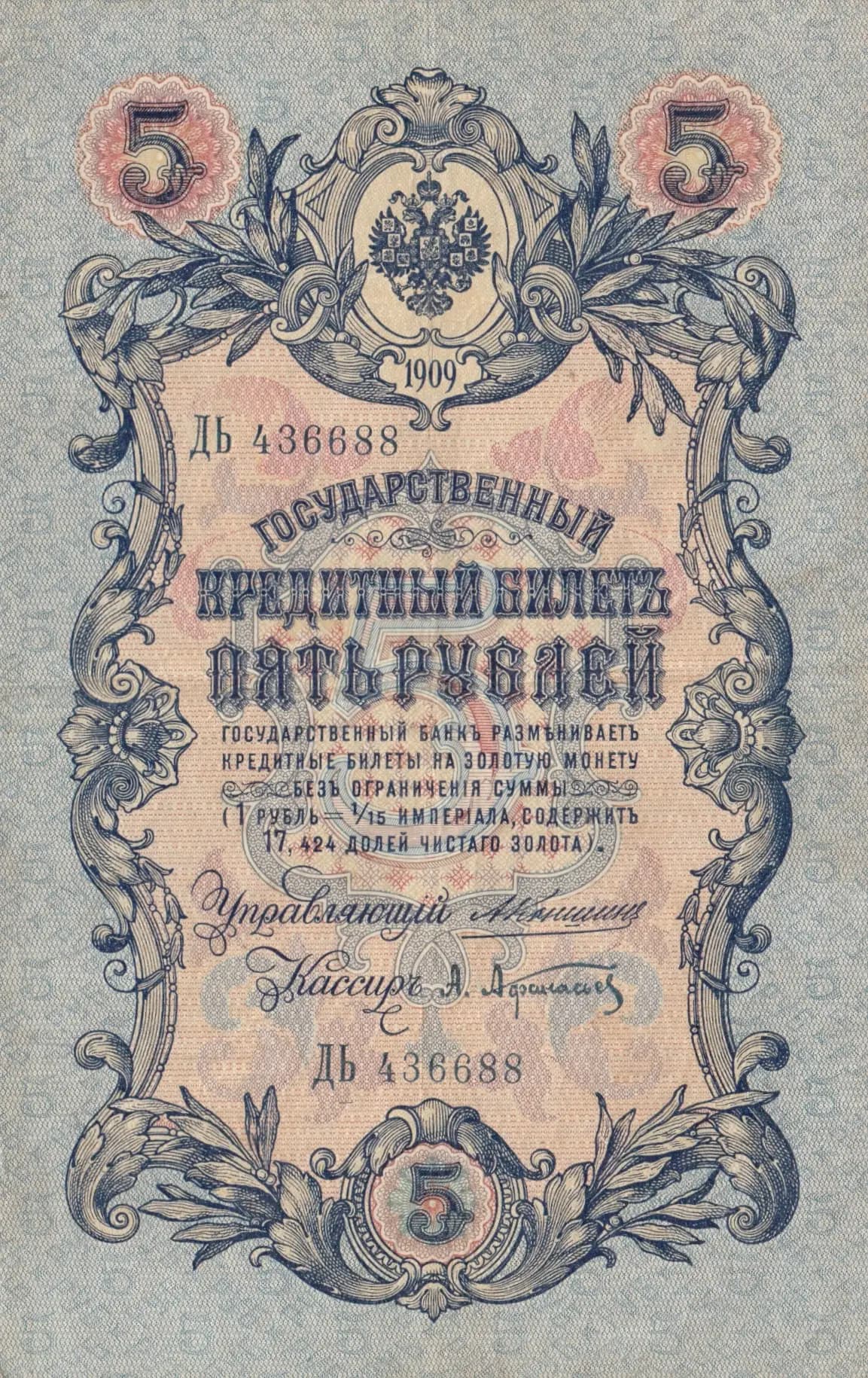
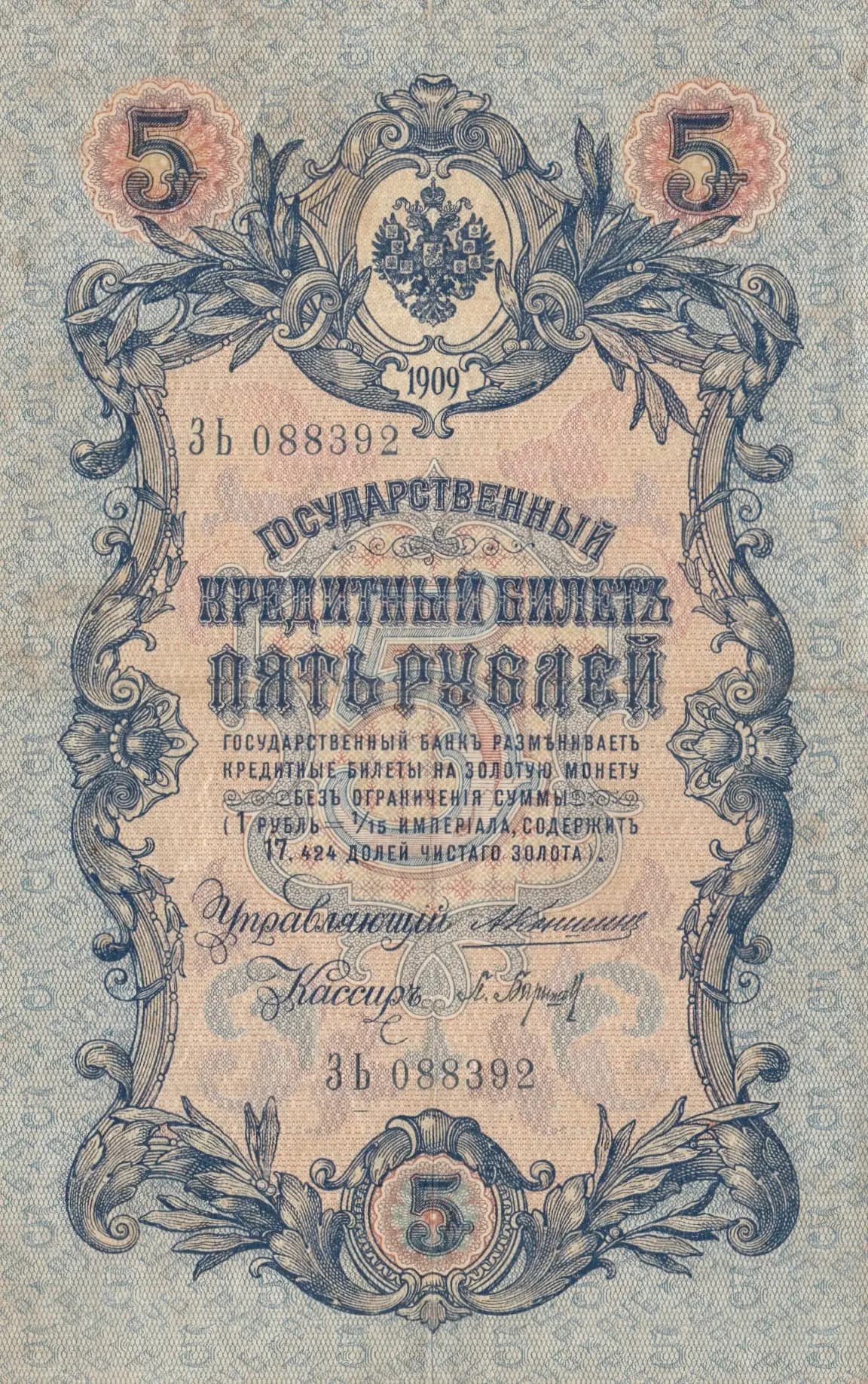
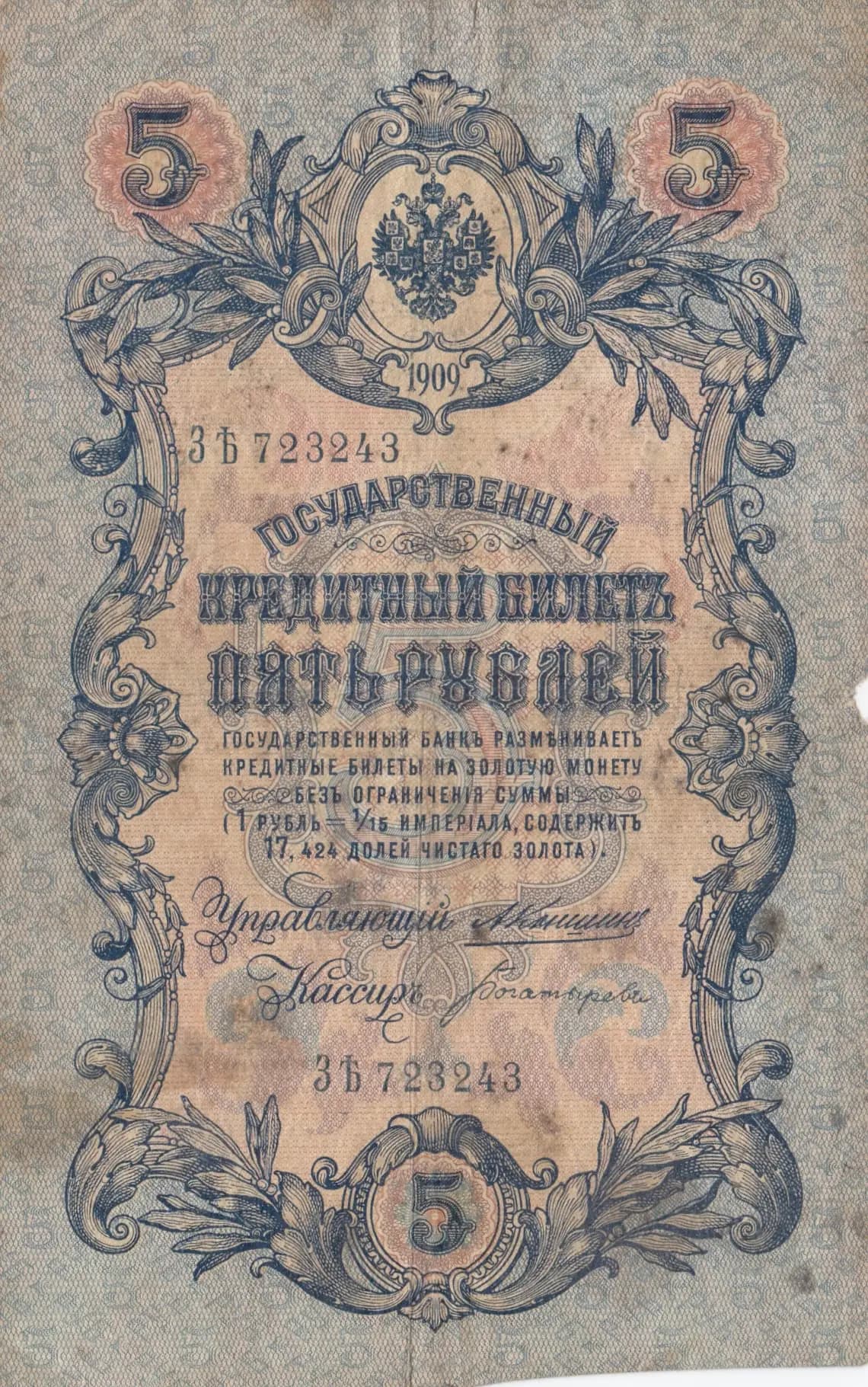
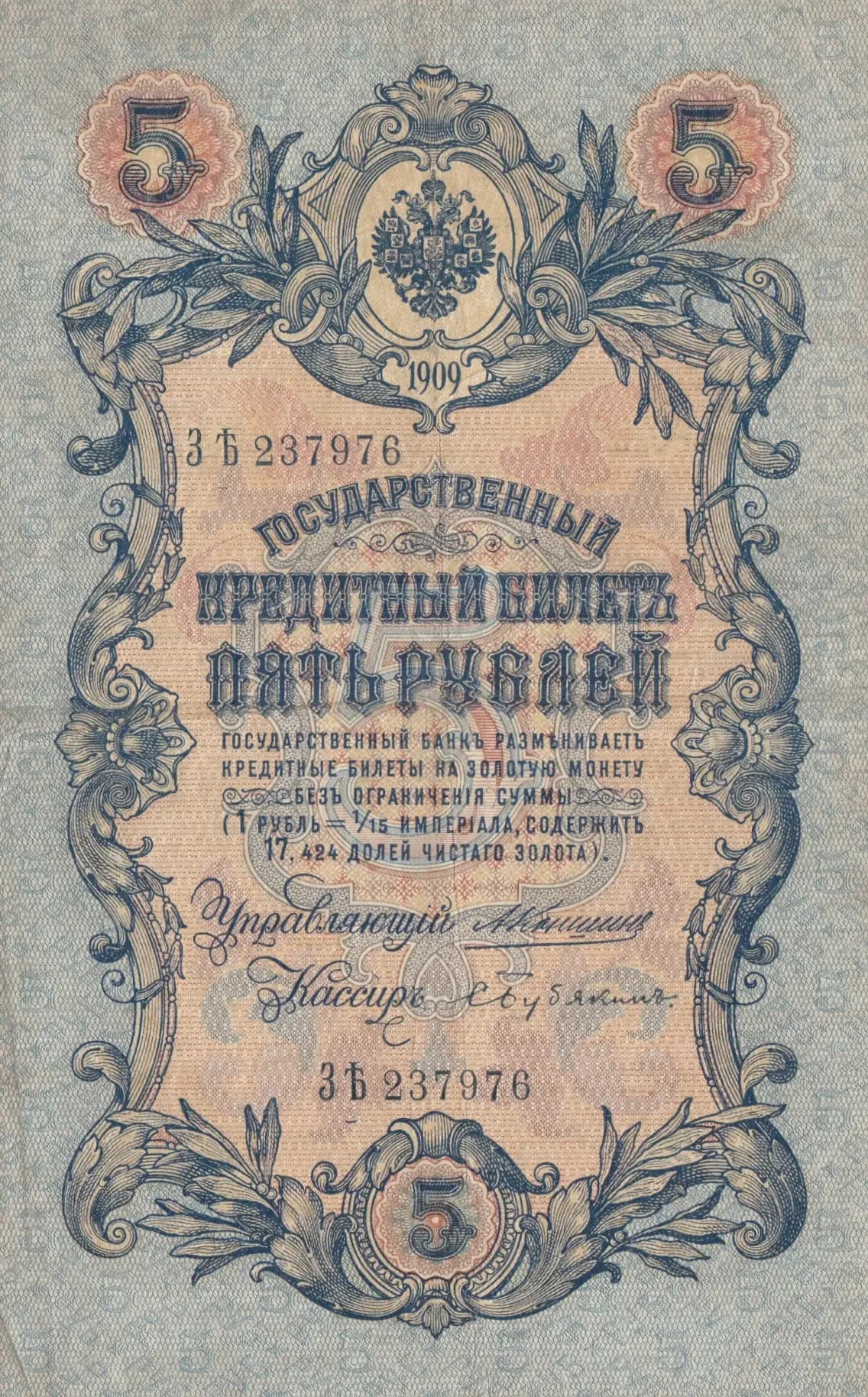
5 rublei 1909
“Sig.Sofronov”
About This Note
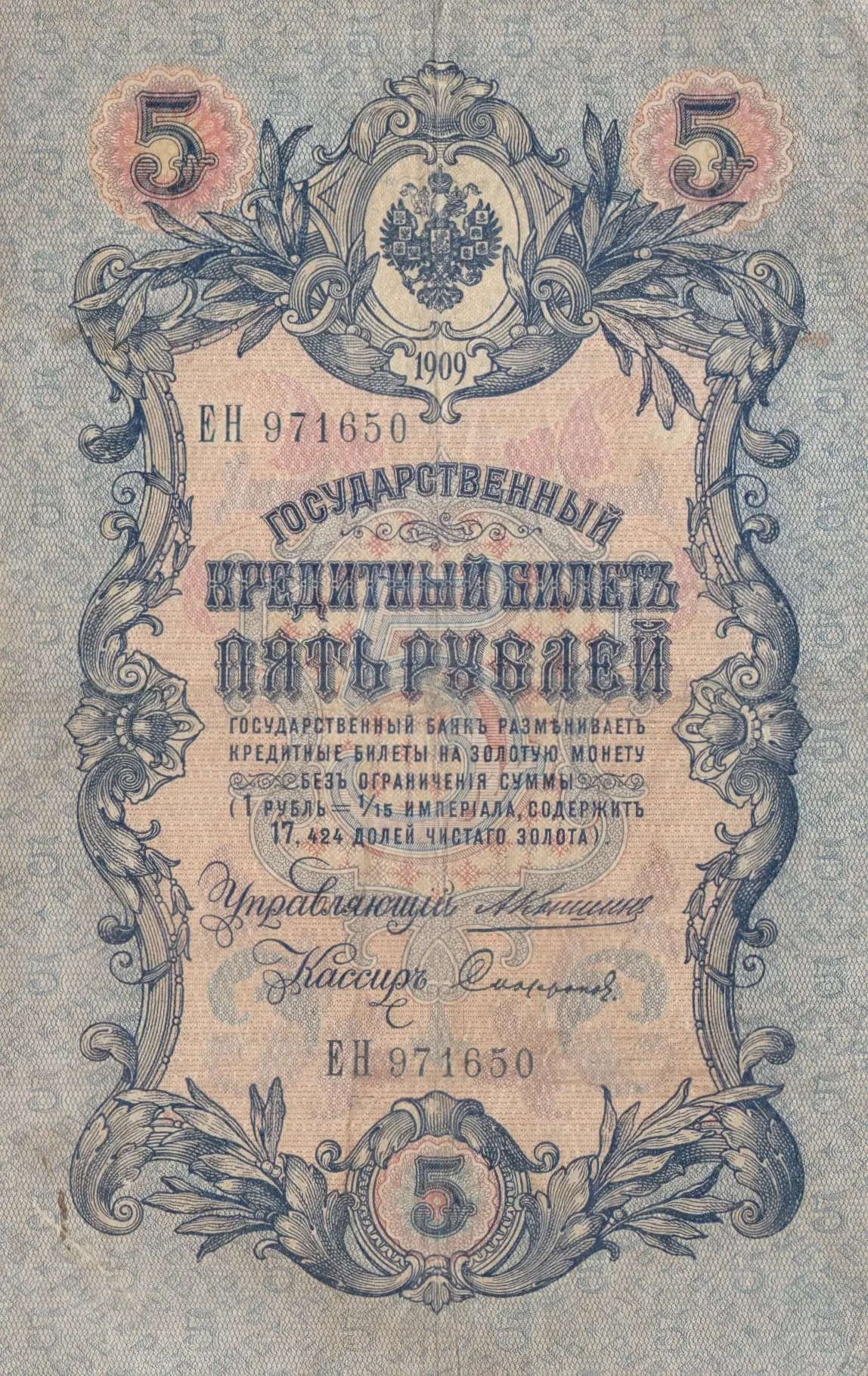
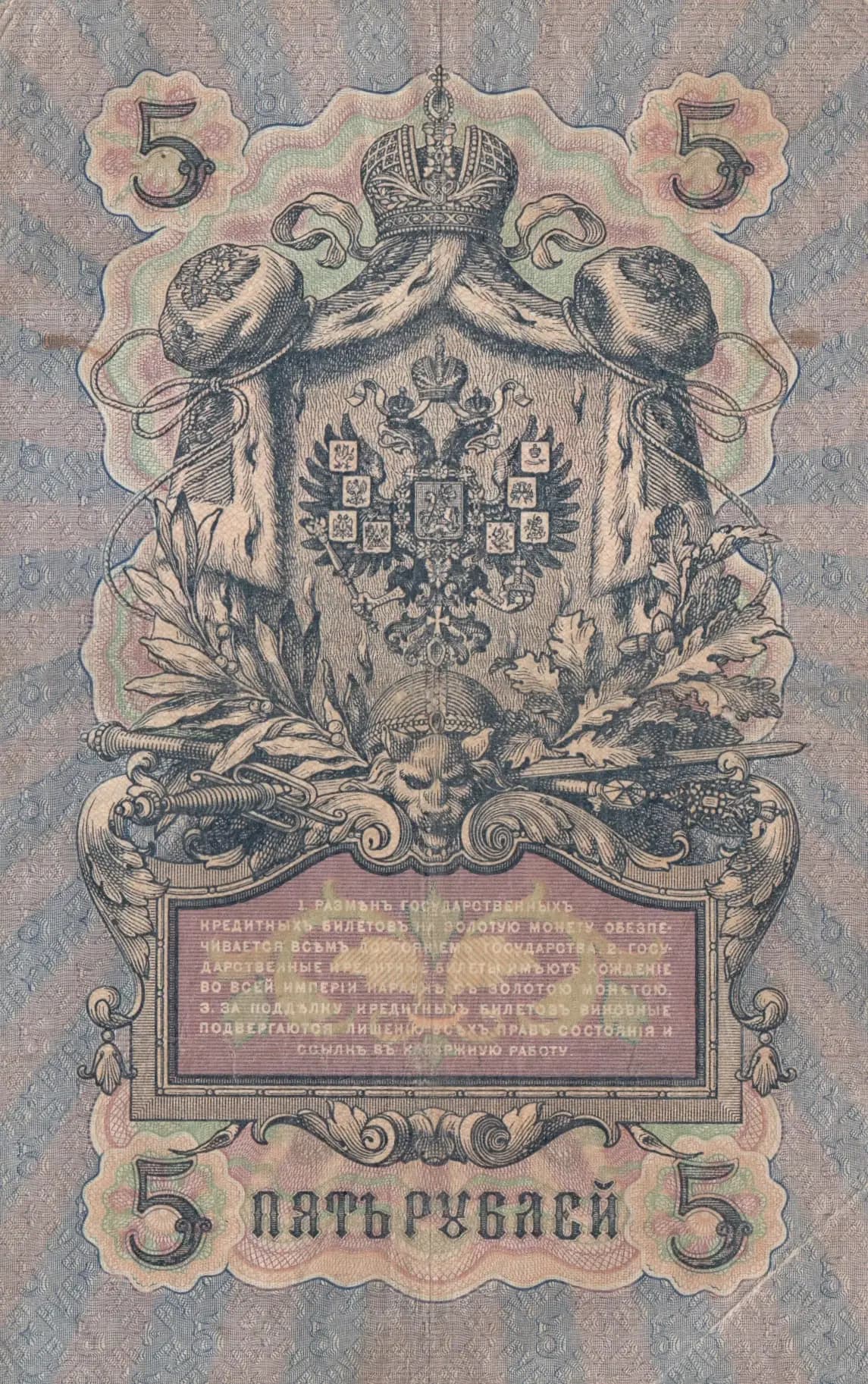
This is an exceptionally well-preserved example of the 1909 Imperial Russian 5 Rubles credit note (Pick P-10a(21)), graded VF, signed by Cashier Sinitsyn. The note displays the characteristic pinkish-beige coloration with navy blue and dark purple engraved details, featuring an elaborate Imperial coat of arms with the double-headed eagle on both sides. The intricate ornamental scrollwork, floral borders, and fine line engraving throughout indicate high-quality security printing typical of Russian Imperial banknotes, and the even coloration and lack of major wear suggests careful handling and storage over more than a century.
Common. The 1909 5 Ruble Sinitsyn signature notes were issued in substantial quantities during the final years of Imperial rule and remain readily available in today's numismatic market. While all Imperial Russian notes have collector appeal due to historical significance, this particular denomination and signature variety shows no evidence of being a short print run or special issue. VF condition examples trade regularly at moderate prices, consistent with common classification.
This 5 Ruble note was issued during the final decade of the Russian Empire under the Tsarist regime, when credit notes were still theoretically redeemable in gold coin at a fixed rate (1 ruble = 1/15 of an imperial containing 17.424 parts pure gold). The prominent Imperial double-headed eagle, crown, and elaborate heraldic imagery reflect the absolute authority of the Romanov dynasty, while the inscriptions detailing the State Bank's guarantee underscore the formal monetary system in place before the upheaval of the 1917 Revolution. The note's design and security features represent the height of Russian Imperial numismatic craftsmanship before monetary collapse.
The obverse and reverse both feature the Imperial Russian State Coat of Arms—the double-headed crowned eagle (Gosudarstwennyi Gerb)—as the dominant central motif, rendered in fine engraved detail. The eagle is depicted holding royal insignia and surmounted by the Imperial Crown, flanked by laurel wreaths symbolizing state authority and victory. The denomination '5' appears in ornate circular frames at the corners of both sides. Elaborate scrollwork, foliate arabesques, and fine-line cross-hatching form complete borders and fill the entire field, creating a visually complex anti-counterfeiting design. The color palette—pinkish-beige paper with navy blue and dark purple inks—was standard for this series. No individual portraits appear; the focus is entirely on Imperial heraldic and ornamental symbolism.
FRONT SIDE: 'ГОСУДАРСТВЕННЫЙ КРЕДИТНЫЙ БИЛЕТА' (State Credit Note); 'ПЯТЬ РУБЛЕЙ' (Five Rubles); '1909' (year); 'ЕН 971650' (Serial number); 'Управляющий Министр' (Managing Minister); 'Кассир Синицын' (Cashier Sinitsyn); 'ГОСУДАРСТВЕННЫЙ БАНК РАЗМЕНИВАЕТЬ КРЕДИТНЫЕ БИЛЕТЫ НА ЗОЛОТО, МОНЕТУ БЕЗ ОГРАНИЧЕНИЯ СУММЫ (1 РУБЛЬ = 1/15 ИМПЕРИАЛА, СОДЕРЖИТ 17,424 ДОЛЕЙ ЧИСТАГО ЗОЛОТА)' (The State Bank exchanges credit notes for gold and coin without limit of amount; 1 ruble = 1/15 of an imperial, contains 17.424 parts pure gold). BACK SIDE: 'ПЯТЬ РУБЛЕЙ' (Five Rubles); Extended legal text regarding the security of state credit notes and citizen obligations regarding their circulation and acceptance.
This note was produced using traditional steel engraving and intaglio printing (recess printing), the standard security printing method for Russian Imperial credit notes. The fine line work, varied line weights, cross-hatching effects, and the deeply impressed printed surface visible in condition observations all confirm intaglio technique. The printer was the State Printing Office (Gosudarstvennaia Tipografiia) of the Russian Empire, which produced all official state currency and securities. Multiple passes and careful registration of colored inks (navy and purple over the pinkish-beige base stock) demonstrate the sophisticated multi-color intaglio methods employed.
This specific variety is identified as P-10a(21) with the signature of Cashier Sinitsyn (Кассир Синицын). The serial number prefix 'ЕН' (EN) and the serial number 971650 are consistent with 1909 issues. Known varieties of the 1909 5 Ruble note primarily differ by signature combinations (Sinitsyn as cashier appears with various ministers) and serial number prefixes. This note represents the standard Sinitsyn-era printing for this denomination.