5 rublei 1909
“Sig.Ovchinnikov”
About This Note
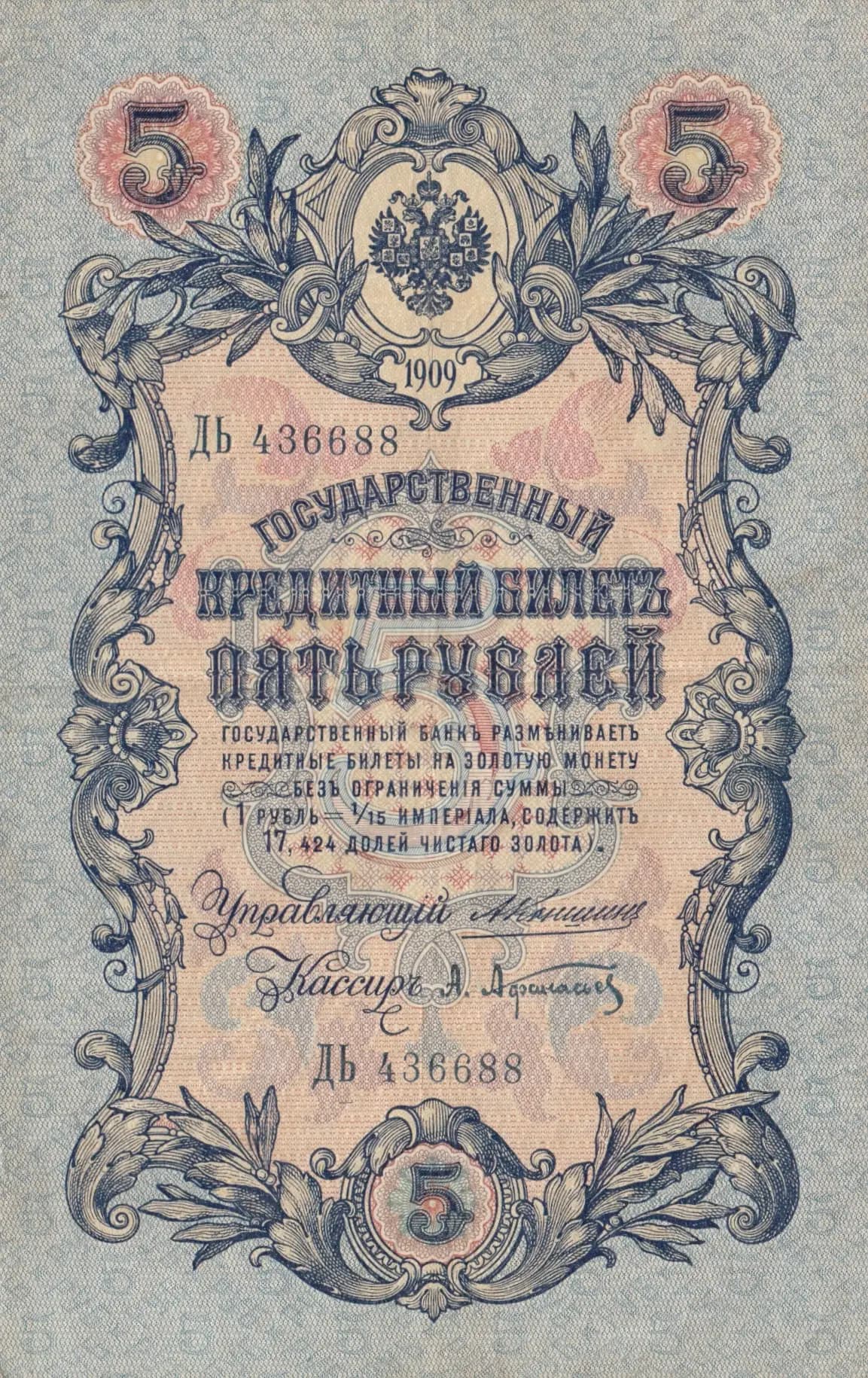
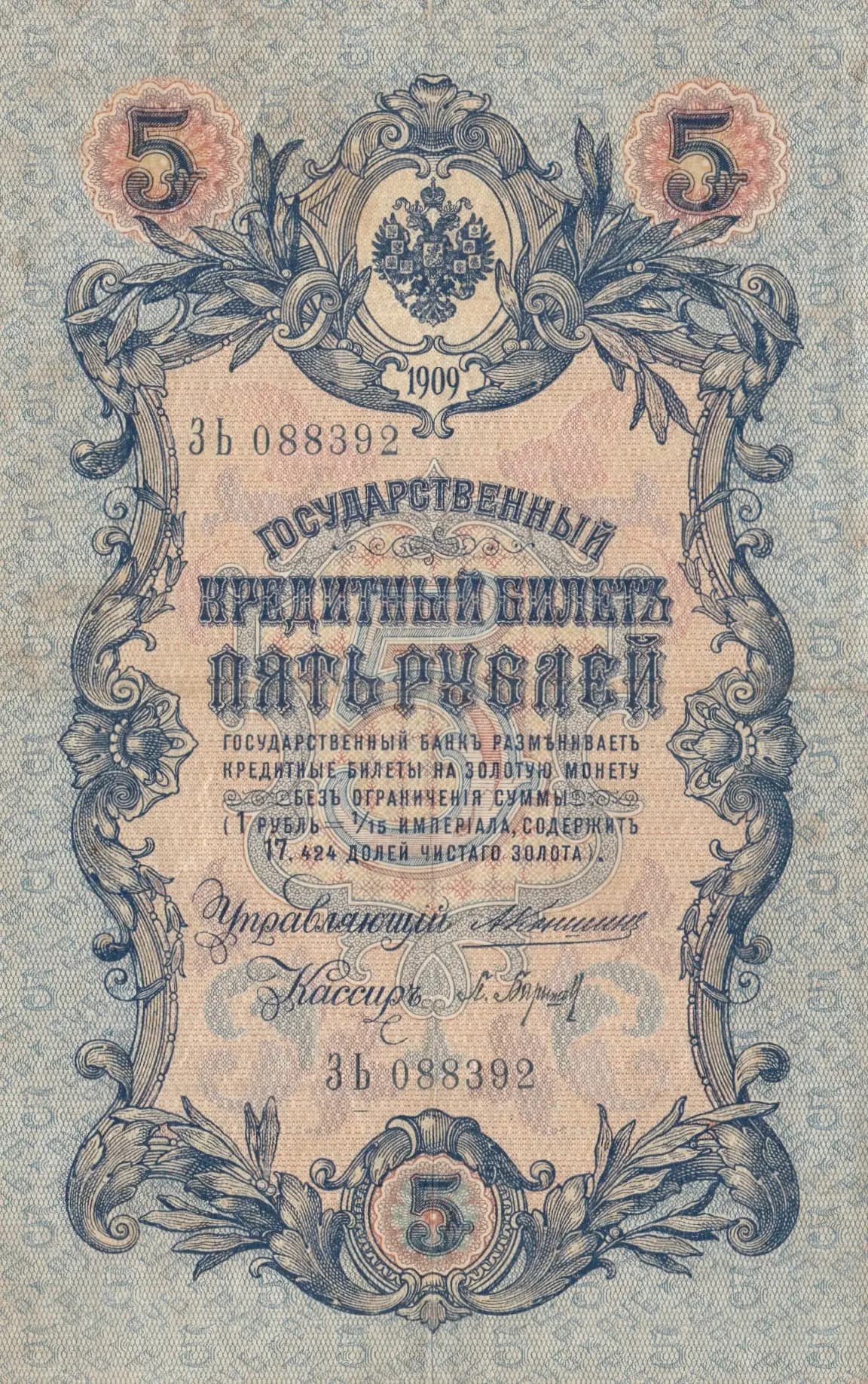
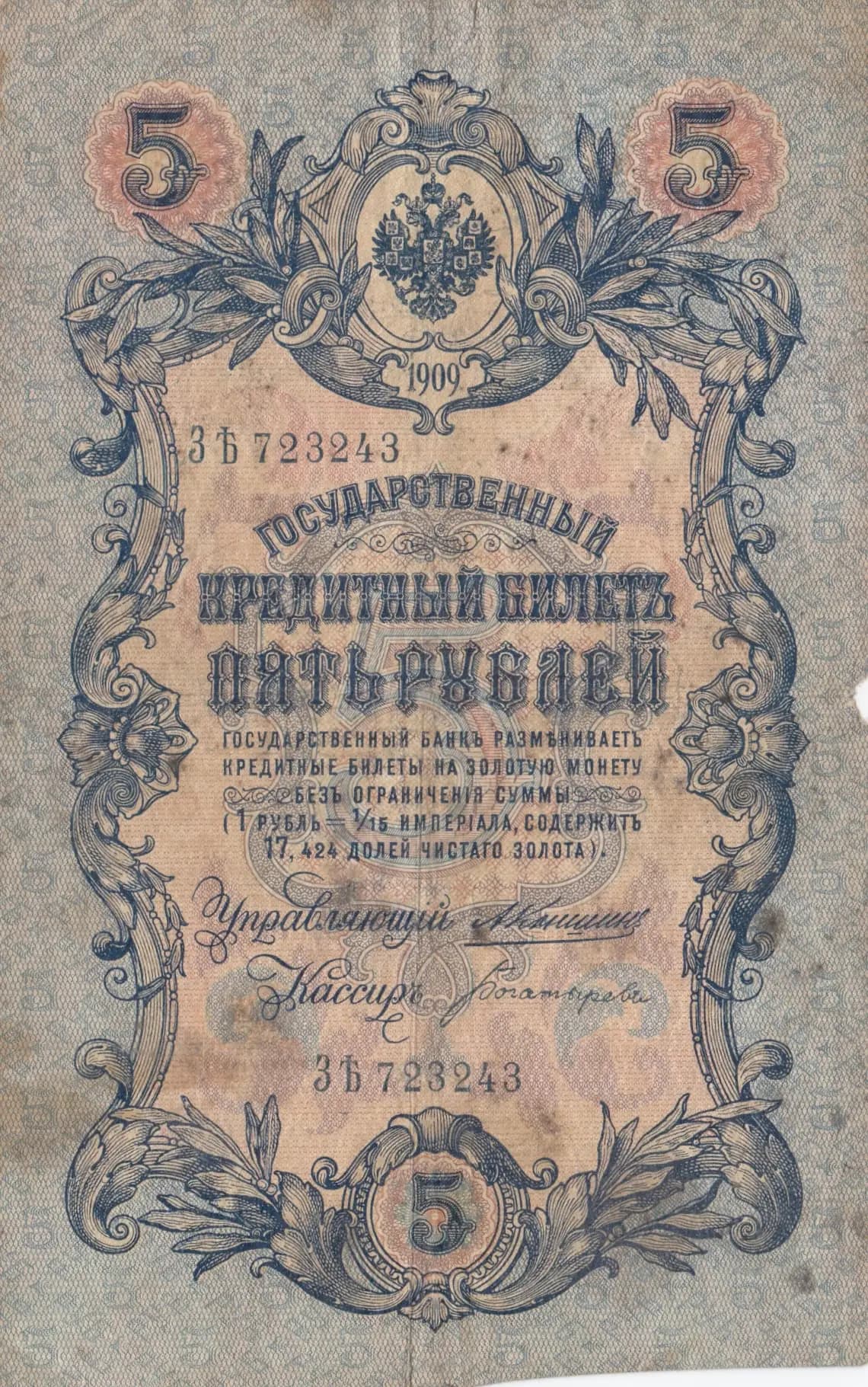
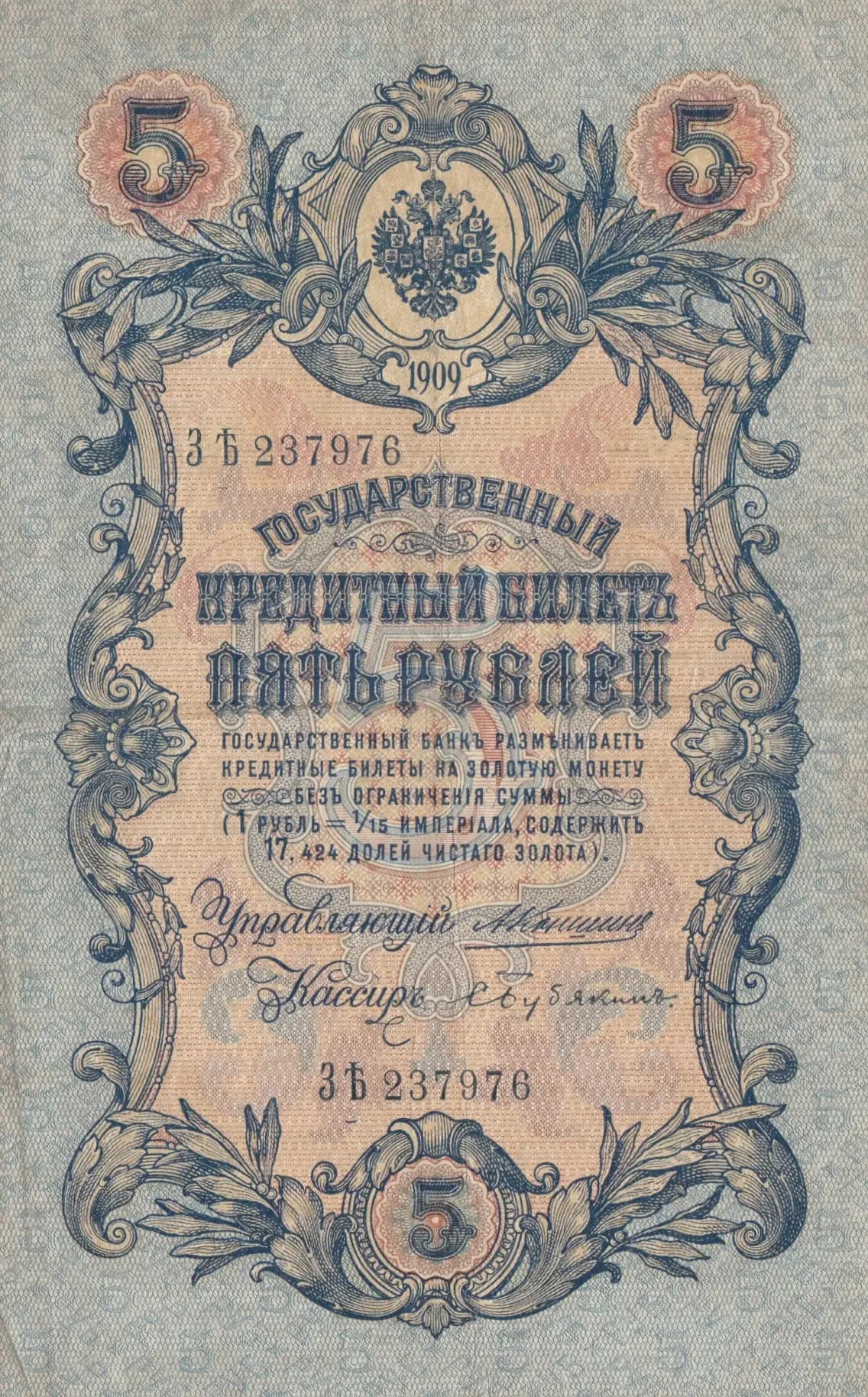
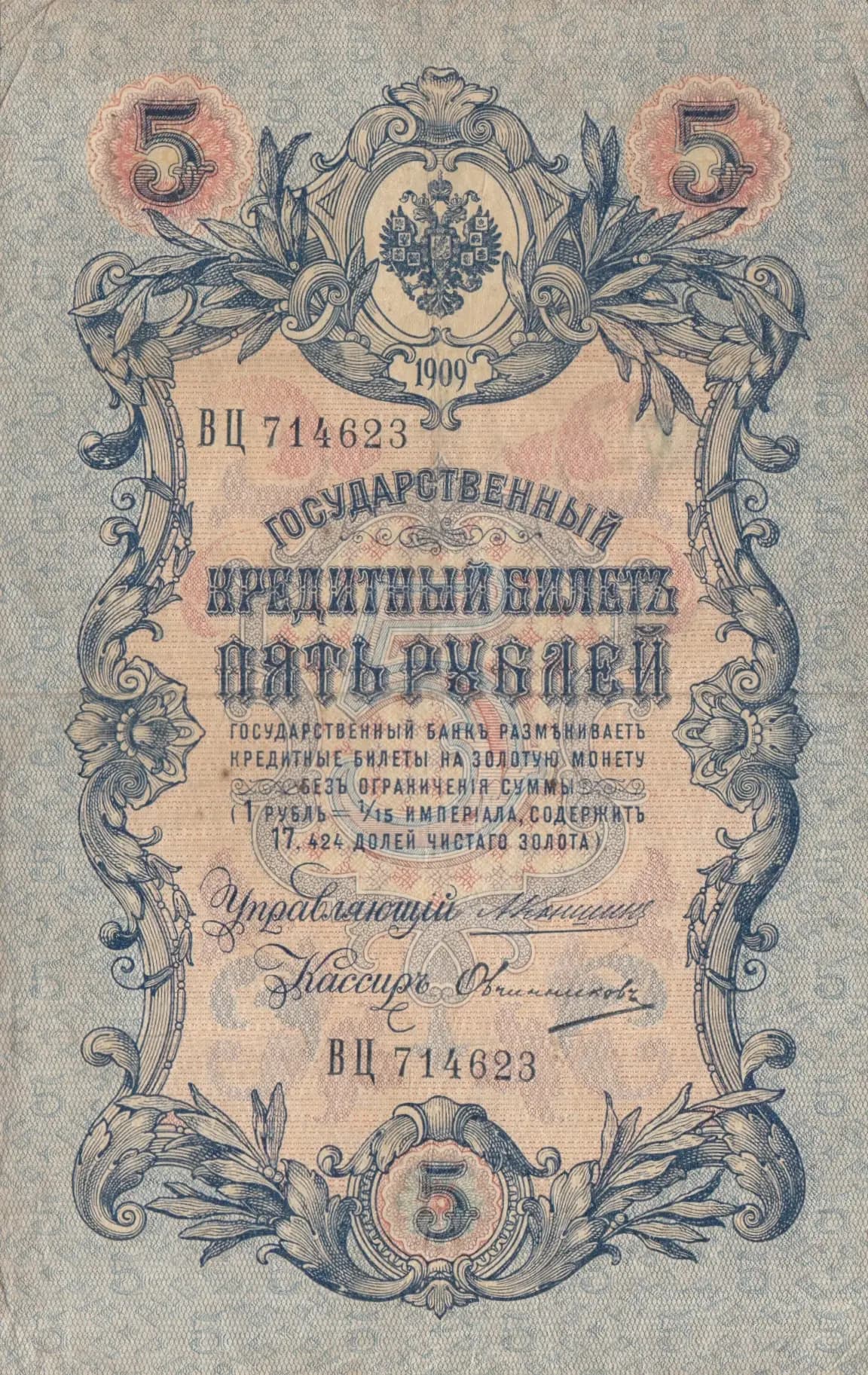
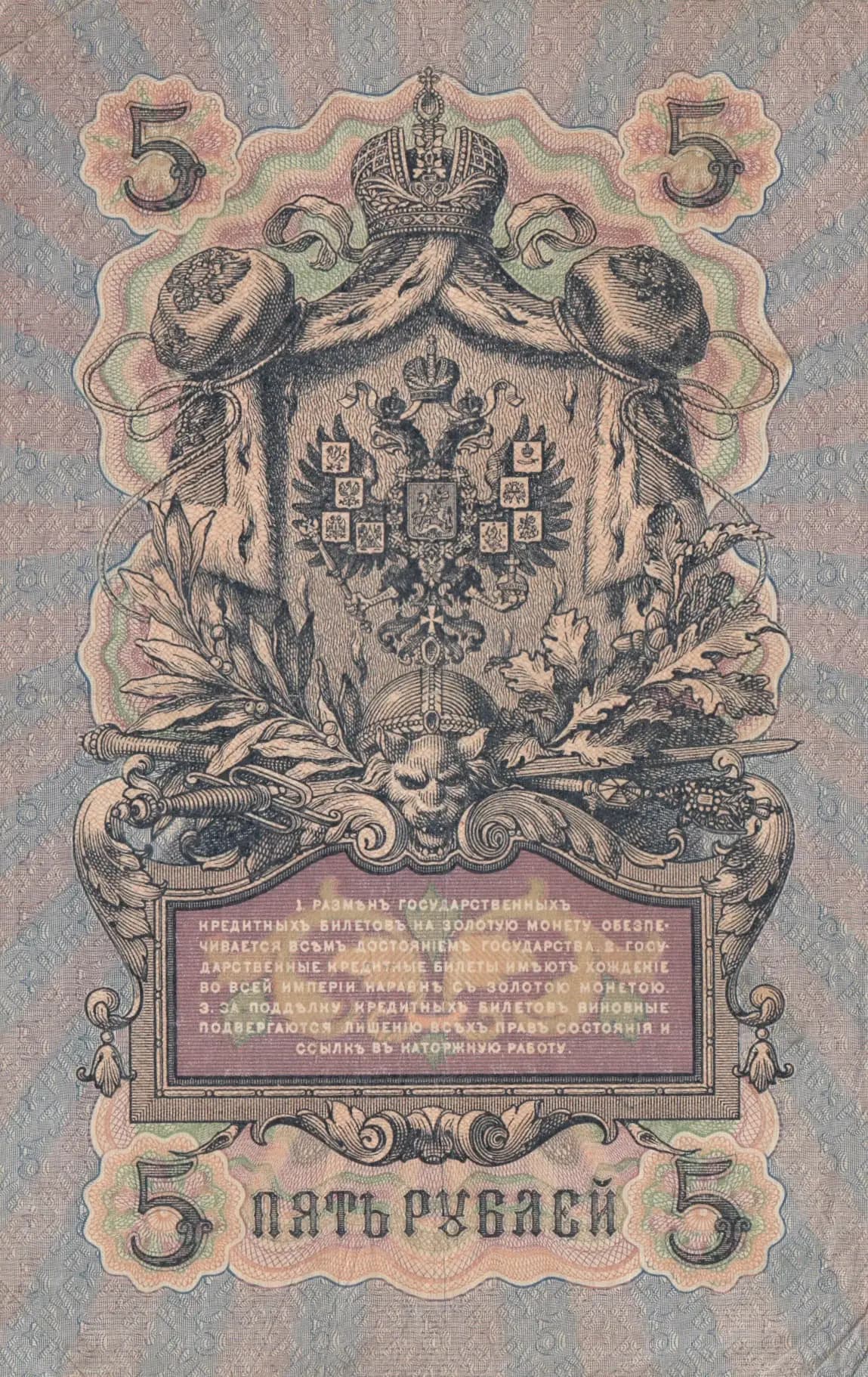
This is a Russian Empire 5 rubles State Credit Note from 1909, graded VF, featuring the characteristic ornate baroque design with the imperial double-headed eagle coat of arms prominently displayed on both sides. The note exhibits the expected aging and circulation wear for a banknote over 115 years old, with visible foxing, yellowing, and creasing throughout the tan/cream paper, yet the fine line engraving and intricate decorative borders remain well-preserved and legible. The dual signatures and multiple serial number placements (ВЦ 714623) reflect the security practices of the Russian State Bank during the gold standard era.
common. The 5 rubles denomination was one of the most frequently issued and circulated denominations of the Russian State Credit Note series, with large print runs throughout the 1909-1912 period. Examples in VF condition, while showing appropriate age and circulation wear, are regularly encountered in the collector market at modest valuations. The Pick 10a designation encompasses multiple signature and date varieties, all of which remain readily available. Absence of any notation of extreme scarcity in the Pick catalog, combined with the standard nature of this denomination and series, confirms common status.
This note was issued during the final years of Imperial Russia's gold standard system, established by Finance Minister Sergei Witte's monetary reform of 1897. The elaborate heraldic imagery—the double-headed eagle wearing an imperial crown, holding orbs and scepters, surrounded by shields representing the Russian Empire's constituent regions—served as powerful symbols of autocratic authority and national stability. The inscriptions explicitly reference the State Bank's guarantee to exchange notes for gold coins without limit, a promise that would become impossible following the Russian Revolution of 1917 and the subsequent collapse of the imperial monetary system.
The 5 rubles 1909 note features a symmetrical design centered on the Imperial Russian coat of arms—the double-headed eagle (Российский орёл), depicted wearing an imperial crown and holding an orb and scepter in its talons, with heraldic shields of the Russian Empire arranged on its chest. The front side presents this emblem in a vertical oval frame surrounded by ornate baroque scrollwork and floral motifs in pink/salmon and blue tones. The reverse side provides a more elaborate presentation of the same heraldic device, expanded to show greater detail of the constituent shields and imperial regalia, flanked by laurel wreaths and palm fronds symbolizing prosperity and victory. Large denomination numerals '5' appear in all four corners of the reverse, and in the upper left and right of the obverse, printed in prominent pink ink. The overall color scheme employs pink/salmon for denominational elements, blue and green for secondary decorative features, and black for all text. No individual historical portraits appear on this note; instead, the imperial heraldry itself serves as the central iconographic element, emphasizing the state's authority and the gold backing of the currency.
FRONT SIDE: Center - 'ГОСУДАРСТВЕННЫЙ КРЕДИТНЫЙ БИЛЕТ' (State Credit Ticket/Note) and 'ПЯТЬ РУБЛЕЙ' (Five Rubles). Text block reads: 'ГОСУДАРСТВЕННЫЙ БАНК РАЗМЕНИВАЕМЪ КРЕДИТНЫЕ БИЛЕТЫ НА ЗОЛОТУЮ МОНЕТУ БЕЗ ОГРАНИЧЕНИЯ СУММЫ (1 РУБЛЬ = 1/15 ИМПЕРИАЛА, СОДЕРЖАТЬ 17.424 ДОЛЕЙ ЧИСТОГО ЗОЛОТА)' translating to 'The State Bank exchanges credit notes for gold coins without limit of sum (1 ruble = 1/15 imperial, contains 17.424 parts pure gold)'. Signature line: 'Управляющий Кассиръ Финансовъ' (Manager Cashier of Finance). Serial number: ВЦ 714623. BACK SIDE: Main text block reads: 'В РАЗМЕН ГОСУДАРСТВЕННЫХ КРЕДИТНЫХ БИЛЕТОВ НА ЗОЛОТУЮ МОНЕТУ ОБЕСПЕЧИВАЮТСЯ ВСЕМИ ЗОЛОТЫМИ ЗАПАСАМИ ГОСУДАРСТВА. В ГОСУДАРСТВЕННЫХ КРЕДИТНЫХ БИЛЕТАХ ИМЕЮТ ХОЖДЕНИЕ ВО ВСЕЙ ИМПЕРИИ НАРАВНЕ СО ЗОЛОТОЮ МОНЕТОЮ. БЕЗ ПОДДЕЛКУ КРЕДИТНЫХ БИЛЕТОВ ВИНОВНЫЕ ПОДЛЕЖАТ СТРОГОМУ СУДУ СОСТОЯНИЯ И ССЫЛКЕ НА КАТОРЖНУЮ РАБОТУ' translating to 'In exchange, State credit notes are secured by all the gold reserves of the State. State credit notes circulate throughout the entire Empire on equal footing with gold coins. For counterfeiting credit notes, those guilty are subject to strict court proceedings, exile and hard labor.' Denomination repeated as 'ПЯТЬ РУБЛЕЙ' (Five Rubles) at bottom.
The note was produced using fine line steel engraving (intaglio printing), evidenced by the precise detail visible in the coat of arms, the intricate baroque border work, and the sharp line quality throughout the design. The multiple ink colors (pink, blue, green, and black) indicate sequential passes through the press or multi-plate engraving. Russian State Credit Notes of this series were typically printed by the State Printing Works (Государственная типография) in St. Petersburg, which employed state-of-the-art engraving and security printing techniques. The fine, consistent line work and the crisp registration of multiple colors are characteristic of high-quality intaglio production by imperial Russian security printers.
This specific example is Pick 10a(19), indicating it belongs to the 1909 emission with the signature variety designated as (19). The serial number ВЦ 714623 with the ВЦ prefix is consistent with notes from this printing period. The signature line reading 'Управляющий Кассиръ Финансовъ' (Manager Cashier of Finance) reflects the dual-signature format typical of this series. The collector attribution 'Sig. Ovchinnikov' likely refers to Ovchinnikov, one of the principal signatories on this variety of note. Distinguishing between the numbered signature varieties (10a(1) through 10a(20) or similar) requires close examination of the actual signatures, which are visible but would require specialized reference material to definitively determine the exact variety designation.