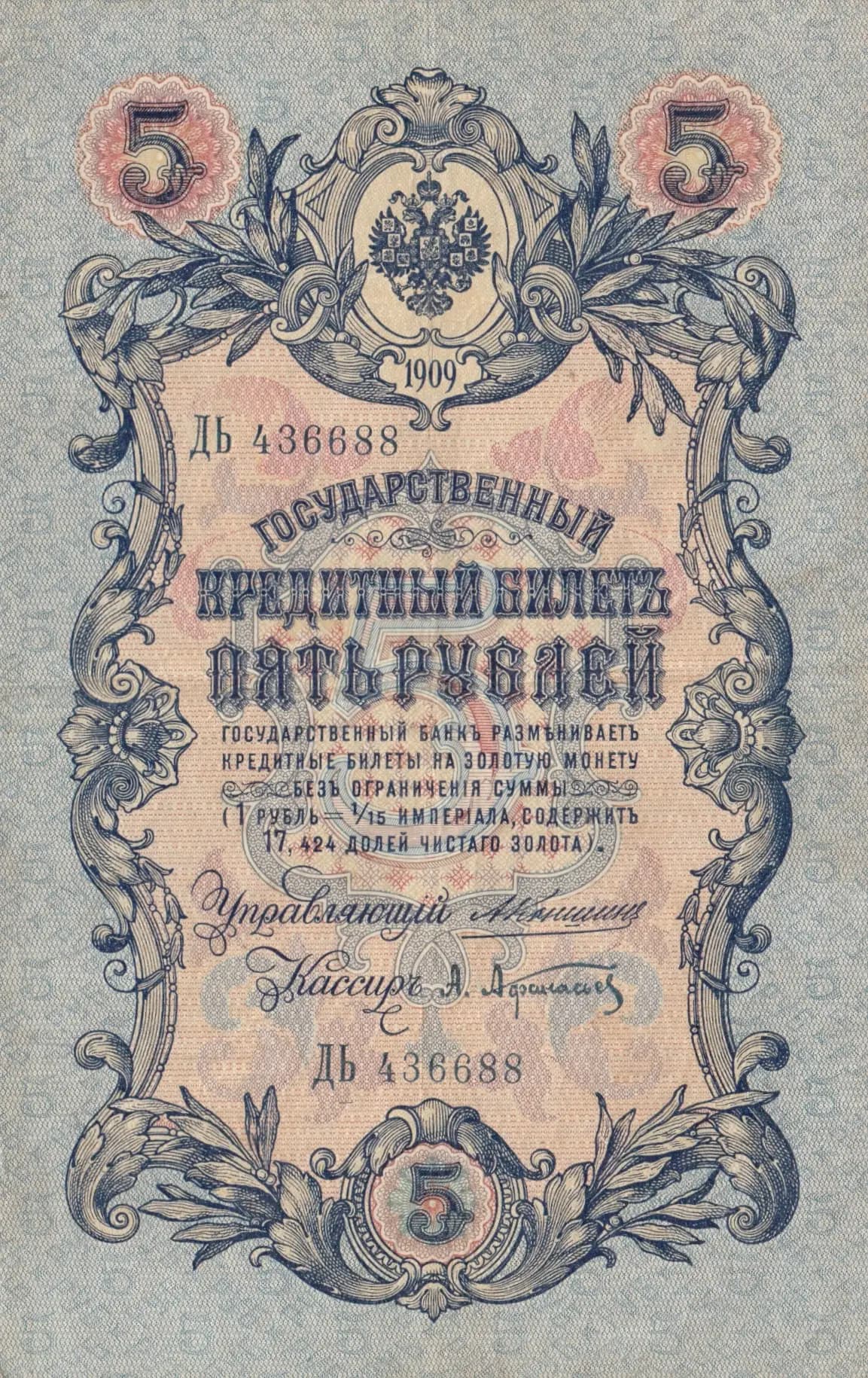
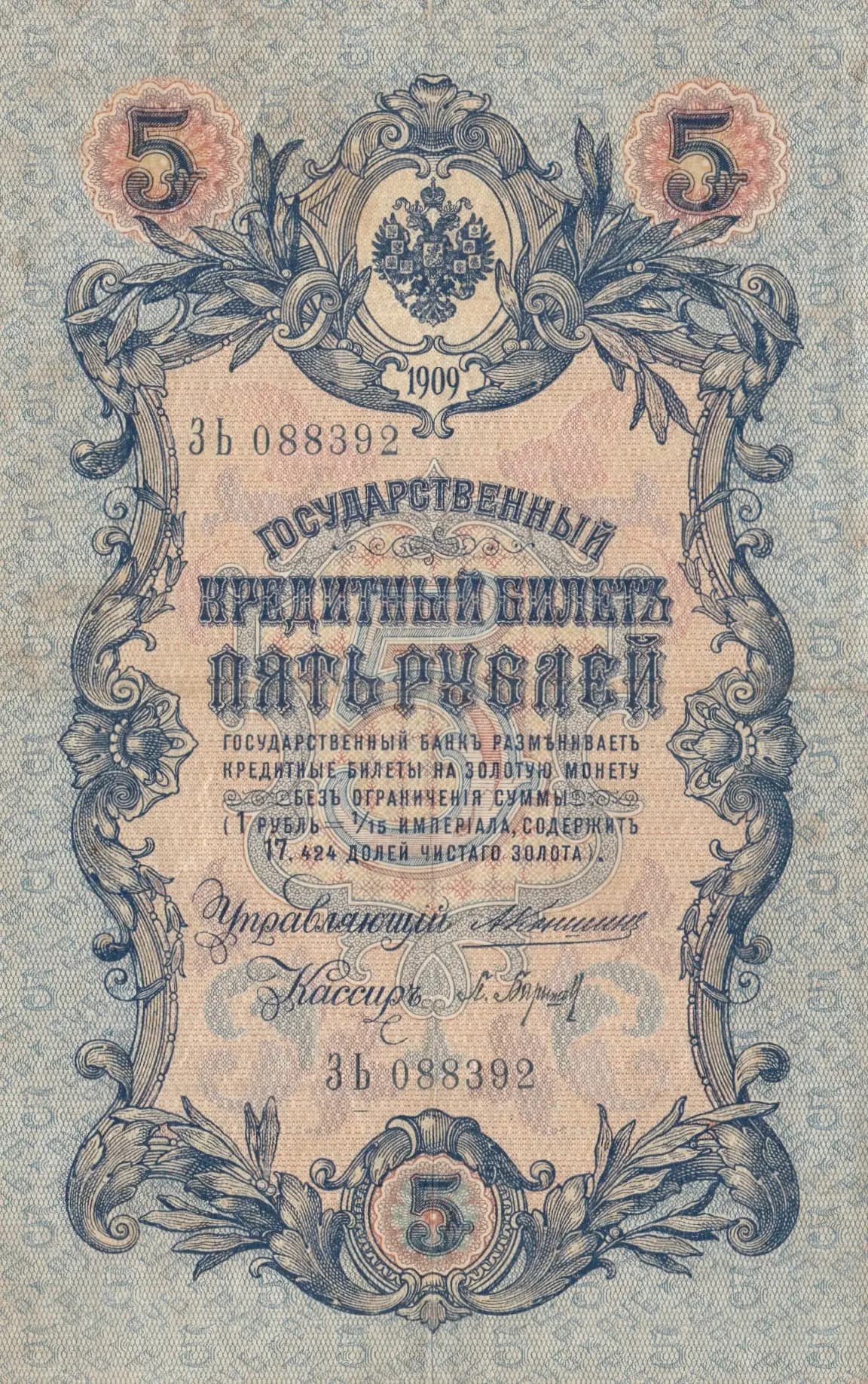
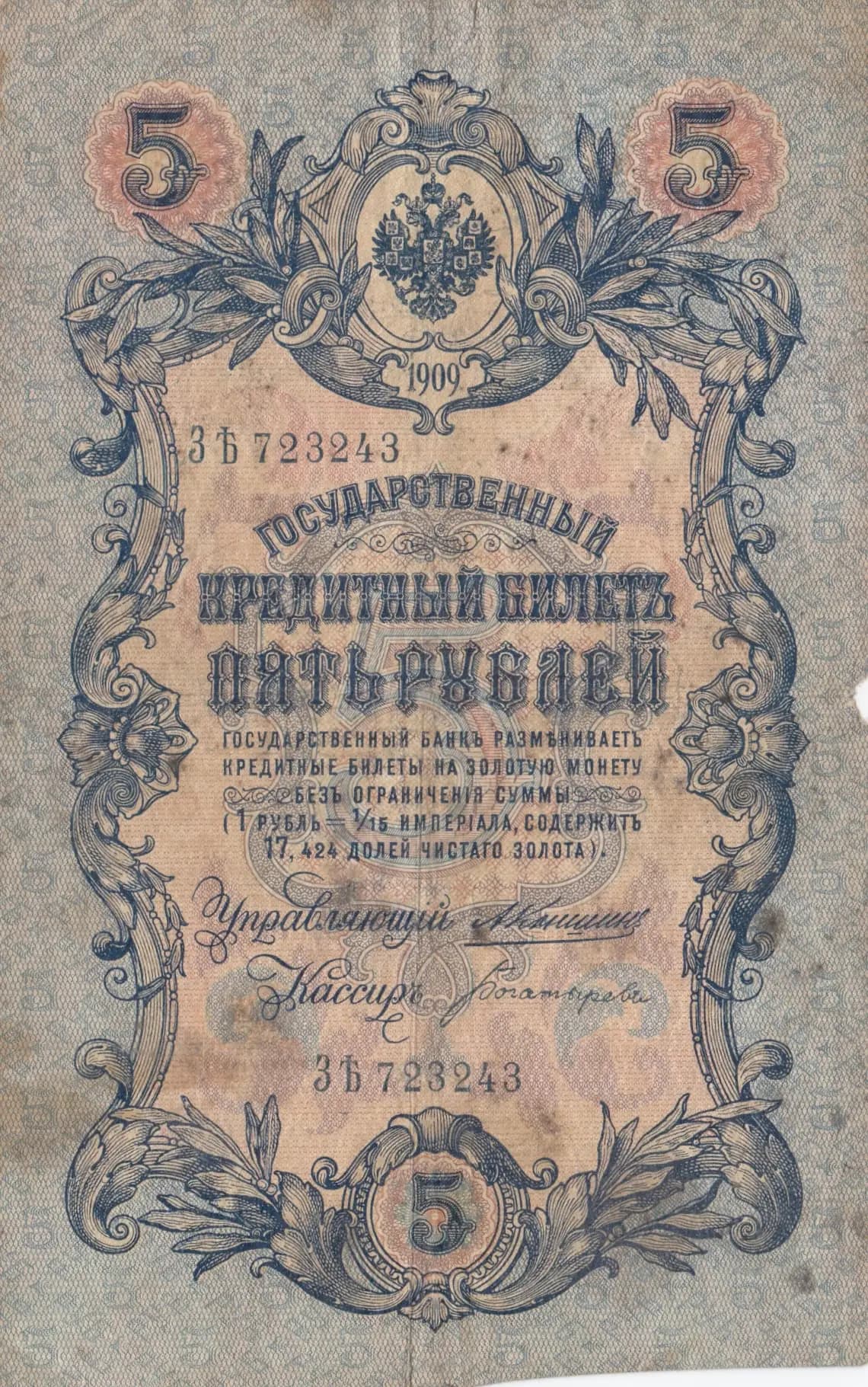
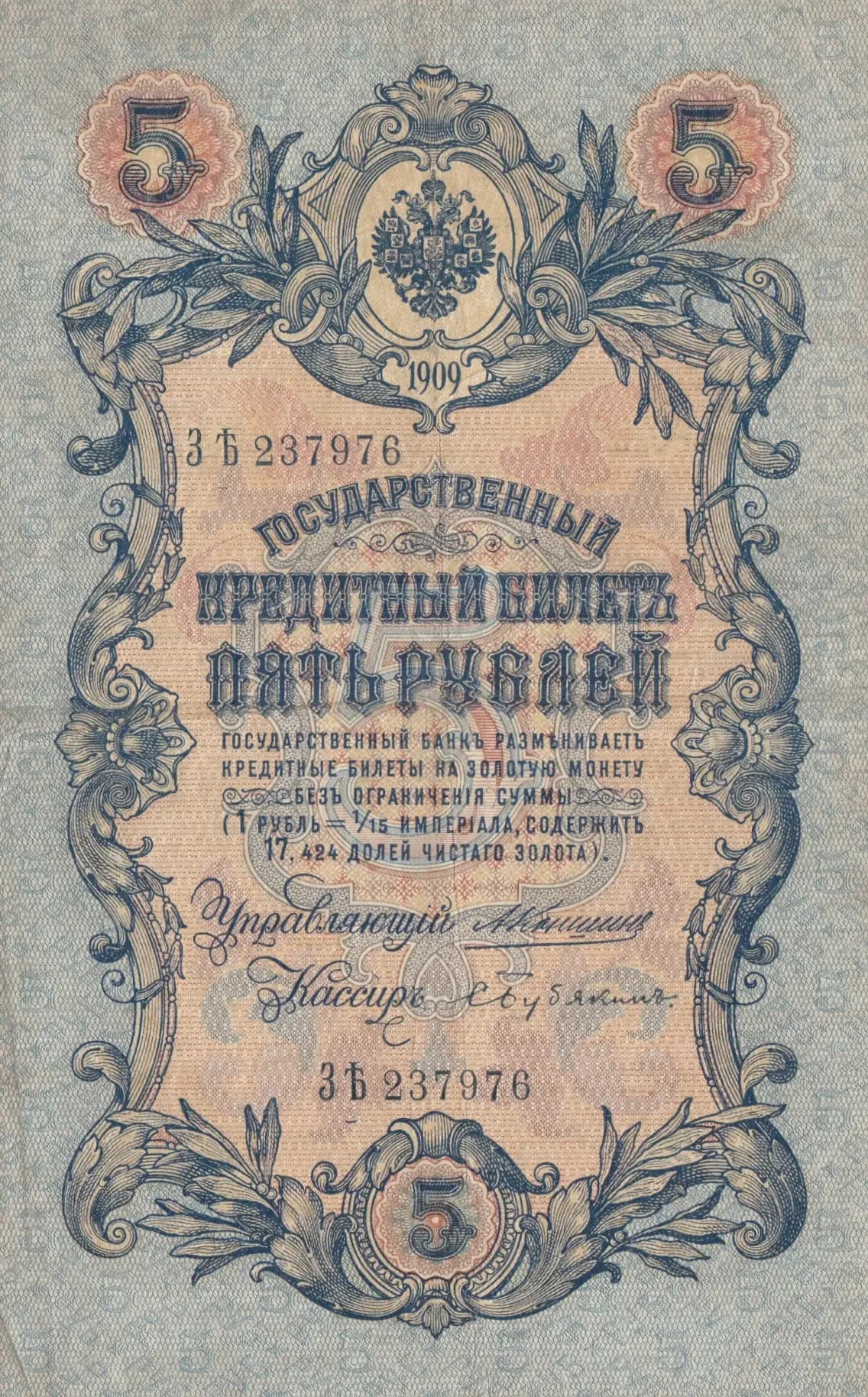
5 rublei 1909
“Sig.Y.Metz”
About This Note
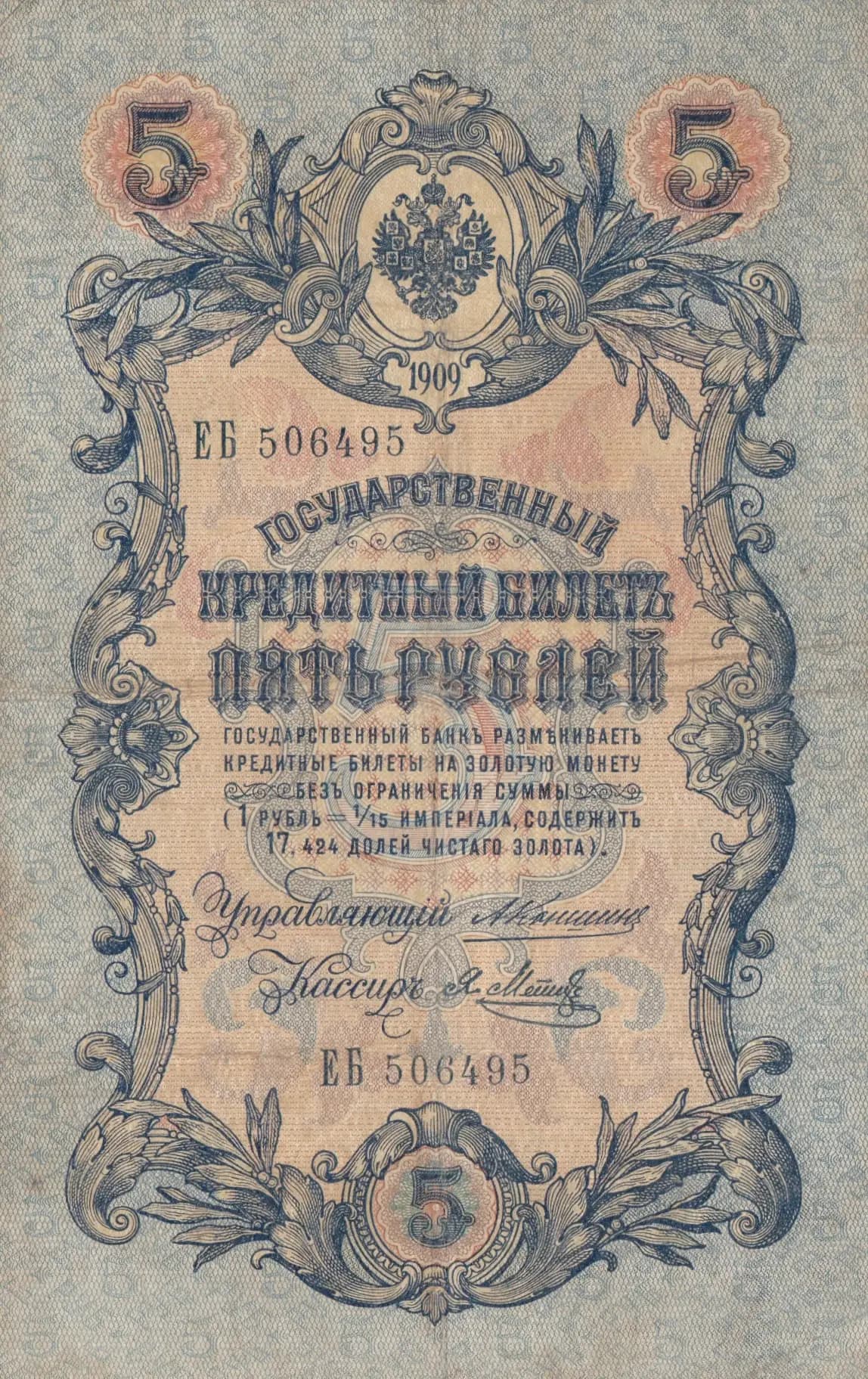
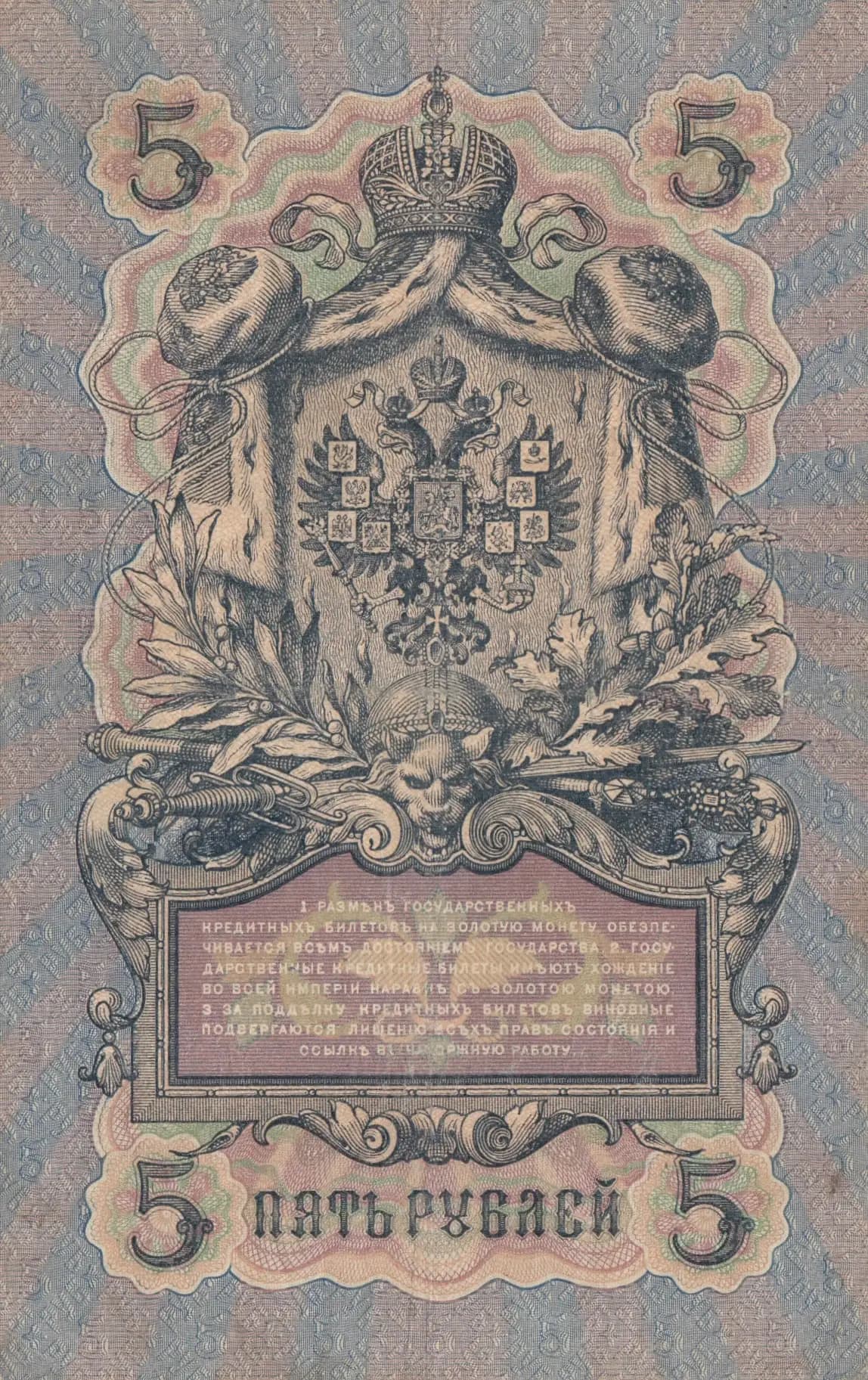
A striking example of the Imperial Russian 5 rubles note from 1909, featuring the characteristic ornate design and multicolor printing that defined the final era of Tsarist currency. The note displays excellent condition with vibrant colors—peachy-pink and green tones dominating both sides—crisp engraving details, and no visible wear, circulation marks, or damage, suggesting either uncirculated or nearly uncirculated preservation. The dual-sided design showcases the Imperial double-headed eagle with crown and complex heraldic shields, exemplifying the sophisticated security printing of the State Credit Note series and representing an important transitional period in Russian monetary history before the 1917 Revolution.
Common. The 1909 5 rubles note (Pick 10a variety 15) was issued in substantial quantities during the final years of Imperial Russian currency circulation, remaining in use until 1917-1918. No significant print run restrictions, recall notices, or scarcity indicators are documented for this denomination and year. While Imperial Russian notes from this period have collector value due to historical significance, they remain widely available in numismatic markets, particularly in well-preserved conditions such as the VF-to-UNC grade observed here. The survival of many examples in good condition reflects their relatively recent production (relative to earlier Russian currency) and the substantial initial circulation of State Credit Notes before the Revolution rendered them largely obsolete.
This 1909 State Credit Note (Государственный Кредитный Билет) was issued during the reign of Tsar Nicholas II, specifically under the reformed monetary system established after the 1905-1906 financial crisis. The note's prominent display of the Imperial double-headed eagle, crowned and holding spheres of authority, directly reflects the autocratic power structure of the Russian Empire at the height of its pre-revolutionary stability. The inscriptions reference gold backing and the ruble's equivalence to 1/15 of the Imperial gold standard coin, demonstrating the Empire's commitment to sound monetary policy in its final decade.
This note represents the Imperial Russian State Credit Note design standard of the 1909 issue period. The OBVERSE (front) features a formal heraldic presentation with the Imperial Russian coat of arms—the double-headed eagle beneath a crown—positioned centrally within an ornamental shield, flanked by large numeral '5' denominations in decorative cartouches at the top corners. The design incorporates intricate acanthus leaf and scrolling floral motifs forming an ornate border frame, with the State Bank's declaration and gold-standard guarantee text prominently displayed in the center field. The REVERSE (back) showcases a more elaborate heraldic composition, with a crowned double-headed eagle as the dominant central element, grasping spheres (representing imperial authority and dominion) in its talons, with a complex multi-quartered coat of arms shield positioned centrally on the eagle's breast. This heraldic eagle is encircled by elaborate floral garlands with ribbon swags and ornamental scrollwork, with large '5' denominations appearing in ornate oval cartouches at all four corners. The color scheme employs pink/magenta, green/olive, navy blue, and cream tones, with the fine-line engraving creating a visually complex and security-conscious design.
FRONT SIDE: Top center: '1909' (year); Serial number 'ЕБ 506495' (EB 506495) appears upper left and lower right. Main text reads 'ГОСУДАРСТВЕННЫЙ КРЕДИТНЫЙ БИЛЕТ' (State Credit Note). Additional inscriptions state 'ГОСУДАРСТВЕННЫЙ БАНК РАЗМЕЩИВАЕТ КРЕДИТНЫЕ БИЛЕТЫ НА ЗОЛОТУЮ МОНЕТУ БЕЗ ОГРАНИЧЕНИЯ СУММЫ' (The State Bank issues credit notes for gold coins without limitation of amount) and '(1 РУБЛЬ = 1/15 ИМПЕРИАЛА, СОДЕРЖИТЬ (17,424 ДОЛЕЙ ЧИСТАГО ЗОЛОТА))' (1 Ruble = 1/15 Imperial, containing 17,424 parts pure gold). Bottom corners show 'Директор Кассир' (Director Cashier) with signature lines. BACK SIDE: Central large text panel contains extended text regarding gold backing: 'В РАЗМЕН ГОСУДАРСТВЕННЫХ КРЕДИТНЫХ БИЛЕТОВ НА ЗОЛОТУЮ МОНЕТУ ОБЕСПЕЧИВАЕТСЯ ЗОЛОТОМ, ХРАНЯЩИМСЯ В ГОСУДАРСТВЕННОЙ КАЗНЕ...' (In exchange for state credit notes for gold coins, guaranteed by gold held in the state treasury...). Denomination 'ПЯТЬ РУБЛЕЙ' (Five Rubles) appears at bottom.
This note was produced using intaglio (steel-plate engraving) printing combined with multicolor lithography. The Russian State Credit Notes of this period were typically printed by the Imperial Russian State Printing Office (Экспедиция заготовления государственных бумаг) in St. Petersburg. The intricate fine-line engraving visible throughout both sides—particularly in the heraldic details, border ornaments, and text—is characteristic of high-security intaglio work typical of the era. The multicolor application (pink, green, blue, cream) suggests additional lithographic passes over the base intaglio impression, a technique common for Russian Imperial currency of the 1906-1917 period to enhance both security and aesthetic appeal.
This specific example is cataloged as Pick 10a(15), indicating it belongs to variety 15 of the 1909 5 rubles issue. The serial number EB 506495 visible on both sides represents a standardized check identification system used by the Imperial State Bank. The signature designation 'Y.Metz' noted in the collector records likely refers to one of the authorized signatories (Director or Cashier) whose facsimile signature appears in the designated boxes on the front of the note. Varieties within the 1909 issue are typically distinguished by: (1) different signature combinations of authorized officials; (2) minor design variations in specific heraldic or border details across different printing runs; and (3) serial number prefix variations indicating different batches from the State Printing Office. This particular specimen, with the 'EB' serial prefix and noted Y.Metz signature, represents a distinctly identified subset of the 1909 5 rubles emission.