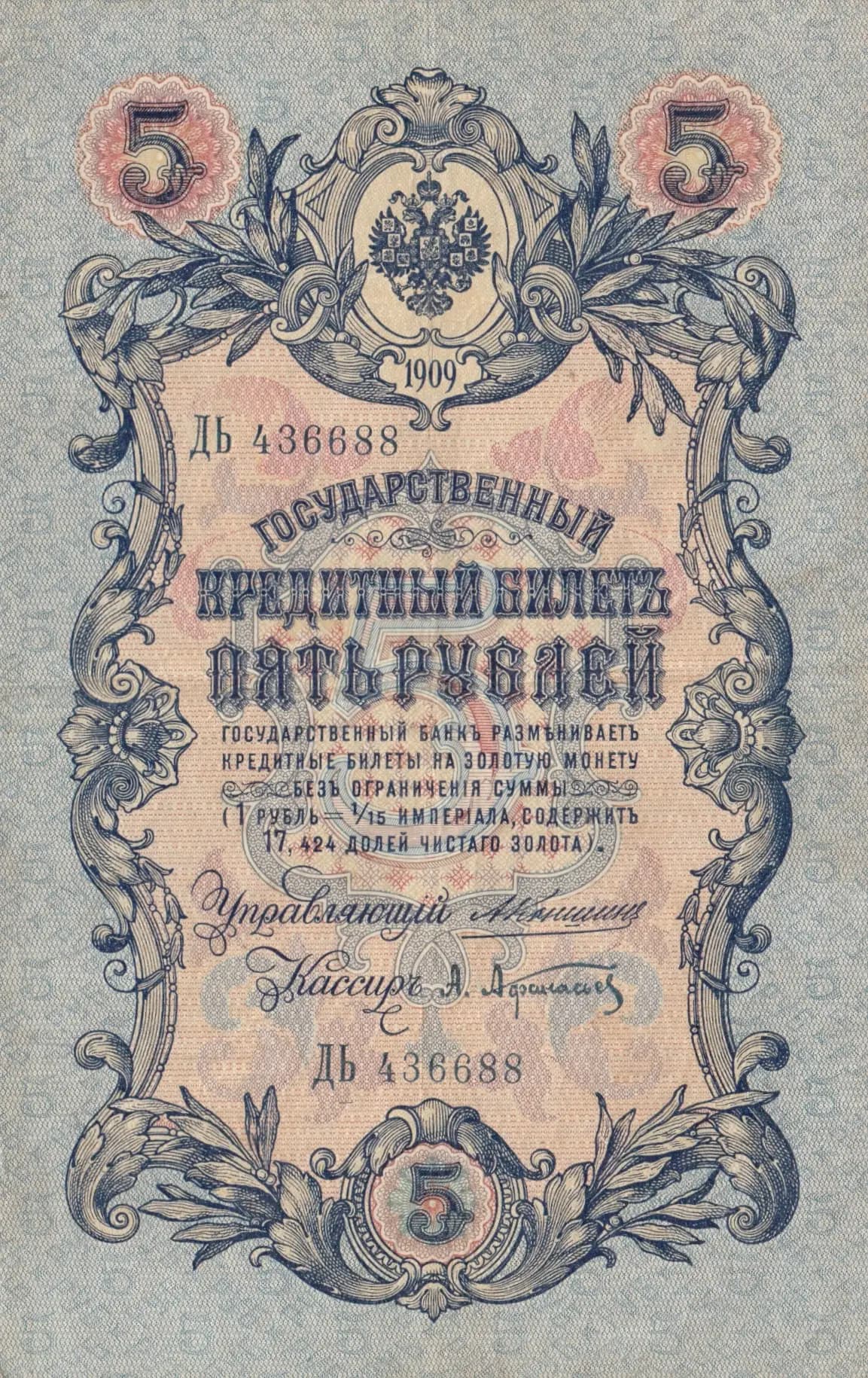
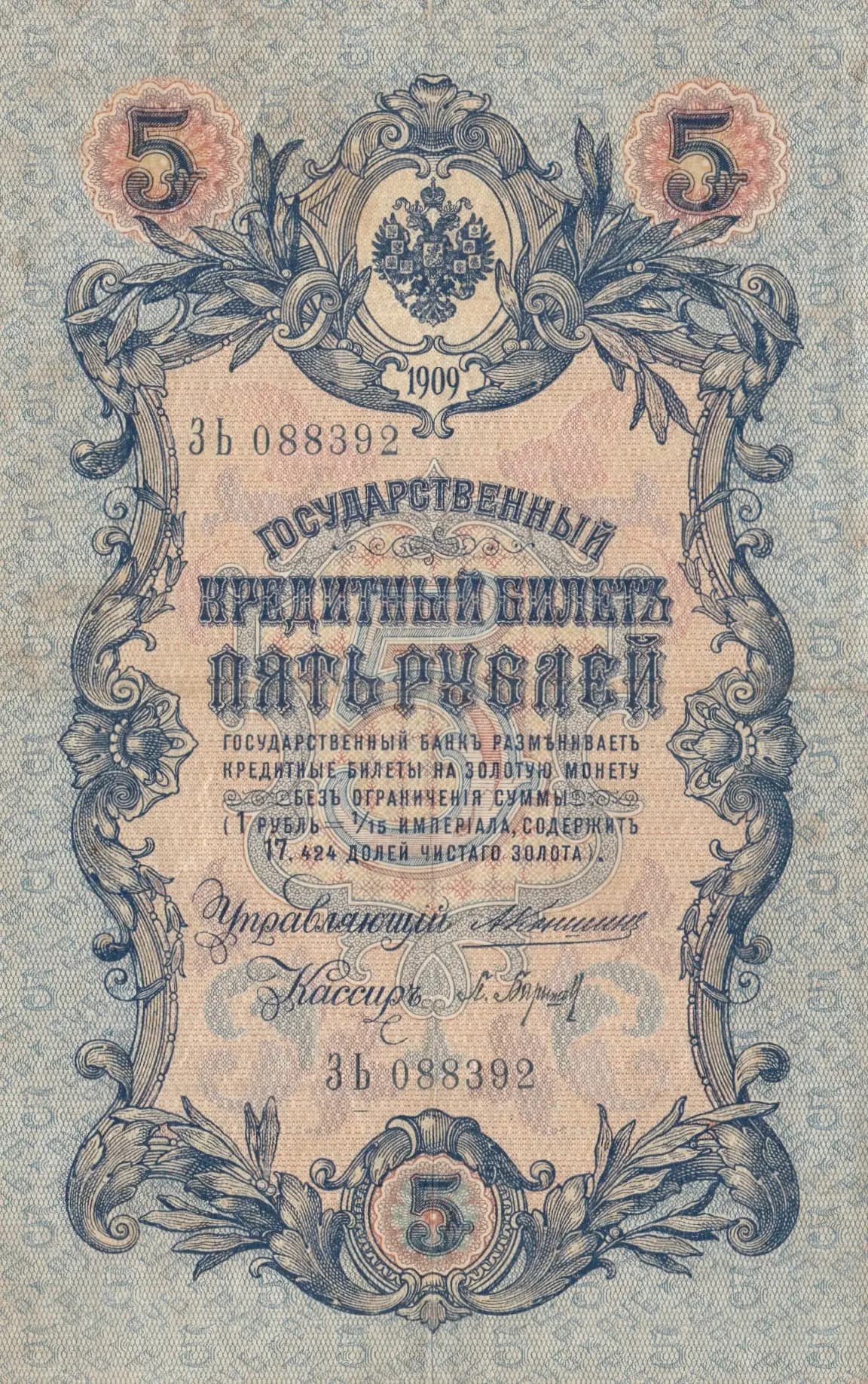
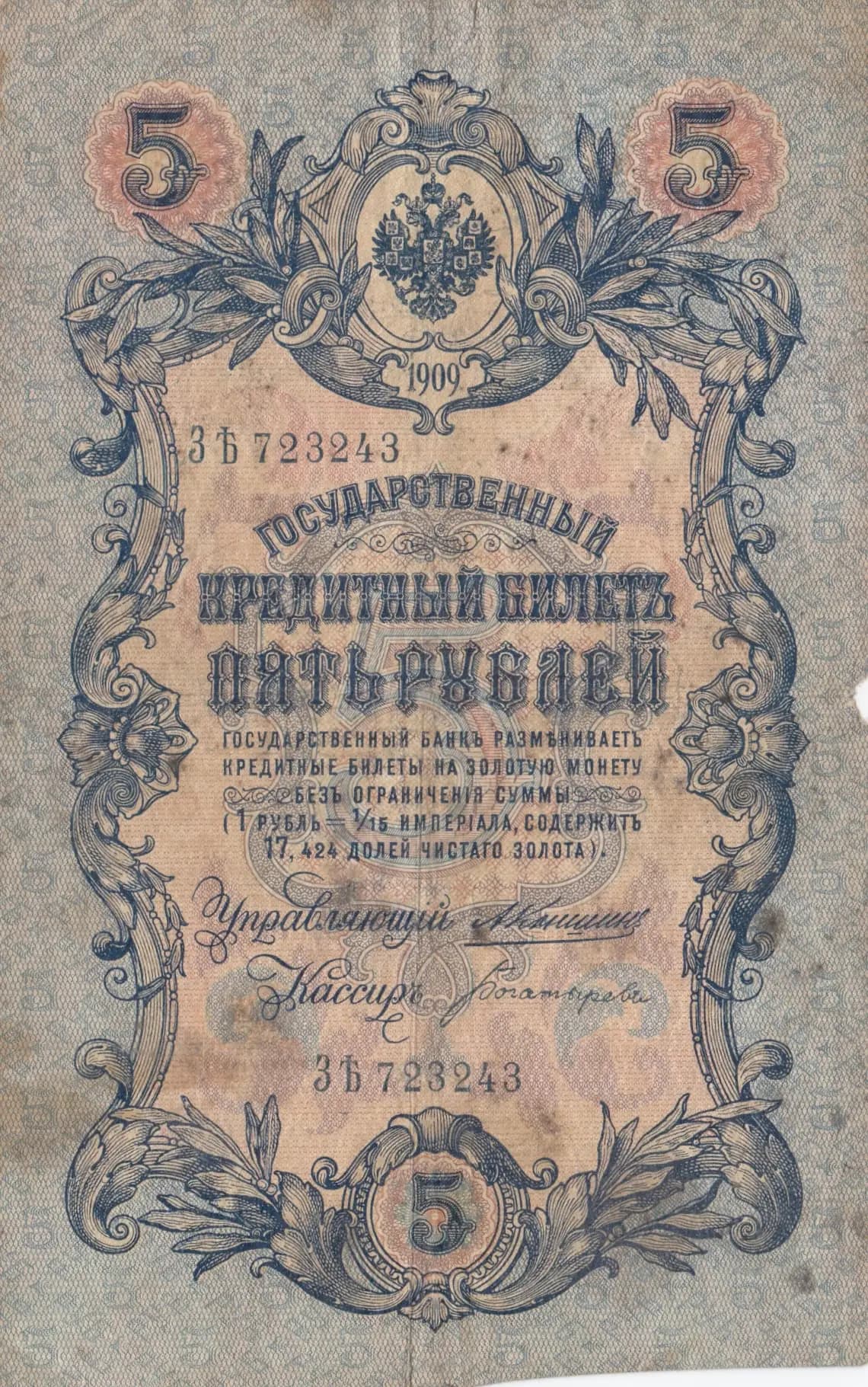
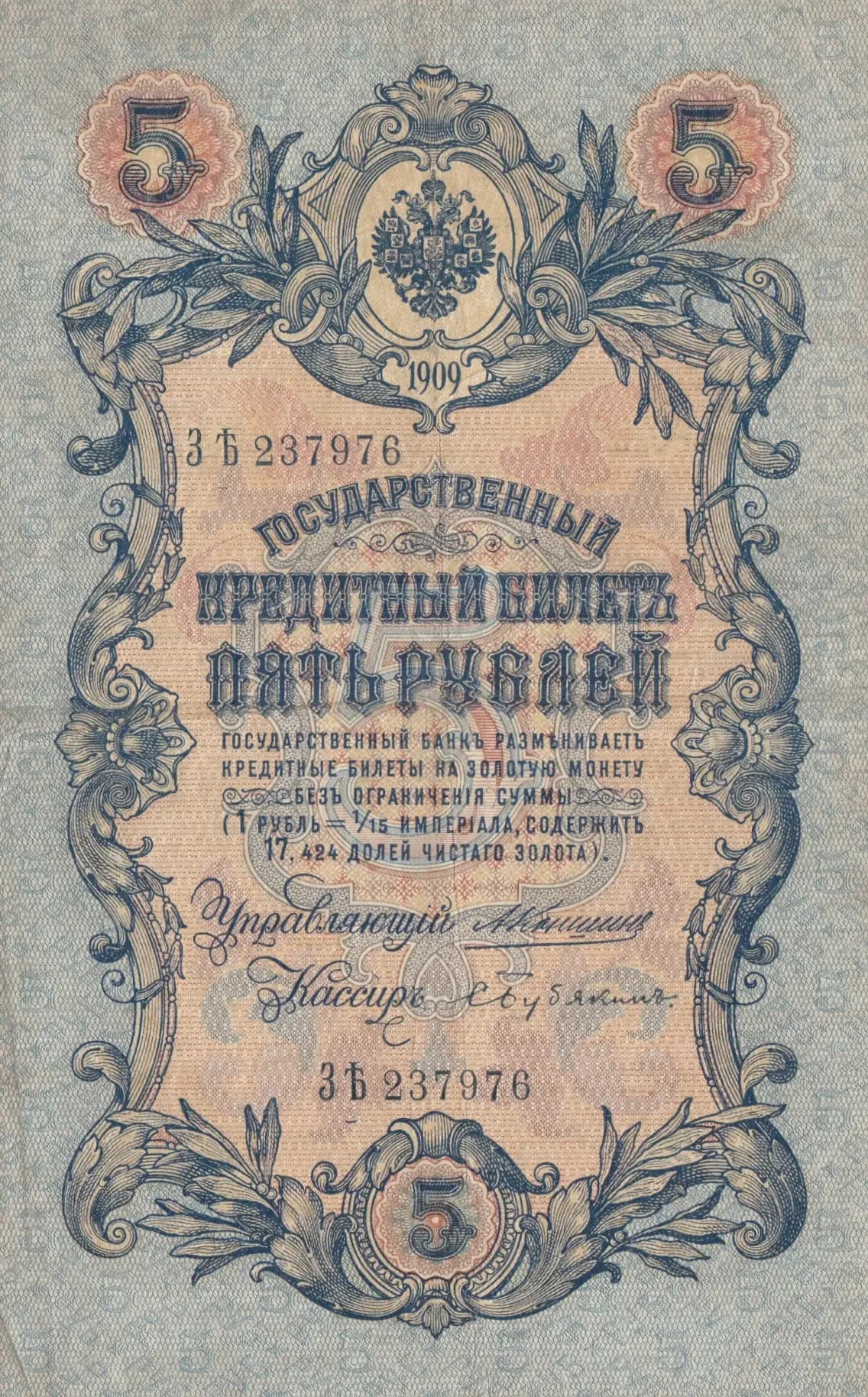
5 rublei 1909
“Sig.Koptelov”
About This Note
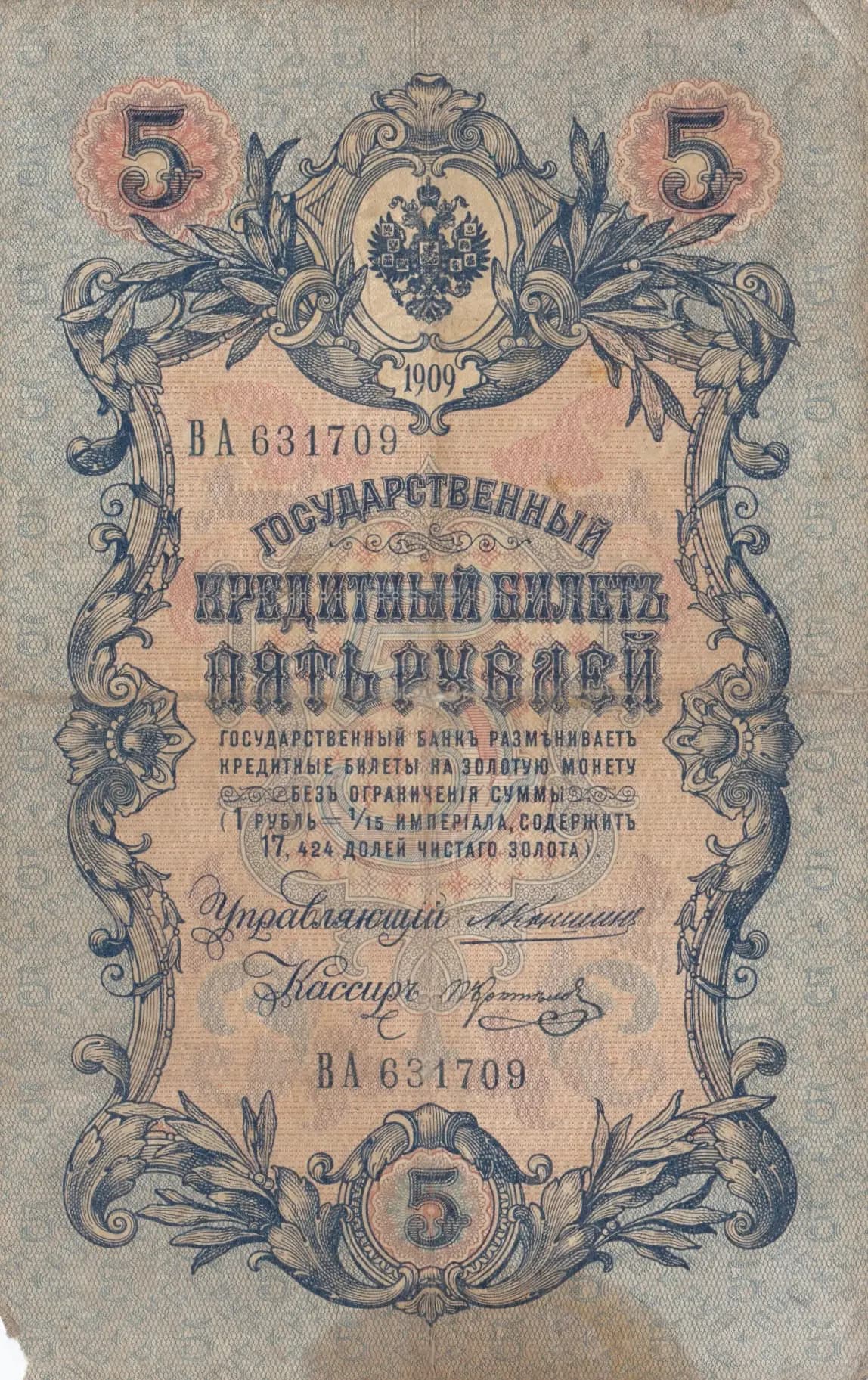
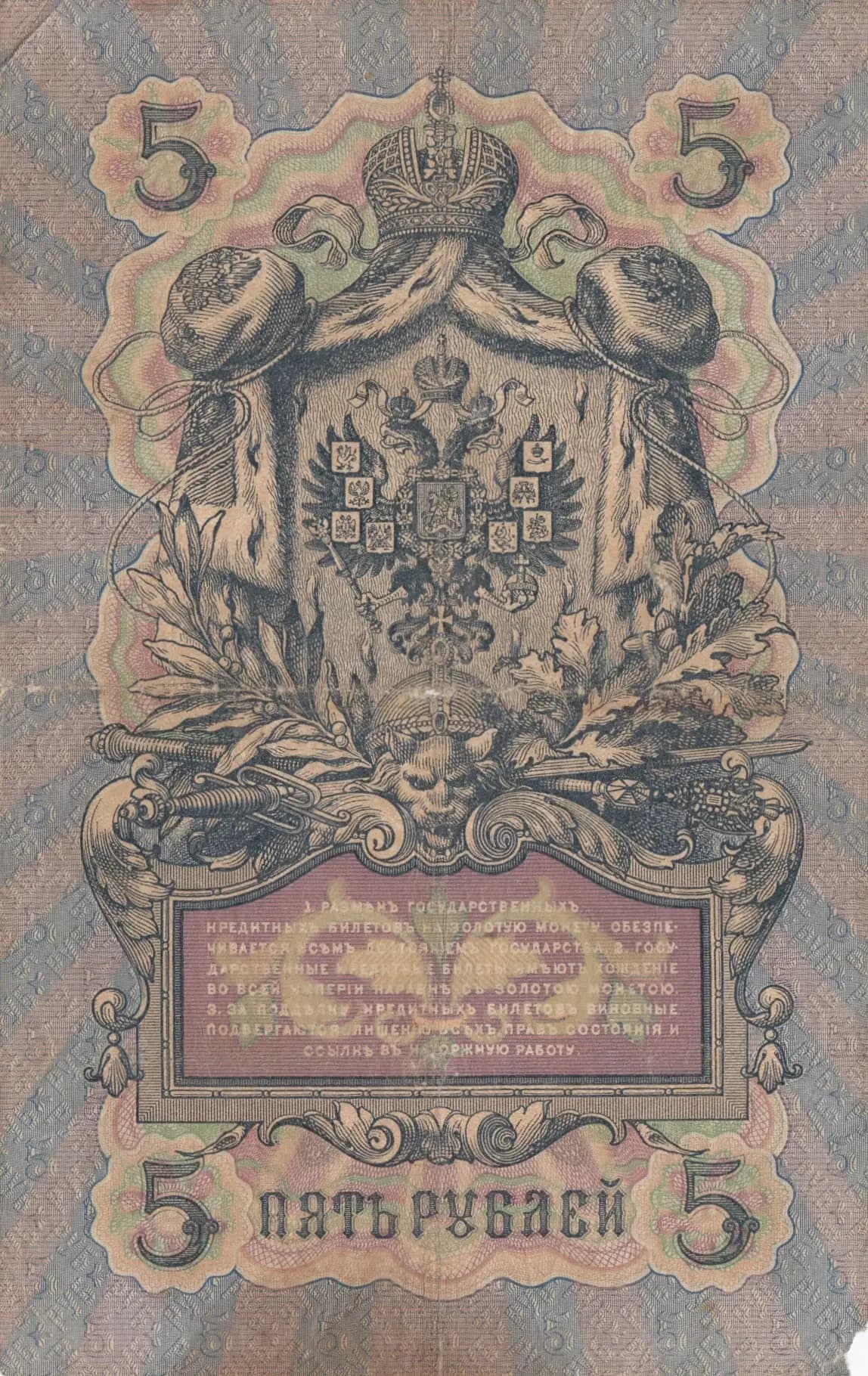
This is a well-circulated 1909 Russian Imperial 5 Rublei note featuring the iconic double-headed eagle coat of arms prominently displayed on both sides. The note exhibits authentic aging with yellowing, creasing, and foxing consistent with early 20th century circulation, grading Fair (F). The ornate engraving and multi-color design (blue, pink, and beige tones) showcase the sophisticated security printing of Imperial Russian currency, making it a desirable example of Tsarist-era credit notes for collectors of Russian or Eastern European numismatics.
Common. The 5 Rublei denomination was the standard mid-range circulation note of the Russian Empire and was printed in substantial quantities throughout the 1909 period and surrounding years. While this specific Pick number (P-10a(13)) variant may have minor distinguishing features, 1909 5 Rublei notes are regularly available in the collector market at modest prices. The Fair condition grade is typical for surviving examples from this era, as few were preserved in better condition. No evidence of limited print runs, recalls, or short-term circulation suggests this is a common date and denomination for Imperial Russian currency collectors.
This 5 Rublei note was issued during the final decade of the Russian Empire under the Tsarist regime, representing the State Bank's gold-backed credit currency system. The elaborate Imperial coat of arms with the double-headed eagle, crown, scepter, and orb symbolized the absolute authority of the Russian monarchy during this period. The note's inscriptions explicitly guaranteed exchange for gold (at the rate of 1 Ruble = 1/15 Imperium, containing 17.424 parts pure gold), reflecting Russia's adherence to the gold standard before World War I disrupted international monetary systems.
Both sides feature the Imperial Russian coat of arms as the central design element: a double-headed eagle wearing an ornate imperial crown with a complex heraldic shield on its chest. The reverse (back) additionally depicts crossed imperial regalia (scepter and orb) positioned behind the eagle, emphasizing sovereign authority. The note is bordered by elaborate ornamental scrollwork and botanical elements (laurel branches, leaf motifs, and flourishes) executed in fine engraving. The front features a beige/cream background with blue and orange/rust-toned inks, while the back employs a pink/mauve palette with blue ornamental work and gray-green background patterning. Denomination numerals '5' appear in ornate circular cartouches in the corners. This design represents the pinnacle of Imperial Russian banknote artistry, emphasizing legitimacy and security through complex engraving and imperial symbolism rather than portraiture.
FRONT: '5' (denomination in corners); 'ВА 631709' (serial number); '1909' (year of issue); 'ГОСУДАРСТВЕННЫЙ КРЕДИТНЫЙ БИЛЕТ' (State Credit Note); 'ПЯТЬ РУБЛЕЙ' (Five Rubles); 'ГОСУДАРСТВЕННЫЙ БАНК РАЗМЕНИВАЕТ КРЕДИТНЫЕ БИЛЕТЫ НА ЗОЛОТУЮ МОНЕТУ БЕЗ ОГРАНИЧЕНИЯ СУММЫ' (The State Bank Exchanges Credit Notes for Gold Currency Without Limit of Amount); '(1 РУБЛЬ = 1/15 ИМПЕРИАЛИ, СОДЕРЖИТ 17,424 ДОЛЕЙ ЧИСТОГО ЗОЛОТА.)' ((1 Ruble = 1/15 Imperium, Contains 17,424 parts Pure Gold.)). BACK: '5' (denomination in all four corners); 'ПЯТЬ РУБЛЕЙ' (Five Rubles); [Additional regulatory text in pink panel below coat of arms, partially legible in image].
Steel engraving (intaglio printing) on paper, executed with sophisticated multi-color printing technique. The fine guilloche patterns, detailed coat of arms engraving, and ornamental scrollwork are characteristic of the highest-quality Imperial Russian banknote production. The security features include intricate background patterns, serial numbers printed in two locations, and fine line engraving throughout. Based on Pick catalog designation for 1909 issues, this note was likely produced by the Imperial Russian State Bank's printing facilities or contracted security printers employed by the Russian government.
The visual analysis indicates serial number 'ВА 631709', with the 'ВА' prefix representing a specific printing plate or series identifier. Pick designation P-10a(13) suggests this is variety 13 within the P-10a classification for 1909 5 Rublei notes. The specific varieties of this denomination are distinguished by signature combinations (noted collector attribution to 'Sig. Koptelov' suggests signature variation study), serial number prefixes, and minor design details. Further variety determination would require comparison with the complete P-10a series variants and examination of signatures present on the note, which are not fully legible in the provided image analysis.