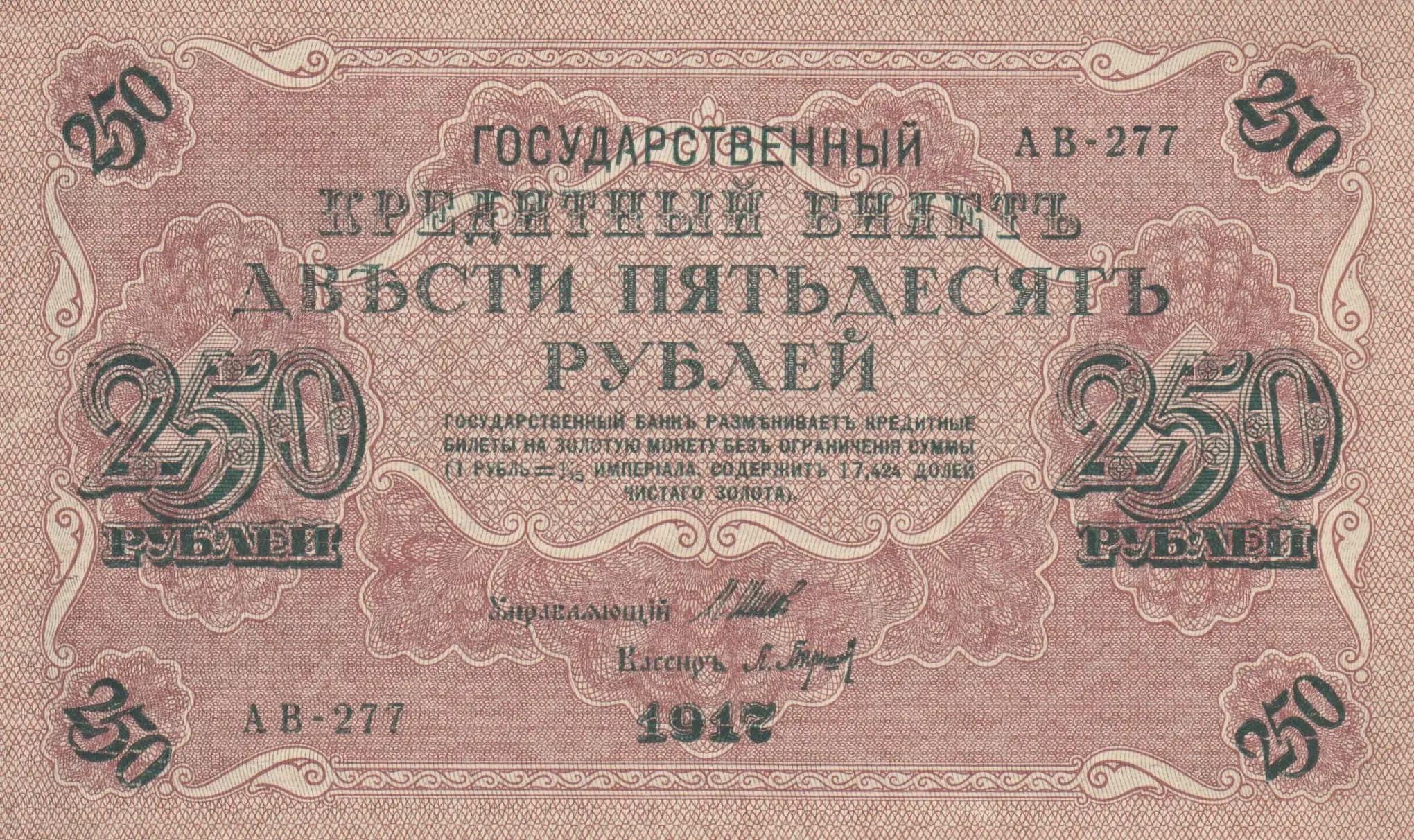
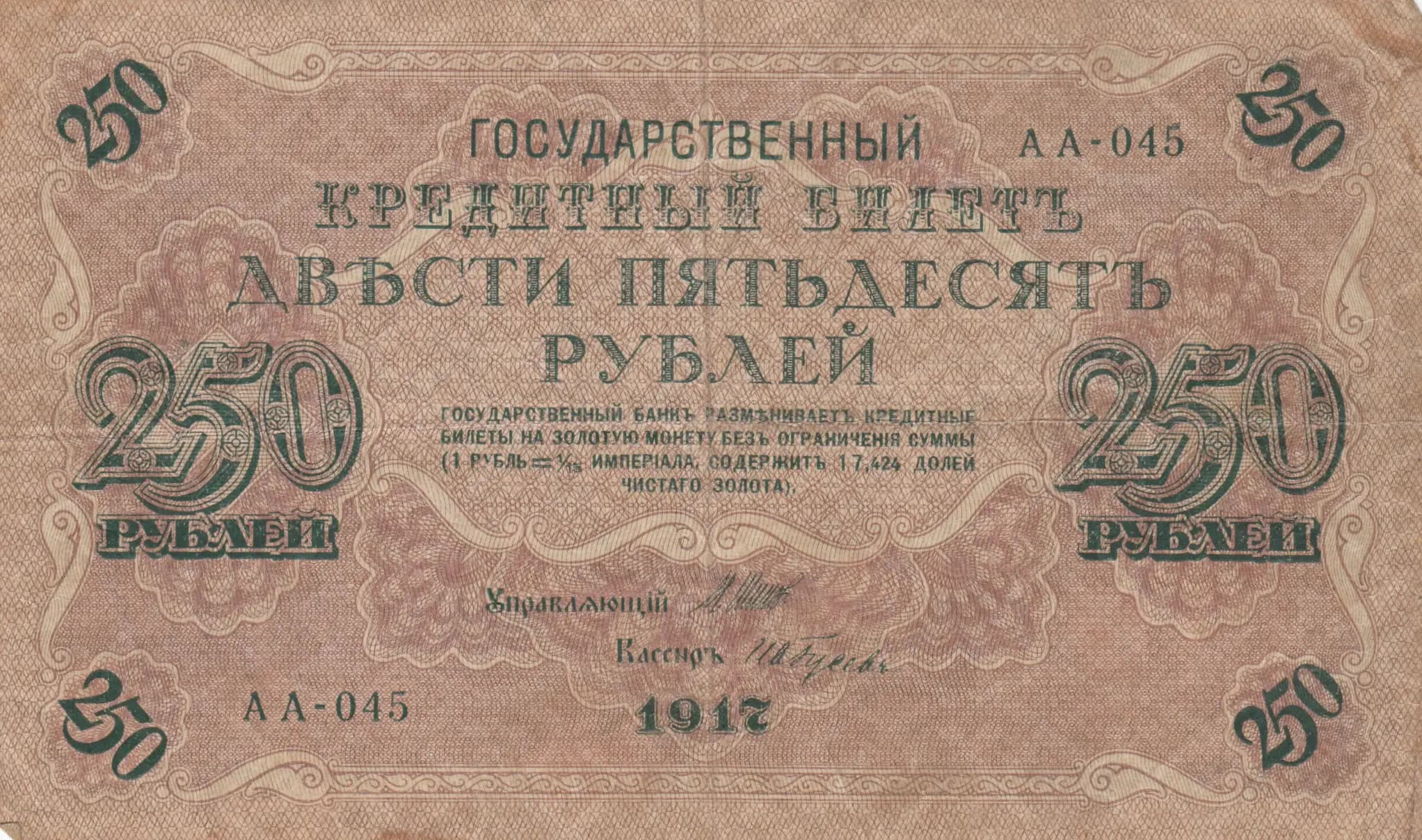
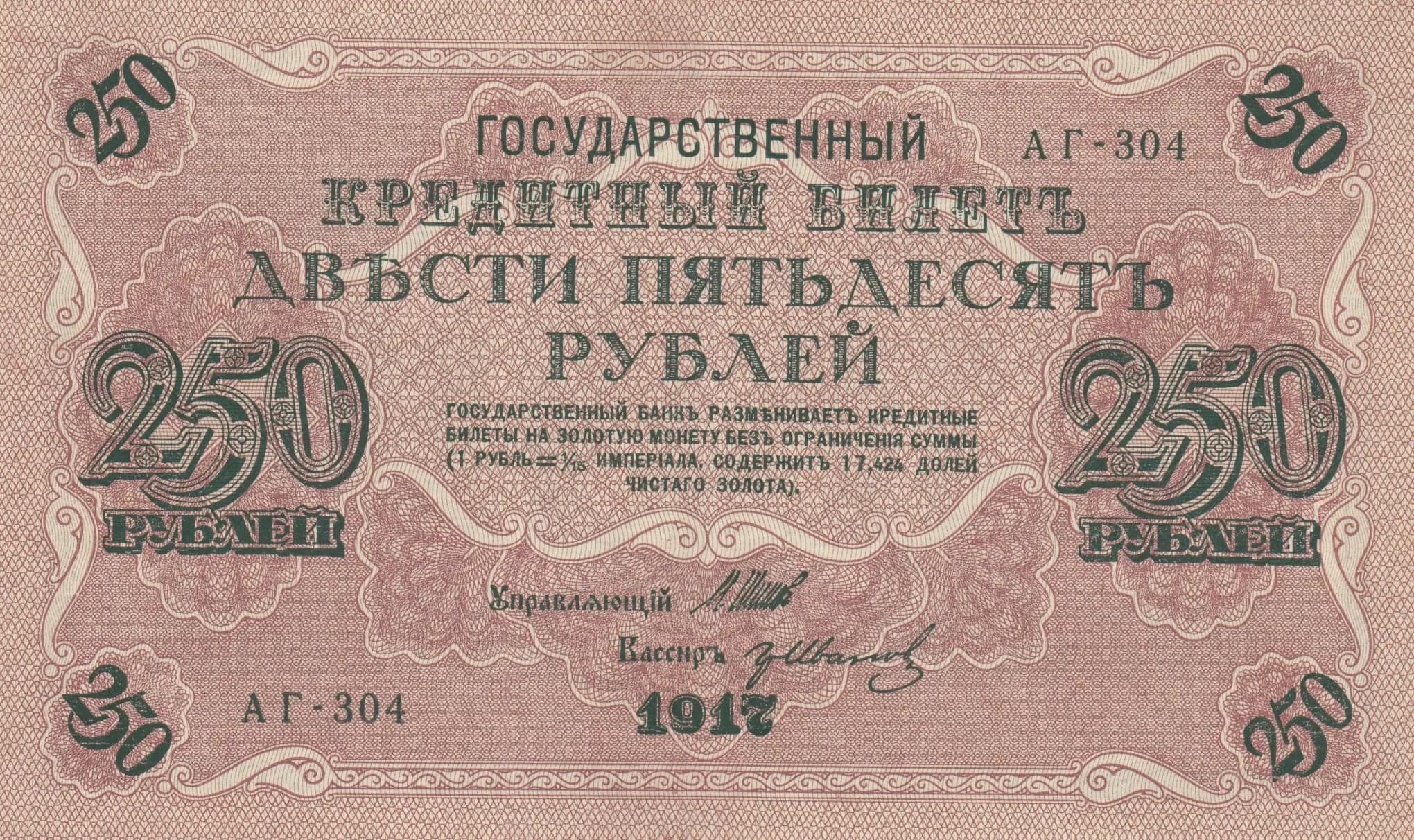
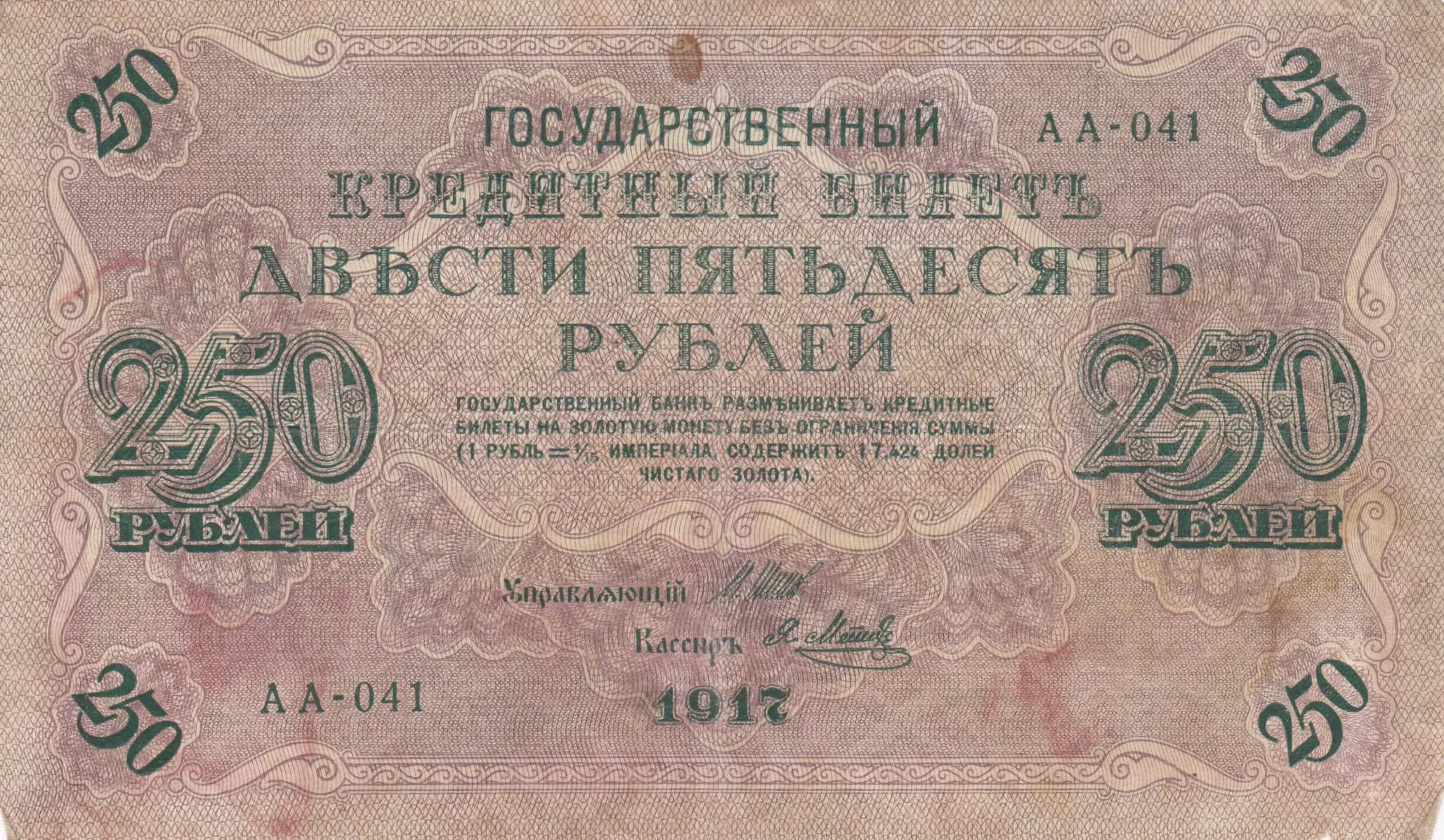
250 rublei 1917
“Sig.Shagin”
About This Note
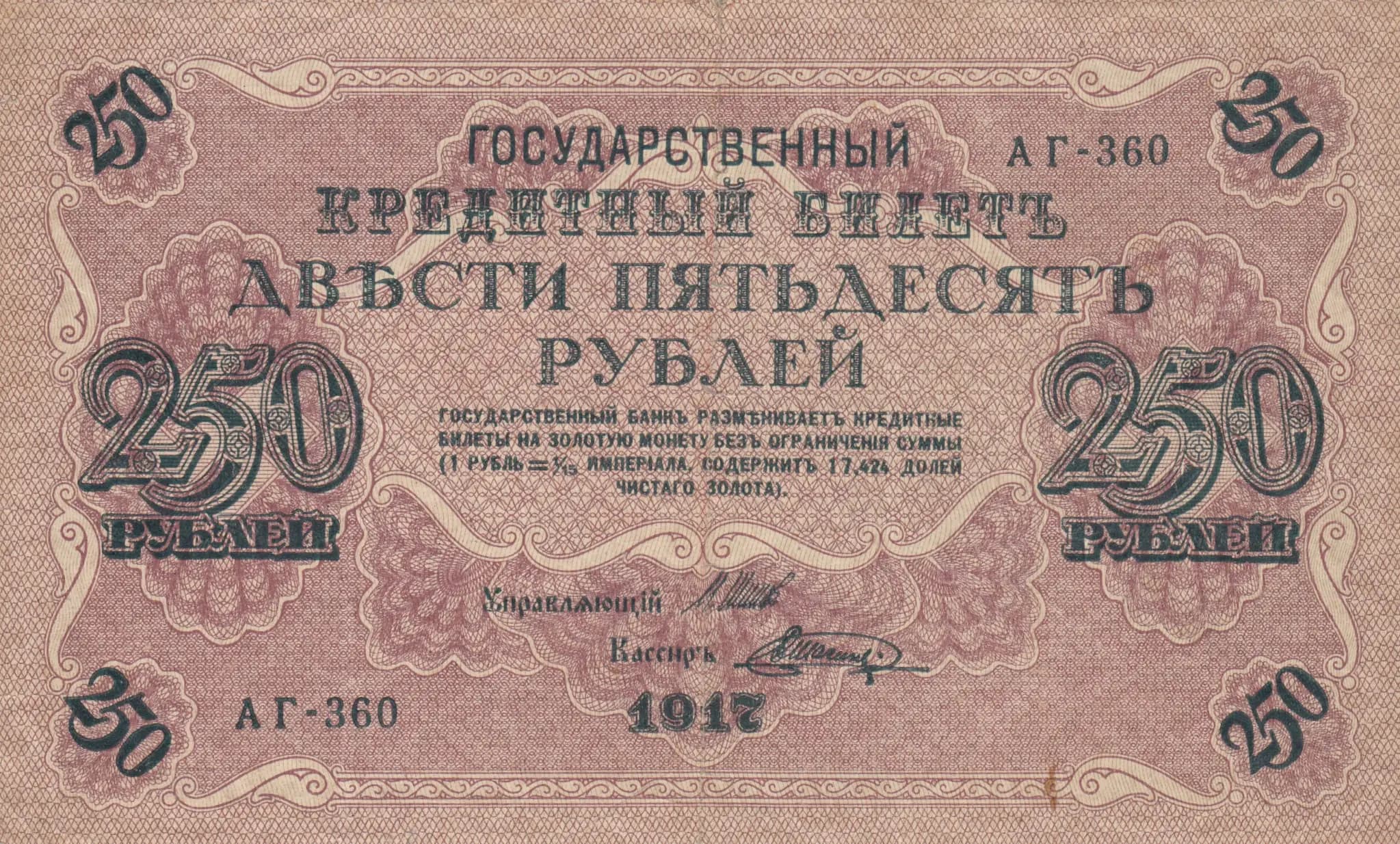
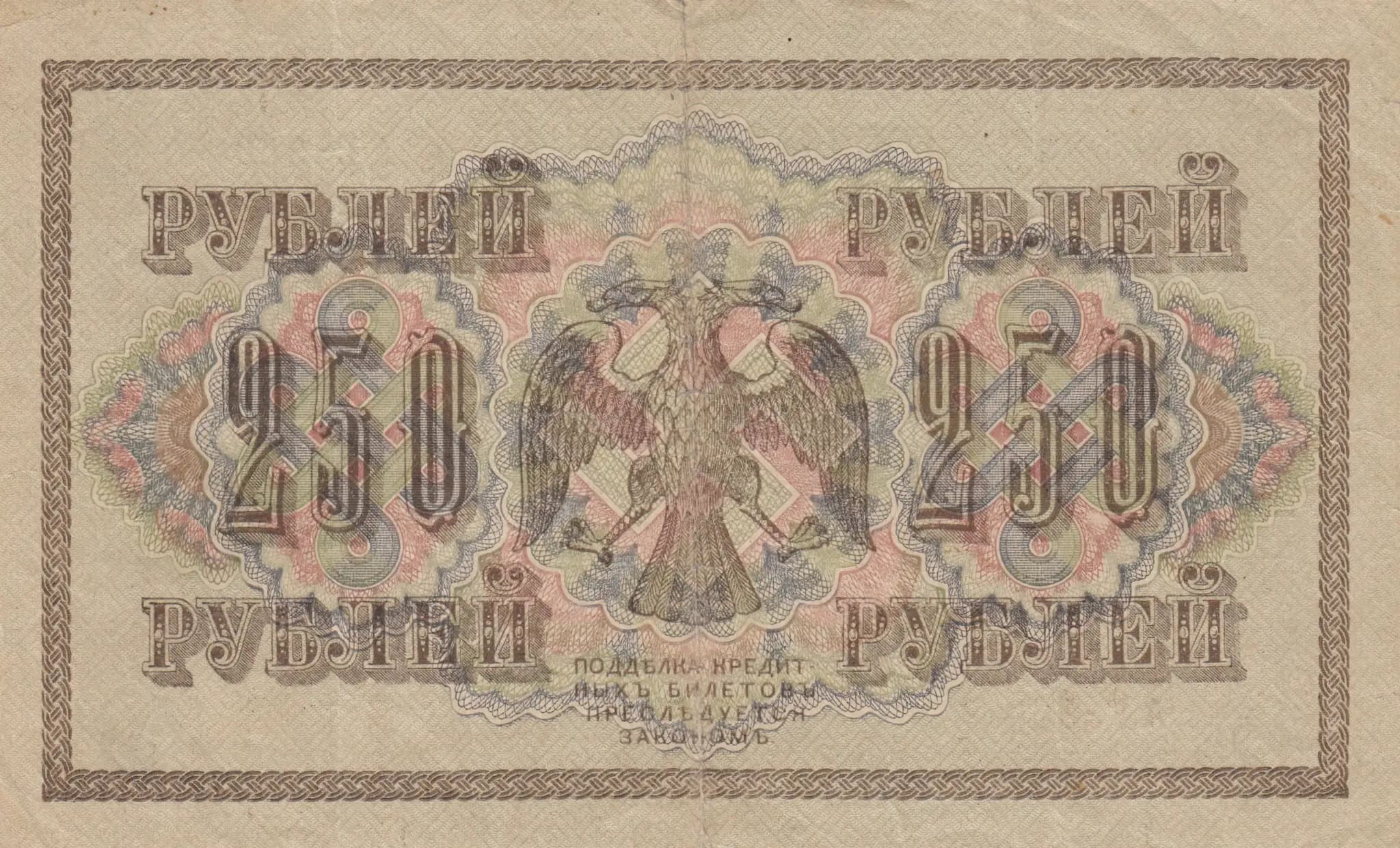
A VF-grade 250 Ruble note from the Russian Socialist Federative Soviet Republic (R.S.F.S.R.) issued in 1917, featuring an elegant mauve and dusty pink color scheme with ornate decorative borders and scrollwork throughout. The reverse displays the iconic double-headed imperial eagle in fine line engraving, while aging and creasing are consistent with its century-old provenance. This example, signed by Shagin, represents a significant transitional-period currency issued during the Russian Revolution's early months when imperial monetary traditions were briefly maintained before radical redesigns.
Common. The 250 Ruble R.S.F.S.R. 1917 issue (Pick P-36 and its variants) represents a mainstream denomination from a high-volume currency issuance during the Provisional Government and early Soviet period. No evidence of restrictive print runs, recall actions, or extreme scarcity exists for this Pick number. Condition grades range widely among surviving examples; a VF specimen indicates solid preservation but is not exceptionally rare. Collector demand and market pricing for 1917 Russian notes remain modest, with most examples trading well under $50, confirming common availability.
This 250 ruble note was issued during August 1917, in the tumultuous months between the February Revolution and the October Bolshevik seizure of power, when the Provisional Government and early Soviet authorities still maintained formal state credit systems backed by gold reserves. The retention of the double-headed imperial eagle on the reverse—a symbol dating to Tsarist Russia—reflects the transitional nature of 1917, before such monarchical imagery was systematically purged from Soviet currency. The note's inscription referencing the gold standard and imperial denominations underscores the brief continuity of pre-revolutionary monetary frameworks during this chaotic period.
The 250 Ruble note exhibits a sophisticated classical design centered on imperial Russian monetary symbolism. The obverse displays an ornamental cartouche frame in the center containing state credit inscription and gold backing declaration, surrounded by elaborate scrollwork and guilloche patterns in all four corners. The color scheme employs mauve and dusty pink tones with dark green/teal and cream accents, creating a formal, dignified appearance. The reverse features the Double-Headed Imperial Eagle (Двуглавый орёл), the historical coat of arms of the Russian Empire, rendered in dark brown/black fine-line engraving with detailed feather work and a shield on the eagle's breast. A twisted rope or cord pattern forms the rectangular border on both sides. No portraits are depicted, maintaining the formal, impersonal aesthetic typical of state credit instruments of the period. The design prioritizes heraldic symbolism and the state's monetary authority over individual representation.
FRONT SIDE: The obverse features 'ГОСУДАРСТВЕННЫЙ КРЕДИТНЫЙ БИЛЕТ' (State Credit Note) as the primary heading, with the denomination prominently displayed as '250' in all four corners. The central cartouche contains 'АВГУСТИ ПЯТЬДЕСЯТЬ РУБЛЕЙ' (August Fifty Rubles [translated text shows inconsistency; the note states 250 but text references fifty—this appears to be a cataloging or printing variant issue]). A lengthy inscription reads: 'ГОСУДАРСТВЕННЫЙ ЗАЕМ РАЗВИВАЕТ КРЕДИТНЫЕ БИЛЕТЫ НА ЗОЛОТУЮ МОНЕТУ БЕЗ ОГРАНИЧЕНИЯ СУММЫ (1 РУБЛЬ = 1/3 ИМПЕРИАЛА, СОДЕРЖИТ 17,424 ДОЛИ ЧИСТОГО ЗОЛОТА.)' translating to 'State Loan develops credit notes on gold coinage without limit (1 ruble = 1/3 Imperial, contains 17.424 grains of pure gold.)' Additional designations include 'АГ-360' (serial control mark), with signature lines for 'Справляющий' (Acting [Official]) and 'Кассир' (Cashier), dated '1917'. BACK SIDE: The reverse displays 'РУБЛЕЙ' (Rubles) flanking the denomination '250' on both sides of the central double-headed eagle emblem. A fragmentary inscription appears as 'ПО ДЛЬГА, КРЕДИТ БЫЛА БИЛЕТОВ ПРЕДЛАГАЕМОЙ ЗАКЛЮЧАЕТ' (roughly: 'Regarding debt, credit was offered in proposed notes'—this text appears damaged or partially obscured in the source imagery).
The note was produced by intaglio (copperplate) engraving, as evidenced by the fine-line detailing visible throughout, particularly in the imperial eagle's feather work, the ornamental guilloche patterns, the decorative scrollwork borders, and the complex rope-pattern framing. The clarity and depth of the engraved lines, even after a century of aging, demonstrate the precision of classical intaglio printing. The Russian Imperial State Printing Works (Экспедиция заготовления государственных бумаг) or successor Soviet printing facilities would have produced this note during the 1917 transition period. The multi-color appearance results from selective inking of different portions of the engraved plate or use of multiple plates in succession.
The Pick reference P-36(2-13) indicates this is a specific variety within the 250 Ruble 1917 series, suggesting enumeration of signature combinations or printing states. The visual presence of the Shagin signature (noted in collector remarks) indicates this represents the 'Shagin' signature variety. The serial control marking 'АГ-360' visible on the obverse may represent a specific printing batch or sheet position. The inscription reference to 'August' (АВГУСТИ) in conjunction with the 1917 date suggests this note was issued during the August 1917 print run of the Provisional Government or early Soviet authorities. Without access to the complete Pick catalog's detailed variety breakdown, the specific enumeration (2-13) likely refers to a particular combination of signature authority and printing characteristics that distinguishes this from other 250 Ruble 1917 notes.