250 rublei 1917
“Sig.Chikhirzin”
About This Note
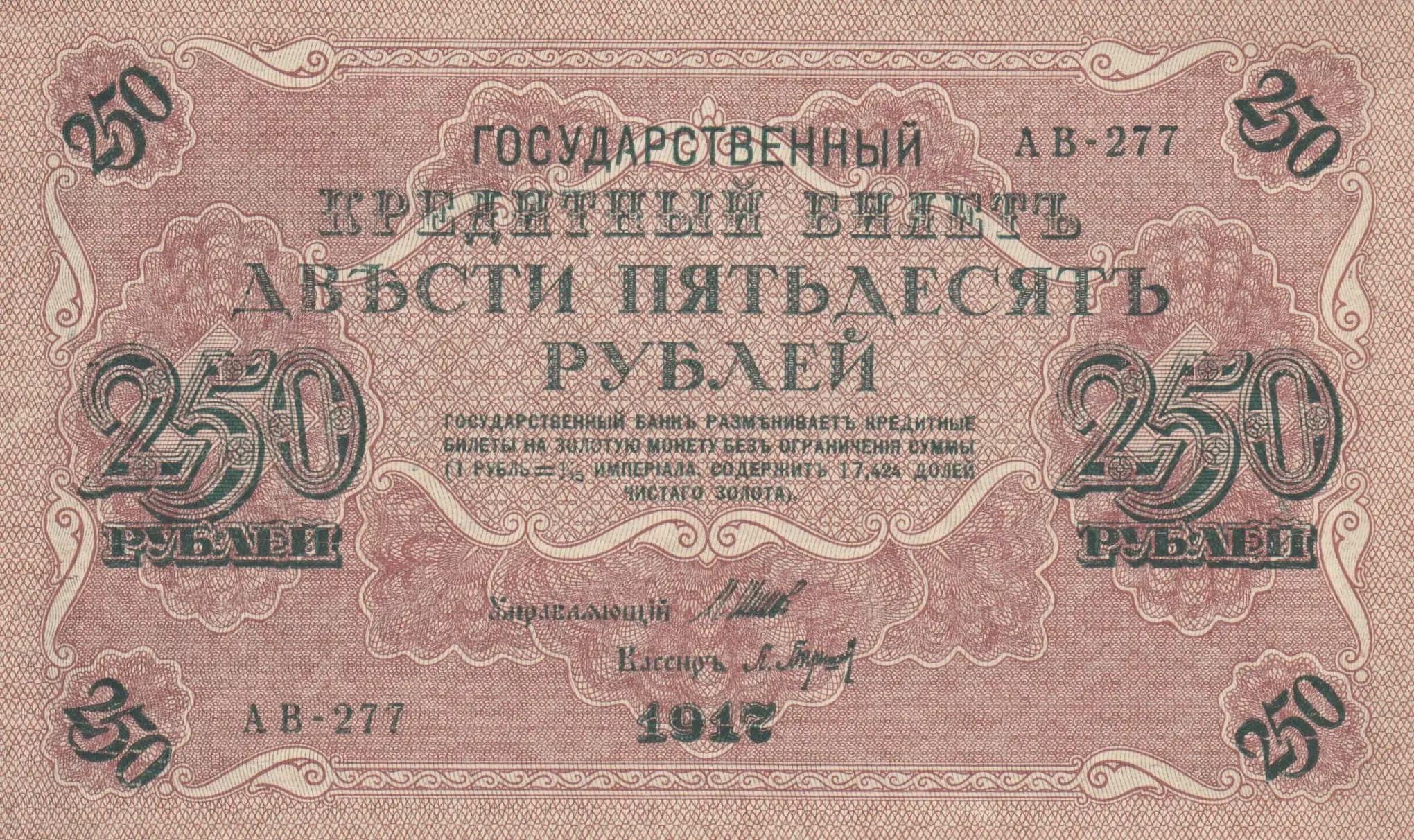
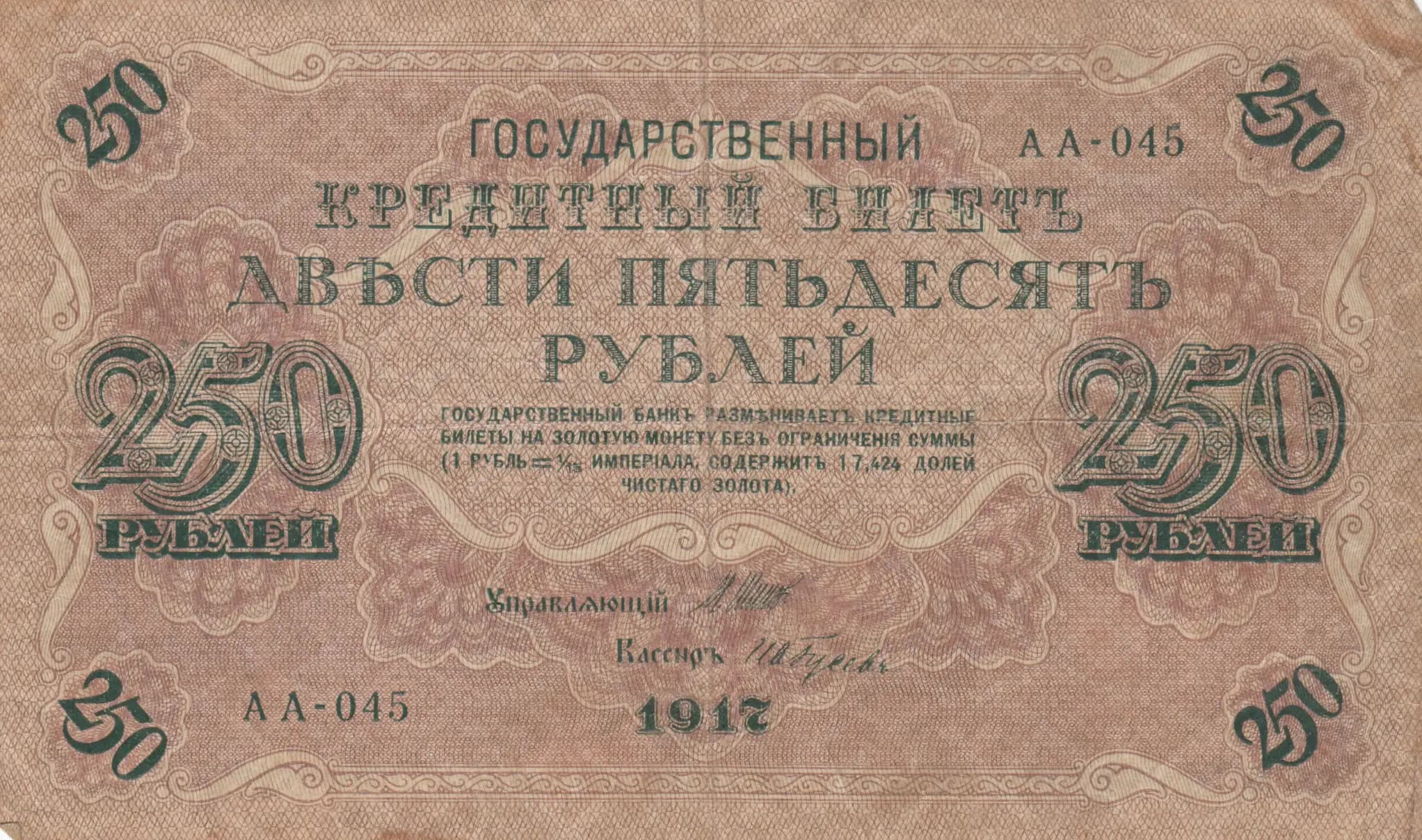
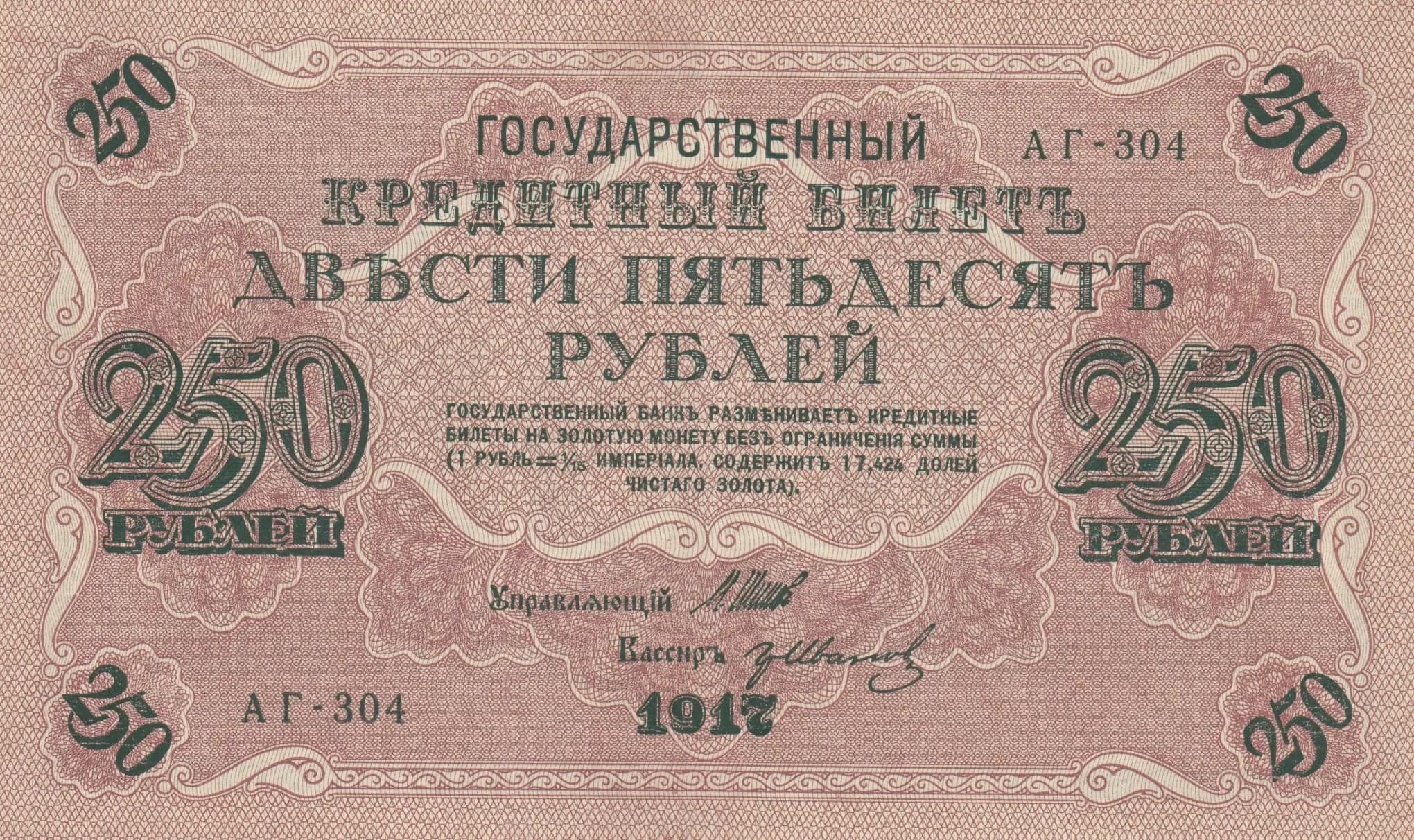
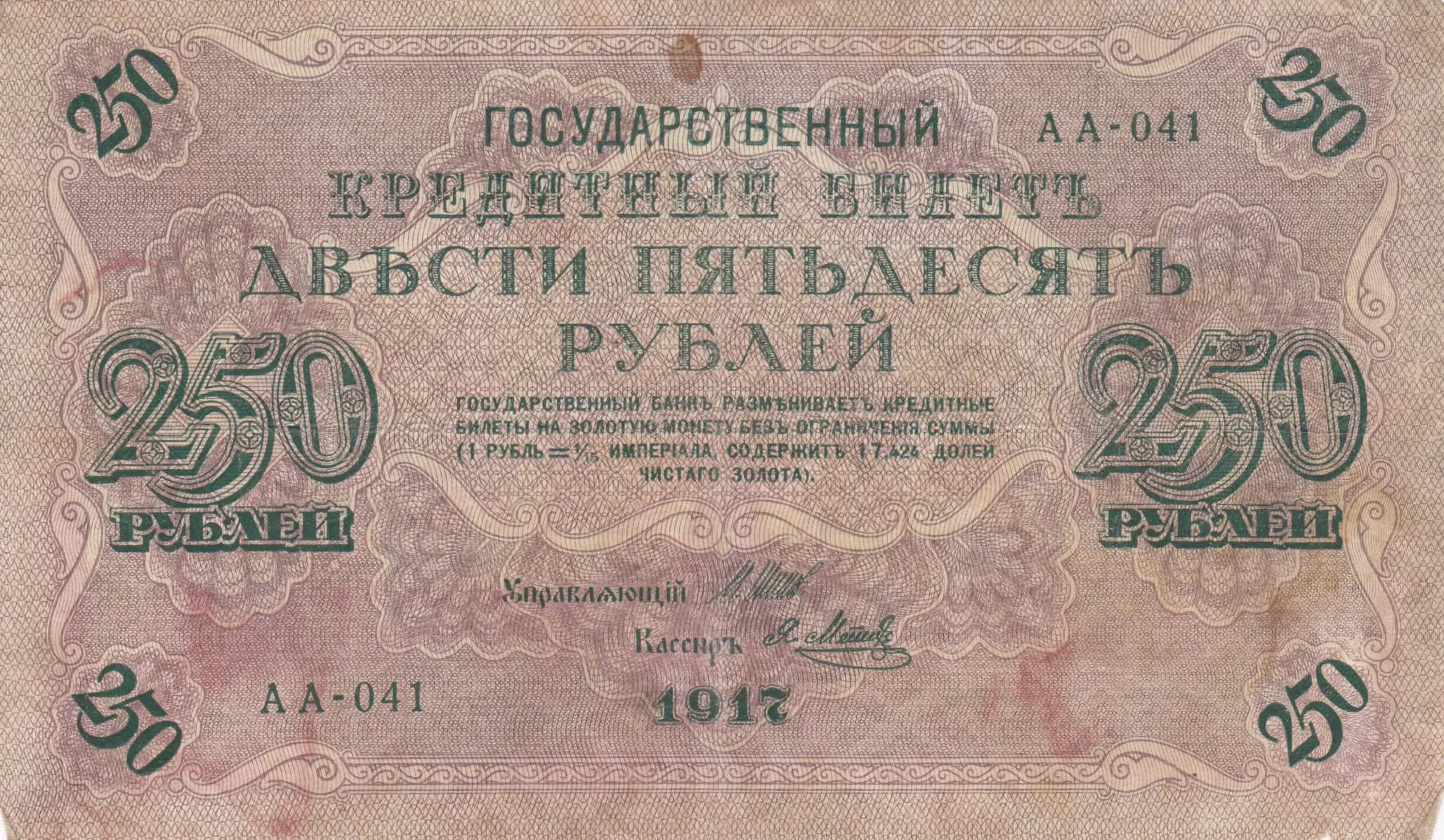
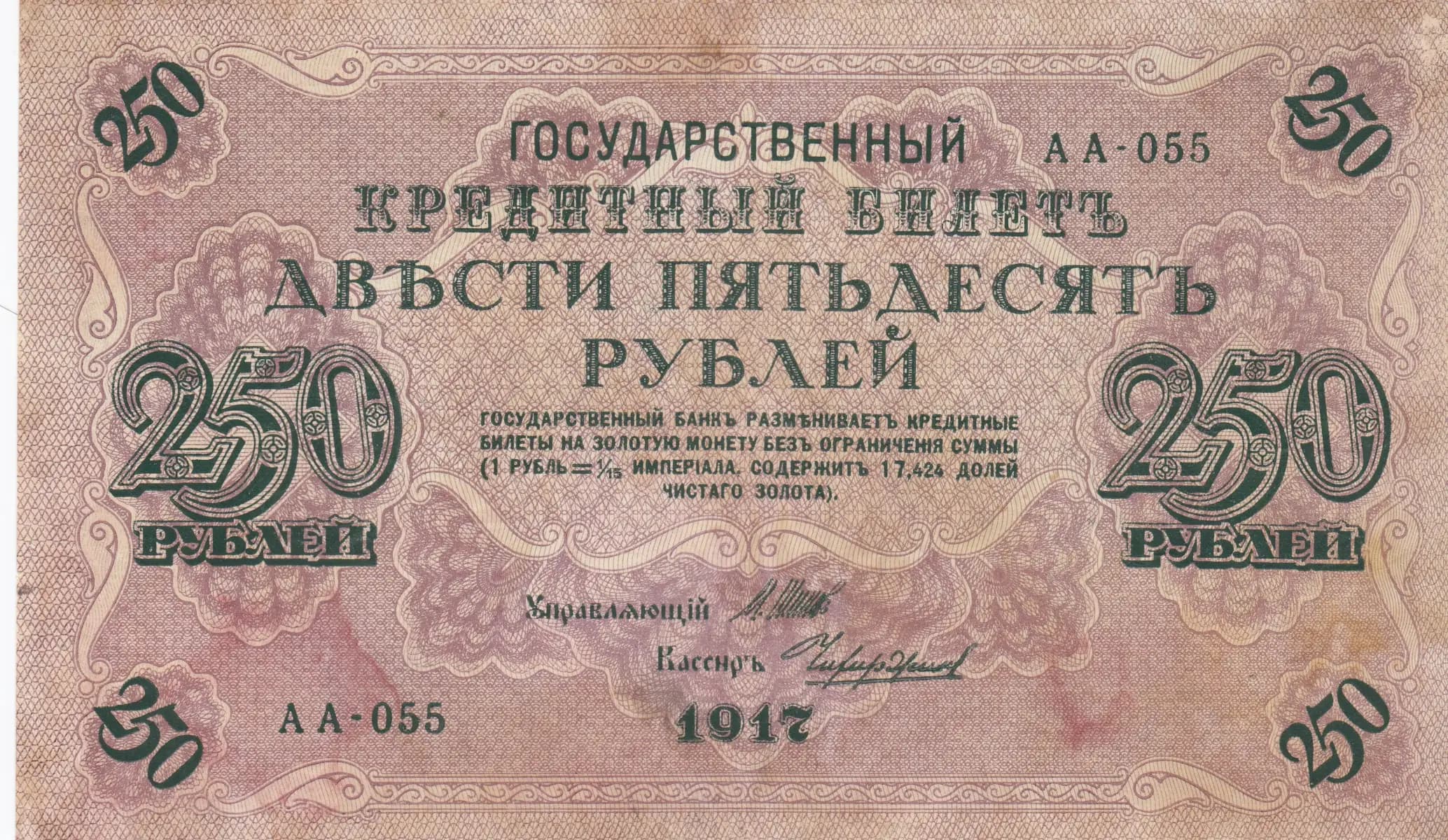
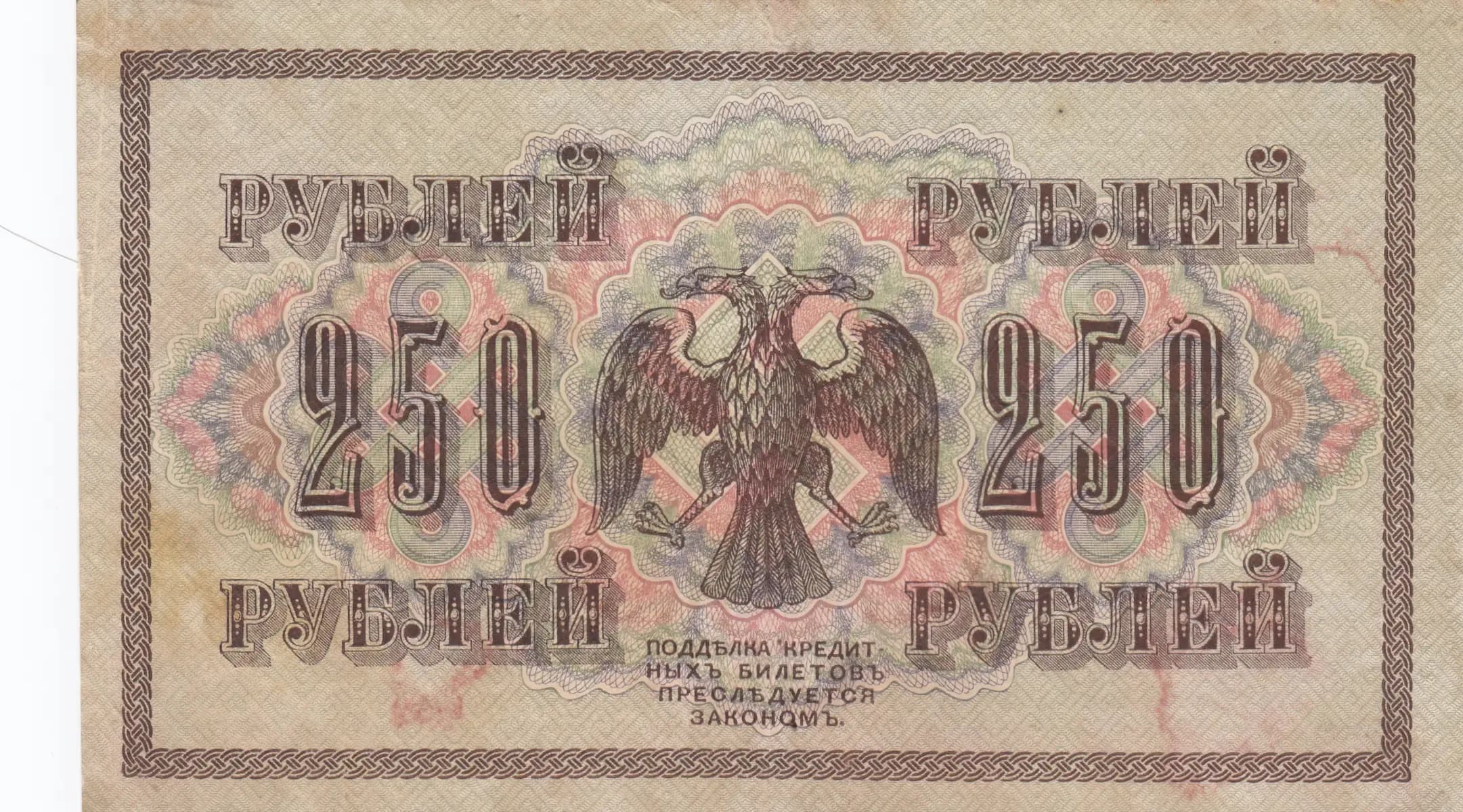
A visually striking 250 ruble note from the Russian Socialist Federative Soviet Republic issued in 1917, rendered in characteristic pink/mauve tones on the obverse with cream and sepia coloring on the reverse. The note displays excellent engraving quality with ornate scrollwork, geometric patterns, and the prominent double-headed Imperial eagle on the reverse, all rendered with fine line work typical of pre-revolutionary Russian currency production. Despite significant aging including foxing, discoloration, and circulation wear consistent with VF grade, the design remains clearly legible and the note retains its historical significance as an artifact from the tumultuous transition period following the Russian Revolution.
Common. The 250 ruble denomination from this 1917 RSFSR series was issued in significant quantities to support the transitional post-revolutionary economy and circulated widely before being superseded by subsequent issues. While individual notes from this era show heavy wear due to extended circulation during the inflation-ravaged early Soviet period, the denomination itself remains commonly encountered in numismatic markets. The VF grade specimen described here, despite its obvious aging and wear, represents a typical example of surviving circulation copies rather than a scarce or rare variety. No evidence suggests this was a limited release, emergency issue, or short-lived series that would elevate its rarity status.
This 250 ruble credit note was issued during 1917, a pivotal year marking the Russian Revolution and the transition from Tsarist to Soviet authority. The note's inscriptions reference the State Bank's commitment to exchange credit notes for gold coins at specified rates (1 ruble = 1/2 Imperial, containing 17.42 parts pure gold), representing the monetary framework still in operation during the early Soviet period before hyperinflation eroded currency value. The reverse prominently features the double-headed eagle of the Russian Imperial coat of arms, a symbol retained briefly by the nascent R.S.F.S.R. before eventually being replaced with Soviet imagery on subsequent issues.
This 250 ruble banknote exemplifies the ornamental style of early 20th century Russian currency design. The obverse features an all-over decorative pattern dominated by scrollwork and floral/geometric motifs rendered in pink and mauve tones against a cream background, with the large denomination numerals '250' positioned prominently in all four corners in green/teal coloring. The reverse presents a more formal heraldic composition, centering on the double-headed eagle of the Russian Imperial coat of arms (Государственный герб России) enclosed within an ornate cartouche or shield-like frame. Surrounding this central eagle device is an elaborate Celtic-style interlocking border pattern with leaf and scroll ornamental elements, rendered in brown and sepia tones. The denomination '250' appears large on both left and right margins of the reverse. The overall design reflects the transitional period when Soviet authorities retained pre-revolutionary symbols while establishing new governmental authority.
FRONT SIDE: 'ГОСУДАРСТВЕННЫЙ КРЕДИТНЫЙ БИЛЕТ' (State Credit Note/Banknote). The note displays denomination text including 'АВГУСТИ ПЯТЬДЕСЯТЬ РУБЛЕЙ' (August Fifty Rubles) with '250 РУБЛЕЙ' (250 Rubles) shown in corners. A critical inscription states: 'ГОСУДАРСТВЕННЫЙ БАНК РАЗМЕНИВАЕТ КРЕДИТНЫЕ БИЛЕТЫ НА ЗОЛОТУЮ МОНЕТУ ОЗНАЧЕННОГО ДОСТОИНСТВА СУММЫ (1 РУБЛЬ = 1/2 ИМПЕРИАЛА, СОДЕРЖИТ 17.42 ДОЛЕЙ ЧИСТАГО ЗОЛОТА)' translating to 'The State Bank exchanges credit notes for gold coins of the specified denomination sum (1 ruble = 1/2 Imperial, contains 17.42 parts pure gold).' Signature blocks indicate positions for 'Управляющий' (Manager/Administrator) and 'Кассир' (Cashier). Serial number visible as 'АА-055'. REVERSE SIDE: 'РУБЛЕЙ' (Rubles) and '250' appear in large numerals. The inscription 'ПОДДЫЖКА КРЕДИТНЫХ БИЛЕТОВЪ ПРЕБОЛЖАЕТСЯ ЗАКОНОМ' translates to 'Support of credit notes is provided by law.'
The banknote was produced using intaglio engraving (copperplate printing), evidenced by the fine line work, intricate detail in the ornamental borders, scrollwork patterns, and the exceptionally detailed rendering of the double-headed eagle and cartouche on the reverse. The precision of the geometric and floral patterns throughout, combined with the clear definition of small typographic elements and security design features, is characteristic of the high-security engraving standards employed by the Russian State Bank. The multiple color printing (pink/mauve, green/teal, brown, sepia, and cream) suggests multi-plate intaglio production. Specific printer attribution for Pick-36 specimens would require consultation of Russian Imperial and early Soviet printing records, though the quality suggests production by the State Printing Works (Государственная типография) or licensed security printer operating under RSFSR authority in 1917.
The specimen is identified as Pick-36(2-12), indicating it is variety 2-12 within the Pick catalog system for this denomination and issuer. The serial number 'АА-055' suggests this is from an early print run, as the prefix begins with the first letters of the Cyrillic alphabet. The signature block shows provision for both Manager and Cashier signatures, typical of this series. The note's lack of overprints or subsequent modifications indicates it represents the standard issue type for this Pick designation without known varieties such as overprints, date variants, or emergency stamp additions. Collector attribution to 'Sig. Chikhirzin' (likely referring to a known signature variant on the note) may provide additional identification within specialized Russian numismatic collections.