5000 lei 1945
Market Prices
50 salesAbout This Note
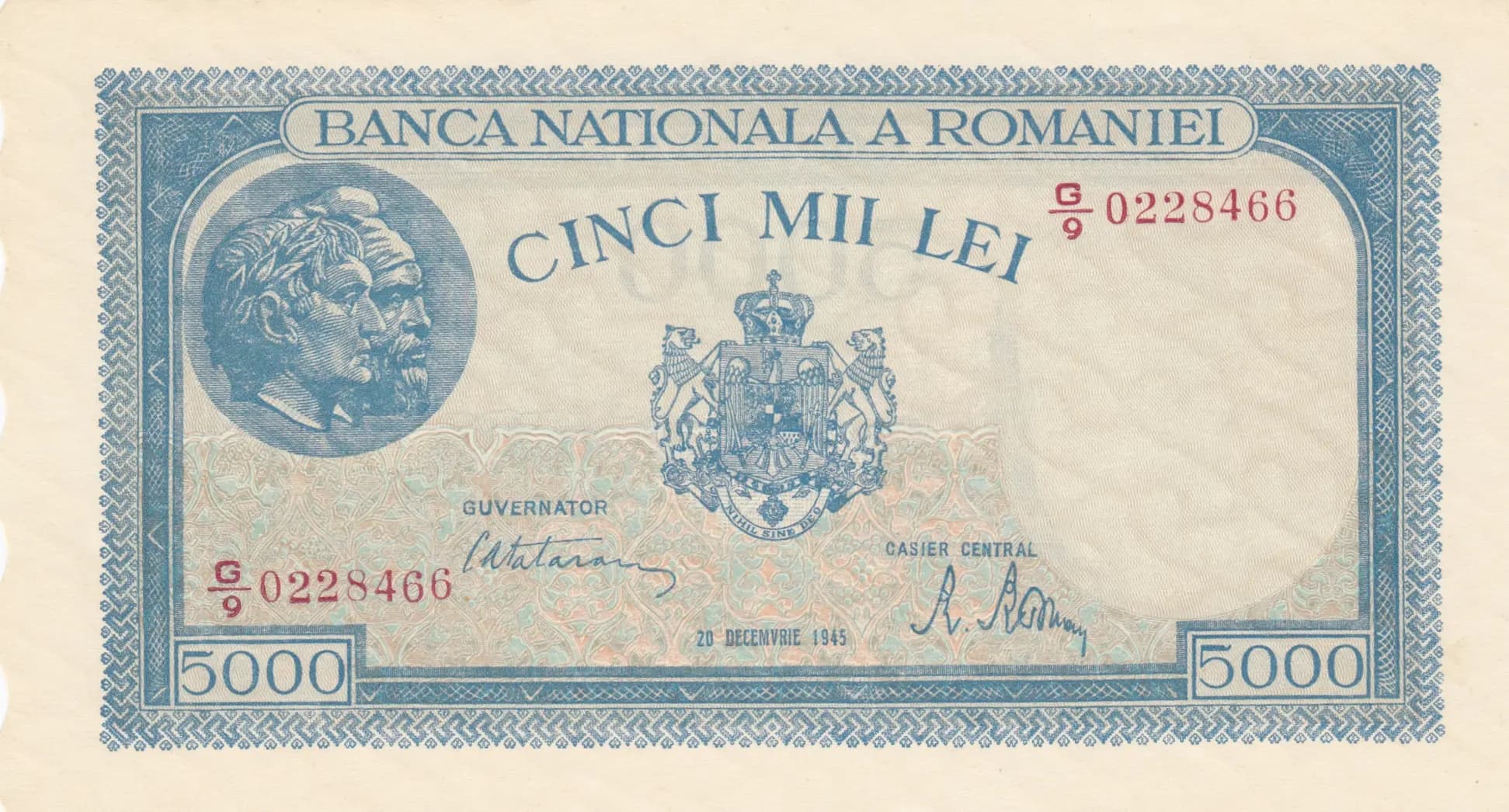
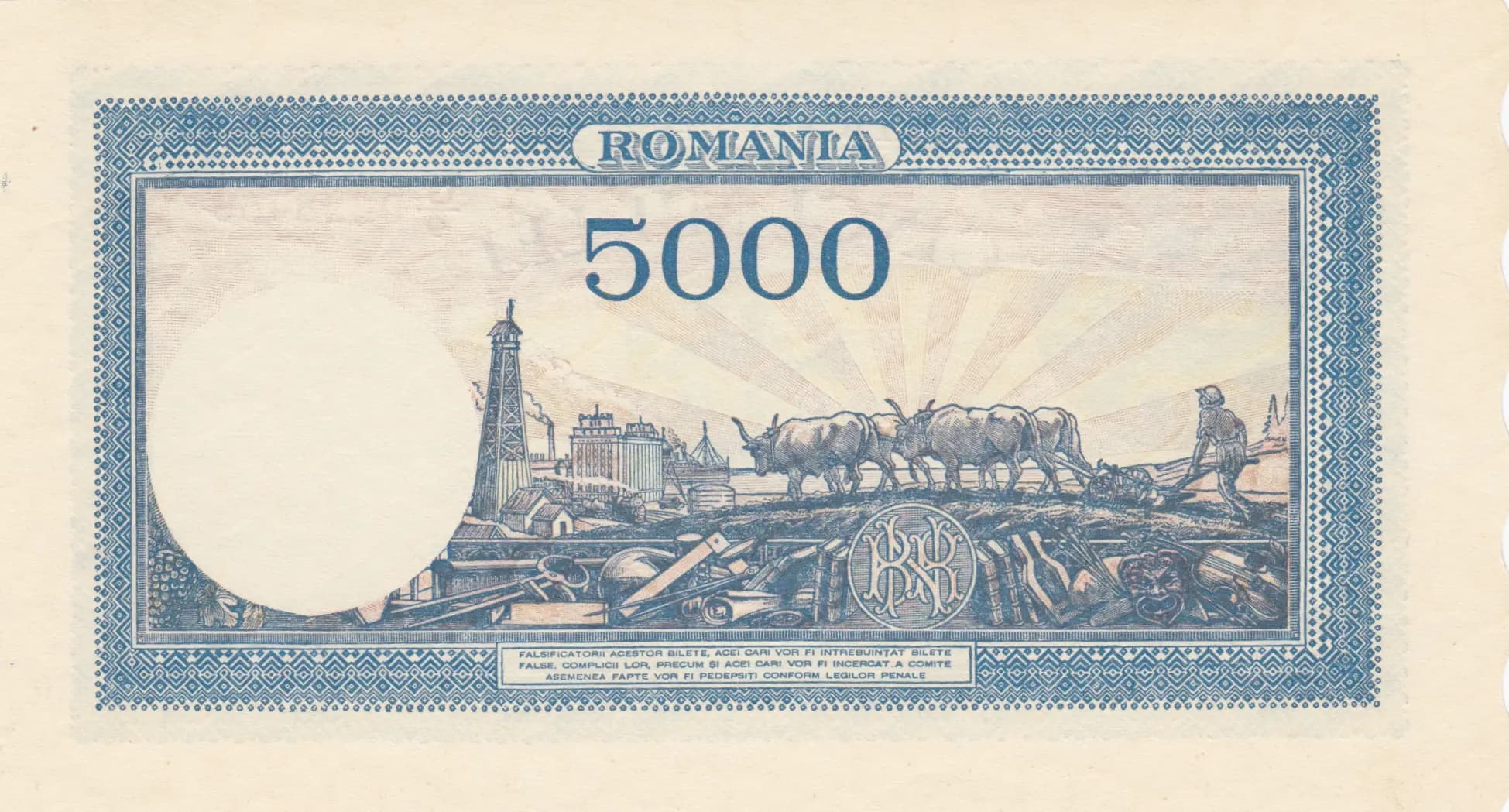
This is a handsome example of Romania's 5000 Lei note from 1945, presented in Uncirculated condition with excellent eye appeal. The note displays the characteristic light blue coloring and fine classical engraving typical of the period, featuring the profiles of Trajan and Decebal on the obverse and an allegorical representation of industry and agriculture on the reverse. The crisp paper, sharp impressions, and absence of wear indicate a note that has been well-preserved since its issue over 75 years ago.
Common. This note circulated widely during its issue period (October 1944–December 1945) and survived in significant quantities. The eBay price data provided shows consistent sales ranging from under $1 to approximately $95 for premium graded examples, with UNC examples typically fetching $5–$22 in recent years (2013–2020), indicating ready market availability and active collector interest at modest price points. The PMG population report shows minimal grading activity, typical of common notes where most collectors preserve examples without professional certification. Print runs for this denomination during this period were substantial.
This banknote was issued during a pivotal moment in Romanian history, specifically during the period of 10 October 1944 to 20 December 1945, following Romania's shift in World War II. The obverse imagery of Trajan and Decebal references Romania's historical Dacian roots and Roman conquest, serving as nationalist symbolism. The reverse design celebrating industry and agriculture reflects the post-war emphasis on national reconstruction and economic development, depicting the oxen-powered farming and petroleum extraction that were vital to Romania's economy.
The obverse features classical profiles of the Roman Emperor Trajan and the Dacian King Decebal in circular medallions, representing the historical relationship between Rome and ancient Dacia (modern Romania). A crowned heraldic shield bearing lions serves as the central coat of arms, flanked by ornamental geometric patterns in blue. Two signature lines for the Governor and Central Cashier appear in the lower section. The reverse depicts an allegorical scene of national prosperity: an oil derrick representing industrial development rises on the left, while a farmer and team of oxen engaged in plowing occupy the center-right, symbolizing agricultural production. Industrial buildings and structures dot the background. The entire design is framed by an intricate decorative geometric border pattern rendered in fine line engraving. Both sides display the denomination prominently and are printed primarily in blue and black on cream-colored paper.
FRONT: 'BANCA NATIONALA A ROMANIEI' (National Bank of Romania) | 'CINCI MII LEI' (Five Thousand Lei) | '5000' (denomination) | 'GUVERNATOR' (Governor) | 'CASIER CENTRAL' (Central Cashier) | '20 DECEMBRIE 1945' (20 December 1945) | Serial number 'G/9 0228466'. BACK: 'ROMANIA' (Romania) | '5000' (denomination) | Counterfeiting warning: 'FALSIFICATORI ACESTOR BILETE, ACEI CARE VOR FI INTREBUINTATI BILETE FALSE COMPLICI LOR, PRECUM SI ACEI CARE VOR FI INCEPUT A CONTI ASEMENEA PARTE VOR FI PEDEPSITI CONFORM LEGILOR PENALE' (Counterfeiters of these notes, those who will use false notes, their accomplices, and those who have begun such work will be punished according to criminal laws).
Intaglio (steel engraving) printing, the standard security printing method for Romanian banknotes of this era. The fine line work, intricate geometric patterns, and the sharp definition of the portrait profiles and landscape details visible in the images are characteristic of high-quality intaglio production. The printer information is not prominently displayed on this note but would have been one of Romania's official security printers or contracted European printers of the period.
Pick P-56 is distinguished from the earlier P-55 (dated 28 September 1943, 2 May 1944, and 22 May 1944) by its later date of 20 December 1945 and the presence of the BNR watermark (documented as either horizontal or vertical orientation). The note is known to exist in two signature varieties. The observed example bears the serial number prefix 'G/9', consistent with standard issue production. No overprints or unusual variants are apparent in the specimen examined.