500 lei 1934
Market Prices
25 salesAbout This Note
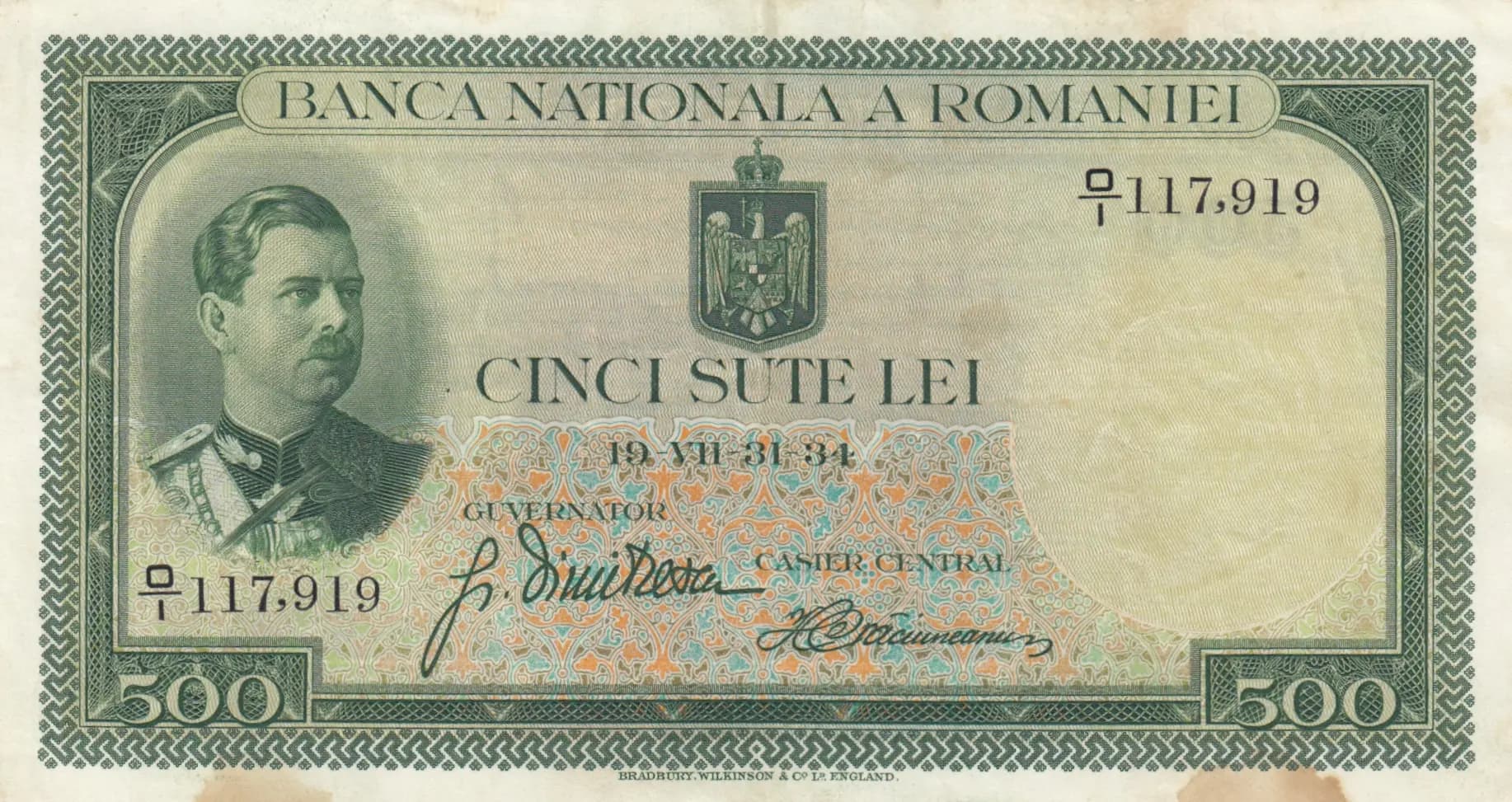
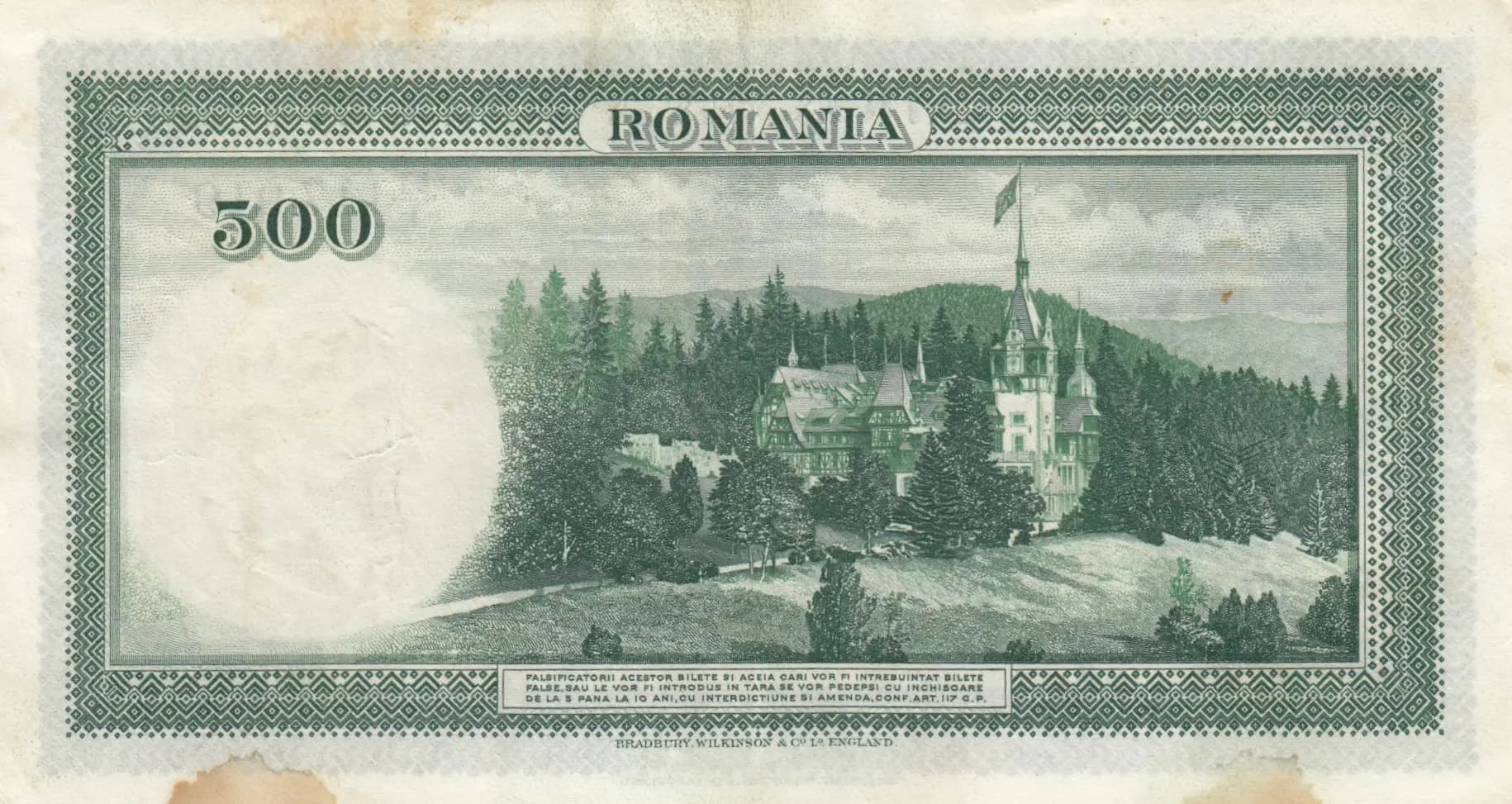
This is a VF-graded Romanian 500 lei banknote from 1934, issued by the Banca Nationala a Romaniei and printed by the prestigious English security printer Bradbury, Wilkinson & Co. The note features King Carol II in military dress on the obverse and Peleș Castle in the reverse, both rendered in fine line engraving with green as the dominant color. The piece shows moderate circulation wear consistent with its age, including light foxing and creasing, but retains excellent detail in the ornate borders and architectural rendering.
Common. This is a standard regular-issue banknote from 1934 with no indication of a limited print run, and it was not recalled or issued by a short-lived authority. The eBay market data provided shows consistent sales activity over many years (2013-2024) with VF examples regularly selling in the $22–$61 range, with most VF sales clustering around $25–$35. This pricing pattern and consistent availability in the secondary market are strong indicators of a common note. The 2016 catalogue value of $55 for VF also reflects moderate, predictable pricing typical of common issues rather than scarce material.
This 1934 issue was authorized during the reign of King Carol II, a period of significant modernization in Romania. The prominence of Carol II's military portrait reflects his status as head of state during the interwar period, while the depiction of Peleș Castle—the royal summer residence in Sinaia—serves as a symbol of national pride and royal authority. The note's production by Bradbury, Wilkinson & Co, a premier British security printer, demonstrates Romania's engagement with Western banking standards and technological sophistication during this era.
The obverse features a left-facing profile portrait of King Carol II in full military ceremonial dress, complete with medals, insignia, and decorative collar, positioned at the left side of the note. The reverse depicts Peleș Castle (Castelul Peleș) in Sinaia, the royal summer residence, rendered as a detailed architectural landscape nestled in a mountain valley surrounded by dense evergreen forest with mountains visible in the background, with a flag flying from the castle's tower. Both sides are framed with ornate geometric border patterns and baroque floral design elements. The Romanian coat of arms (featuring the shield with eagle and crown) appears at the top center of the obverse. The denomination '500' is displayed prominently on both sides, and the color palette consists primarily of dark green on a cream/beige underprint with orange and blue accents in the decorative elements.
Front side: 'BANCA NATIONALA A ROMANIEI' (National Bank of Romania), 'CINCI SUTE LEI' (Five Hundred Lei), '19.VIII-31.34' (issue date range: 19 August to 31 August 1934), 'GUVERNATOR' (Governor), 'CASIER CENTRAL' (Chief Cashier), 'BRADBURY, WILKINSON & CO LTD, ENGLAND' (printer attribution). Back side: 'ROMANIA', '500' (denomination), 'FALSIFICATORI ACESTOR BILETE SI ACEAIA CARI VOR FI INTREBUINTATI BILETE FALSE SAU LE VOR FI INTREPUSI IN TARA SE VOR PEDEPSI CU INCHISOARE DE LA 5 PANA LA 10 ANI, CU INTERDICTIUNE SI AMENDA, CONF ART 117 S.P.' (Counterfeiters of these banknotes and those who will use or introduce false banknotes into the country will be punished with imprisonment from 5 to 10 years, with interdiction and fine, according to Article 117 S.P.), 'BRADBURY, WILKINSON & CO LTD, ENGLAND' (printer attribution).
This banknote was produced using fine line engraving, a traditional intaglio method employed by the security printer Bradbury, Wilkinson & Co Ltd of New Malden, England. The complexity of the border designs, the detailed rendering of Carol II's portrait and medals, the intricate landscape architecture of Peleș Castle, and the ornamental elements throughout the note all demonstrate the high-security standards of this printing technique. The multi-color design, achieved through multiple passes during the intaglio printing process, creates the characteristic depth and security features visible in the detailed geometric and floral patterns.
The observed date range inscription '19.VIII-31.34' (19 August to 31 August 1934) indicates this is part of the standard 1934 issue authorized by the National Bank of Romania on 31 July 1934 (per the external catalog reference date of 31.07.1934). The serial number observed (Ψ117,919) indicates a mid-range serial number for this issue. No overprints, signature varieties, or other distinguishing features indicative of a separate variety are apparent from the visual analysis. This note conforms to the standard Pick P-36 design and should be cataloged as a typical example of the 1934 regular issue.