20 lei 1920
Market Prices
38 salesAbout This Note
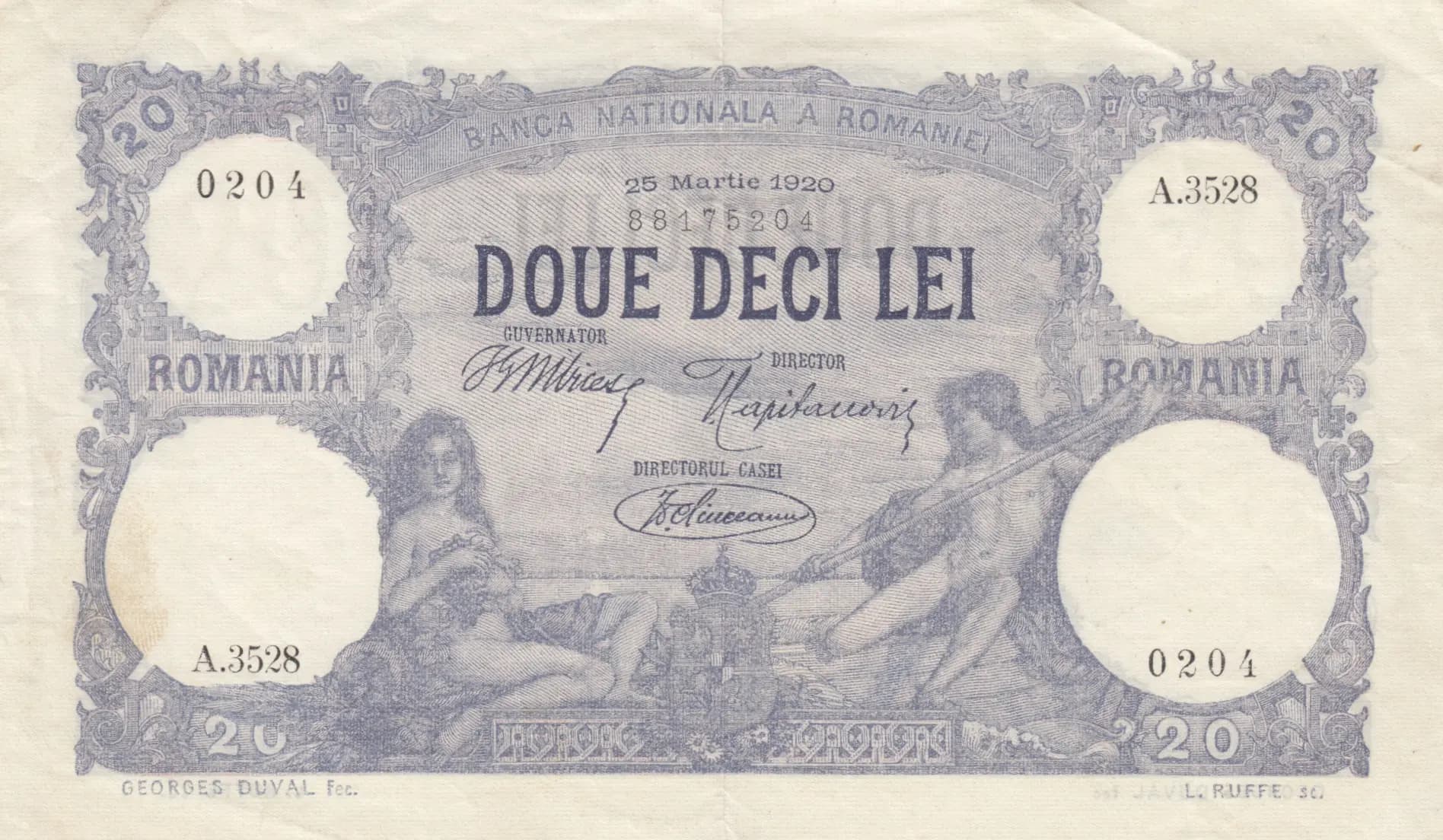
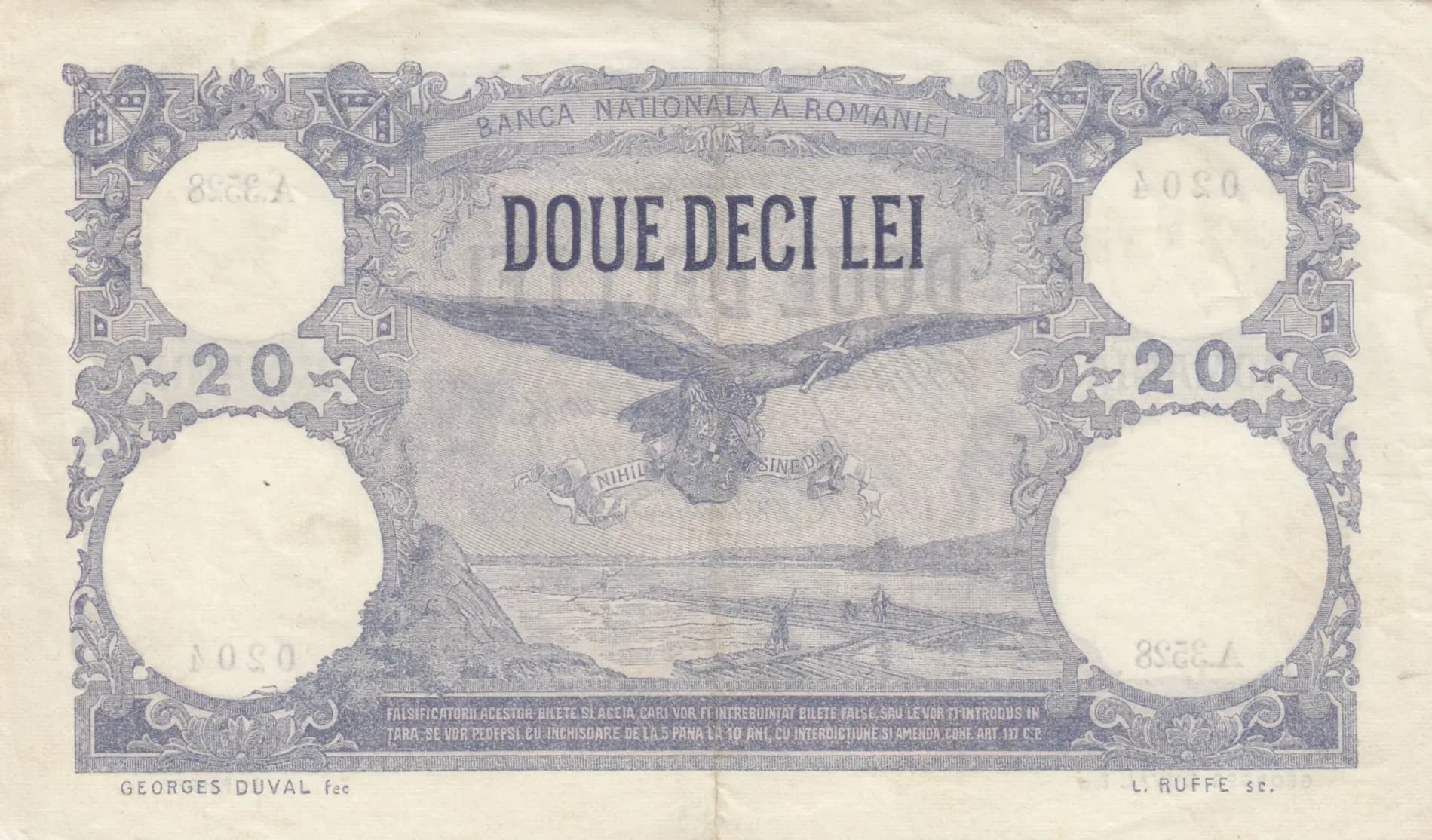
This is a VF-grade example of Romania's iconic 1920 20 Lei banknote, featuring allegorical figures representing youth and labor on the obverse and a majestic eagle soaring over a mountainous river landscape on the reverse. The note displays excellent preservation for its age with vibrant blue-violet coloring, intricate guilloche patterns, and fine line engraving throughout, though it exhibits the expected foxing and patina consistent with a century-old banknote. Dated 25 March 1920 and engraved by Georges Duval and L. Ruffe, this is a foundational piece of Romanian currency history from the interwar period.
Common. This note was issued over a 20-year period (1909-1929) with 12 documented signature varieties and substantial circulation throughout the interwar period, indicating a large print run. eBay market data confirms this assessment: VF specimens regularly sell between $50–$200, with recent sales in the $59–$350 range, and catalog values placing VF examples at approximately $45–$95. Notes commanding such modest prices across numerous sales indicate ready availability in collector channels and no scarcity premium.
Issued in 1920 by the Banca Nationala a Romaniei during the early interwar period following Romania's territorial expansion after World War I, this banknote reflects the nation's artistic and institutional confidence through its refined neoclassical and baroque design elements. The allegorical figures on the obverse—a girl with fruit and a boy with an oar—symbolize agricultural and river-based prosperity, while the reverse's eagle with cross and national arms represents sovereignty and national pride. The Latin motto 'Nihil Sine Deo' (Nothing Without God) and severe counterfeiting penalties reflect both the conservative religious values and the monetary instability concerns of the period.
The obverse features two allegorical figures—a youthful girl holding fruit (representing agriculture and harvest) on the left and a boy wielding an oar (representing labor and river commerce) on the right, both framed by elaborate baroque scrollwork and geometric ornaments. Two circular medallion areas remain blank, likely reserved for security features or heraldic elements. The denomination appears prominently in the center with the bank's name in a bold cartouche. The reverse depicts a soaring eagle with outstretched wings bearing the Romanian coat of arms and cross, positioned above a mountainous river landscape suggesting the Danube valley—a natural symbol of Romanian territorial identity. Byzantine and medieval-inspired border patterns frame both sides, with corner medallions echoing the architectural heritage of the Romanian state. The color scheme of grayish-blue and purple-gray on cream stock creates a dignified, official appearance.
OBVERSE: 'Banca Nationala a Romaniei' (National Bank of Romania) | '25 Martie 1920' (25 March 1920) | 'Doue Deci Lei' (Twenty Lei) | 'Guvernator' (Governor), 'Director' (Director), 'Directorul Casei' (Director of the House) [signature lines] | 'Georges Duval fec.' / 'L. Ruffe sc.' (Engraved by Georges Duval / Engraved by L. Ruffe) | Serial numbers: 88417520 4, 0204, A.3528. REVERSE: 'Banca Nationala a Romaniei' (National Bank of Romania) | 'Doue Deci Lei' (Twenty Lei) | 'Nihil Sine Deo' (Nothing Without God) | 'Falsificatori acestui bilete si aceia, cari vor fi intrebuintai bilete false, sau le vor d'introdus in tara, se vor pedepsi cu inchisoare de la 5 pana la 10 ani, cu interdictiune si amenda, dupe art 117 C.P.' (Counterfeiters of this note and those who will use false notes, or introduce them into the country, will be punished with imprisonment from 5 to 10 years, with prohibition and fines, according to Article 117 of the Penal Code) | 'Georges Duval fec.' / 'L. Ruffe sc.' (Engraved by Georges Duval / Engraved by L. Ruffe) | Serial number components: 8596.1, 2090.
Intaglio (copperplate) engraving, the standard security printing method for high-value banknotes of the era. The fine line work, intricate guilloche patterns, and the signatures of engravers Georges Duval and L. Ruffe confirm the use of hand-engraved steel plates with multiple passes for security layering. The sharp detail visible in the allegorical figures, eagle, and ornamental borders is characteristic of professional intaglio work rather than lithography, providing natural anti-counterfeiting security through the difficulty of reproduction.
This specimen is dated 25 March 1920 and bears three signature lines (Guvernator, Director, Directorul Casei), placing it within the 12 known signature varieties of this Pick-20 issue spanning 1909–1929. Serial number 88417520 4 (with secondary numbering 0204, A.3528, 8596.1, 2090) may be documented in specialty Romanian catalogs. The catalog reference notes that a similar note dated 19.09.1929 with 2 signatures corresponds to Pick-30, while an unissued green specimen exists as Pick-41, confirming this blue-violet 1920 three-signature type as the standard variety for the early issuance period.