5 lei 1920
Market Prices
51 salesAbout This Note
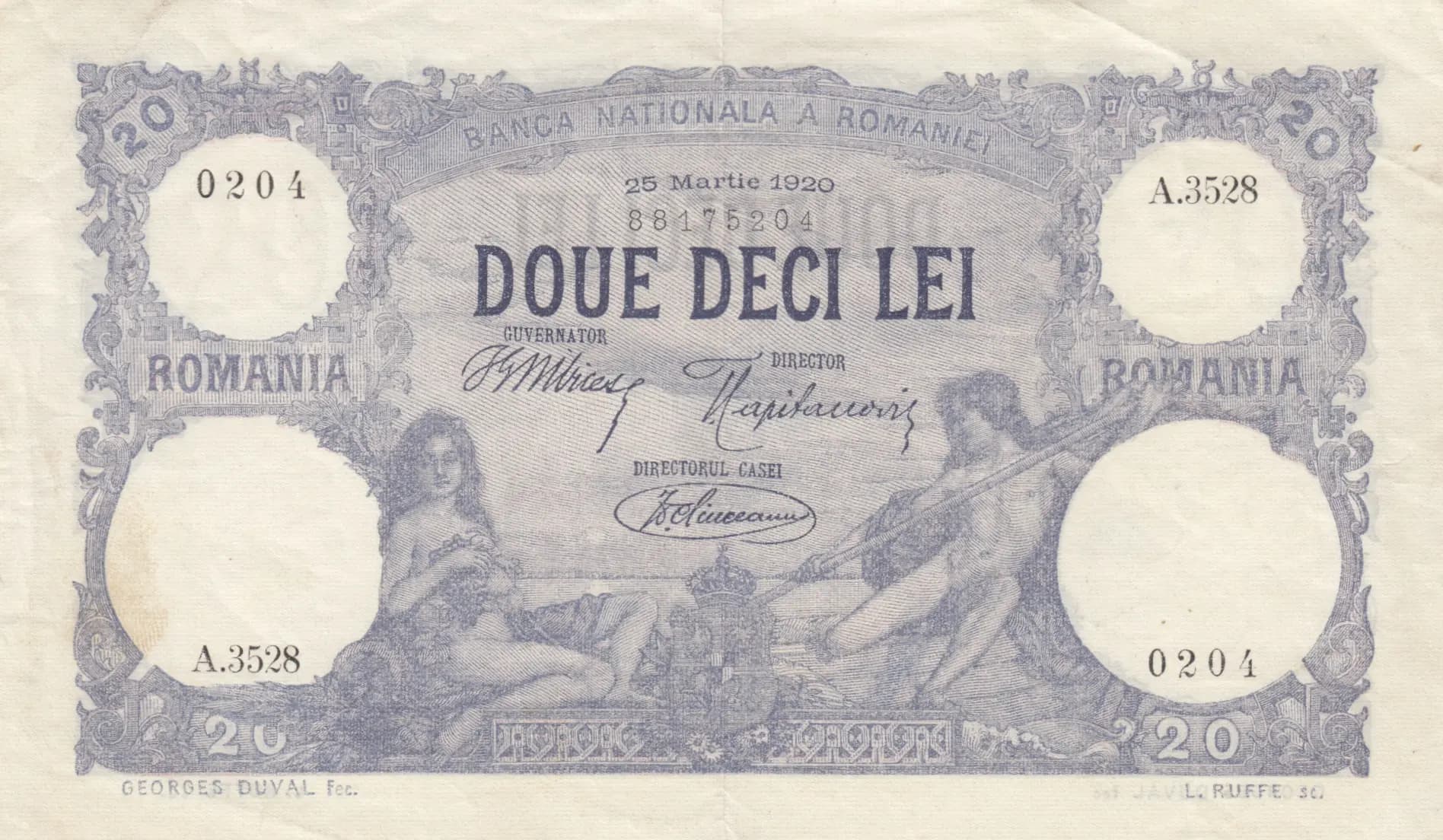
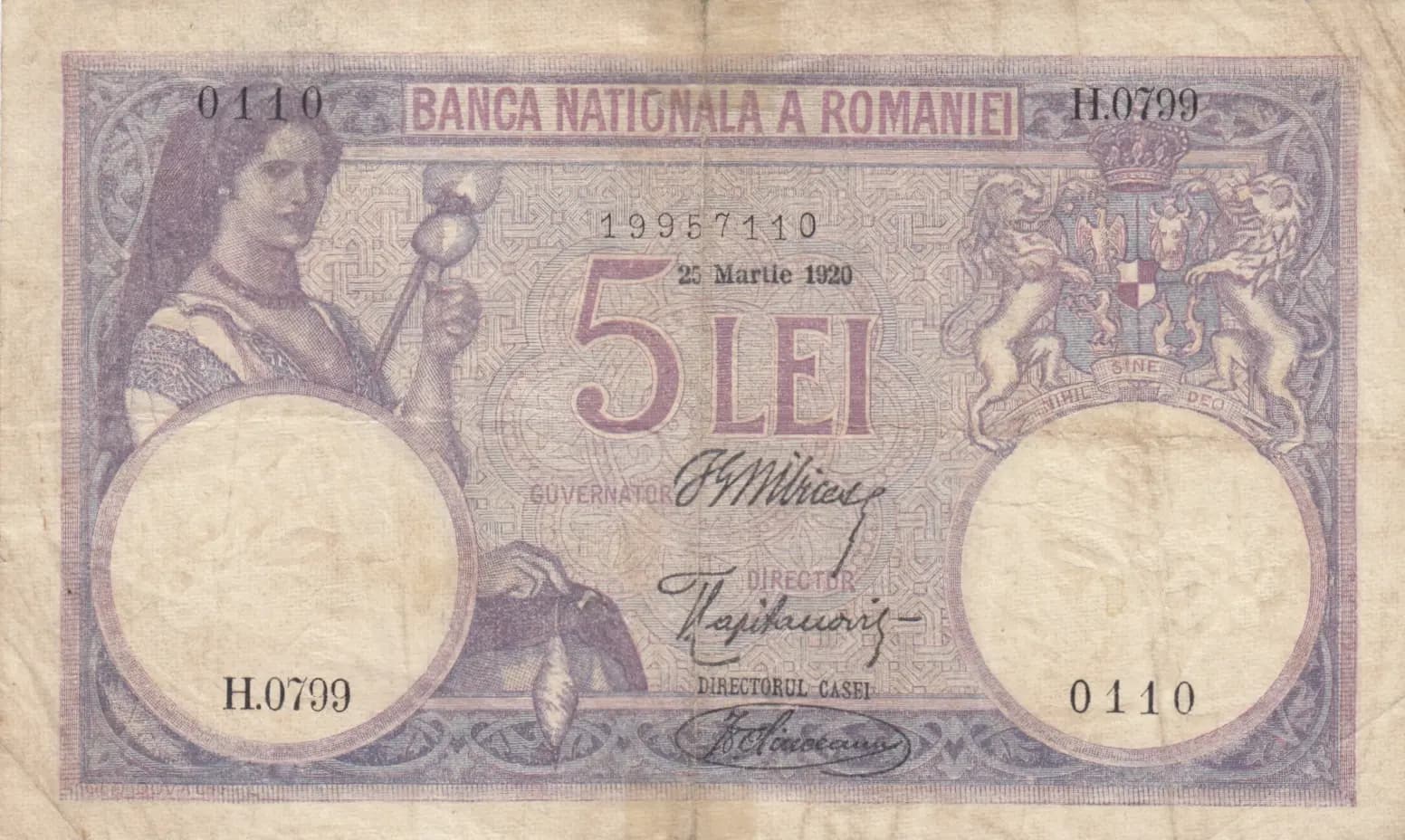
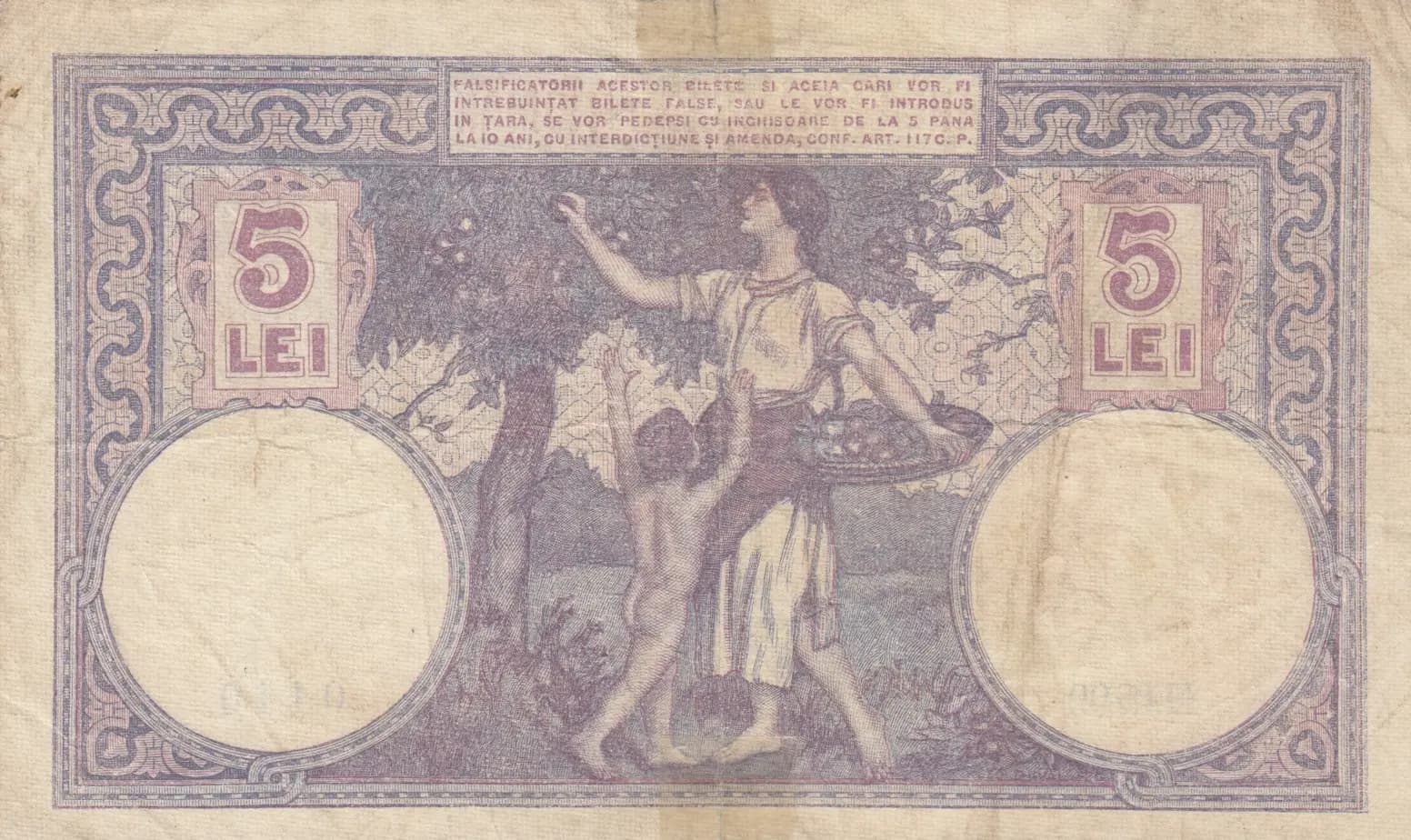
This Romanian 5 Lei banknote from 1920 represents an interesting early post-WWI emission from the Banca Nationala a Romaniei, featuring classical allegorical female figures in both the agricultural context of fruit harvesting on the reverse and governance symbolism on the obverse. The note in Fair condition shows typical period circulation wear with creasing and foxing in the security medallion areas, while the purple/lavender color scheme and fine-line engraving remain largely legible, making it a solid example of interwar Romanian currency design.
Common. The eBay price history provided shows consistent sales in the $10-$50 range across various condition grades over more than a decade, with Fair-condition examples regularly selling for $10-$35. The note was issued in large quantities across the 1914-1928 period (14 years of continuous use), and numerous examples remain in collector hands. Print run estimates and survival rates suggest this is a readily available note for collectors seeking interwar Romanian currency, despite its historical interest.
Issued on 25 March 1920, this banknote reflects Romania's post-World War I territorial expansion and national consolidation under the newly unified Romanian state. The imagery—particularly the fruit harvest scene on the reverse and the female allegorical figure representing national authority on the obverse—symbolizes the agrarian wealth and renewal of the expanded Romanian nation during the early interwar period. The prominent anti-counterfeiting warning in Romanian reflects the currency security concerns of the early 1920s as the nation sought to establish monetary stability in its newly enlarged territories.
The obverse features a classical allegorical female figure (likely representing a farmer's wife or personification of labor/agriculture) on the left side holding a distaff or staff, symbolizing productive work and the agrarian foundation of the Romanian economy. The right side displays heraldic lions and crown symbols representing state authority. The reverse depicts a more detailed allegorical composition of a woman and child harvesting fruit (apples), representing fertility, abundance, and the agricultural wealth central to Romania's identity. Both sides incorporate two prominent circular medallion areas (watermark locations) and utilize fine-line intaglio engraving with complex geometric border patterns. The purple/lavender color scheme was consistent across the entire 1914-1928 series. The three signature lines indicate official authorization from the Bank's Governor, Director, and Director of the House.
{"front":{"institution":"BANCA NATIONALA A ROMANIEI = National Bank of Romania","date":"25 Martie 1920 = 25 March 1920","denomination":"5 LEI = 5 Lei (currency)","officials":"GUVERNATOR = Governor; DIRECTOR = Director; DIRECTORUL CASEI = Director of the House","serialNumbers":"H.0799 and 19957110 (serial number components)"},"back":{"denomination":"5 LEI = 5 Lei (appears in both upper corners)","antiCounterfeiting":"FALSIFICATORII ACESTOR BILLETE SI ACEIA CARI VOR FI INTREBUINTATI BILLETE FALSITE, SAU LE VOR FI INTRODUSE IN TARA, SE VOR PEDEPSI CU INCHISOARE DE LA 5 PANA LA 10 ANI, OU INTERDICTIUNE SI AMENDA, CONF. ART. 117C. P. = Counterfeiters of these banknotes and those who will use counterfeit banknotes or bring them into the country will be punished with imprisonment from 5 to 10 years, or prohibition and fine, in accordance with Article 117C of the Penal Code."}}
Intaglio printing (engraving and recess printing), evident from the fine-line detail work, the depth of impression visible on the paper, and the intricate geometric background patterns characteristic of high-security banknote production of the period. The watermark areas feature embedded security medallions depicting classical heads (cataloged as Trajan and Minerva). This production method was standard for Banca Nationala a Romaniei currency of the 1910s-1920s period, typically executed by specialist security printers such as Bradbury Wilkinson or similar European banknote houses.
This example is dated 25 March 1920, placing it within the 1914-1928 issue period. The catalog indicates six signature varieties exist for this pick number (P-19), and the visual analysis shows three signature lines present on the obverse. The serial number format (H.0799 and 19957110) and the specific date may identify this as belonging to a particular signature variety, though the visual resolution does not permit definitive identification of which of the six known variants this represents. Variant P-19a and P-19s are cataloged by PMG; this note would require examination against both variants to determine which it represents. The color scheme is consistent with standard issues (not the violet numerals noted for the 16.02.1917 variant).