100 lei 1952
Market Prices
9 salesAbout This Note
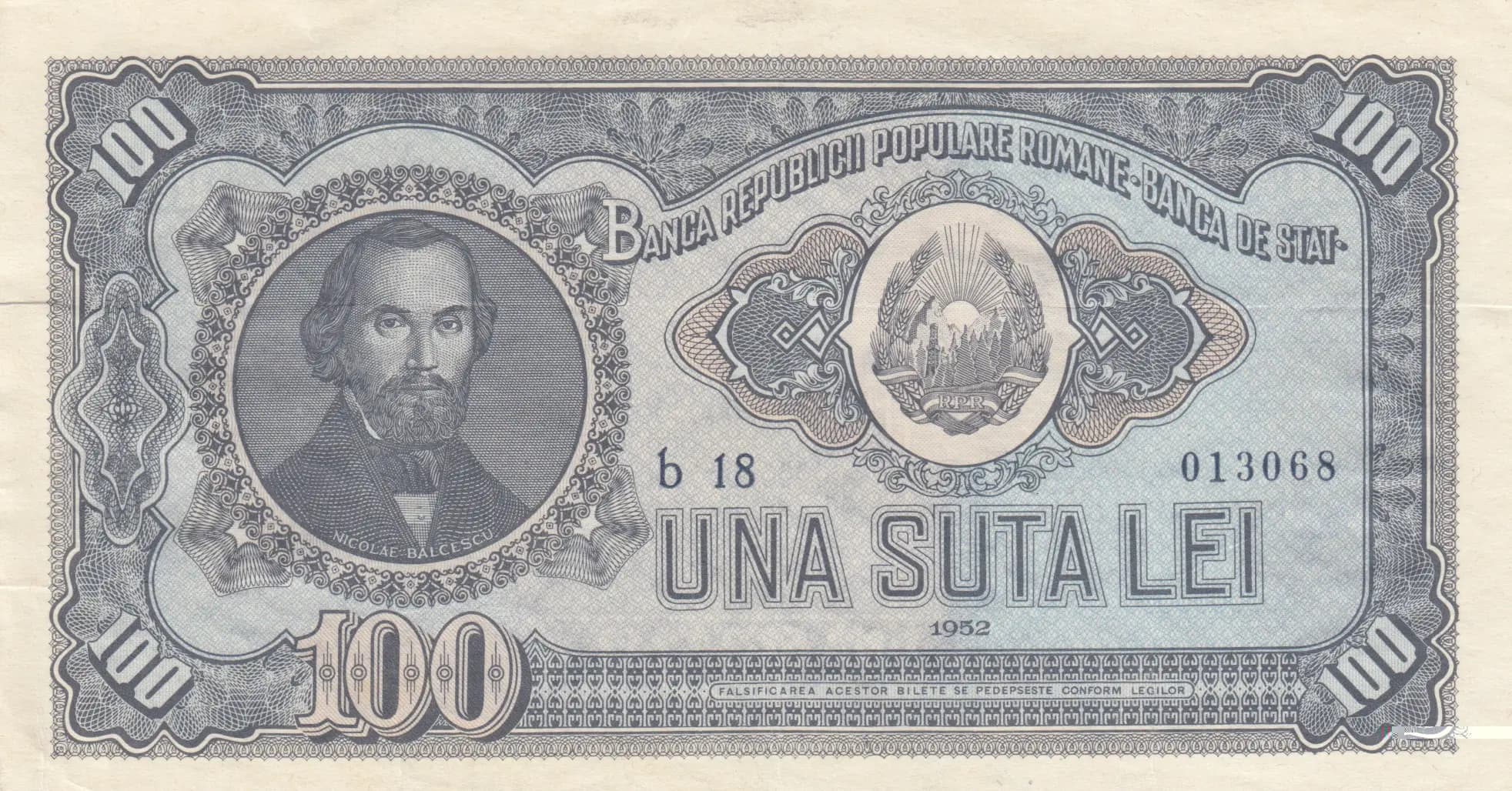
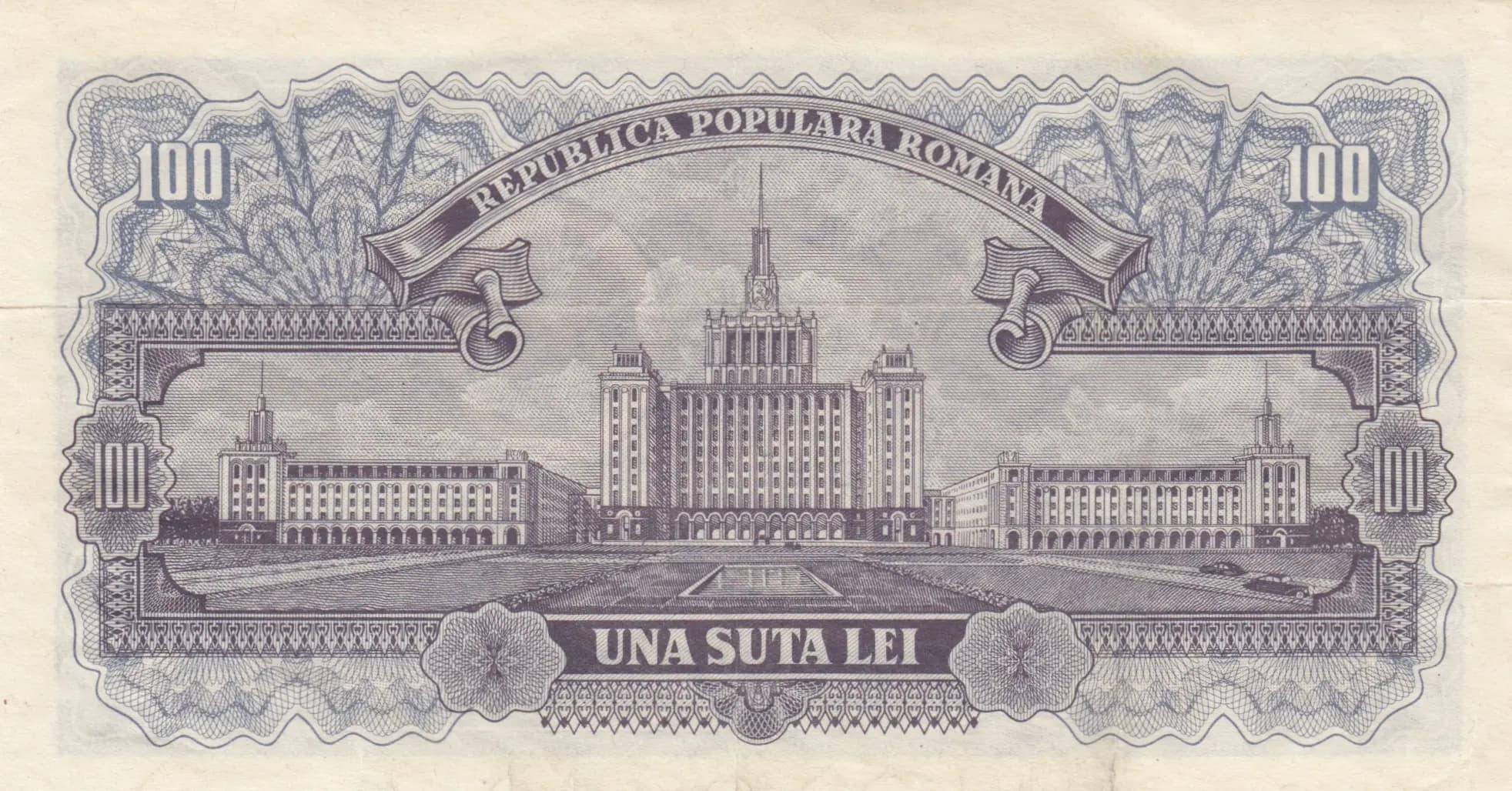
This is a VF-graded 100 Lei banknote from Romania's 1952 issue by Banca de Stat, featuring Nicolae Bălcescu on the obverse and the iconic Casa Scânteii (House of the Press) on the reverse. The note displays the characteristic blue-gray coloring and fine engraved security patterns typical of post-WWII Romanian currency, with excellent preservation showing minimal wear despite its age of over 70 years.
Common. This is a regular-issue banknote from a substantial print run during 1952. eBay transaction data shows consistent market availability with VF examples selling for $7-32 USD in recent decades, with 2016 catalogue values listing VF at only $8, indicating robust supply in the collector market. No print run restrictions, recall notices, or scarcity indicators are associated with Pick-90b.
Issued during the early years of the Romanian People's Republic (established 1947), this note reflects the communist regime's iconography and propaganda. The obverse features Nicolae Bălcescu, a 19th-century Romanian intellectual and nationalist whose legacy was appropriated by the communist government. The reverse depicts Casa Scânteii in Bucharest, the headquarters of Scânteia (The Spark), the official newspaper of the Romanian Workers Party, symbolizing the regime's control over information and state institutions during the Stalinist period under Gheorghe Gheorghiu-Dej.
The obverse features a circular portrait medallion of Nicolae Bălcescu (1819-1891), a Romanian historian, politician, and national figure, positioned on the left side within an ornate frame. The center-right displays the state coat of arms within a decorative emblem incorporating a forested landscape. The reverse is dominated by a detailed engraved representation of Casa Scânteii (House of the Press) in Bucharest, a monumental multi-story building complex with classical architectural elements, multiple towers, and flag poles, rendered in precise architectural perspective. Both sides incorporate elaborate repeating geometric and floral border patterns throughout, with denomination markers '100' in corner ornaments and the text 'Una Suta Lei' in decorative banners.
Front: 'Nicolae Bălcescu' (historical figure's name); 'Banca Republicii Populare Române-Banca de Stat' (Bank of the People's Republic of Romania - State Bank); 'Una Suta Lei' (One Hundred Lei); 'Republica Populara Romana' (People's Republic of Romania); '100' (denomination); '1952' (year of issue); Serial numbers 'b 18' and '013068'. Back: 'Republica Populara Romana' (People's Republic of Romania); 'Una Suta Lei' (One Hundred Lei); '100' (denomination in corners).
Intaglio engraving (recess printing), the standard technique for banknotes of this era. The note exhibits fine-line engraving with complex crosshatching patterns, detailed architectural rendering, and security patterns characteristic of high-quality banknote production by specialized security printers. The precision of the ornamental borders and portrait medallion indicates master engraving work typical of mid-20th century Eastern European state currency production.
The catalog data references Pick-90b as the specific variety, with PMG records indicating P-90a as an alternate variant. The observed serial number format 'b 18' 013068 is consistent with standard Romanian banknote serialization of this period. The visual note appears to be P-90b based on catalog alignment, though definitive variety confirmation would require comparison with P-90a specimens to identify distinguishing characteristics such as signature variations or minor design differences.