20 rupias 1945
About This Note
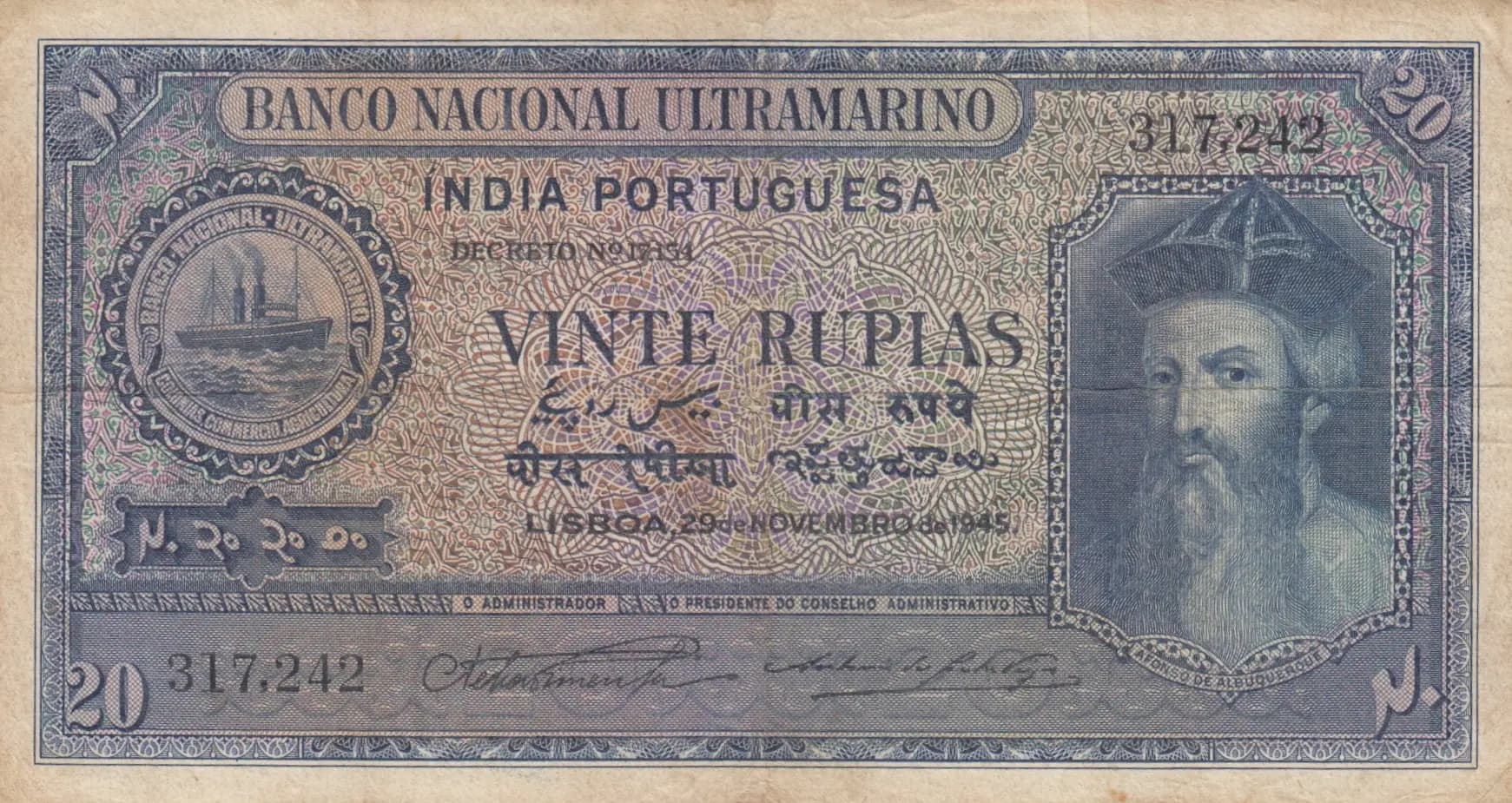
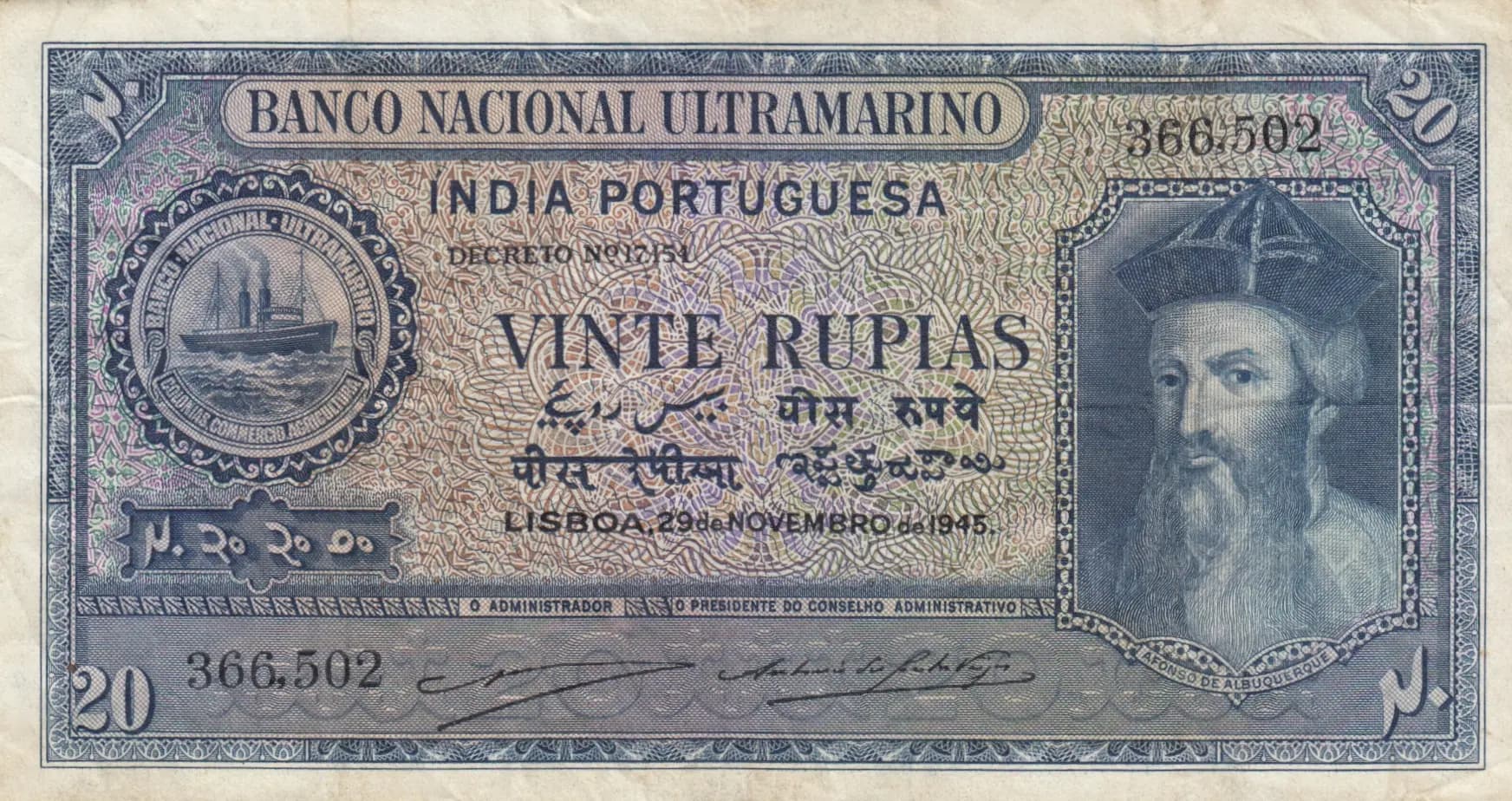
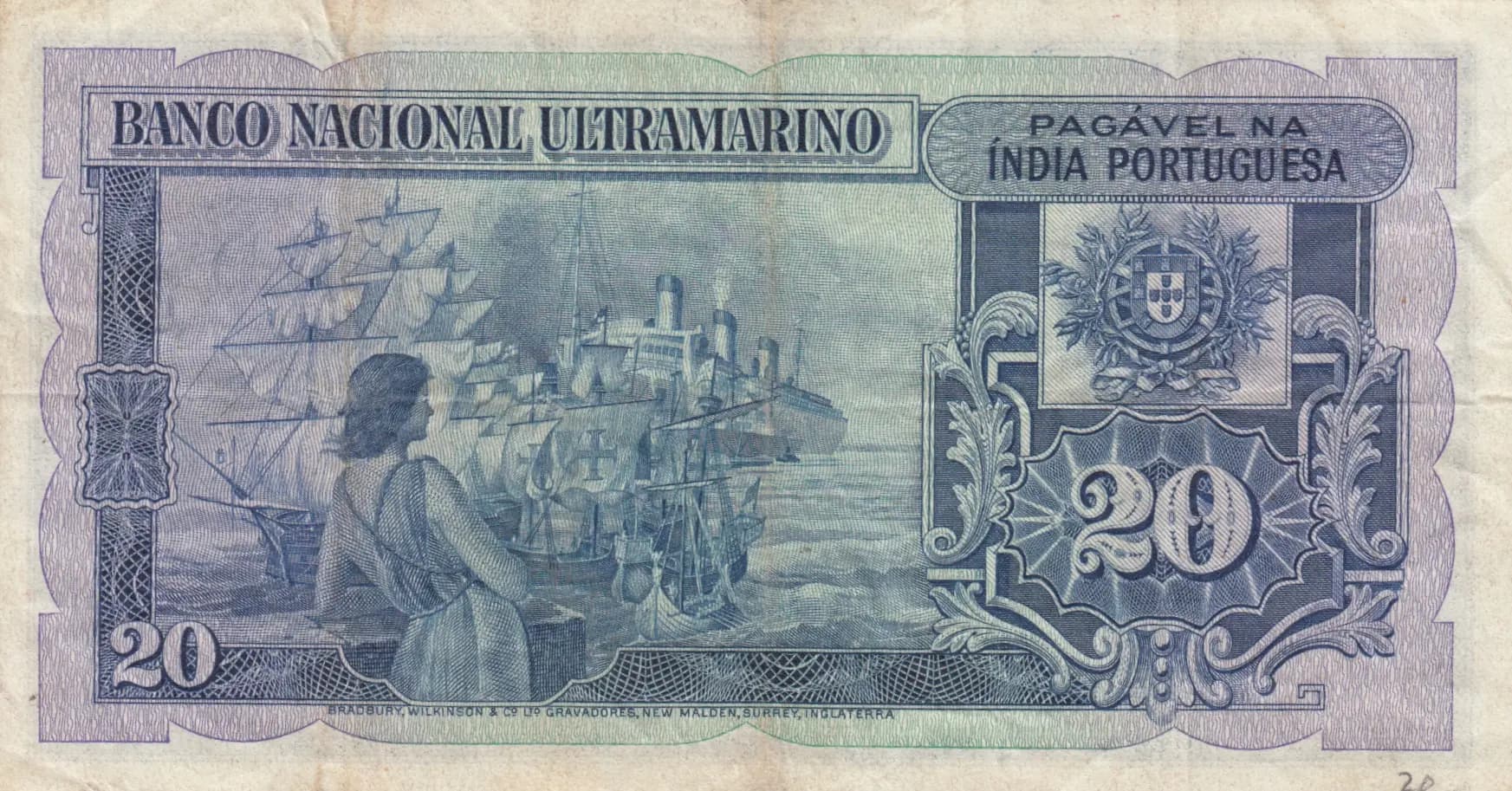
A VF-grade 20 rupias banknote issued by Banco Nacional Ultramarino in 1945, representing Portuguese India's colonial currency. The note features striking maritime imagery including sailing ships, an allegorical female figure, and a bearded male portrait, with bilingual Portuguese-Hindi inscriptions reflecting the territory's cultural context. Despite visible aging, creasing, and discoloration consistent with 75+ years of circulation, the fine engraving details remain well-preserved, making this a notable example of Portuguese colonial numismatics.
Common. The 20 rupias denomination from Portuguese India's 1945 issue was produced in substantial quantities for circulation in the colony and remains readily available in numismatic markets. VF-condition examples are frequently encountered in dealer inventories and auctions. The note has no documented scarcity factors such as limited print runs, recall status, or printing errors that would elevate its rarity classification.
This 1945 issue marks the late colonial period of Portuguese India under the Estado Novo regime, with the Banco Nacional Ultramarino serving as the central financial authority for Portuguese overseas territories. The maritime imagery—including the prominent sailing ship and allegorical female figure—reflects Portugal's historical identity as a maritime trading power and the economic importance of maritime commerce to the colony. The inclusion of both Portuguese and Hindi text demonstrates the administrative bilingualism required to govern a Portuguese-ruled Indian territory with a predominantly Hindi-speaking population.
The obverse (front) features a formal male portrait positioned on the right side, depicting a bearded gentleman in formal dress wearing a cap, likely representing a Portuguese colonial administrator or dignitary. On the left, a circular seal contains an image of a sailing ship, symbolizing maritime commerce and Portugal's naval heritage. The reverse (back) presents an allegorical female figure in classical style on the left, accompanied by a large sailing ship in the background—a common motif in Portuguese colonial currency symbolizing commerce and territorial possession. The Portuguese coat of arms with crown and palm fronds appears in an ornate cartouche on the right, with the denomination '20' displayed prominently below. Both sides feature intricate decorative borders, scrollwork, and cross-hatched background patterns typical of high-security banknote design.
FRONT: 'BANCO NACIONAL ULTRAMARINO' (Ultramarino National Bank); 'INDIA PORTUGUESA' (Portuguese India); 'DECRETO Nº' (Decree No.); 'VINTE RUPIAS' (Twenty Rupias); 'विंटे रूपीआस' (Twenty Rupias in Hindi); 'LISBOA 29 de NOVEMBRO de 1945' (Lisbon, 29 November 1945); '366.502' (serial/reference number); 'O ADMINISTRADOR' (The Administrator); 'O PRESIDENTE DO CONSELHO ADMINISTRATIVO' (The President of the Administrative Council); '20' (denomination). BACK: 'BANCO NACIONAL ULTRAMARINO' (Ultramarino National Bank); 'PAGAVEL NA INDIA PORTUGUESA' (Payable in Portuguese India); '20' (denomination); 'BRADBURY WILKINSON & CO LTD GRAVADORES NEW MALDEN SURREY INGLATERRA' (Bradbury Wilkinson & Co Ltd Engravers, New Malden, Surrey, England).
Intaglio (steel engraving) process, as evidenced by the fine line work, detailed cross-hatching, and intricate background patterns visible throughout the note. The printer is identified on the reverse as Bradbury Wilkinson & Co Ltd, a renowned British security printer located in New Malden, Surrey, England. This firm was a leading producer of colonial and international banknotes during the mid-20th century. The multiple colors (blue, green, brown, cream on obverse; green, blue, black on reverse) were achieved through multi-plate color intaglio printing.
The specific variety observed is the 1945 issue dated 'LISBOA 29 de NOVEMBRO de 1945' (Lisbon, 29 November 1945) with reference number 366.502. This represents the standard 1945 circulation issue of Pick catalog P-37. No significant varieties (such as signature variations, overprints, or error notes) are apparent from the visual analysis. The bilingual Portuguese-Hindi text is characteristic of all notes issued for Portuguese India during this period.