20 rupias 1945
About This Note
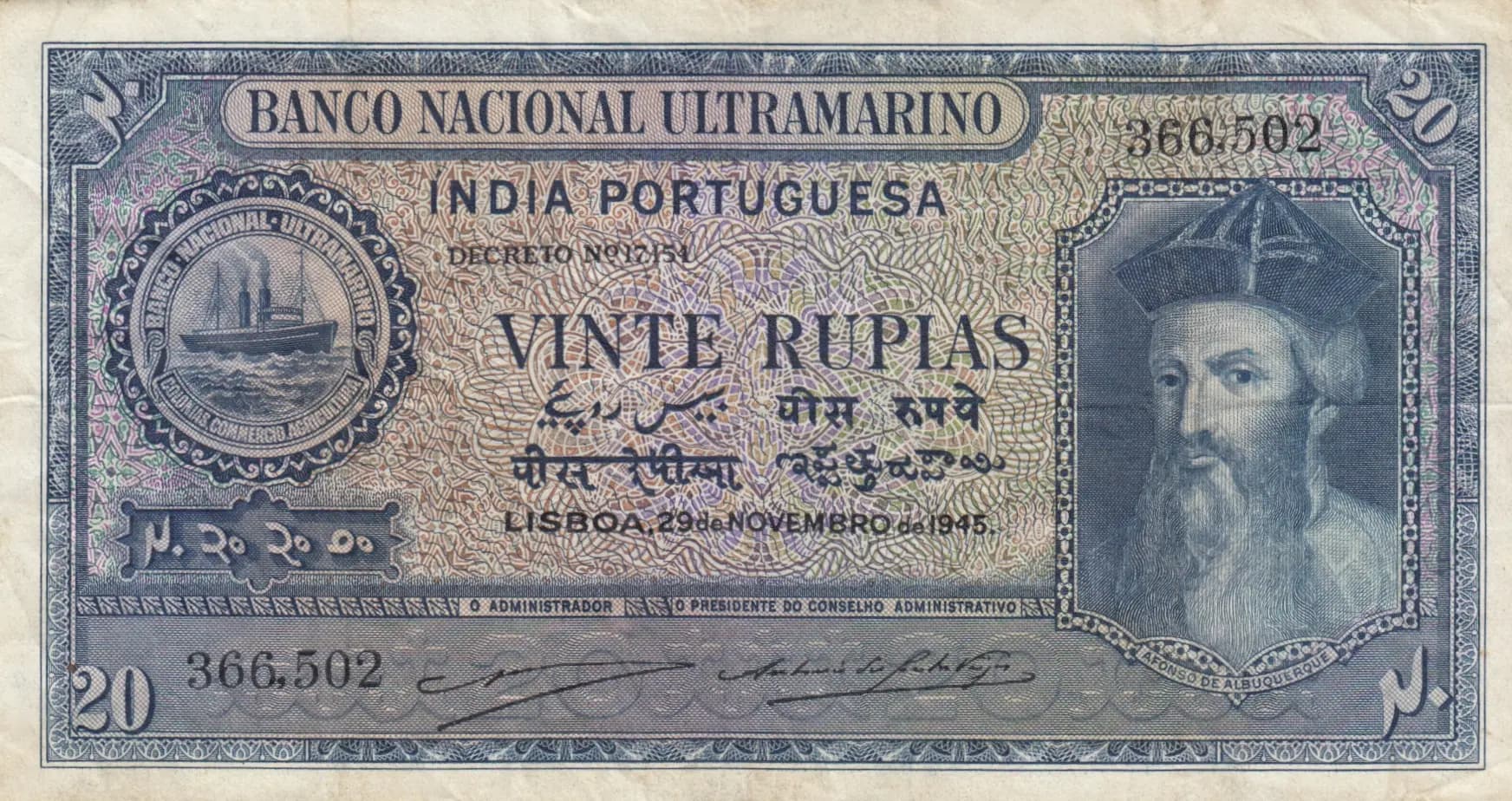
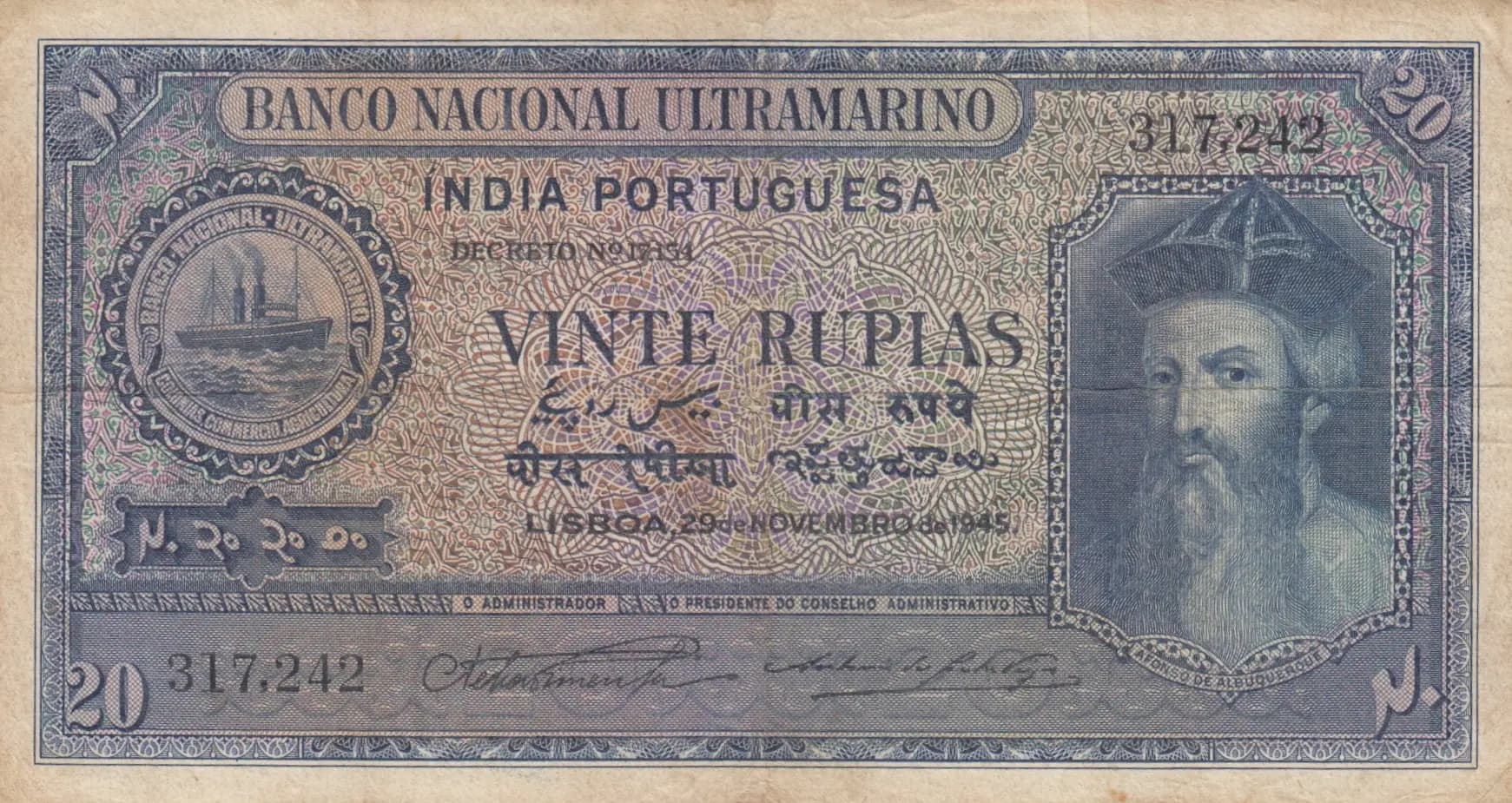
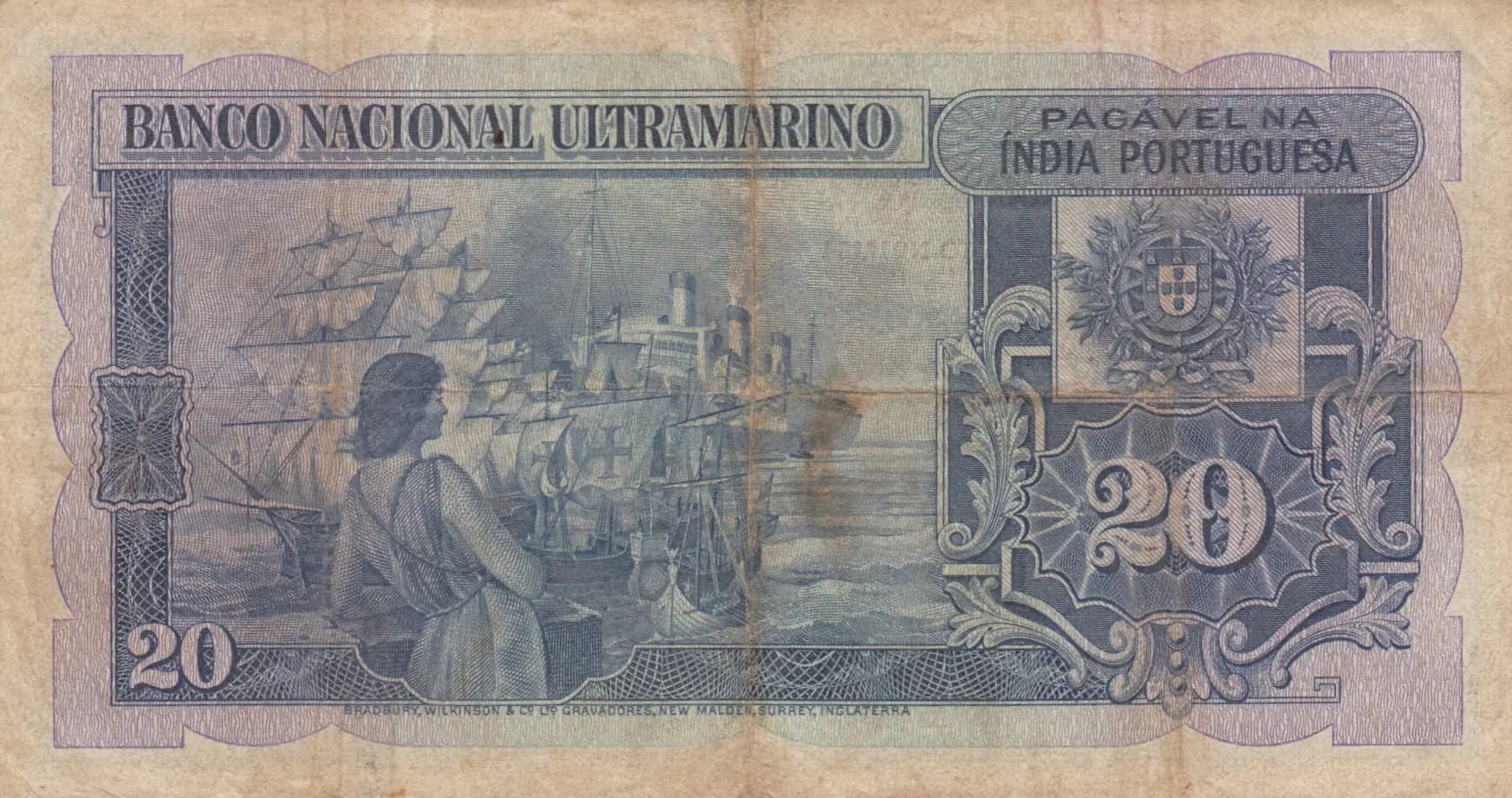
A 20 Rupias banknote from Portuguese India issued by Banco Nacional Ultramarino in 1945, graded in Fine condition. The note displays well-executed intaglio engraving with ornate borders in blue and purple tones, featuring a bearded male portrait on the obverse and a female allegorical figure on the reverse, both complemented by maritime imagery including sailing ships. Despite visible creasing, foxing, and age-related wear consistent with its 79-year history, the note retains excellent detail in its decorative patterns and heraldic elements, making it a notable example of Portuguese colonial currency design.
Common. Portuguese India rupias from the 1945 series circulated in the territory for sixteen years until 1961, allowing for substantial print runs. The Pick catalog designation P-37 indicates this was a standard issue for the denomination during this period. Notes from this series appear regularly in the collector market, and condition alone (rather than rarity) is the primary determinant of collector value. The Fine grade specimen described here represents a moderately common condition level for surviving examples.
This banknote represents the final years of Portuguese India under Banco Nacional Ultramarino, issued in 1945 near the end of World War II when Portugal maintained its overseas colonies. The maritime imagery—sailing ships featured prominently in both circular medallions and background scenes—reflects Portugal's historical identity as a great seafaring nation and its colonial trading heritage in India. The heraldic coat of arms on the reverse symbolizes Portuguese sovereign authority over the territory, which would persist until 1961 when Indian armed forces integrated Portuguese India into the Indian Union.
The obverse features an ornate rectangular composition with a central Portuguese inscription identifying the issuer and denomination, flanked by a circular medallion containing a sailing ship (representing Portuguese maritime heritage) on the left and a portrait of a bearded man wearing a cap on the right, rendered in profile. The reverse displays an allegorical female figure in profile on the left with a maritime scene featuring a sailing ship and architectural structures in the background, balanced by a heraldic Portuguese coat of arms within a decorative frame on the right. Both sides employ intricate geometric and floral border designs in the neoclassical style typical of early 20th-century Portuguese colonial currency. The color scheme of blue, tan, purple, and gray-green creates visual distinction between the two sides while maintaining design cohesion.
FRONT: 'BANCO NACIONAL ULTRAMARINO' (National Ultramarino Bank), 'INDIA PORTUGUESA' (Portuguese India), 'VINTE RUPIAS' (Twenty Rupias), '20' (denomination numeral), '317.242' (serial number). BACK: 'BANCO NACIONAL ULTRAMARINO' (National Ultramarino Bank), 'PAGÁVEL NA INDIA PORTUGUESA' (Payable in Portuguese India), '20' (denomination numeral), 'BARBOUR WILKINSON & Co LTD GRAVADORES NEW MALDEN SURREY INGLATERRA' (Barbour Wilkinson & Co Ltd Engravers New Malden Surrey England).
Intaglio engraving (line engraving), executed by Barbour Wilkinson & Co Ltd, a prominent British security printer located in New Malden, Surrey, England. The fine-line background patterns, detailed heraldic imagery, and complex geometric and floral decorative elements visible throughout both sides are characteristic of high-quality intaglio production. The security features include finely rendered cross-hatching patterns and intricate line work typical of period banknote security printing.
This specimen is identified as Pick P-37, the standard 20 Rupias note from the 1945 Banco Nacional Ultramarino series for Portuguese India. Serial number 317.242 is visible on the obverse. No overprints or significant design variations are evident from the visual analysis. Signature varieties may exist within this Pick number designation, but cannot be definitively assessed from the provided images. The note was printed by Barbour Wilkinson & Co Ltd as indicated in the back inscription, suggesting it may be part of the primary printing batch for this issue.