50 escudos 1960
Market Prices
8 salesAbout This Note
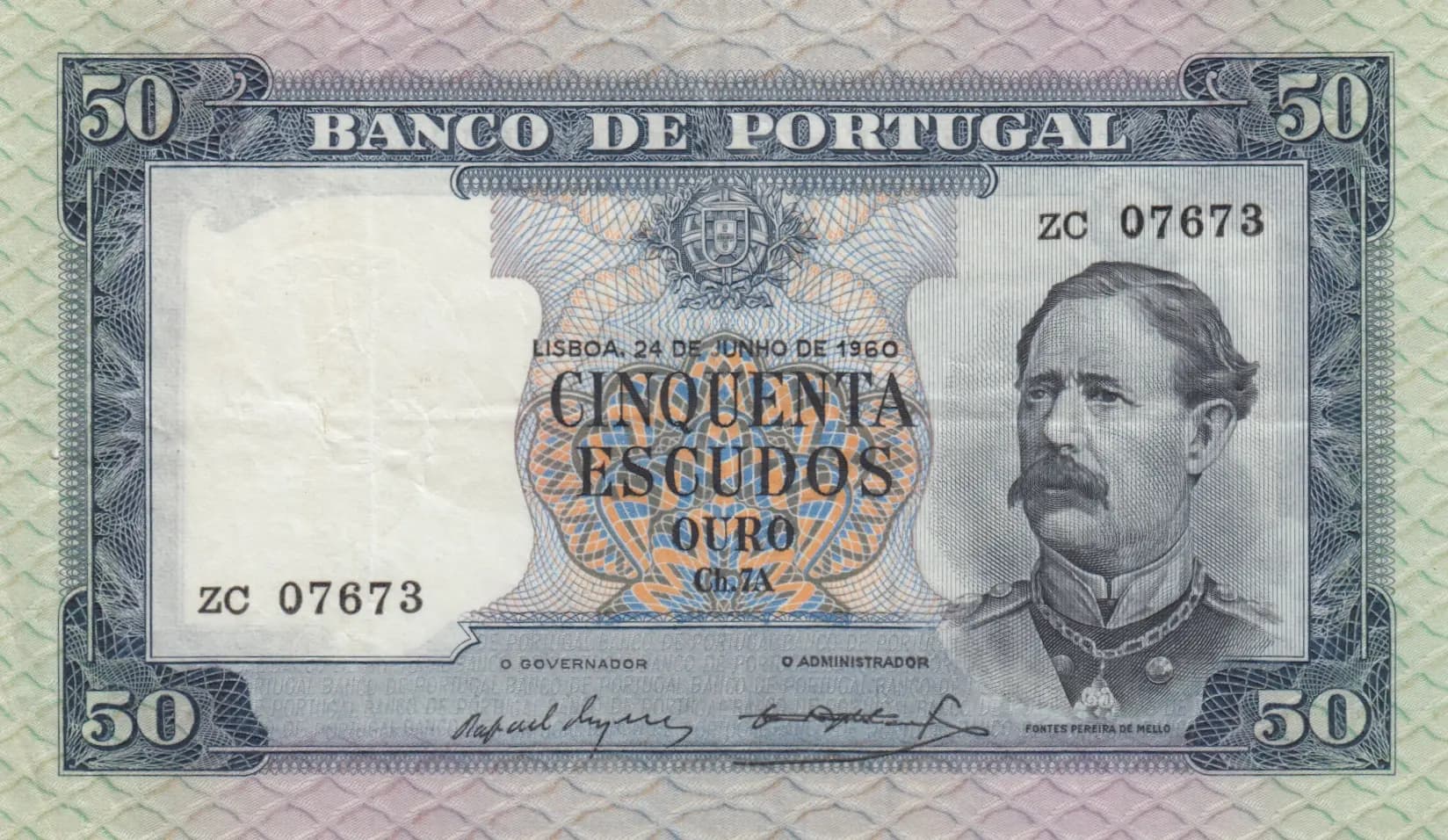
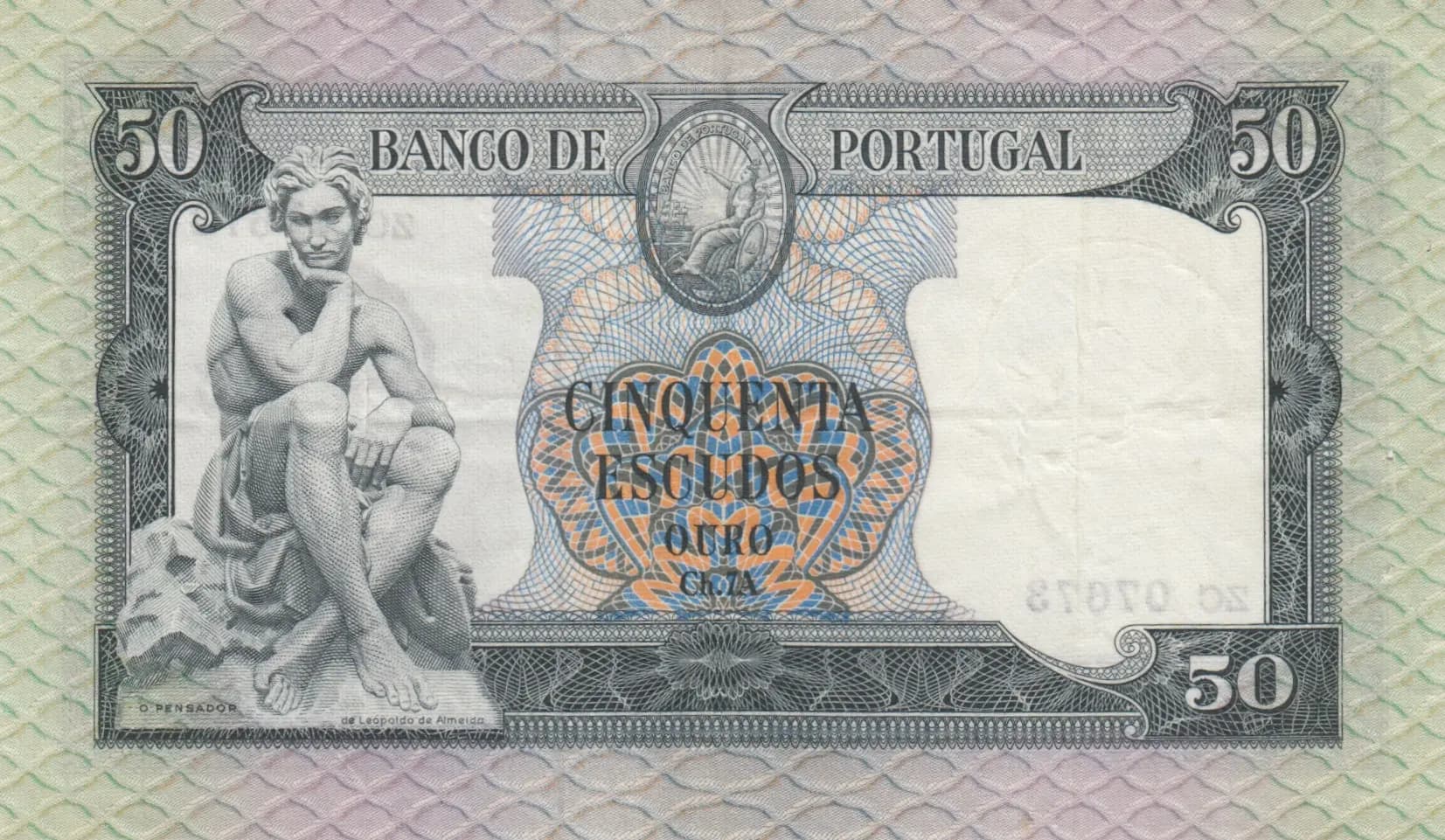
This is a Portuguese 50 Escudos banknote from 1960, issued by Banco de Portugal, presented in Very Fine condition. The note features a striking portrait of Fontes Pereira de Mello on the obverse and 'O Pensador' (The Thinker) sculpture by Leopoldo de Almeida on the reverse, both rendered in fine intaglio engraving. The green-tinted paper, crisp appearance, and excellent preservation of fine detail work make this an attractive example of mid-20th century Portuguese currency design.
Common. This note is a standard regular-issue banknote from the Portuguese escudo series with no indicators of limited production or recall. eBay sales data shows consistent market activity across multiple condition grades (F through EF), with VF examples selling in the $15-$23 range between 2012 and 2020. The 2016 catalog valuation of $15 VF further confirms this as an ordinary circulation issue with stable, modest collector value. The existence of at least one PMG-graded variant and steady secondary market trading all point to routine commercial availability.
This 1960 issue represents Portugal during the Estado Novo regime under Salazar, when the nation maintained the escudo standard as its monetary unit. The choice to honor Fontes Pereira de Mello, a 19th-century Portuguese statesman and Prime Minister, reflects the regime's emphasis on national historical figures and continuity. The inclusion of 'O Pensador' by modernist sculptor Leopoldo de Almeida on the reverse demonstrates Portugal's engagement with contemporary artistic achievement during this period of cultural and economic consolidation.
The obverse features Fontes Pereira de Mello, a bearded 19th-century Portuguese statesman, positioned on the right side in formal period dress. The dominant central element is the Portuguese coat of arms, rendered with intricate geometric patterns in blue and orange with fine cross-hatching. Corner ornaments and a winged emblem above the shield add decorative complexity. The reverse depicts 'O Pensador' (The Thinker), a classical allegorical seated female figure by sculptor Leopoldo de Almeida positioned on the left, with the same ornate coat of arms in the center. Both sides employ the characteristic light green-tinted paper stock of Portuguese notes from this era. The diagonal 'CINQUENTA ESCUDOS OURO' overprint spans both sides, with denomination numerals positioned in all four corners.
{"front":{"50":"50 (denomination)","BANCO DE PORTUGAL":"Bank of Portugal","LISBOA, 24 DE JUNHO DE 1960":"Lisbon, June 24, 1960 (issue date)","CINQUENTA ESCUDOS OURO":"Fifty Gold Escudos","CNZA":"Currency abbreviation (Consignação)","ZC 07673":"Serial number","O GOVERNADOR":"The Governor (signature line)","O ADMINISTRADOR":"The Administrator (signature line)","FONTES PEREIRA DE MELLO":"Name of historical figure depicted (1823-1908, Portuguese statesman)"},"back":{"50":"50 (denomination)","BANCO DE PORTUGAL":"Bank of Portugal","CINQUENTA ESCUDOS OURO":"Fifty Gold Escudos","CNZA":"Currency abbreviation (Consignação)","O PENSADOR":"The Thinker (sculptural artwork)","de Leopoldo de Almeida":"by/of Leopoldo de Almeida (artist attribution)"}}
Intaglio (copper-plate engraving), characteristic of high-security banknote production. The fine line work, cross-hatching patterns in the coat of arms, and detailed sculptural rendering visible in the visual analysis are hallmarks of intaglio printing. Printer: TDLR (Tipografia de Lito Ribeiro), without imprint mark on the note itself. The complex geometric patterns and fine detail preservation evident in the VF condition example demonstrate the durability and security features inherent in this printing method.
This example is dated 24 June 1960 and bears serial number ZC 07673. The catalog references note that this denomination was issued in both 1953 and 1955, with a 1960 overprint visible on the present note. The Pick P-160 designation encompasses notes with Chapa (plate) 7 printed by TDLR. Varieties within this Pick number may be distinguished by signature combinations (Governor and Administrator), specific overprint dates, and serial number prefixes. The ZC prefix on the observed note's serial number may indicate a specific printing run or security feature variant, though PMG's population report indicates only one main variant has been professionally graded for P-160.