10 centavos 1917
Market Prices
15 salesAbout This Note
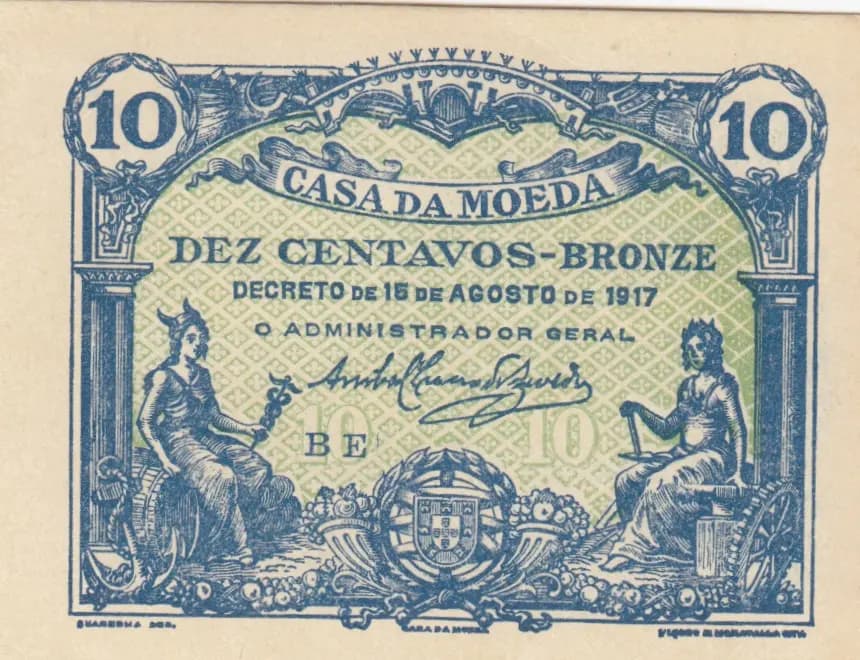
This 10 centavos banknote from Casa da Moeda (1917) represents an attractive example of early Portuguese Republic currency in AU condition. The note displays crisp blue printing on cream-colored paper with excellent preservation, minimal aging, and no significant wear—characteristics consistent with the AU grade assigned. The ornate classical design featuring allegorical female figures and baroque scrollwork, combined with its historical significance as a decree-issued note from August 15, 1917, makes this a desirable piece for collectors of Portuguese numismatic history.
Common. Historical eBay market data shows this note in various grades consistently selling between $3-$20 USD, with even higher-grade examples (PMG 65) reaching approximately $150 as outliers. The 2016 catalogue values list UNC examples at only $10. These price points and transaction volumes indicate substantial circulation and availability in the collector market. No evidence exists of limited print runs, recalls, or exceptional scarcity for this Pick number. The AU condition grade specimen observed here represents solid collector appeal but not a scarce variety.
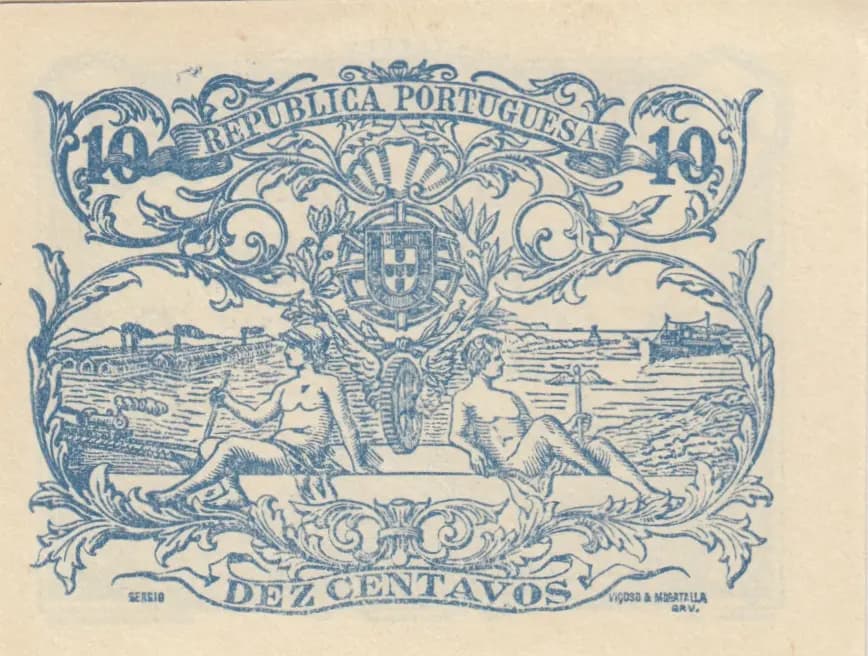
Issued under Decree of August 15, 1917, during the Portuguese First Republic period, this 10 centavos note represents the republic's monetary stabilization efforts in the midst of World War I. The allegorical female figures—likely representing attributes such as Liberty, Justice, Industry, and Commerce—reflect the classical iconography favored by republican governments to symbolize national virtues and economic strength. The prominent display of the Portuguese coat of arms and 'REPÚBLICA PORTUGUESA' inscription reinforces the state's control over currency issuance and the modernization of Portugal's monetary system during this turbulent period.
The obverse features two allegorical female figures seated on either side of the Portuguese coat of arms, with ornate baroque scrollwork adorning the top. The left figure holds a caduceus or staff (suggesting Mercury/Commerce), while the right figure holds a torch or staff (suggesting Liberty or Justice). The background employs diagonal hatching in a cream/pale yellow tone for security purposes. The reverse presents a more elaborate design with two allegorical figures flanking a landscape scene depicting a fortified structure, waterfront buildings, and harbor or river scenery—likely representing Portuguese maritime commerce and strategic fortifications. Both sides feature ornamental cartouches and shell motifs characteristic of early 20th-century Portuguese banknote design. The fine line engraving and complex scrollwork throughout demonstrate high-quality security printing appropriate for official currency.
FRONT SIDE: 'CASA DA MOEDA' (House of the Mint), 'DEZ CENTAVOS-BRONZE' (Ten Centavos-Bronze), 'DECRETO de 15 de AGOSTO de 1917' (Decree of August 15, 1917), 'O ADMINISTRADOR GERAL' (The General Administrator), 'Amaro Gomes Rebello' (signature of the General Administrator), '10' (denomination in upper corners), 'BE' (printer/engraver initials). BACK SIDE: 'REPÚBLICA PORTUGUESA' (Portuguese Republic), 'DEZ CENTAVOS' (Ten Centavos), '10' (denomination in upper corners), 'SERGIO' (artist/engraver signature, lower left), 'VIUVO & MOURALHA S.A.V.' (printer mark, lower right).
Intaglio engraving (line engraving) on cream-colored paper with blue ink. The fine line work, ornamental borders, and diagonal security hatching pattern are characteristic of intaglio printing. Casa da Moeda (Portuguese Mint) served as the issuer and primary printer, though the notation 'VIUVO & MOURALHA S.A.V.' on the reverse suggests collaboration with or involvement of this printing firm. The engraver 'SERGIO' is credited on the reverse side. The security features include fine-line crosshatching and complex baroque ornamentation designed to prevent counterfeiting.
The specific variety can be identified by the signature of Amaro Gomes Rebello as 'O Administrador Geral' (General Administrator) on the obverse, the engraver signature 'SERGIO' on the reverse, and the printer attribution 'VIUVO & MOURALHA S.A.V.' This note lacks a watermark according to catalog references. The 'BE' marking on the obverse may indicate an engraver or printer code. Pick catalog P-95c designation suggests this is part of a series with documented varieties; variant signatures and printer marks may distinguish sub-types within this denomination and issue year.