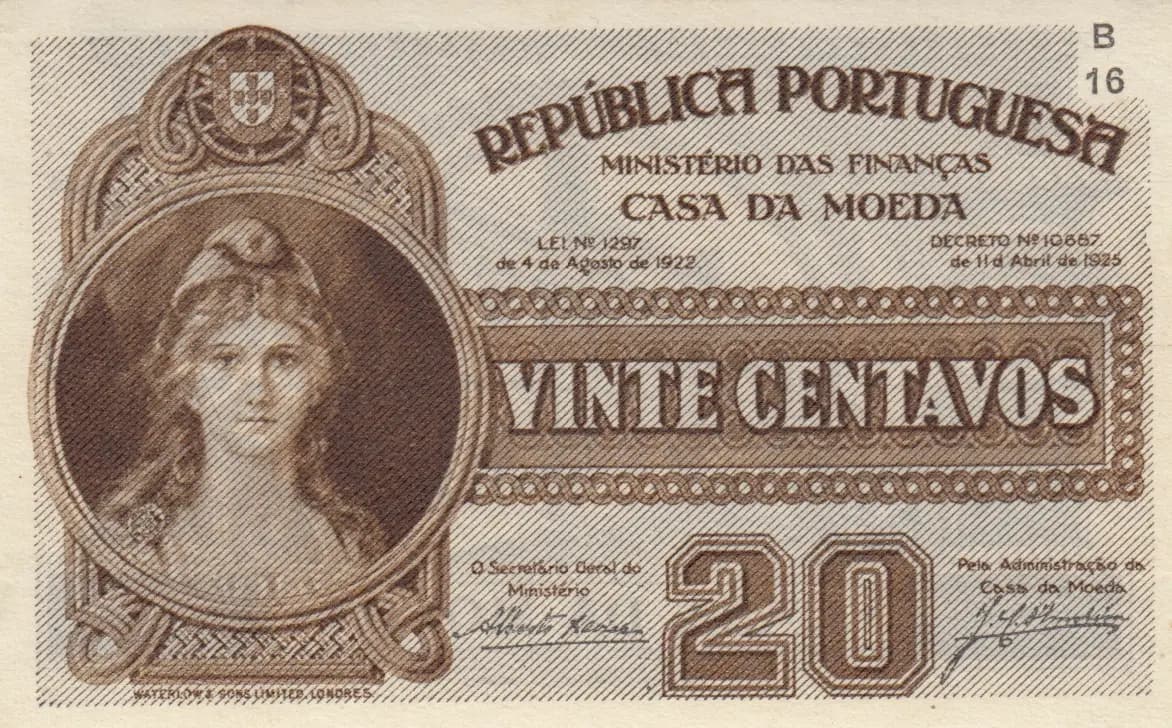
20 centavos 1922
Market Prices
9 salesAbout This Note
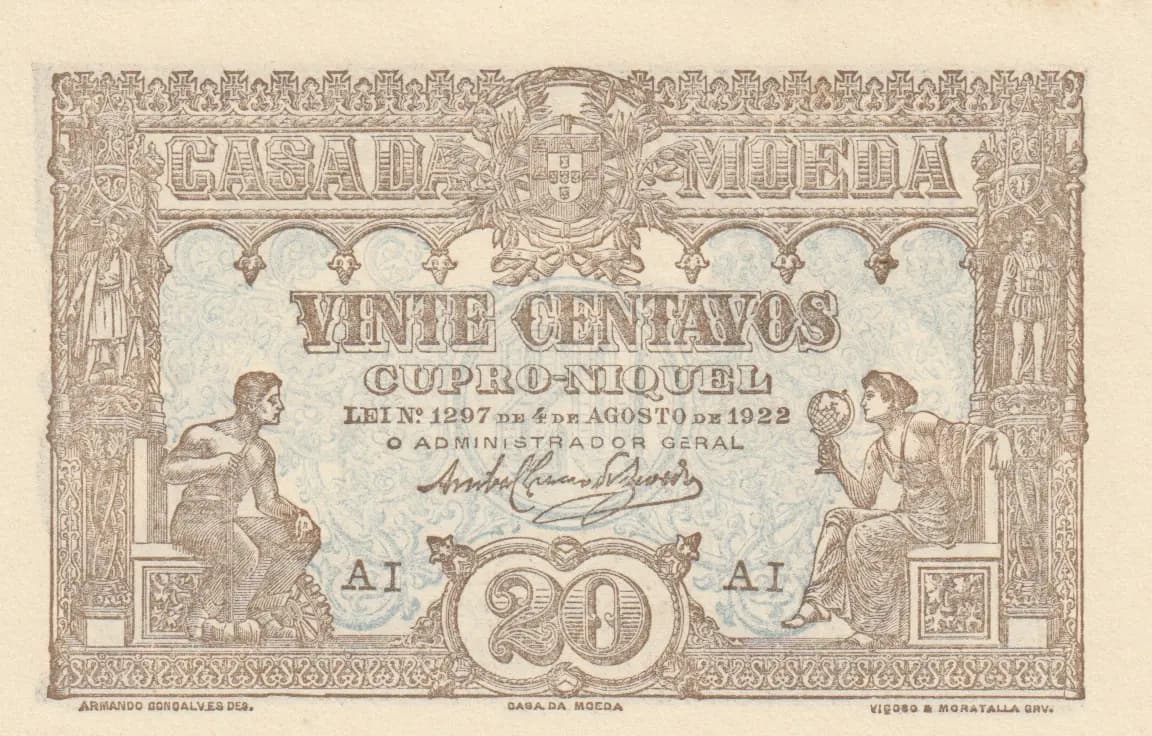
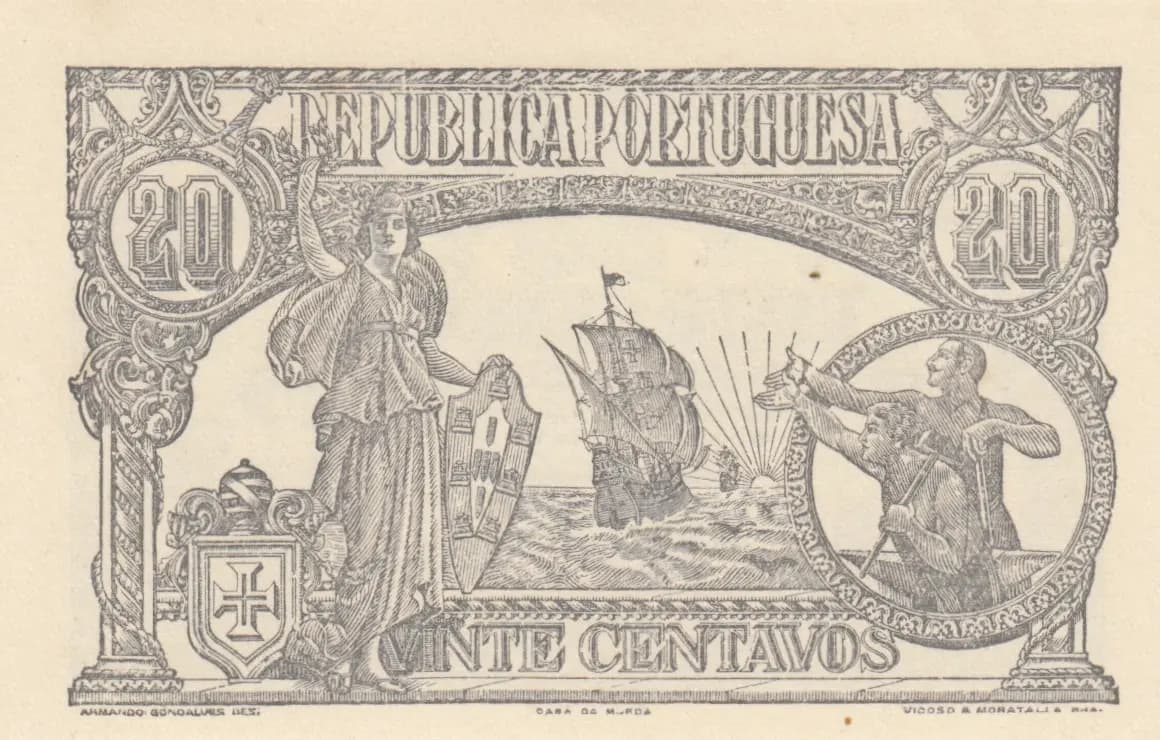
An excellent uncirculated example of Portugal's 1922 20 Centavos banknote (Pick P-100), featuring classical allegorical imagery representing Industry and Commerce on the obverse, with a striking maritime scene including a Portuguese caravel on the reverse. The note displays crisp, sharp engraving throughout with no signs of circulation, foxing, or discoloration, exemplifying the high-quality production standards of Casa da Moeda during the early Portuguese Republic period.
Common. Historical market data from eBay sales indicates this note in various grades regularly achieves modest prices ($3.50–$13.08 for EF to UNC examples between 2014–2018), with a 2016 catalog value of $10 for UNC specimens. The consistent availability and low to moderate pricing across multiple sales over several years indicates a reasonably large surviving population. No print run restrictions, recall history, or short-issue status are documented for this Pick number.
Issued under Law No. 1297 of August 4, 1922, this banknote commemorates Portugal's maritime heritage and commercial identity during the First Portuguese Republic era (1910-1926). The prominent sailing caravel on the reverse represents Portugal's age of exploration, while the allegorical female figures on both sides symbolize the nation's industrial and commercial aspirations during the post-World War I period of reconstruction and modernization.
The obverse features two classical female allegorical figures seated symmetrically, representing Industry (left) and Commerce (right), flanking a central ornamental circular cartouche containing the denomination '20'. The composition includes the Portuguese coat of arms centered above, framed by elaborate cross-pattern decorative borders. The reverse depicts a nautical scene with a Portuguese caravel (historical sailing ship) bearing the national flag as the central focal point, attended by a standing allegorical female figure (representing Portugal or Navigation) on the left holding a shield with the Portuguese coat of arms, and a cherub (putto) on the right. Decorative '20' numerals appear in circular frames in the upper corners. The entire design employs fine engraved line work characteristic of early 20th-century security printing, with cream/beige background and brown/tan ink throughout.
FRONT SIDE: 'CASA DA MOEDA' (House of the Mint); 'VINTE CENTAVOS' (Twenty Centavos); 'CUPRO-NÍQUEL' (Copper-Nickel); 'LEI Nº 1297 DE 4 DE AGOSTO DE 1922' (Law No. 1297 of August 4, 1922); 'O ADMINISTRADOR GERAL' (The General Administrator); 'ARMANDO GONÇALVES DES.' (Armando Gonçalves Designer); 'VIGORO & MORATALLA GRV.' (Vigoro & Moratalla Engraver); 'AI 20 AI' (reference mark). REVERSE SIDE: 'REPUBLICA PORTUGUESA' (Portuguese Republic); 'VINTE CENTAVOS' (Twenty Centavos); 'ARMANDO GONÇALVES DES.' (Armando Gonçalves Designer); 'CASA DA MOEDA' (House of the Mint); 'VIGORO & MORATALLA GRV.' (Vigoro & Moratalla Engraver).
Intaglio engraving (recess printing), executed by Casa da Moeda, Lisbon. The note was designed by Armando Gonçalves and engraved by Vigoro & Moratalla, employing the traditional security printing methods standard for Portuguese currency of this period. The fine detail work, ornate borders, and complex allegorical imagery visible in the visual analysis are characteristic of high-quality intaglio production.
This note is dated 4 August 1922 per the legislative reference (Lei Nº 1297). The designer is consistently credited as Armando Gonçalves and the engravers as Vigoro & Moratalla across both sides. No serial number variations or significant design varieties are apparent from the visual analysis. The 'AI 20 AI' marking on the obverse may represent a control or mint mark, though its specific meaning requires further research in Portuguese numismatic documentation.