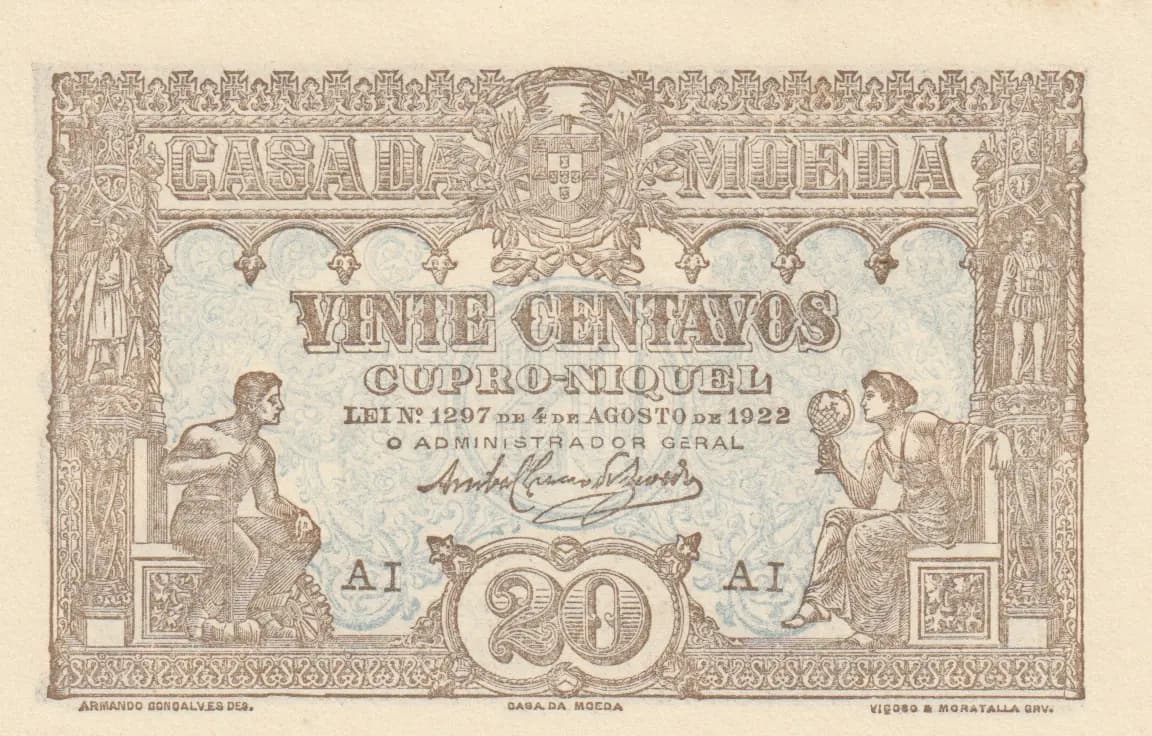
20 centavos 1922
Market Prices
7 salesAbout This Note
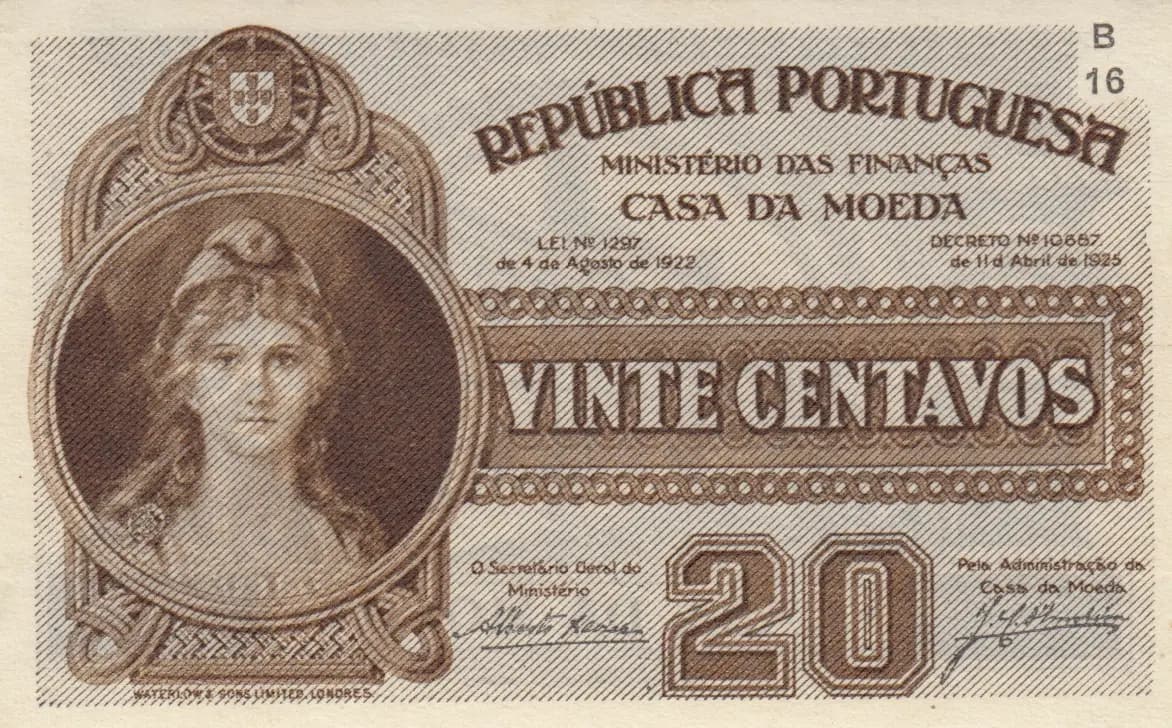
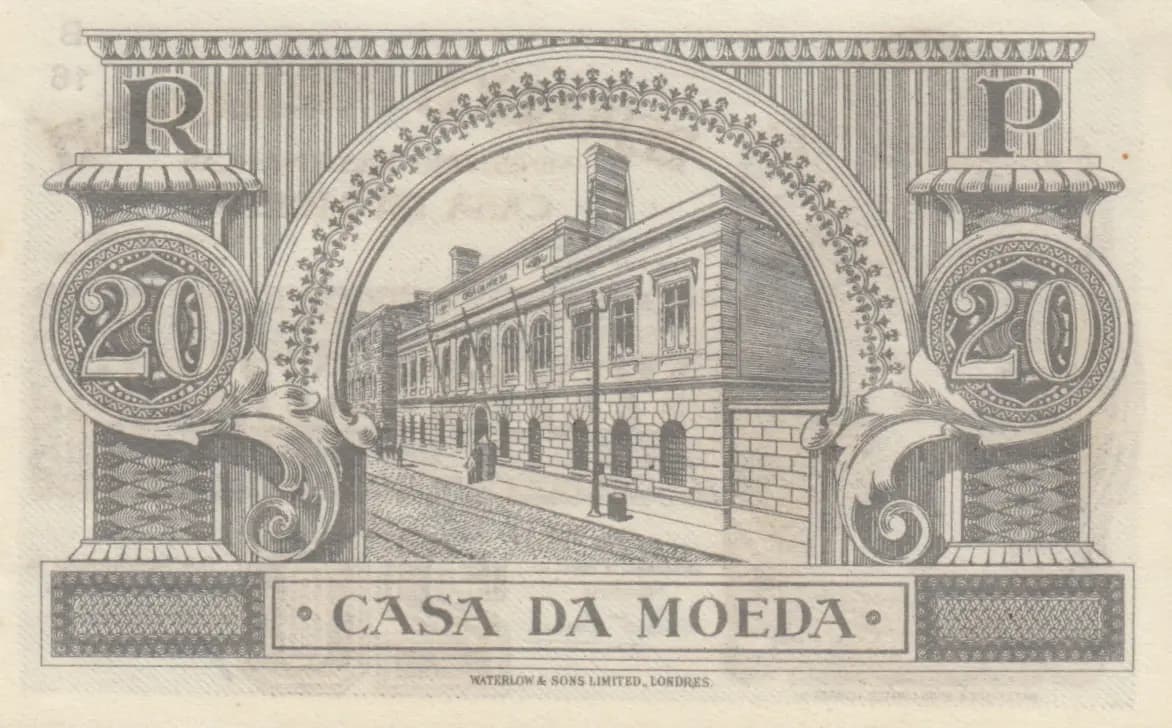
This is a well-preserved Portuguese 20 Centavos from 1922, issued by Casa da Moeda under Decree No. 10887 and printed by the prestigious London firm Waterlow & Sons. The obverse features a classical female portrait (Liberty) in profile within an ornate circular frame, rendered in brown on a beige underprint with fine diagonal hatching as a security feature. The reverse displays an elegant architectural engraving of the Casa da Moeda building itself, surrounded by decorative botanical wreathing and ornamental columns. While the note exhibits age-appropriate patina consistent with early 20th-century currency, it remains in excellent condition with no major tears or creases, making it a desirable example of Portugal's transition-period coinage.
Common. Despite its age and historical significance, this denomination survives in substantial quantities on the numismatic market. eBay price tracking data provided shows consistent sales ranging from $5.50 to $27 USD depending on condition grade, with UNC examples selling for approximately $12–$15, well within the range for commonly traded early 20th-century Portuguese notes. The 2016 catalog valuation of $15 for UNC condition further supports common status. High print runs by Waterlow & Sons and the note's non-commemorative status as regular currency issue contribute to its availability today.
This banknote was issued during the First Portuguese Republic (1910–1926), a period of significant political and economic instability following the 1910 revolution. The inscription 'REPÚBLICA PORTUGUESA' and 'MINISTÉRIO DAS FINANÇAS' reflect the republican government's effort to establish fiscal authority and modernize currency. The depiction of Casa da Moeda (the national mint) on the reverse symbolized the state's control over monetary production, while the allegorical female figure (Liberty) on the obverse represented Republican ideals. The note's 1922 authorization date and 1925 decree date bracket a critical period in Portuguese economic history, shortly before the 1926 military coup that would end the Republic.
The obverse features an allegorical representation of Liberty as a classical female profile facing left, positioned within an elaborate circular decorative frame topped with the Portuguese coat of arms or heraldic shield. The design employs fine diagonal hatching throughout the background as an anti-counterfeiting measure, with intricate engraved border work surrounding the portrait medallion. The reverse displays a precise architectural engraving of the Casa da Moeda (Portuguese House of the Mint) building—a three-story neoclassical institutional structure with regular window arrangements, roof chimneys, and detailed masonry work. This central image is enclosed within an ornate oval frame decorated with botanical wreathing (likely laurel branches), flanked by vertical fluted columns on both sides. The denomination '20' appears prominently in circular medallions on the left and right margins. The entire design demonstrates the high technical standards of Waterlow & Sons' intaglio printing, with elaborate ornamental friezes and security features characteristic of early 20th-century Portuguese Republican currency.
FRONT SIDE: 'REPÚBLICA PORTUGUESA' (Portuguese Republic) at top; 'MINISTÉRIO DAS FINANÇAS' (Ministry of Finance); 'CASA DA MOEDA' (House of the Mint); 'VINTE CENTAVOS' (Twenty Centavos); 'LEILÃO 1896' (Auction 1896); 'de 4 de Agosto de 1922' (of August 4, 1922); 'DECRETO Nº 10887' (Decree No. 10887); 'de 11 de Abril de 1925' (of April 11, 1925); 'WATERLOW & SONS LIMITED, LONDRES' (Waterlow & Sons Limited, London); Series letter 'B' and serial number component '16'. BACK SIDE: 'CASA DA MOEDA' (House of the Mint) below the central building engraving; denomination '20' appears in circular medallions; 'WATERLOW & SONS LIMITED, LONDRES' (Waterlow & Sons Limited, London); Series letters 'R' and 'P' present.
Intaglio (line engraving) printed by Waterlow & Sons Limited of London, one of the world's foremost security printers. The fine line work, detailed shading, intricate decorative borders, and high-quality reproduction visible in both obverse and reverse demonstrate classic intaglio methodology. The diagonal hatching pattern used throughout the obverse as a security feature is characteristic of Waterlow's anti-counterfeiting techniques of the era. The complexity of the building engraving on the reverse, with its fine architectural detailing and decorative wreathing, further evidences the sophisticated intaglio process employed.
This example exhibits series letter 'B' on the obverse with serial number component '16', and back-side letter markings 'R' and 'P'. The note falls under the standard 1922-1925 issuance authorized by Decree No. 10887. The date range spanning the law's authorization (August 4, 1922) and implementation (April 11, 1925) suggests this may be from the later printing run. No overprints or unusual signature variations are noted. The Waterlow & Sons printing credit is standard for this series, with no variant printers identified for this Pick number.