50 escudos 1941
Market Prices
12 salesAbout This Note
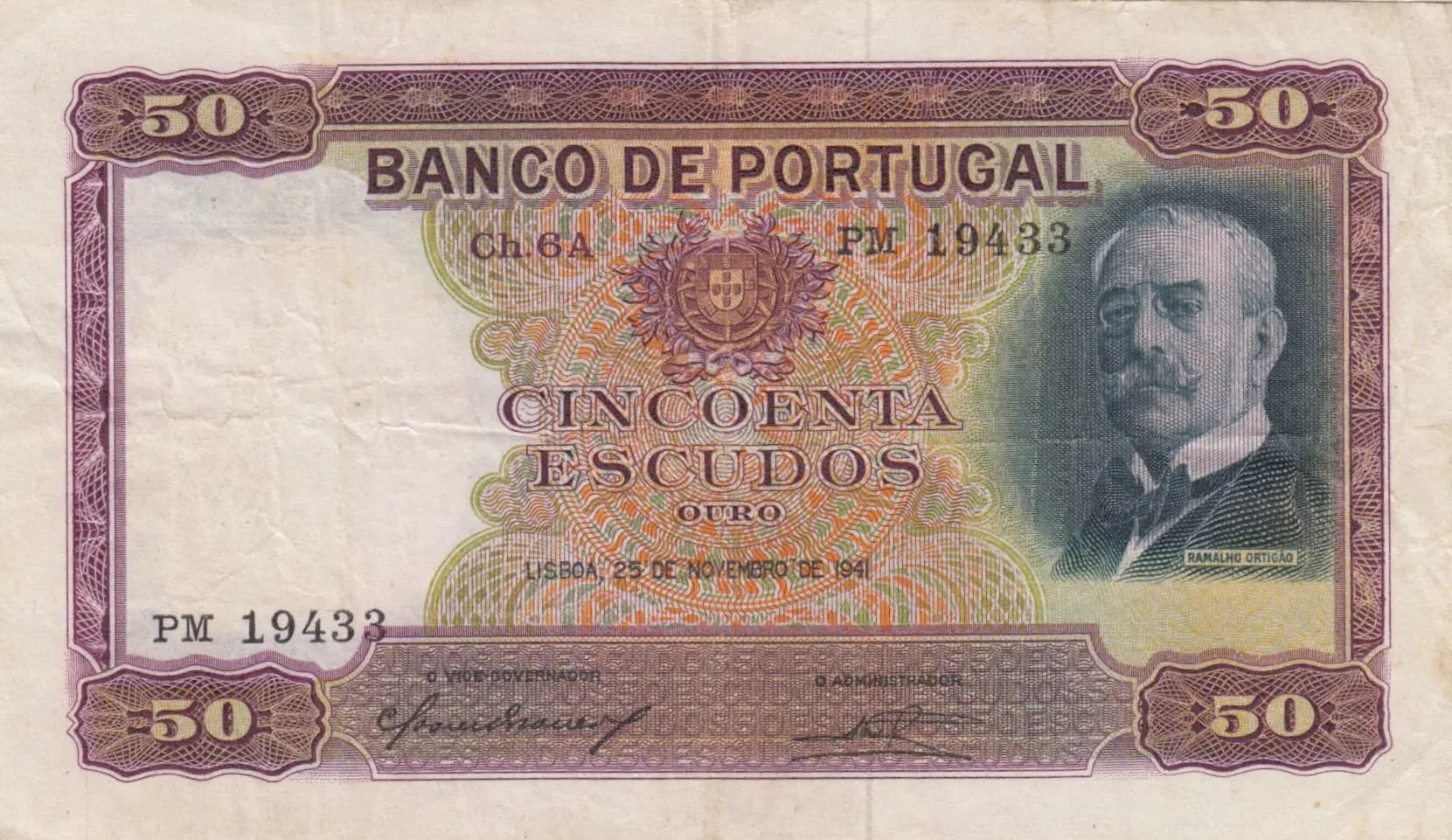
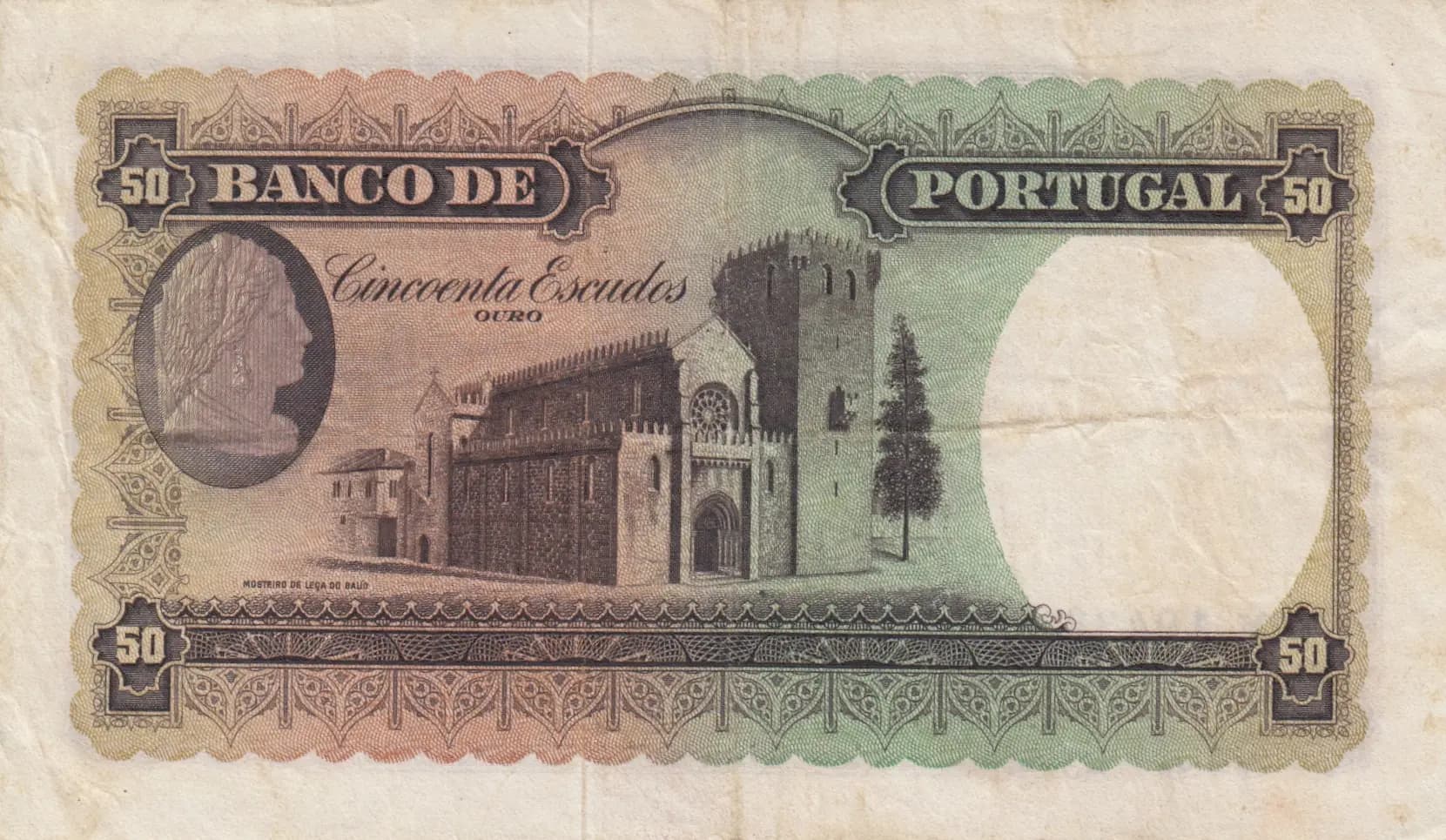
This is a VF-graded 50 Escudos banknote from Portugal dated November 24, 1941, issued by Banco de Portugal during the Estado Novo period. The note features a striking purple and multicolor design with the Portuguese coat of arms prominently displayed on the obverse and an architectural monument on the reverse, showing appropriate age-related wear consistent with circulation from the 1940s era. Despite visible creasing and foxing typical of an 85-year-old circulated note, the intricate engraving and color registration remain well-preserved, making this a desirable example for Portuguese numismatic collections.
Common. The eBay price tracking data shows consistent sales in the $30-65 range for Fine and VF examples from 2012-2022, with 2016 catalogue values listing VF at approximately $30-39 equivalent. The long issuing period (November 25, 1941 through June 28, 1949) and Banco de Portugal's substantial print runs for this denomination ensure adequate supply in the market. PMG population data confirms standard cataloguing without rarity variants noted.
Issued during the Estado Novo regime of António de Oliveira Salazar, this 1941 banknote reflects Portugal's monetary policy during World War II when the country maintained official neutrality. The iconography—featuring the Portuguese coat of arms with its characteristic five shields and the depiction of a significant religious/institutional building—reinforced national identity and historical continuity during this politically complex period. The gold standard notation ('OURO') on the note reflects Portugal's monetary framework of the era, which remained anchored to gold reserves.
The obverse features a portrait of Ramalho Ortigão, a 19th-century Portuguese writer and journalist, positioned on the right side in formal dress with characteristic facial hair, rendered in the classical portrait style typical of the era. The dominant design element is the Portuguese coat of arms (Escudo Português) at center-right, displaying the shield with five smaller shields in quincunx formation surrounded by elaborate heraldic ornamentation. The note employs a color scheme of purple, green, orange, and cream with ornate geometric borders featuring rosette patterns and intricate line work throughout. The reverse depicts the Mosteiro da Lapa de Basto (or similar monastic complex), rendered as an architectural view showing fortified walls, towers with crenellations, and a cypress tree in muted greens and browns, with a second portrait in oval frame on the left side. The dual-tone color treatment (cream and green) on the reverse creates visual interest while maintaining the classical aesthetic of Portuguese note design.
FRONT: 'BANCO DE PORTUGAL' (Bank of Portugal), 'CINCOENTA ESCUDOS' (Fifty Escudos), 'OURO' (Gold), 'LISBOA, 24 DE NOVEMBRO DE 1941' (Lisbon, November 24, 1941), 'PM 19433' (likely printer's mark or plate number), '50' (denomination). BACK: 'BANCO DE PORTUGAL' (Bank of Portugal), 'CINCOENTA ESCUDOS' (Fifty Escudos), 'OURO' (Gold), 'MOSTEIRO DA LAPA DE BASTO' (Monastery of Lapa de Basto).
This banknote was produced using traditional intaglio (engraved) printing methods by Bradbury Wilkinson & Co. (BWC), a renowned British security printer without imprint mark on this particular issue. The fine line work, intricate geometric patterns, and complex border designs visible throughout both obverse and reverse are characteristic of high-security intaglio engraving. The multicolor printing required multiple passes through the press, with careful color registration evident in the surviving example despite age-related wear.
This example exhibits Chapa 6A (plate 6A), as noted in the realbanknotes.com reference, indicating it derives from the sixth engraved plate used during the note's production run. Serial number prefix 'PM 19433' is recorded on the front. The note falls within the standard issue type with no known overprints, color varieties, or error variants documented for Pick 154. Dating to the 1941 portion of the extended issue period (1941-1949), this represents an earlier printing from the series.