10 escudos 1925
Market Prices
2 salesAbout This Note
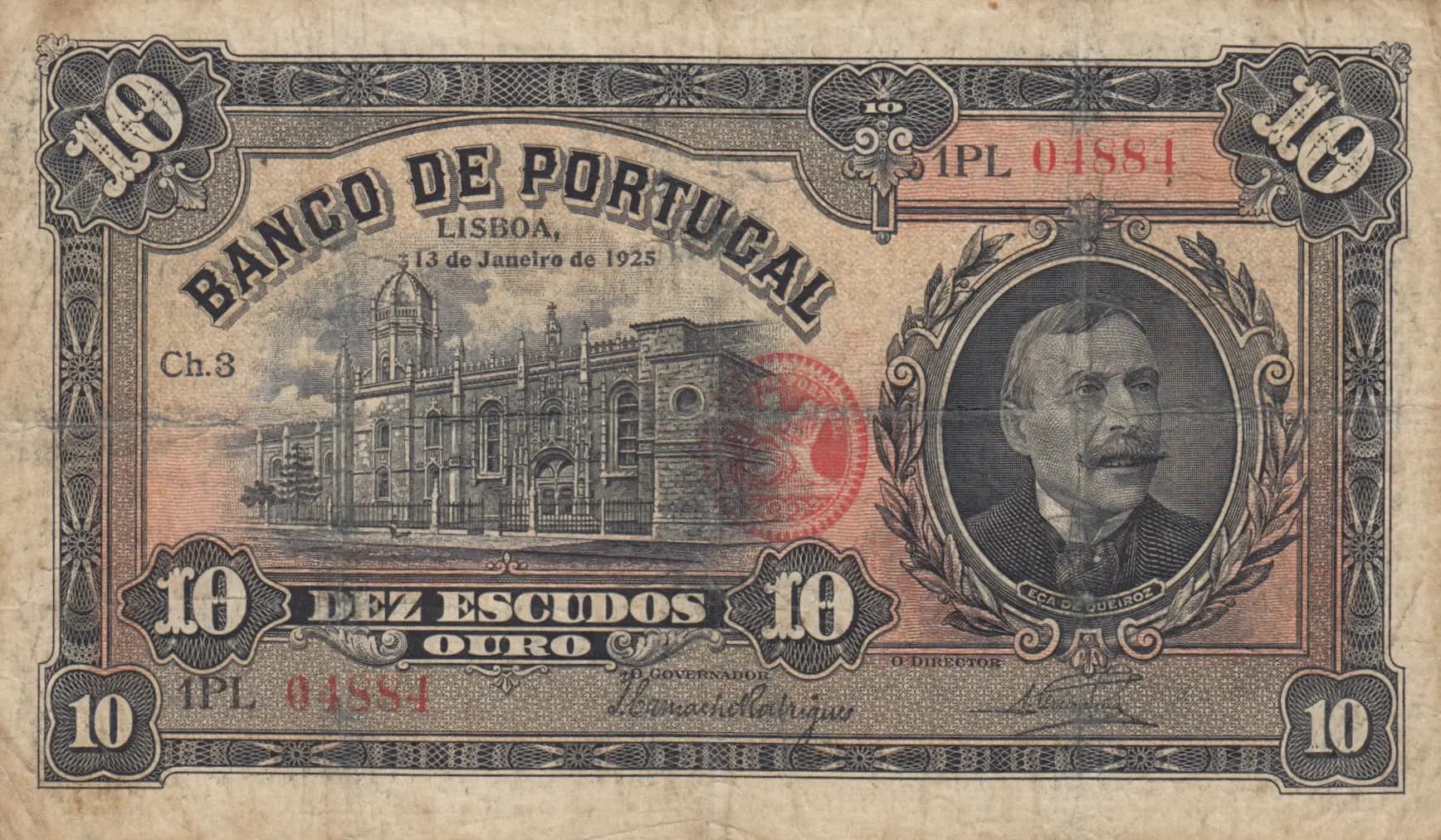
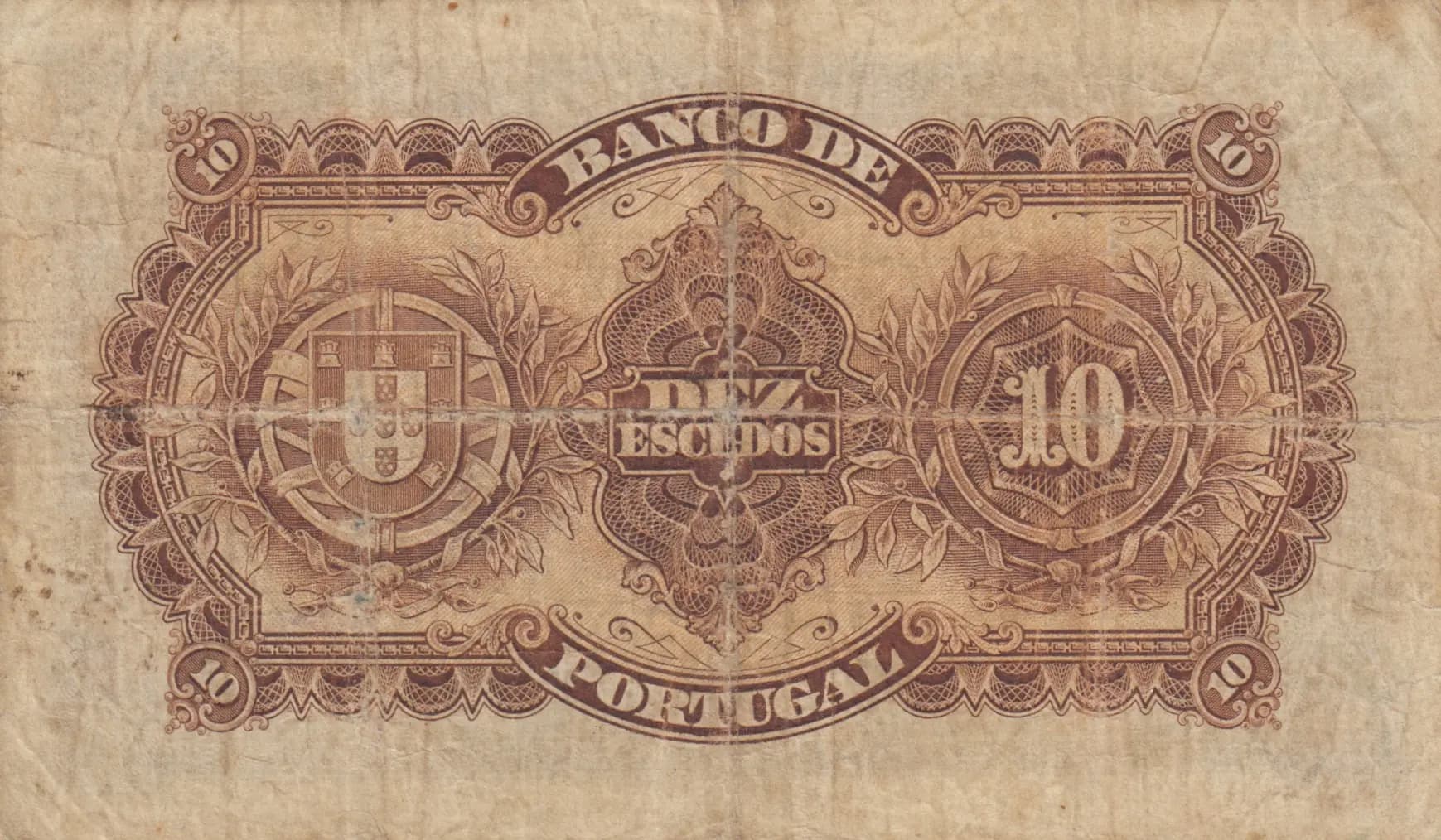
This is a Portuguese 10 Escudos banknote from 1925, issued by Banco de Portugal on January 13th, featuring the iconic Jerónimos Monastery on the obverse and Portuguese heraldic arms on the reverse. The note is in Fair (F) condition with visible age-related wear including foxing, staining, and prominent red cancellation marks across the front, suggesting this specimen has been heavily circulated or stored long-term. The fine engraved detailing remains legible despite the condition, making it a representative example of early Portuguese republican-era currency design.
Common. The eBay price tracking data indicates relatively modest market values ($125-171.50 in F condition as of 2013), with notes appearing with reasonable frequency in the secondary market. The 1925 10 Escudos was part of a regular issue (not a commemorative or limited printing), and population data from PMG shows only one documented variant, suggesting straightforward production without significant rarity factors. The presence of red cancellation marks on this specimen, while reducing aesthetic appeal, does not make it rare as such marked notes were common practice in Portugal during this era.
Issued during the First Portuguese Republic period (1910-1926), this 1925 banknote reflects Portugal's economic stabilization efforts following World War I and the tumultuous early years of the republican government. The Jerónimos Monastery, depicted on the obverse, is one of Portugal's most significant architectural monuments located in Lisbon, symbolizing national heritage and cultural pride during a period of political consolidation. The inclusion of Eça de Queirós, Portugal's acclaimed 19th-century writer, on the reverse portrait further emphasizes the nation's intellectual and cultural identity during this transitional decade.
The obverse features the Jerónimos Monastery (Mosteiro dos Jerónimos) prominently positioned on the left-center, rendered with Gothic architectural details including its distinctive dome and tower. A portrait of Eça de Queirós (José Maria de Eça de Queirós), Portugal's celebrated novelist, appears on the right side within an ornate circular medallion frame decorated with laurel wreaths, symbolizing artistic achievement. The reverse displays the Portuguese coat of arms on the left with heraldic shield elements featuring crosses and traditional heraldic ornaments, complemented by symmetrical decorative scrollwork, crowns, and leafy flourishes. The denomination appears multiple times across both sides within ornamental cartouches and corner decorations.
Front side: 'BANCO DE PORTUGAL' (Bank of Portugal), 'LISBOA' (Lisbon), '13 de Janeiro de 1925' (January 13, 1925), 'DEZ ESCUDOS' (Ten Escudos), 'OURO' (Gold), 'Ch.3' (Chapter 3 - printer's mark), 'IPL' (printer's initials), '0155 I' (serial number variant), 'GOVERNADOR' (Governor), 'DIRECTOR' (Director). Back side: 'BANCO DE PORTUGAL' (Bank of Portugal), 'DEZ ESCUDOS' (Ten Escudos), with repeated denomination numerals '10'.
This note was produced using traditional intaglio engraving techniques, characteristic of early 20th-century banknote production. The fine-line cross-hatching, detailed geometric border patterns, and precise heraldic engraving visible throughout both sides confirm the use of steel plate engraving. The printer was Waterlow & Sons (W&S), as documented in catalog records and evidenced by the characteristic engraving style typical of this security printer's Portuguese commissions. The lack of printer's imprint on the note itself was standard practice for this issuer during this period.
This specimen is identified as Chapa 3 (Plate 3) according to the engraved notation on the obverse, indicating it derives from the third plate used in the production run. The serial number variant '0155 I' is visible. The red stamp marks across the note appear to be Portuguese institutional cancellation marks rather than defacement, which was standard processing for notes passing through government or banking institutions. Waterlow & Sons produced this note without their imprint, as was typical for Banco de Portugal issues of this period. No major varieties beyond plate differences have been documented for this Pick number.