10 escudos 1920
Market Prices
About This Note
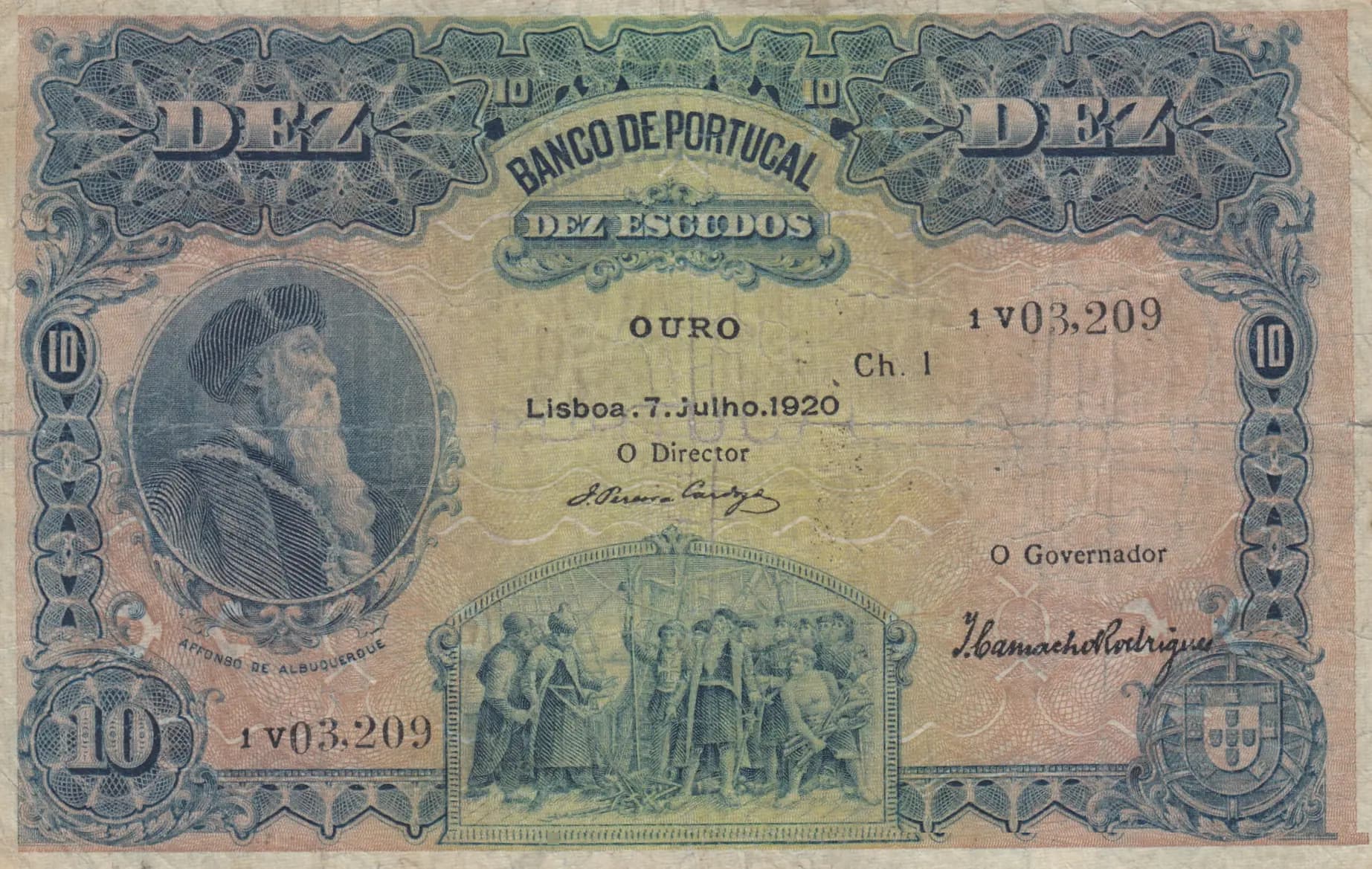
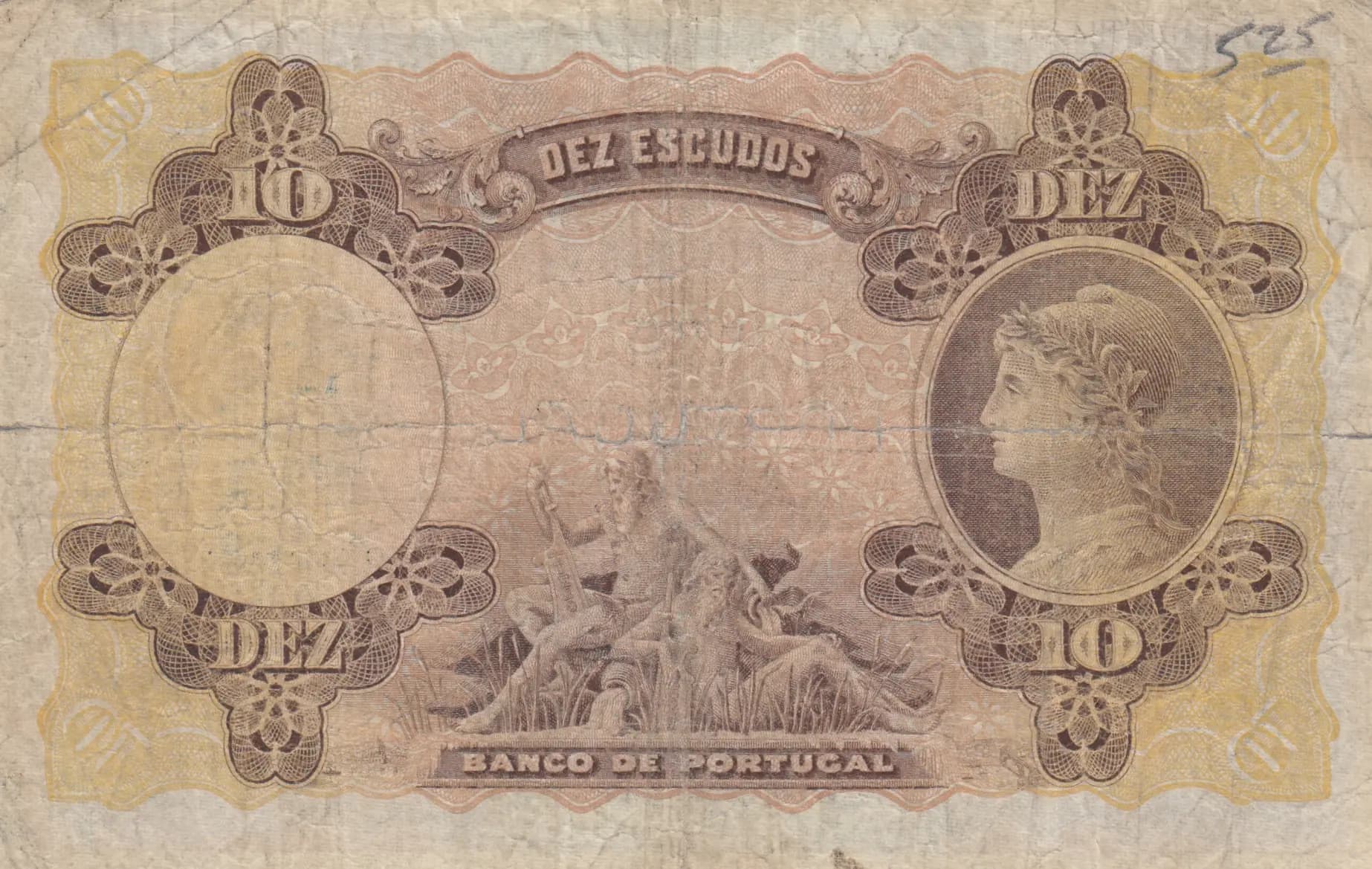
This is a 10 Escudos note from Banco de Portugal dated 7 July 1920, representing an early 20th-century Portuguese banknote during a period of significant political and economic transition. The note features a striking dual-portrait design with Afonso de Albuquerque, the celebrated Portuguese explorer, on the obverse and an allegorical female figure (Liberty) on the reverse, both rendered in fine engraved detail. In Fine (F) condition, the note exhibits the expected characteristics of a century-old circulated banknote: multiple creases and folds, aged yellowing and cream patina, foxing, and brown spots consistent with extended circulation, though it remains structurally intact without tears.
Common. The catalog values from 2016 indicate this note in Fine condition is valued at approximately $300 USD, and eBay market data shows multiple sales across various grades ranging from $98.50 to $2,999.99 USD depending on condition, with regular circulation grades priced between $150-$650. The fact that multiple examples appear regularly on the secondary market, combined with catalog valuations indicating modest pricing for the Fine grade, demonstrates this is a regularly available note. The 1919-1920 issue appears to have had a substantial print run sufficient to ensure examples remain accessible to collectors.
This banknote was issued during the First Portuguese Republic (1910-1926), a period marked by economic instability and frequent currency reforms. The choice to feature Afonso de Albuquerque—the 16th-century Portuguese explorer and viceroy of India—reflects Portugal's continued national pride in its maritime and colonial legacy, even as the nation faced domestic political turmoil. The classical allegorical Liberty figure on the reverse embodies the republican ideals that defined the period, contrasting with the historical commemoration of imperial conquest on the obverse.
The obverse features a left-facing profile portrait of Afonso de Albuquerque, the renowned 16th-century Portuguese explorer, military commander, and first viceroy of Portuguese India, rendered within an ornate oval frame. Below the portrait is a detailed historical scene depicting the explorer in a colonial or maritime context with multiple figures, representing either a discovery scene or diplomatic encounter. The note is framed by ornate Baroque-style decorative borders with guilloche patterns and scrollwork in blue and green tones on a cream and pink underprint. The reverse displays a classical allegorical female figure wearing a laurel wreath or crown—representing Liberty or the Portuguese Republic—positioned in profile on the right side. The center features an elaborate allegorical scene with multiple figures in a classical landscape composition. Both sides bear the Portuguese coat of arms and are executed in fine line engraving with intricate cross-hatching throughout. The color scheme alternates between the blue-and-green obverse and the brown-and-sepia reverse on cream/beige paper.
FRONT: 'BANCO DE PORTUGAL' (Bank of Portugal); 'DEZ ESCUDOS' (Ten Escudos); 'OURO' (Gold); 'Ch. 1' (Chapter/Plate 1); 'Lisboa. 7. Julho. 1920' (Lisbon. 7 July 1920); 'O Director' (The Director); 'Alfredo Lopes' (signature of Director); 'O Governador' (The Governor); 'Ibanemacho Rodrigues' (signature of Governor); 'AFFONSO DE ALBUQUERQUE' (Afonso de Albuquerque); Serial number '1V03.209'; denomination '10'. BACK: 'DEZ ESCUDOS' (Ten Escudos); 'BANCO DE PORTUGAL' (Bank of Portugal); denomination marking '10' and 'DEZ' (Ten).
Intaglio engraving (relief printing from engraved plates), as evidenced by the fine line work, detailed guilloche patterns, and intricate cross-hatching visible throughout the note. The printer is identified as BWC (Banknote World Currency, likely a division of a major security printer of the era), with no imprint visible on the note itself, which was standard practice for Portuguese notes of this period. The multi-color printing required multiple passes, typical of high-security banknote production of the 1920s.
This specific note is identified as Chapa 1 (Plate 1), dated 7 July 1920, with signatures of Director Alfredo Lopes and Governor Ibanemacho Rodrigues. The serial number 1V03.209 places it within the first printing series. According to PMG population data, P-117s represents the sole cataloged variant for the base Pick number P-117, indicating consistency in this design and print run. The 1919 and 1920 date variations noted in external catalogs likely reflect the issuing authority's extended release of this plate design across two calendar years.