50 pesos 1949
Market Prices
18 salesAbout This Note
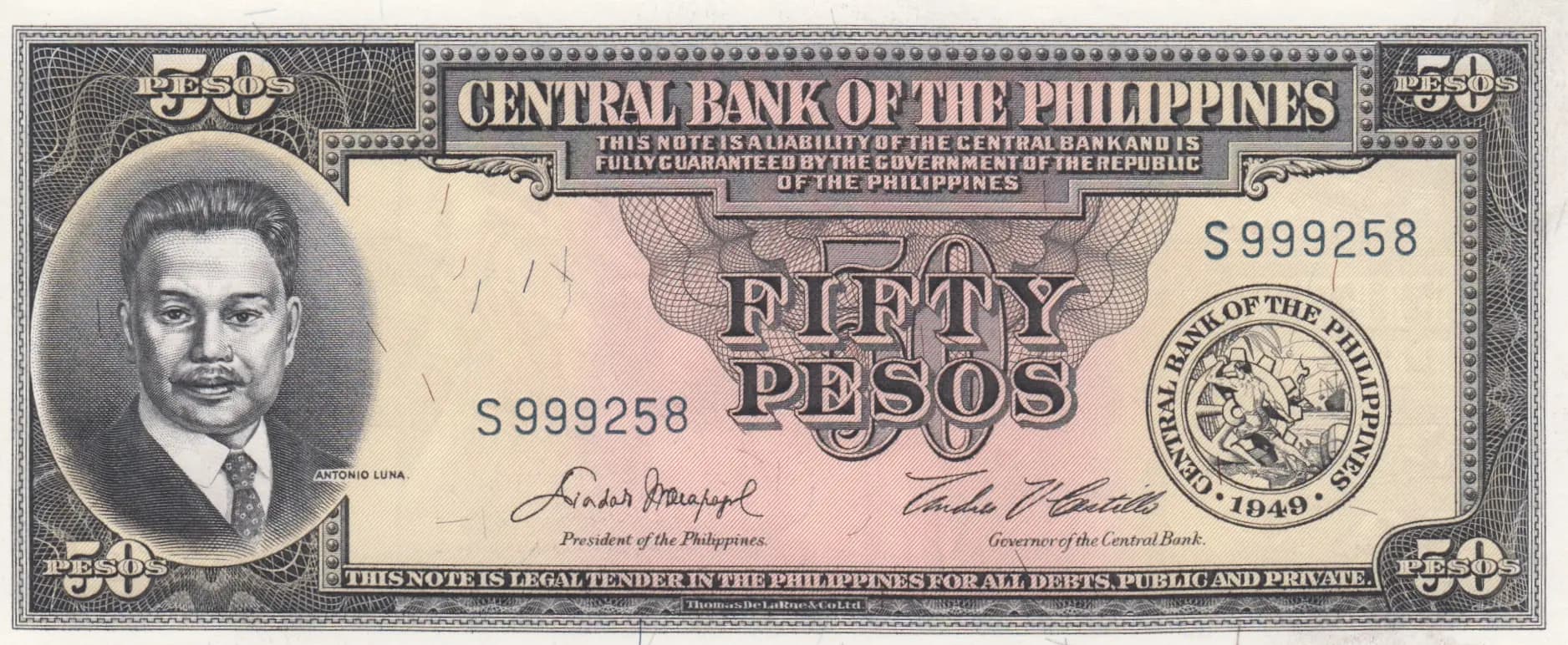
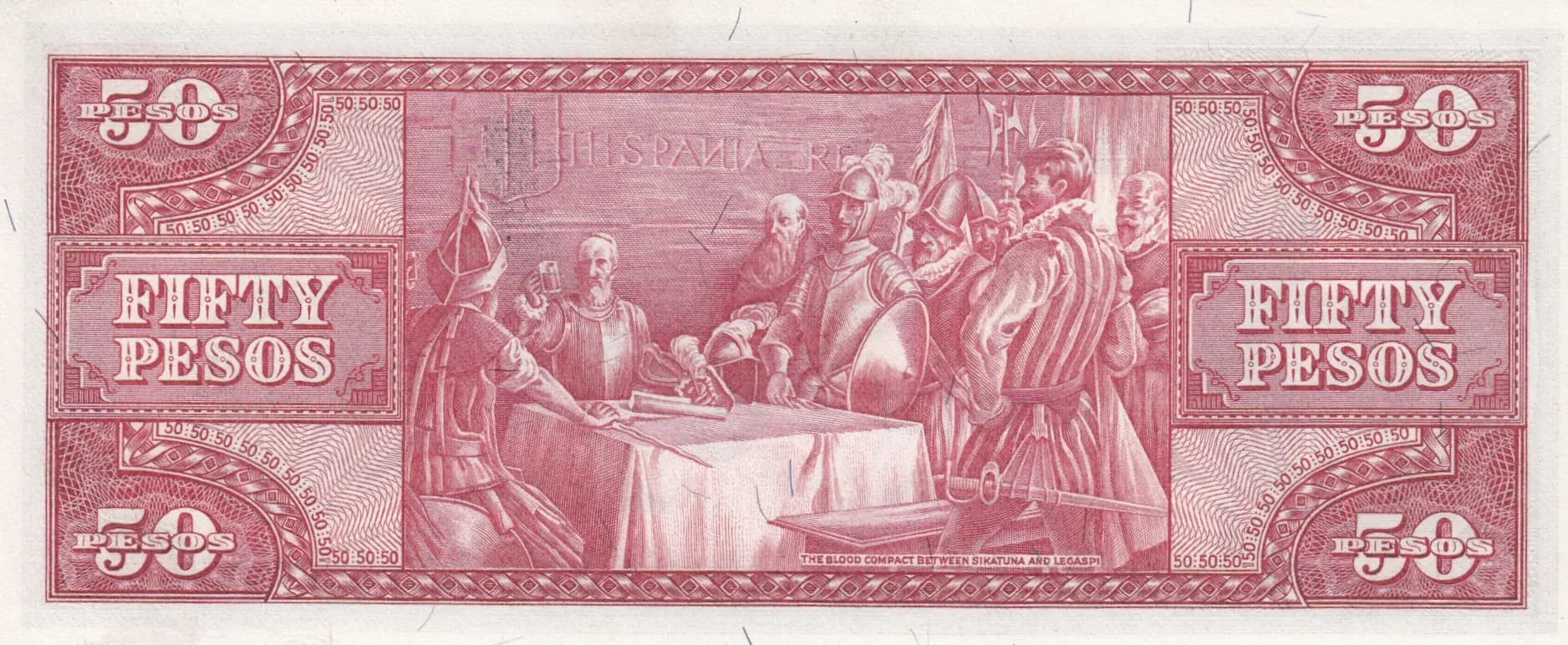
This is a 1949 Central Bank of the Philippines 50 pesos note in UNC condition, featuring a striking portrait of Antonio Luna on the obverse and the historically significant Blood Compact scene on the reverse. The note displays excellent preservation with crisp impressions, vibrant colors (black/cream on the front, red/pink on the back), and minor wear consistent with careful handling rather than active circulation. The fine engraving work and security features are clearly visible, making this an exemplary example of post-war Philippine currency design.
Common. This note is a regular-issue Central Bank of the Philippines banknote from a 1949-1969 circulation period with substantial print runs. eBay market data shows consistent sales in the $3-44 range depending on condition grade, with UNC examples regularly selling for $4-18, indicating robust availability in the collector market. No evidence of restricted print runs, recalls, or short-lived issuing period that would warrant a rarity classification higher than common.
Issued in 1949, shortly after Philippine independence from the United States (1946), this note commemorates two pivotal figures in the nation's history: Antonio Luna, a revolutionary general, and the Blood Compact between Sikatuna (a Boholano chieftain) and Miguel López de Legazpi (Spanish conquistador), which symbolized the first recorded peaceful alliance between indigenous Filipinos and colonial powers. The Central Bank's establishment and early currency issues reflected the Philippines' transition to monetary sovereignty following independence.
The obverse features a formal portrait of Antonio Luna (1866-1899), a Filipino revolutionary general and national hero, positioned at the left in military dress with distinctive mustache, rendered in fine engraving detail. The Central Bank of the Philippines seal, dated 1949, appears prominently at lower right. The reverse depicts the Blood Compact ceremony of 1565, showing multiple figures in Spanish colonial-era military uniforms and indigenous dress gathered around a ceremonial table, representing the historic meeting between Datu Sikatuna and Miguel López de Legazpi. Both sides employ elaborate guilloche patterns, ornamental frames, and geometric borders typical of Thomas de la Rue's high-security banknote production.
FRONT: 'CENTRAL BANK OF THE PHILIPPINES' (header); '50 PESOS' (denomination); 'THIS NOTE IS A LIABILITY OF THE CENTRAL BANK AND IS FULLY GUARANTEED BY THE GOVERNMENT OF THE REPUBLIC OF THE PHILIPPINES' (legal text); 'THIS NOTE IS LEGAL TENDER IN THE PHILIPPINES FOR ALL DEBTS PUBLIC AND PRIVATE' (legal declaration); 'ANTONIO LUNA' (portrait identification); 'President of the Philippines' and 'Governor of the Central Bank' (authority signatures); '1949' (year); 'Thomas De La Rue & Co Ltd' (printer mark); Serial number 'S999258'. BACK: 'FIFTY PESOS' and '50 PESOS' (denominations); 'THE BLOOD COMPACT BETWEEN SIKATUNA AND LEGASPI' (historical scene description); repeating '50' denomination markers and decorative 'HISPANIA' text.
Intaglio engraving (line engraving/gravure), as evidenced by the fine guilloche patterns, detailed portrait work, and intricate security features visible in the visual analysis. Printed by Thomas de la Rue & Co Ltd, London, one of the world's premier security printers. The technique produces the characteristic fine line work, precise detail registration, and tactile raised impressions observed in this note.
The observed note corresponds to Pick P-138d (1949 issue). The visual analysis indicates this is a standard type with Central Bank Seal Type 1 visible at lower right. Serial number S999258 is observed. No significant overprints, date variations, or signature variations are apparent that would constitute distinct collecting varieties. The catalog reference notes a variant P-138fp exists in PMG records, suggesting potential signature or seal type differences among 1949-1969 period notes, but this specimen appears to be the standard P-138d type.