10 centavos 1917
Market Prices
10 salesAbout This Note
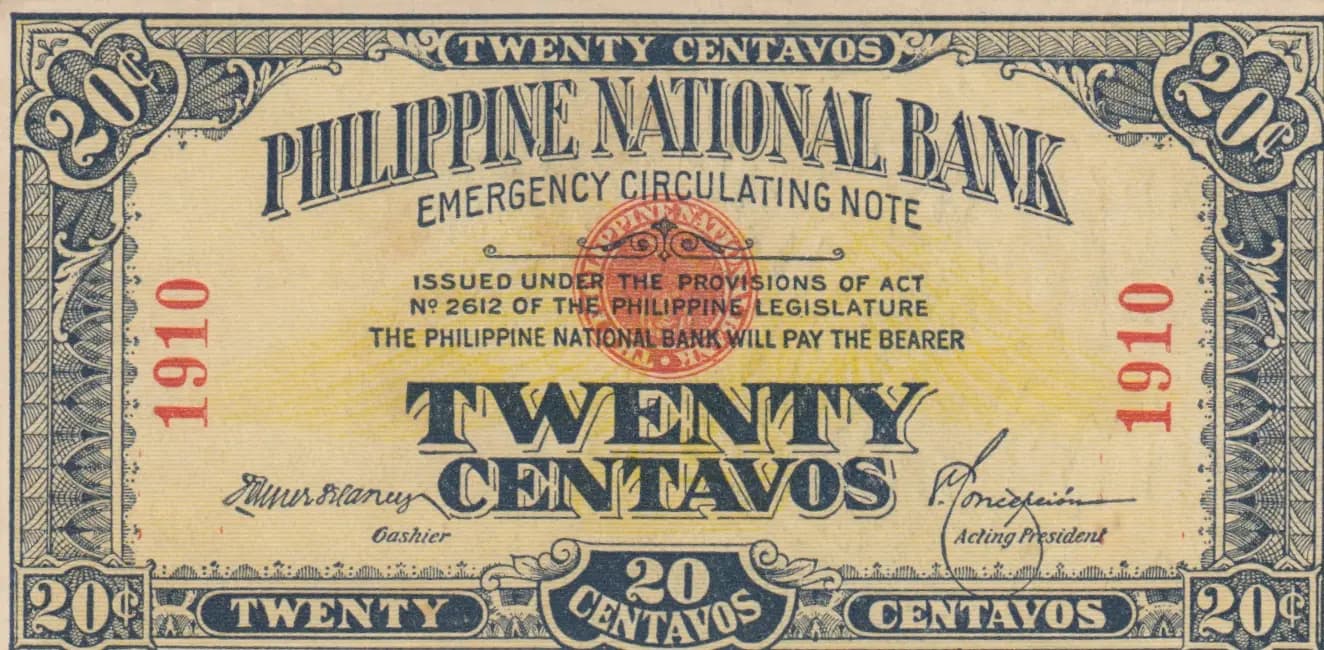
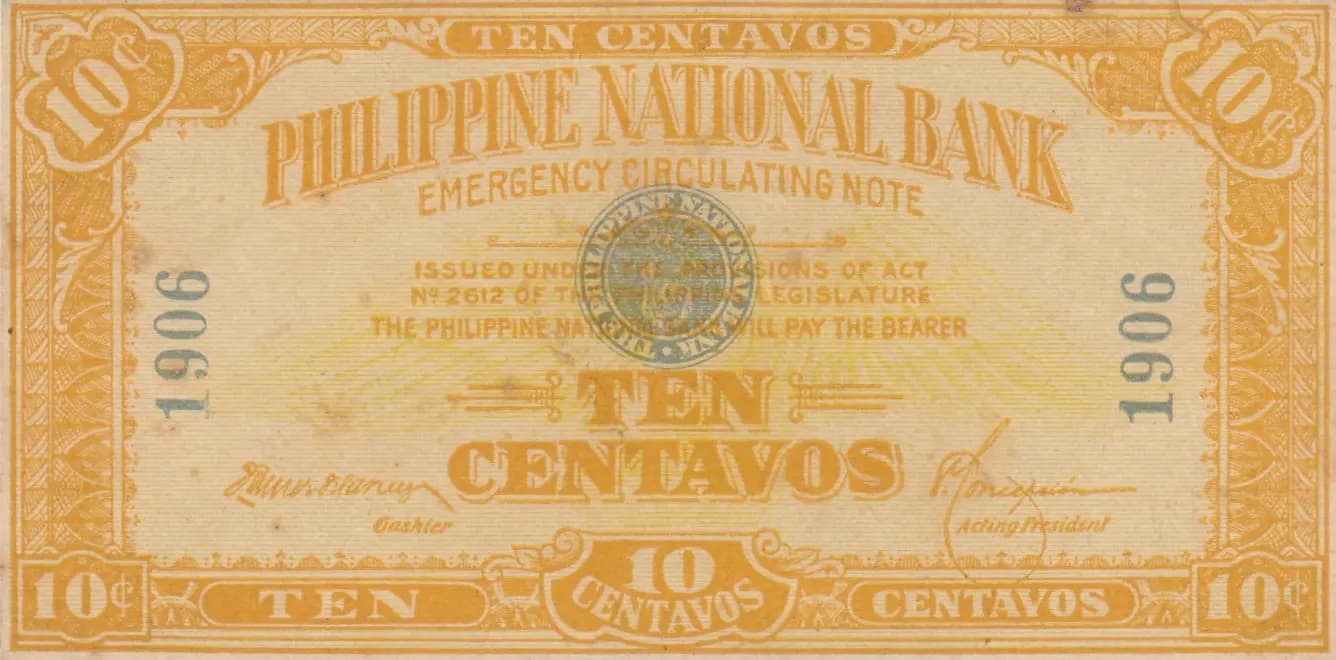
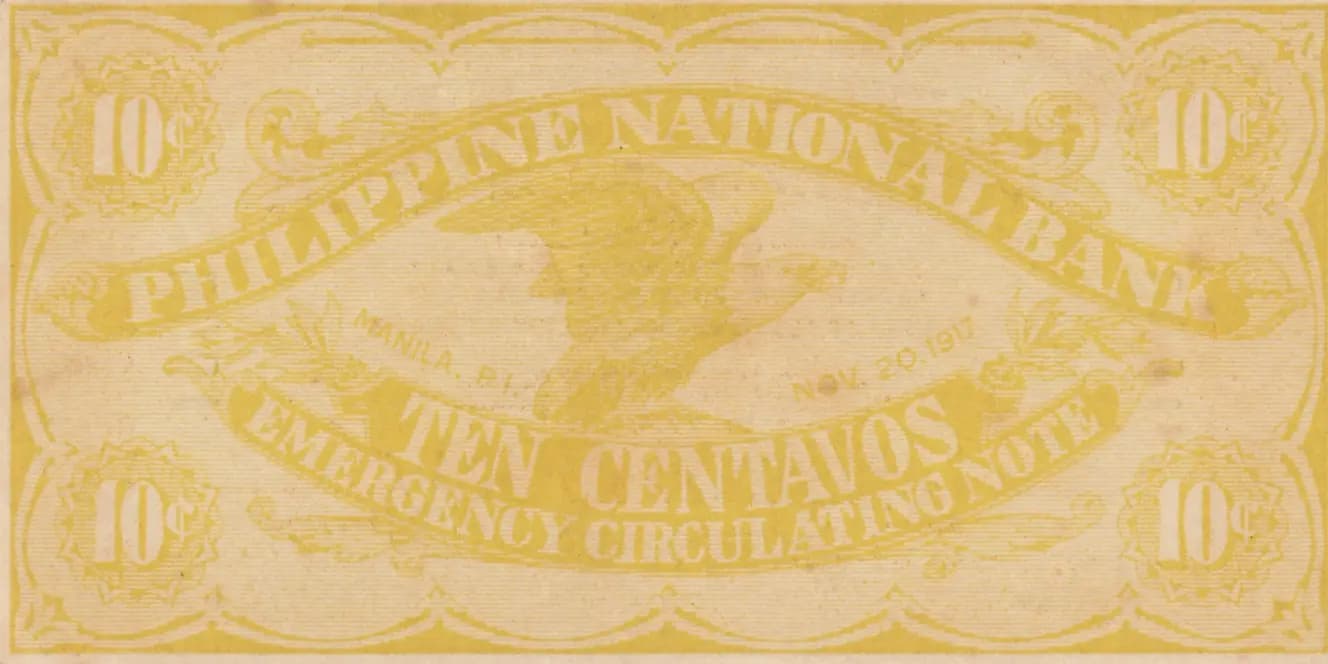
This Philippine National Bank 10 centavos emergency circulating note from 1917 exhibits the characteristic orange-gold color scheme and ornate Art Nouveau-style borders typical of early 20th-century Philippine currency. The note displays significant aging with foxing and yellowing throughout, consistent with its AU grade and over 105 years of circulation history. The obverse features the Philippine National Bank seal, while the reverse displays a prominent American bald eagle, reflecting the historical ties between the Philippines and the United States during the American colonial period.
Common. Despite being an emergency issue from 1917, eBay price tracking data shows consistent sales in the $17.50–$57 range across multiple condition grades (UNC to PMG 64), with numerous transactions dating back to 2009. Current catalog values (2016) place this note at $50 for UNC and $20 for VF, well within the range of commonly traded Philippine notes. The print run was substantial enough to ensure regular availability in the numismatic market, and the AU grade specimen observed is typical of surviving examples.
This note was issued on November 20, 1917, under the provisions of Act No. 2612 of the Philippine Legislature during a period of monetary strain in the Philippines under American colonial administration. The inclusion of an American bald eagle on the reverse symbolizes the political and economic dominance of the United States in the Philippine islands during this era. Emergency circulating notes like this were issued to supplement the money supply during periods of economic or monetary crisis, indicating specific conditions requiring additional liquidity in the Philippine financial system in 1917.
The note features a symmetrical layout with elaborate Art Nouveau decorative borders in orange and gold tones framing the central design elements. The obverse displays the circular seal of the Philippine National Bank prominently positioned in the center-upper portion, with multiple denomination indicators (both written 'TEN CENTAVOS' and numeric '10¢') positioned in the corners. The reverse showcases an American bald eagle as the central focal point, rendered in detail and surrounded by decorative flourishes, with the issuing location 'MANILA' and specific issue date 'NOV. 20 1917' clearly visible. Both sides employ a cream to yellow underprint with orange-gold overprinting, creating a warm, distinctive color palette characteristic of emergency currency issues of this period.
Front Side: 'PHILIPPINE NATIONAL BANK' — Philippine National Bank; 'EMERGENCY CIRCULATING NOTE' — Emergency Circulating Note; 'ISSUED UNDER THE PROVISIONS OF ACT NO. 2612 OF THE PHILIPPINE LEGISLATURE' — Issued under the provisions of Act No. 2612 of the Philippine Legislature; 'THE PHILIPPINE NATIONAL BANK WILL PAY THE BEARER' — The Philippine National Bank will pay the bearer; 'TEN CENTAVOS' — Ten Centavos; '1906' — 1906 [date]; '10¢' — 10 cents; 'TEN' — Ten; 'CENTAVOS' — Centavos. Back Side: 'PHILIPPINE NATIONAL BANK' — Philippine National Bank; 'TEN CENTAVOS' — Ten Centavos; 'EMERGENCY CIRCULATING NOTE' — Emergency Circulating Note; 'MANILA' — Manila; 'NOV. 20 1917' — November 20, 1917; '10' — 10 [denomination].
Letterpress or relief printing, typical of Philippine National Bank notes of this era. The ornate borders, fine line work, and sharp definition of the eagle and seal indicate traditional intaglio or combination letterpress techniques. Local Philippine printing was employed, as noted in the reference materials, suggesting production at Manila facilities. The color separation technique, with distinct orange-gold overprints on yellow underprint, indicates multi-pass printing characteristic of early-20th-century currency production.
This note represents the standard 1917 issue, identified by the specific date 'NOV. 20 1917' on the reverse and the reference to Act No. 2612. The Pick number P-39 denotes a single cataloged variant. The front bears '1906' (likely referring to the establishment year of the Philippine National Bank or a regulatory date), while the back carries the actual issue date of 1917, a common practice for emergency currency. No significant signature, serial number, or overprint varieties have been documented for this Pick number in standard references.