5 pesos 1916
Market Prices
About This Note
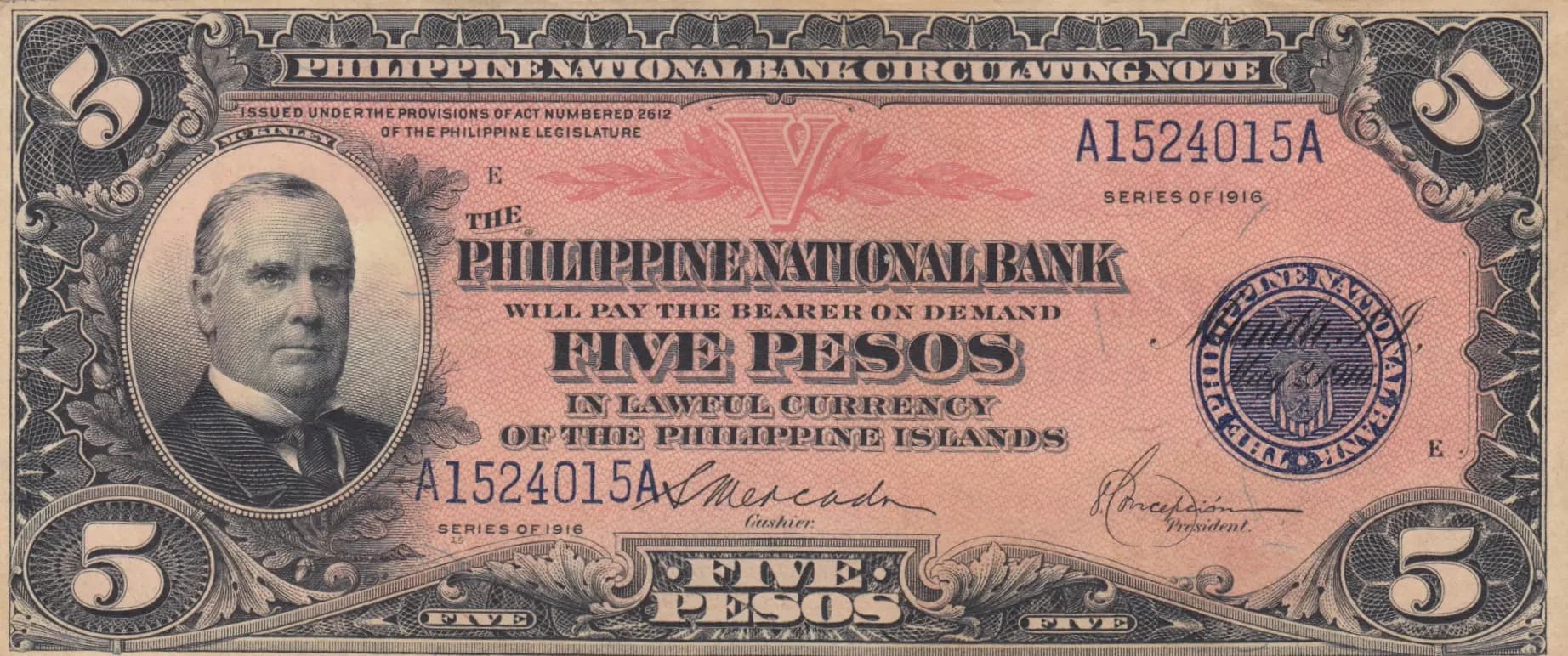
This is a Philippine National Bank 5 pesos note from 1916 (Pick P-46), graded AU (About Uncirculated), featuring a formal portrait of President William McKinley in black engraving on a distinctive pink/rose underprint. The note exhibits the ornate Victorian-era design typical of early 20th-century Philippine currency, with intricate decorative borders and the bank's circular seal prominently displayed. Despite showing minor signs of age and circulation, the note retains excellent detail and color, making it a desirable example of this historically significant denomination.
Common. While this is an early 20th-century Philippine banknote, eBay market data shows a wide range of prices ($14.99 USD to $575.00 USD) with multiple examples regularly listed, indicating healthy availability. The AU grade specimen observed here aligns with mid-range pricing around $195.00 USD. The 1916 5 pesos was part of a regular issue with sufficient print runs to meet circulation demands during the Philippine colonial period. No evidence from PMG population data or historical records suggests limited production or recall status that would elevate rarity.
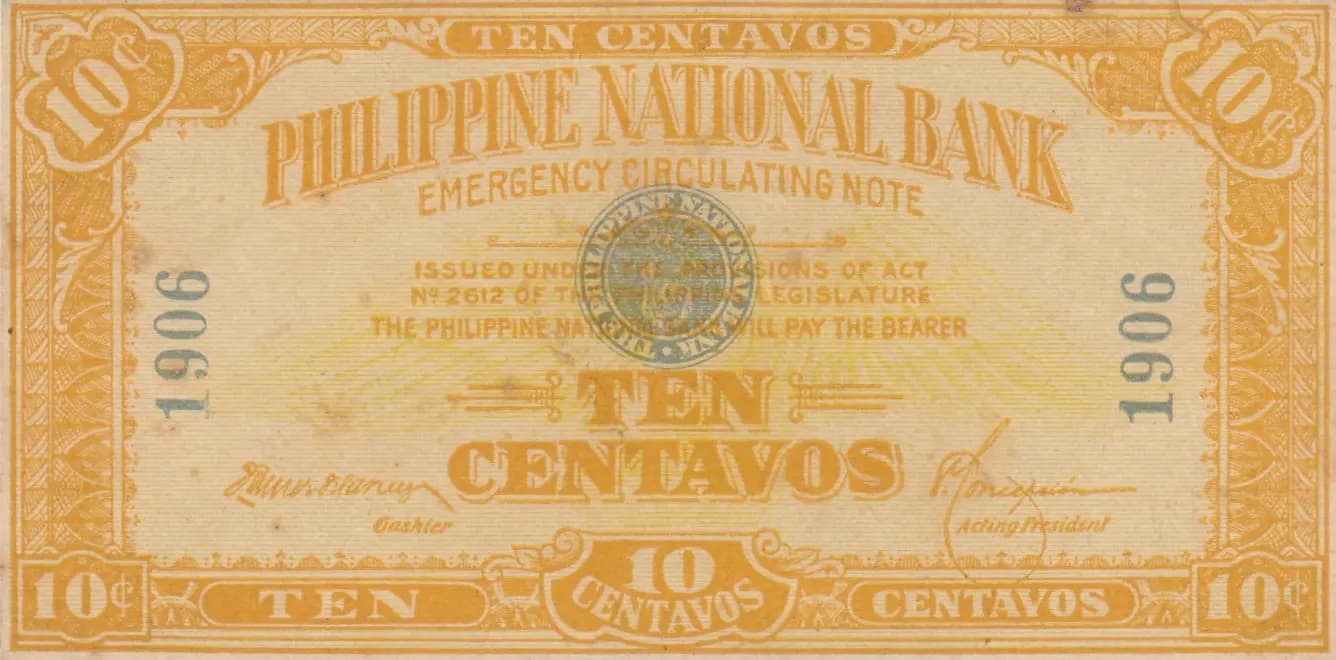
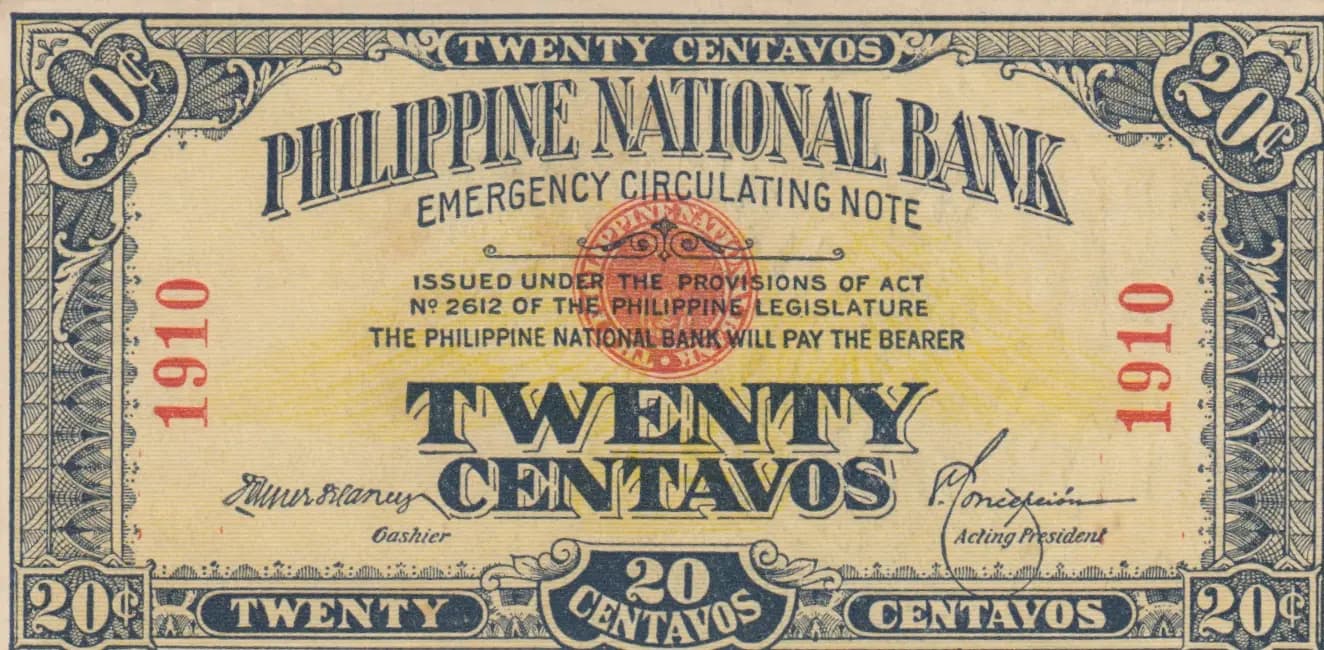
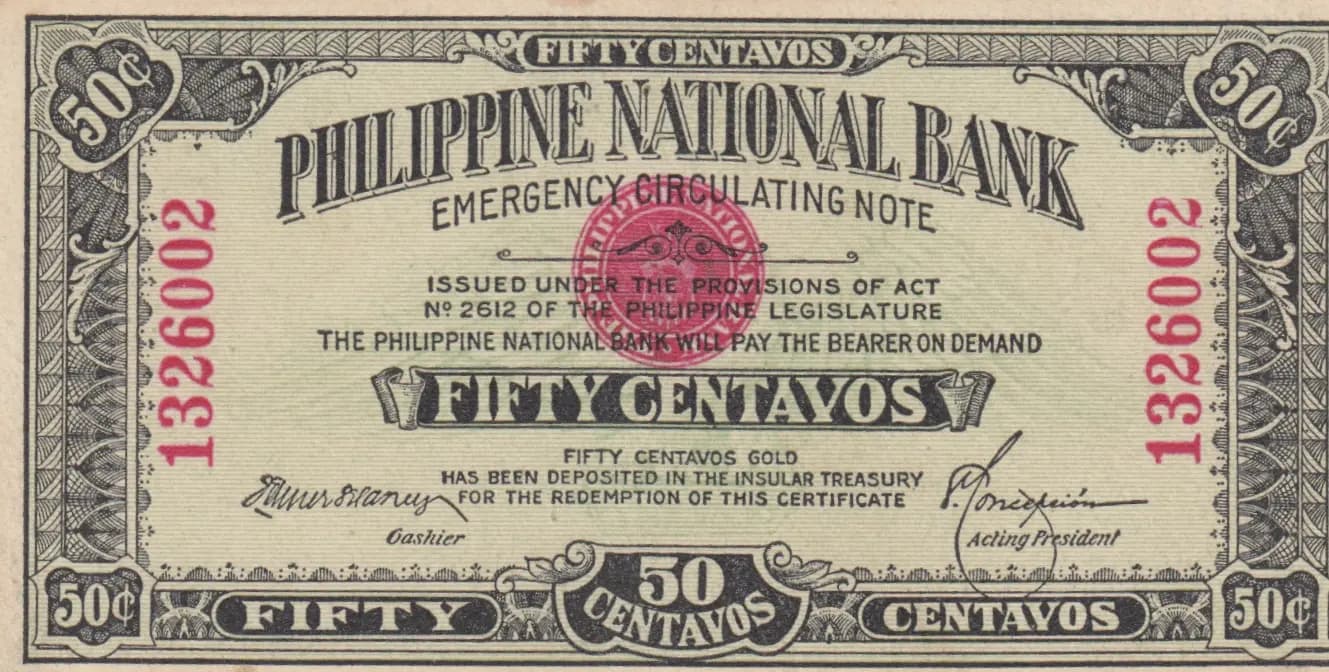
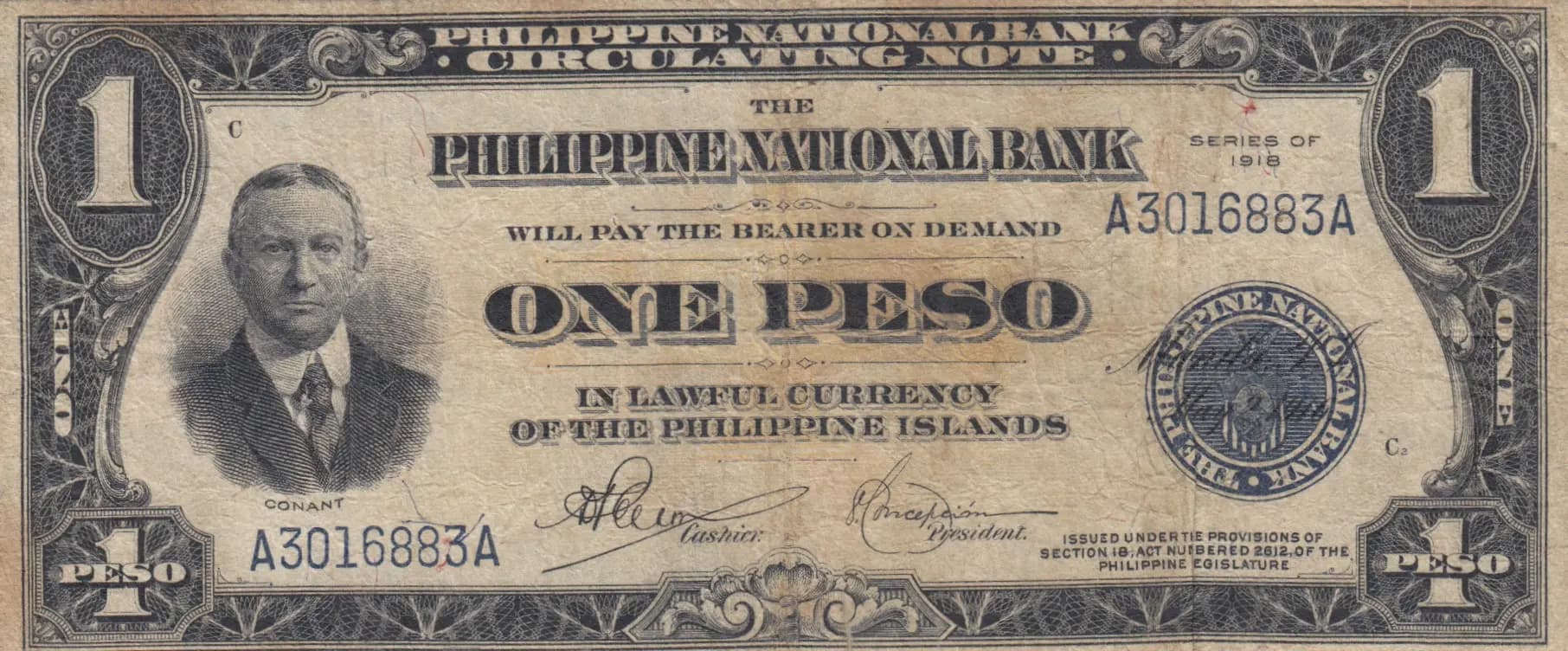
This circulating note was issued by the Philippine National Bank under Act 2612 of the Philippine Legislature in 1916, during the American colonial period in the Philippines. The inclusion of President William McKinley's portrait reflects the political context of American governance and economic influence in the Philippine Islands at that time. The note's promise to redeem in 'lawful currency of the Philippine Islands' and its acceptance by the Philippine Government for taxes and obligations underscore the currency's official status within the colonial administration.
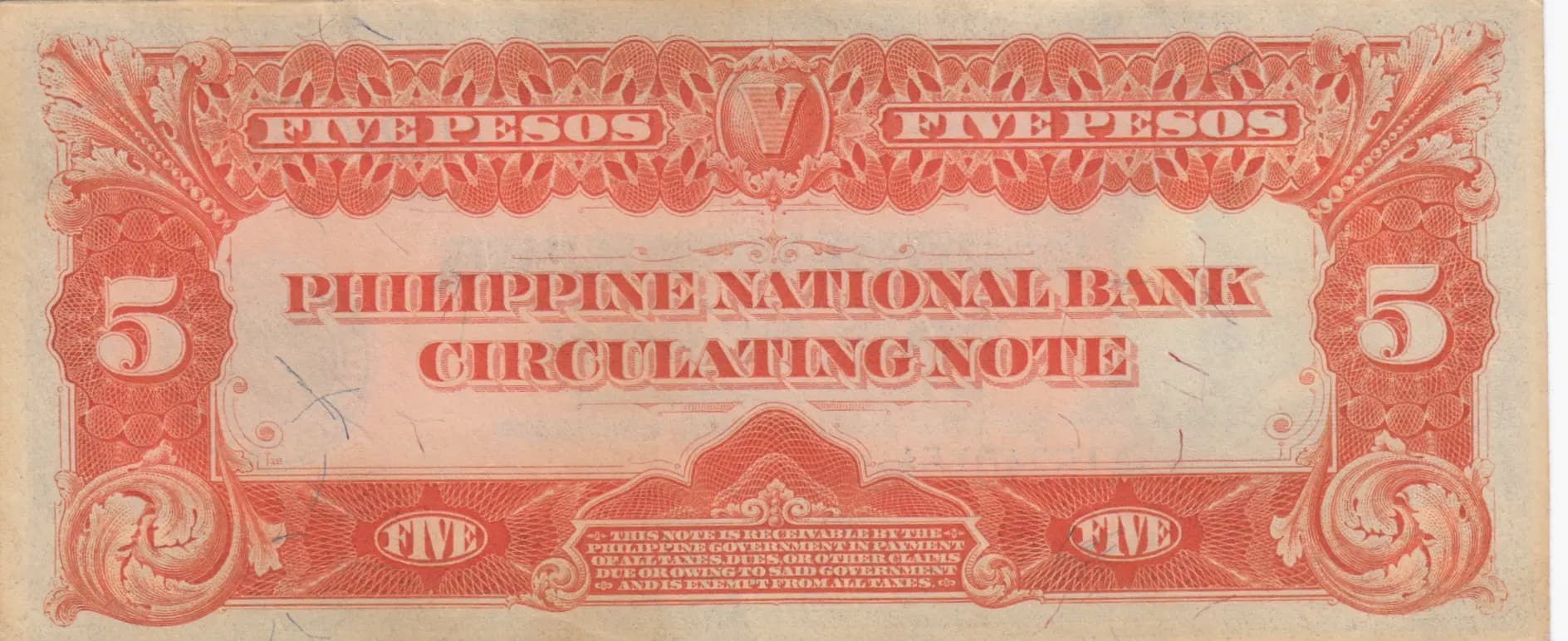
The obverse features a formal left-facing portrait of U.S. President William McKinley rendered in fine black and white engraving, positioned on the left side of the note against a distinctive pink/rose colored background. The design incorporates ornate Victorian-era decorative elements including elaborate geometric and floral borders, corner scrollwork, and flourishes throughout. The Philippine National Bank's circular seal is prominently displayed on the right side of the obverse. The reverse features large ornamental corner numerals reading 'FIVE' and 'FIVE PESOS' in red/coral coloring on a cream/beige background, with decorative circular medallions, central cartouche elements, and intricate geometric border patterns. The entire design reflects the high-quality engraving standards typical of U.S. Bureau of Engraving and Printing work of this era.
FRONT: 'PHILIPPINE NATIONAL BANK CIRCULATING NOTE' — Philippine National Bank Circulating Note. 'ISSUED UNDER THE PROVISIONS OF ACT NUMBERED 2612 OF THE PHILIPPINE LEGISLATURE' — Issued under the provisions of Act numbered 2612 of the Philippine Legislature. 'THE PHILIPPINE NATIONAL BANK WILL PAY THE BEARER ON DEMAND FIVE PESOS IN LAWFUL CURRENCY OF THE PHILIPPINE ISLANDS' — The Philippine National Bank will pay the bearer on demand five pesos in lawful currency of the Philippine Islands. 'SERIES OF 1916' — Series of 1916. 'FIVE PESOS' and '5' — Denomination markings. Serial number: A1524015A. BACK: 'FIVE PESOS' and 'FIVE' — Denomination text. 'PHILIPPINE NATIONAL BANK CIRCULATING NOTE' — Philippine National Bank Circulating Note. 'THIS NOTE IS RECEIVABLE BY THE PHILIPPINE GOVERNMENT OF ALL TAXES DUTIES AND OTHER GOVERNMENT OBLIGATIONS' — This note is receivable by the Philippine Government of all taxes, duties, and other government obligations.
This note was produced using intaglio engraving, the standard security printing method for currency during this period. The printer is identified as the U.S. Bureau of Engraving and Printing (USBEP), without imprint visible on the note itself. The characteristic fine line work, cross-hatching, and complex geometric patterns observed throughout both sides are hallmarks of intaglio engraving. The multi-color printing with black and red/coral inks on colored underprints required multiple press passes, a technique carefully controlled to prevent counterfeiting.
This note is consistent with Pick P-46b*, the standard USBEP variety without imprint. The visible serial number A1524015A with prefix 'A' is typical of the series. Specific signature varieties may exist within this pick number designation, though the visual analysis does not provide clear enough signature detail to definitively identify which signature variety this represents. Further examination under magnification would be needed to determine if this is the P-46a or P-46b variant based on signature combinations or other distinguishing features.