5 pesos 1949
Market Prices
30 salesAbout This Note
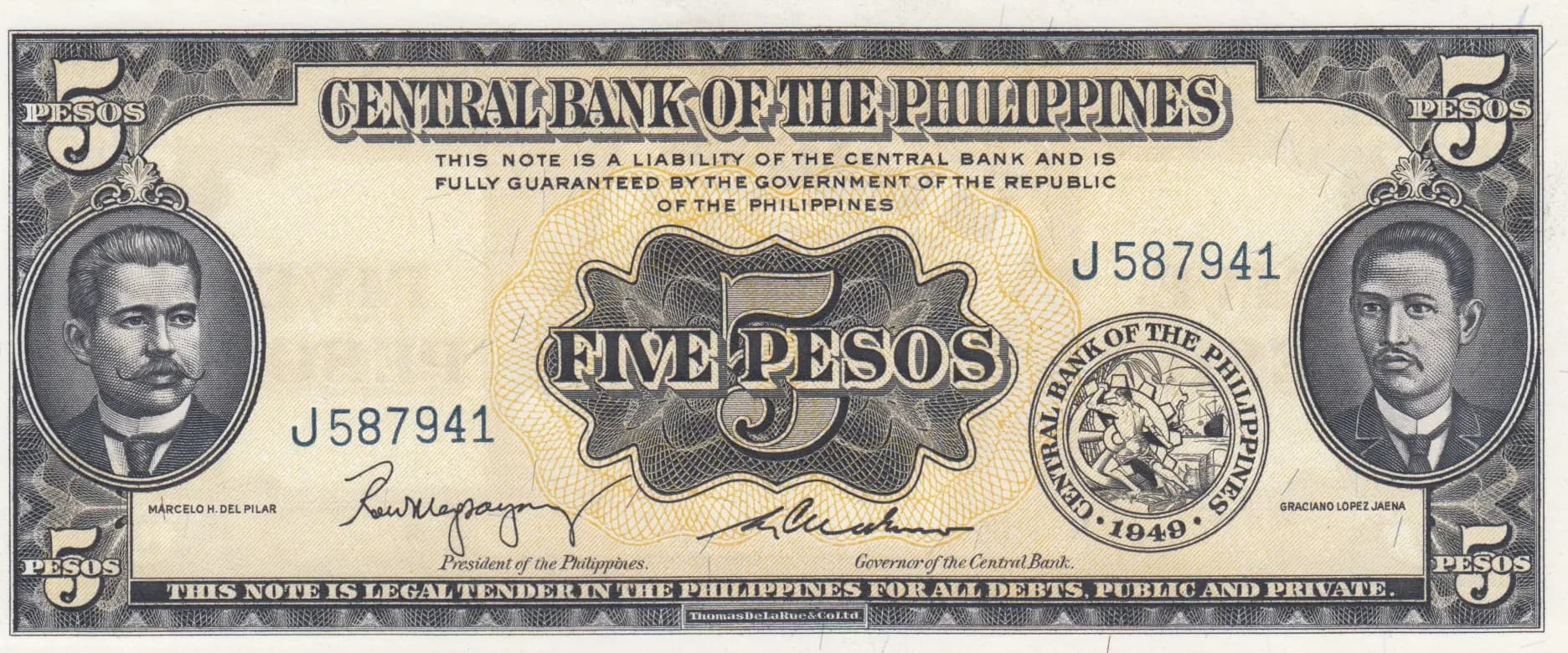
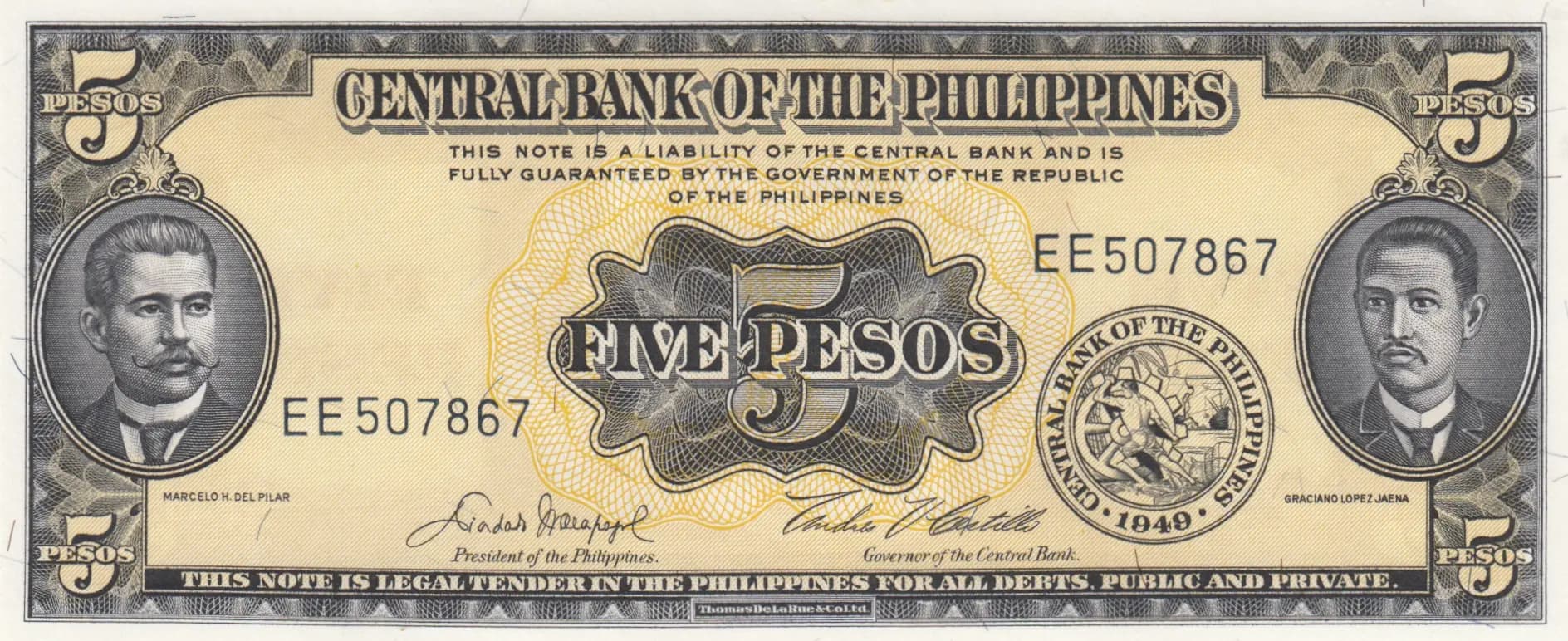
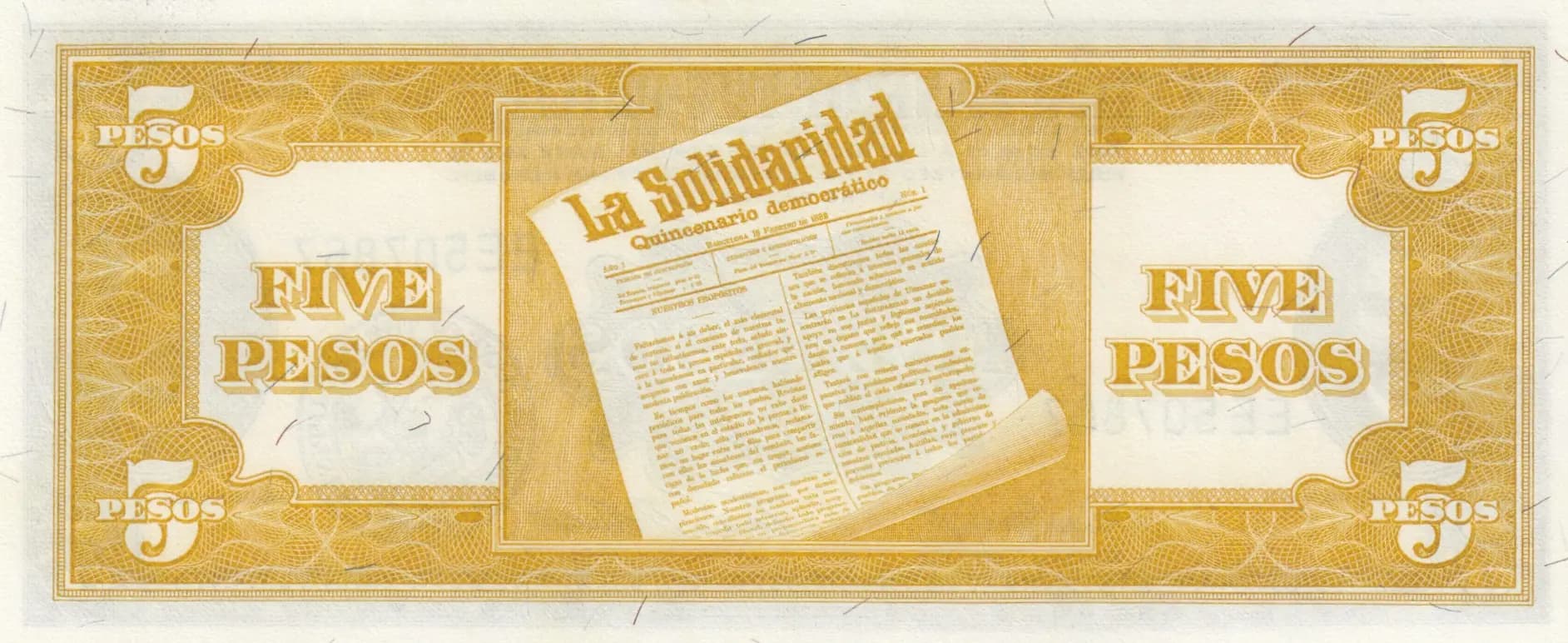
Philippine 5 Pesos banknote from 1949 (Pick P-135e) featuring dual portraits of nationalist heroes Marcelo H. del Pilar and Graciano Lopez Jaena on a cream and gold background with the Central Bank seal dated 1949. The note displays visible aging characteristics including creasing, folds, and discoloration consistent with circulation wear, placing it below strict UNC standards despite the catalog grade designation. This historically significant note commemorates the independence movement through its portraiture and reverse design featuring La Solidaridad newspaper, making it an important piece of Philippine numismatic history.
Common. Secondary market eBay data consistently shows UNC specimens selling in the $3–$6 range across multiple years (2012–2026), with catalog values at $2 UNC (2019). Print runs for this 1949 issue were substantial given the Central Bank's need to establish circulation currency for the newly independent nation. The abundance of examples on secondary markets and stable, modest pricing indicate this is a widely available note among collectors. Even higher grades (PMG 65) command only $10–$54, confirming common circulation status rather than scarcity.
Issued in 1949, shortly after the Philippines' independence from the United States (July 4, 1946), this note reflects the newly sovereign nation's commitment to honoring its revolutionary leaders. The dual portraits of del Pilar and Lopez Jaena, both prominent figures in the propaganda movement and La Solidaridad newspaper during Spanish colonial times, underscore the Central Bank of the Philippines' role in establishing national monetary identity. The reverse's depiction of La Solidaridad—the groundbreaking publication that unified Filipino nationalists through democratic ideals—reinforces the connection between currency design and the nation's independence struggle.
The obverse features a formal dual-portrait composition with Marcelo H. del Pilar on the left and Graciano Lopez Jaena on the right, both rendered in dignified formal attire with prominent mustaches, characteristic of late 19th-century Philippine nationalist leadership. The central denomination cartouche displays 'FIVE PESOS' in ornate Gothic lettering surrounded by decorative scrollwork. The Central Bank of the Philippines seal, prominently positioned in the lower right, includes the 1949 date and establishes the note's official authority. The color scheme employs cream and beige as the dominant background with gray ornamental borders and black portraiture, enhanced by gold/tan underprinting. The reverse presents La Solidaridad newspaper as a central vignette on a predominantly gold background, with the subtitle 'Quincenario democratico' emphasizing its role as the democratic fortnightly publication that unified Philippine nationalist thought. Intricate guilloche patterns, geometric crosshatching, and fine line work throughout provide security against counterfeiting.
FRONT SIDE: 'FIVE PESOS' (denomination in English), 'CENTRAL BANK OF THE PHILIPPINES' (issuing authority), 'THIS NOTE IS A LIABILITY OF THE CENTRAL BANK AND IS FULLY GUARANTEED BY THE GOVERNMENT OF THE REPUBLIC OF THE PHILIPPINES' (legal guarantee), 'MARCELO H. DEL PILAR' and 'GRACIANO LOPEZ JAENA' (portrait identifications), 'President of the Philippines' and 'Governor of the Central Bank' (authority signatures), 'THIS NOTE IS LEGAL TENDER IN THE PHILIPPINES FOR ALL DEBTS, PUBLIC AND PRIVATE' (legal tender declaration), 'Thomas De La Rue & Co Ltd' (printer identification), '1949' (date), Serial number 'EE507867'. BACK SIDE: 'FIVE PESOS' (denomination repeated), 'La Solidaridad' (Spanish: 'The Solidarity'), 'Quincenario democratico' (Spanish: 'Democratic Fortnightly'—reference to the publication's biweekly schedule).
Intaglio (engraved) printing produced by Thomas de la Rue & Co Ltd, London, the world-renowned security printer. The fine line work, detailed portraiture, intricate guilloche patterns, and geometric crosshatch security features visible in both the visual analysis and known for this Pick number are characteristic of intaglio production. The precise registration between the black/gray primary design and gold/tan underprinting, along with the finely detailed banknote border ornamentations, confirm the use of multi-plate intaglio processes typical of mid-20th century high-security banknote production.
This specimen (Pick P-135e) is identifiable by serial number prefix 'EE' and exhibits characteristics of the 1949 initial issue. The Central Bank Seal Type 1 design as noted in reference sources is present. The Pick P-135e designation specifically denotes the 1949 issue with the described portraits and La Solidaridad reverse. No overprints or significant design variants are apparent in the visual analysis. The note's condition—showing genuine circulation wear with creasing and aging—represents the more commonly encountered state of this denomination in surviving examples.