5 pesos 1949
Market Prices
2 salesAbout This Note
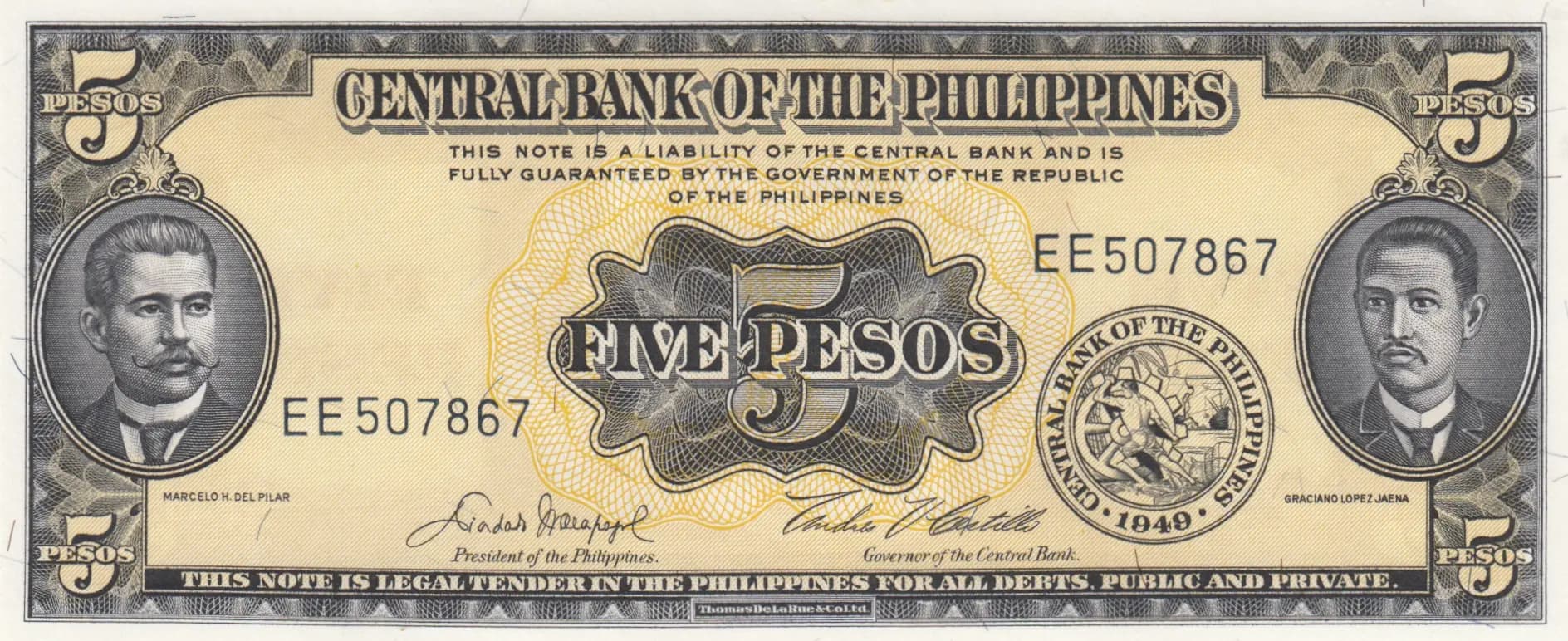
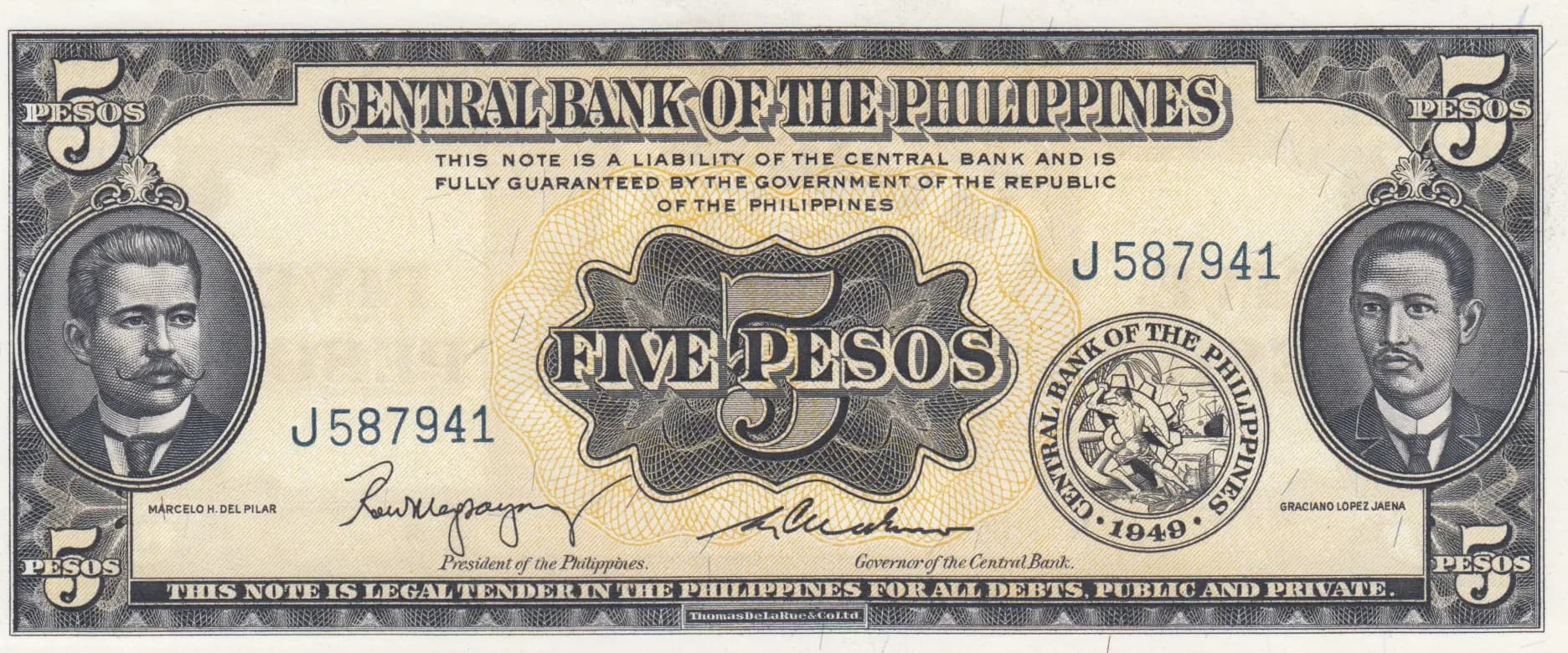
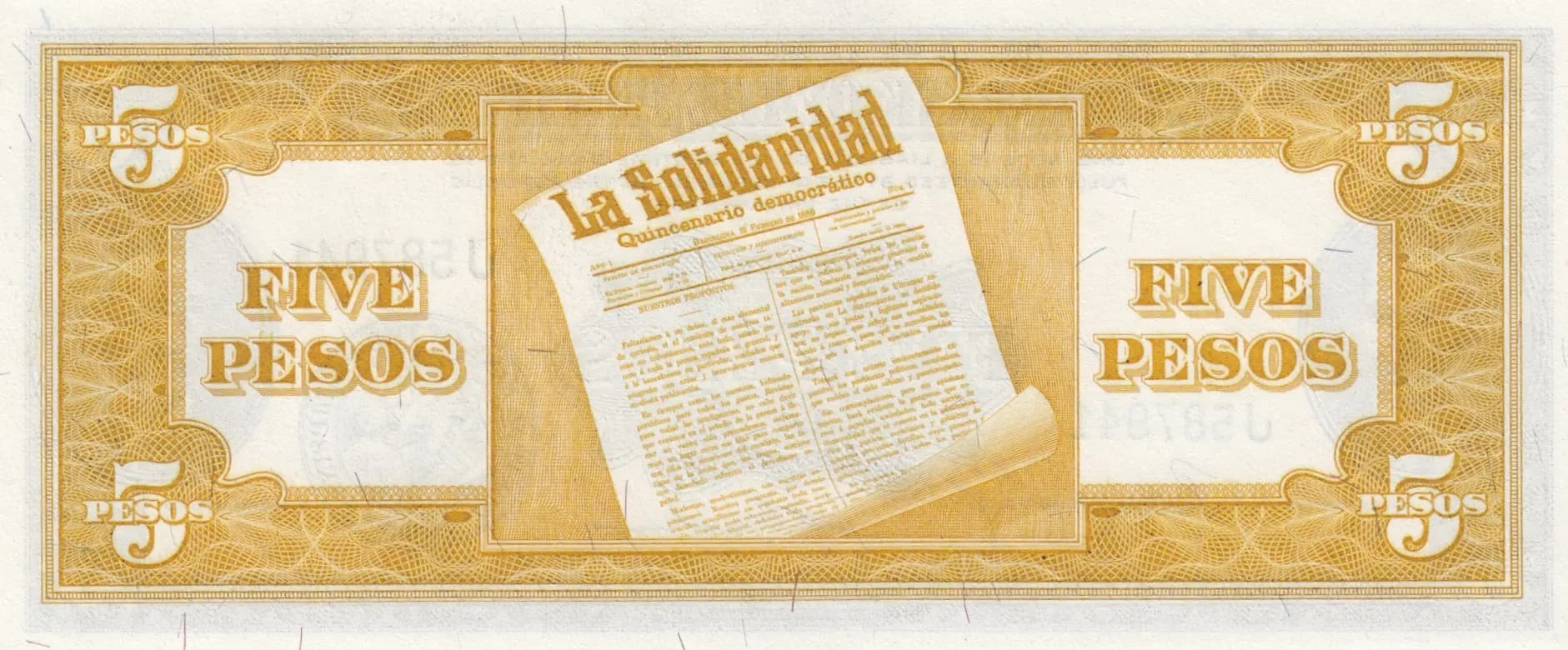
This is a Philippines 5 Pesos banknote from 1949, issued by the Central Bank of the Philippines and printed by Thomas de la Rue in London. The note presents in UNC condition with crisp printing, sharp portraiture, and minimal wear, featuring a distinctive cream and gold color scheme with dual portrait medallions on the obverse and the historically significant La Solidaridad newspaper depicted on the reverse. The note represents an important piece of Philippine numismatic history, commemorating two nationalist figures and a landmark publication of the Philippine independence movement.
Common. The eBay price data provided shows sales in the $2.82–$5.50 range for similar grades, with 2019 catalog values of $10 for UNC specimens. These modest market prices and the availability of sales records indicate this is a commonly encountered banknote among collectors. The note had a substantial print run during the post-independence period and was in regular circulation, making examples readily available today. No evidence of a short print run, recall, or scarcity exists for this Pick number.
Issued in 1949, three years after Philippine independence, this banknote honors Marcelo H. del Pilar and Graciano Lopez Jaena, prominent 19th-century Filipino nationalist journalists and propagandists. The reverse features La Solidaridad, the groundbreaking newspaper they helped establish in Spain during the Filipino nationalist movement, serving as a powerful symbol of the intellectual foundations of Philippine independence. This note reflects the early Philippine Republic's commitment to memorializing its revolutionary heritage through currency design.
The obverse features a cream and beige background with dark gray and black decorative elements in a classical banknote design. Two oval portrait medallions dominate the left and right sides: on the left is Marcelo H. del Pilar, a prominent Filipino writer and nationalist; on the right is Graciano Lopez Jaena, his collaborator and fellow propagandist. The center displays a large ornate shield-shaped cartouche containing 'FIVE PESOS' in gold lettering. A circular seal bearing the Central Bank of the Philippines emblem with '1949' appears at lower right. Intricate scrollwork, cross-hatching, and fine line engraving frame the entire design, providing both aesthetic appeal and security. The reverse showcases a predominantly yellow and gold background with an elaborate three-dimensional rendering of the open newspaper La Solidaridad as the central focal point, surrounded by ornate decorative borders and corner elements, with 'FIVE PESOS' repeated on both sides in large gold text.
FRONT: 'Central Bank of the Philippines' (English) - issuing authority; 'Five Pesos' (English) - denomination; 'This note is a liability of the Central Bank and is fully guaranteed by the Government of the Republic of the Philippines' (English) - legal guarantee; 'Marcelo H. Del Pilar' and 'Graciano Lopez Jaena' (English) - portrait identifications; 'President of the Philippines' and 'Governor of the Central Bank' (English) - signatory titles; 'This note is legal tender in the Philippines for all debts, public and private' (English) - legal tender declaration; 'Thomas De La Rue & Co Ltd' (English) - printer credit. BACK: 'Five Pesos' and 'Pesos' (English) - denomination; 'La Solidaridad' (Spanish) - newspaper title meaning 'Solidarity'; 'Quincenario democratico' (Spanish) - subtitle meaning 'Democratic Fortnightly'.
Intaglio engraving, the standard security printing method for banknotes of this era. Thomas de la Rue, the London-based security printer credited on the note, employed classical engraving techniques featuring fine cross-hatching, detailed line work, and intricate decorative patterns that would be difficult to counterfeit. The crisp reproduction of portrait details and the sharp definition of security elements observed in the visual analysis are characteristic of high-quality intaglio work from this period.
This specimen corresponds to Pick P-135b, specifically the 1949 issue with the Central Bank Seal Type 1 visible at lower right. The serial number observed (J587941) indicates this is from the standard circulation series. The note is unoverprinted and represents the basic variety of this denomination issued in 1949. No notable varieties (such as signature variations or date changes) are evident from the visual analysis provided, though collectors should note that the 5 Pesos 1949 exists in multiple minor varieties based on signature combinations and seal types across its extended print period (1949–1969 per catalog dating).