5 centavos 1942
Market Prices
5 salesAbout This Note
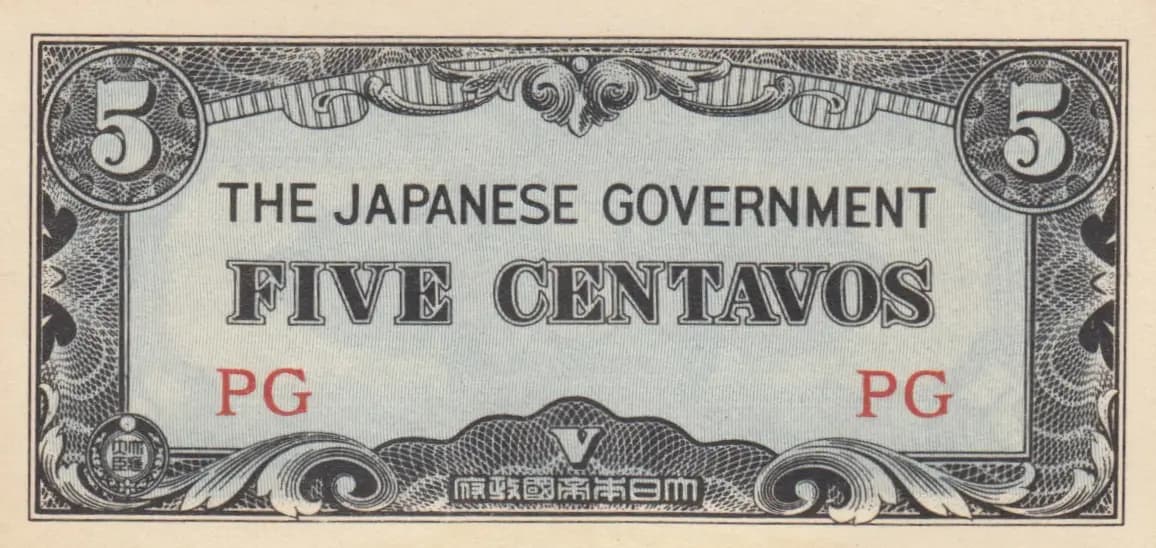
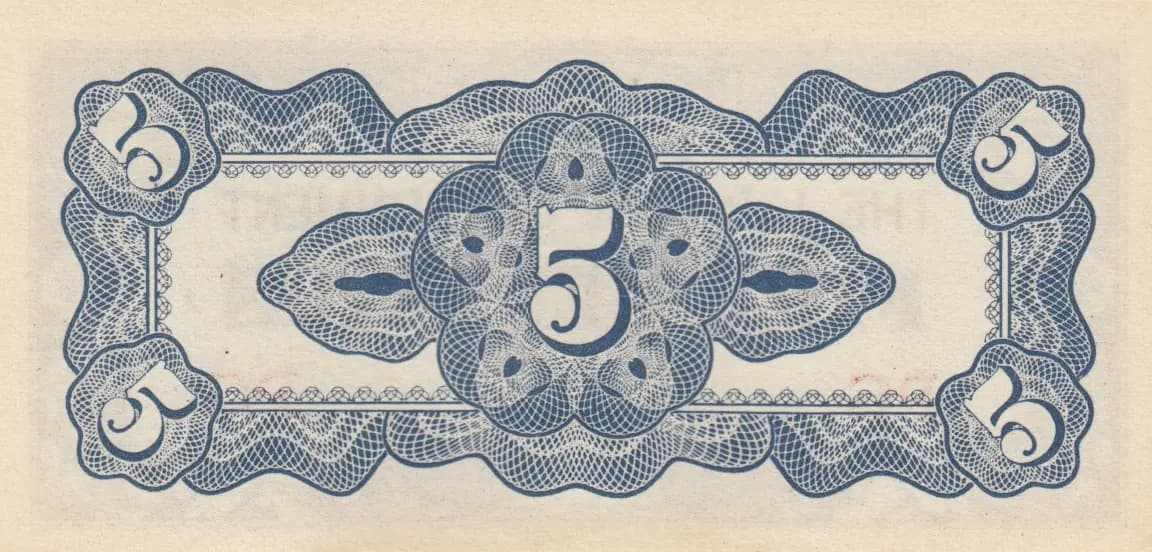
This is an uncirculated example of the Japanese Government's 5 Centavos note issued for the Philippines in 1942, featuring a crisp, well-preserved specimen with no signs of circulation. The obverse displays formal English inscriptions identifying the issuer and denomination, accompanied by ornamental circular seals and detailed crosshatching security work in black on a contrasting background. The reverse showcases an elegant blue-toned design with symmetrical floral medallions and scalloped cloud-like borders, demonstrating the refined engraving techniques characteristic of Japanese occupation currency.
Common. While these occupation notes have historical significance, the 5 Centavos denomination was produced in substantial quantities for everyday transactions during the occupation period. eBay market data consistently shows prices under $2.00 for both VF and UNC examples, with catalog values listed at $0.50 for UNC condition (2016), confirming widespread availability. The denomination's low face value and the length of the occupation (1942-1945) resulted in large print runs, making even uncirculated examples readily accessible to collectors.
This note was issued during Japan's occupation of the Philippines (1942-1945), when the Japanese Government replaced existing Philippine currency with military occupation scrip to facilitate economic control of occupied territories. The deliberate use of English language inscriptions ('THE JAPANESE GOVERNMENT,' 'FIVE CENTAVOS') was a strategic choice to maintain administrative continuity while asserting Japanese authority over the colonial monetary system. The refined decorative design elements reflect Japanese aesthetic principles applied to occupation currency, distinguishing these notes from both pre-war Philippine issues and standard Japanese military yen denominations.
The obverse features a formal, austere design dominated by 'THE JAPANESE GOVERNMENT' text in the upper center, with circular denomination seals (marked '5') positioned in all four corners containing fine crosshatching patterns typical of security engraving. A central ornamental vignette with elaborate scrollwork and flourishes occupies the upper-center area. The reverse presents a more decorative composition with a large symmetrical floral medallion at the center, surrounded by scalloped and cloud-like borders executed in the classical Japanese aesthetic. Four matching ornamental corner designs with scalloped edges provide balanced framing. The note contains no portraits or landscape landmarks, relying instead on geometric and floral ornamentation for its visual appeal and security features.
OBVERSE: 'THE JAPANESE GOVERNMENT' (English), 'FIVE CENTAVOS' (English denomination), 'PG' (block letter designation, appears twice in corner positions), '5' (numeral denomination, appears in two corners). REVERSE: '5' (numeral denomination, appears in all four corners). All text is in English with no Japanese language inscriptions on this denomination.
Intaglio engraving (recess printing), evidenced by the crisp, detailed fine line work, intricate crosshatching patterns, and three-dimensional quality of the ornamental elements visible on both sides. The precision of the border designs and decorative vignettes is consistent with high-quality steel engraving employed for Japanese occupation currency. The printer for Japanese Government occupation notes of this period was typically the Imperial Japanese Government's central printing authority, though specific printer identification is not definitively documented for all denominations of this series.
The observed 'PG' block letter designation visible in the corner positions indicates this specimen belongs to the standard issue with these letter blocks (possibly referring to 'Philippine Government' or similar administrative designation). The note displays no visible overprints, serial numbers (standard for this low-denomination occupation issue), or date markings beyond '1942' cataloging. Known varieties for this Pick number primarily relate to block letter variations; this example represents the documented 'PG' variety. No significant sub-varieties have been documented for the 5 Centavos denomination beyond these block letter designations.