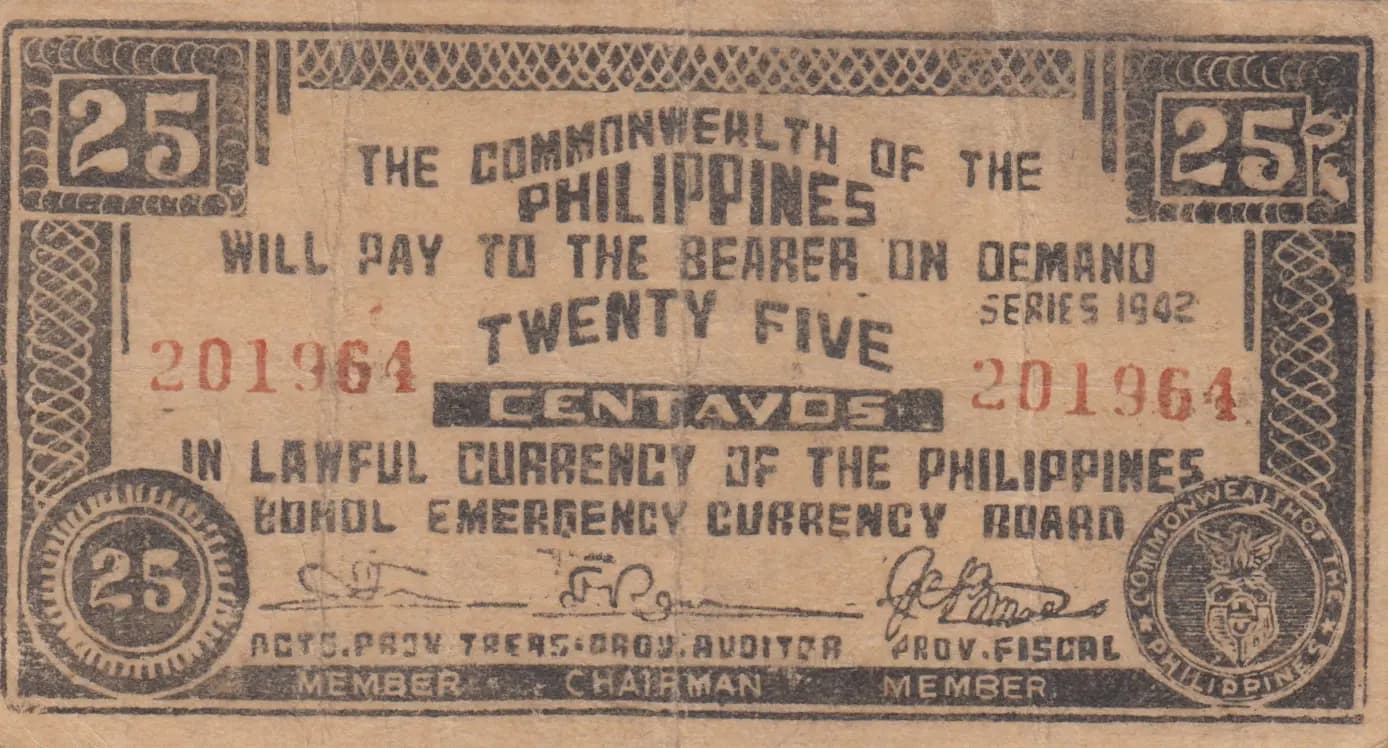
25 centavos 1942
“Bohol”
Market Prices
About This Note
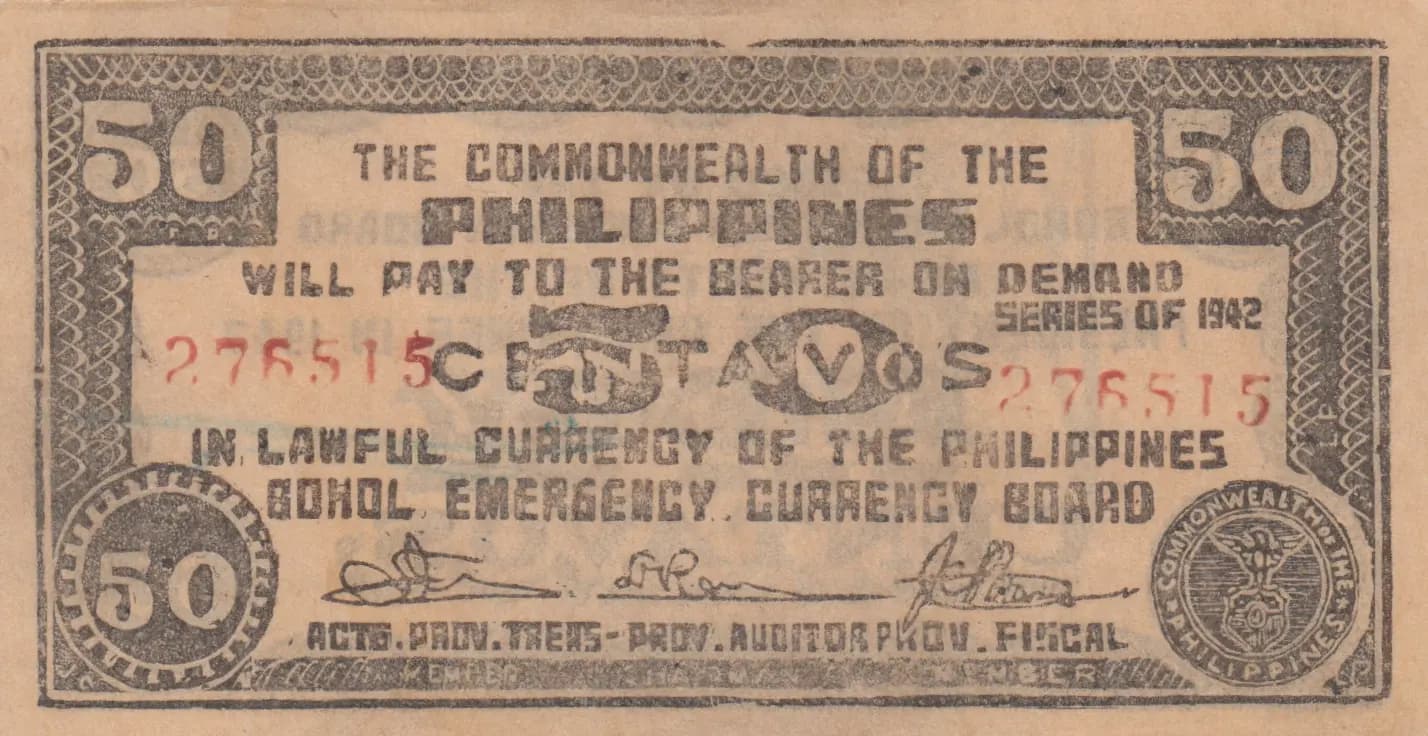
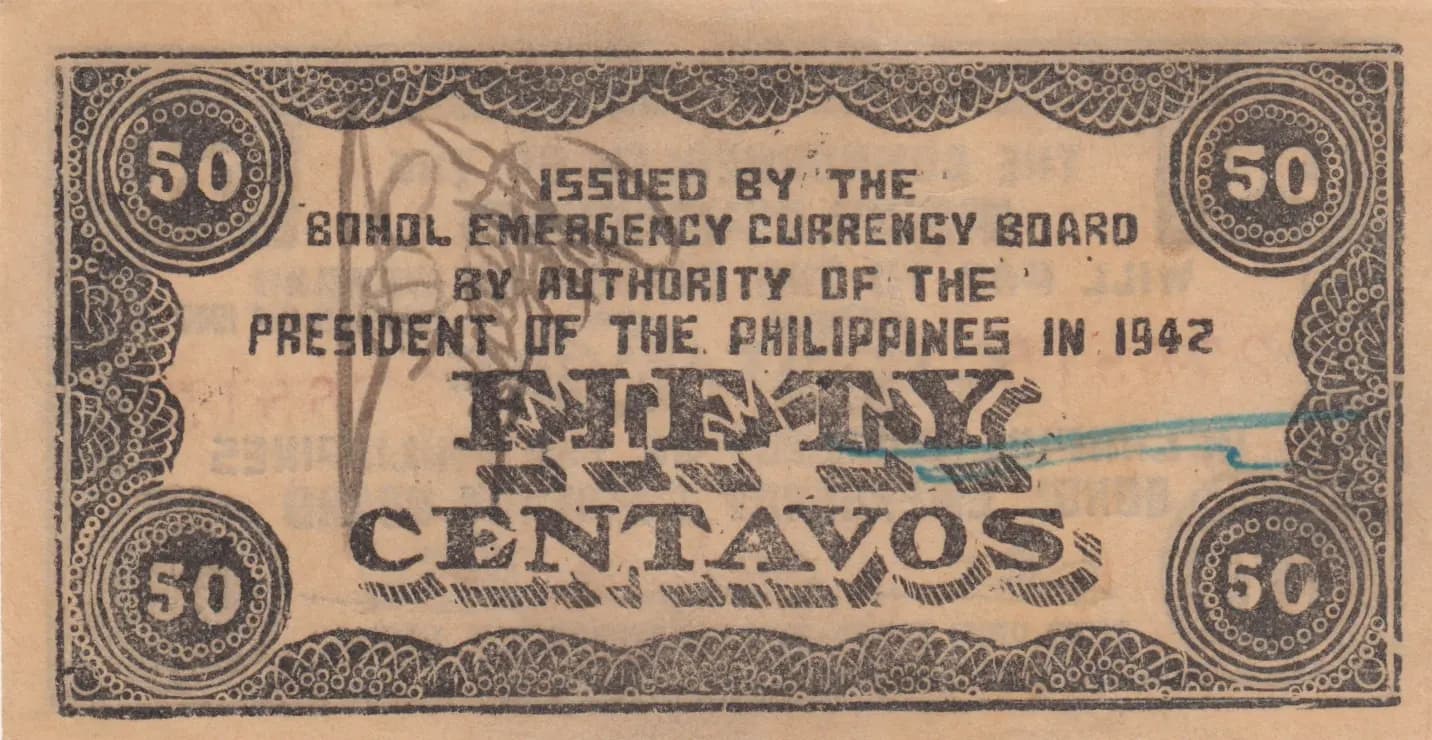
A 50 centavos emergency currency note issued by the Bohol Emergency Currency Board in 1942 under Commonwealth of the Philippines authority. The note displays significant aging with yellowing, foxing, and creasing throughout, consistent with its AU grade. Notable features include red serial numbers, three signature lines for authentication, and distinctive circular seals in all four corners, with the reverse showing a blue line crossing through the denomination text—likely a cancel mark.
Common. Market pricing data from eBay sales shows this denomination and series trading primarily between $3.99 and $50.00 USD, with most sales in the $10-20 range. Notes in AU condition command higher prices in the $30-40 range, but the denomination was issued in significant quantities by the Bohol Emergency Currency Board. The lack of premium pricing across multiple sales indicates adequate supply in the collector market. Bohol provincial emergency issues, while historically significant, were produced in sufficient quantity to remain obtainable for collectors.
This note represents emergency currency issued during the Japanese occupation of the Philippines in World War II. The Bohol Emergency Currency Board was a local provincial authority that issued these notes under the Commonwealth of the Philippines president's authority in 1942, when normal currency supply was disrupted. The formal inscription 'WILL PAY TO THE BEARER ON DEMAND IN LAWFUL CURRENCY OF THE PHILIPPINES' reflects the transitional political status of the Commonwealth period.
The note features a formal, geometric design typical of Commonwealth-era Philippine currency. Both sides employ a tan/beige background with black and red ink printing. The front displays a decorative geometric border pattern, with denomination numerals '50' positioned in corners and central text clearly stating the issuing authority and promise to pay. The back is equally formal, featuring four circular emblems or seals with concentric circle designs positioned in each corner—likely provincial or board insignia—with scalloped decorative borders at top and bottom. Red serial numbers appear on the front, while a distinctive blue line crosses the reverse, suggesting a cancellation mark or deliberate defacement. The three signature lines at the bottom of the front represent provincial officials required to authenticate the issue.
FRONT: 'THE COMMONWEALTH OF THE PHILIPPINES' / 'WILL PAY TO THE BEARER ON DEMAND' / 'FIFTY CENTAVOS' / 'SERIES OF 1942' / 'IN LAWFUL CURRENCY OF THE PHILIPPINES' / 'BOHOL EMERGENCY CURRENCY BOARD' / 'ACTS. PRIN. TREAS. PROV. AUDITOR PROV. FISCAL' (Accountant, Provincial Treasurer, Provincial Auditor, Provincial Fiscal) / Serial number: 276515. BACK: 'ISSUED BY THE BOHOL EMERGENCY CURRENCY BOARD' / 'BY AUTHORITY OF THE PRESIDENT OF THE PHILIPPINES IN 1942' / 'FIFTY CENTAVOS' (with 'TWENTY CENTAVOS' appearing as an overprint or correction). The blue line on the reverse may indicate a cancellation or defacement mark.
Letterpress printing on banknote paper, utilizing multiple color passes: black ink for primary text and borders, red ink for serial numbers, and blue ink for the reverse line marking. The decorative borders and circular emblems show characteristics consistent with traditional intaglio or high-relief letterpress production methods typical of early 1940s Philippine currency printing. The color separation and registration appear consistent with multi-pass printing common to emergency currency production of the period.
This note is cataloged as Pick P-S133 and represents the 50 centavos denomination from the Commonwealth of the Philippines, Series of 1942, issued specifically by the Bohol Emergency Currency Board authority. The visual analysis reveals a potential overprint or correction on the reverse showing 'TWENTY CENTAVOS' text overlaid on the primary denomination marking, suggesting this may be a corrected or variant printing. The specific serial number 276515 is documented. The blue line across the reverse appears to be a deliberate cancellation mark, indicating this note was either defaced or marked as non-negotiable at some point in its history, which is consistent with emergency currency handling protocols.