25 centavos 1942
“Bohol”
Market Prices
About This Note
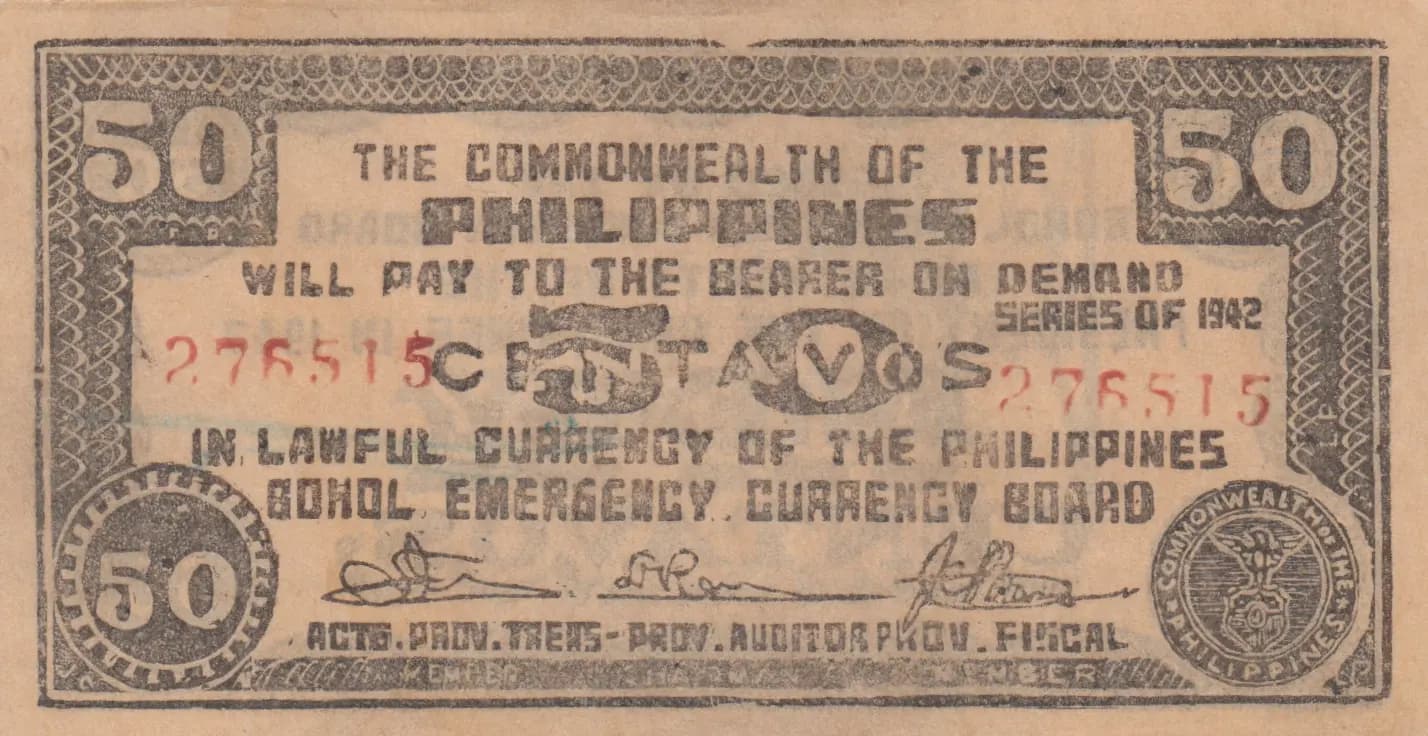
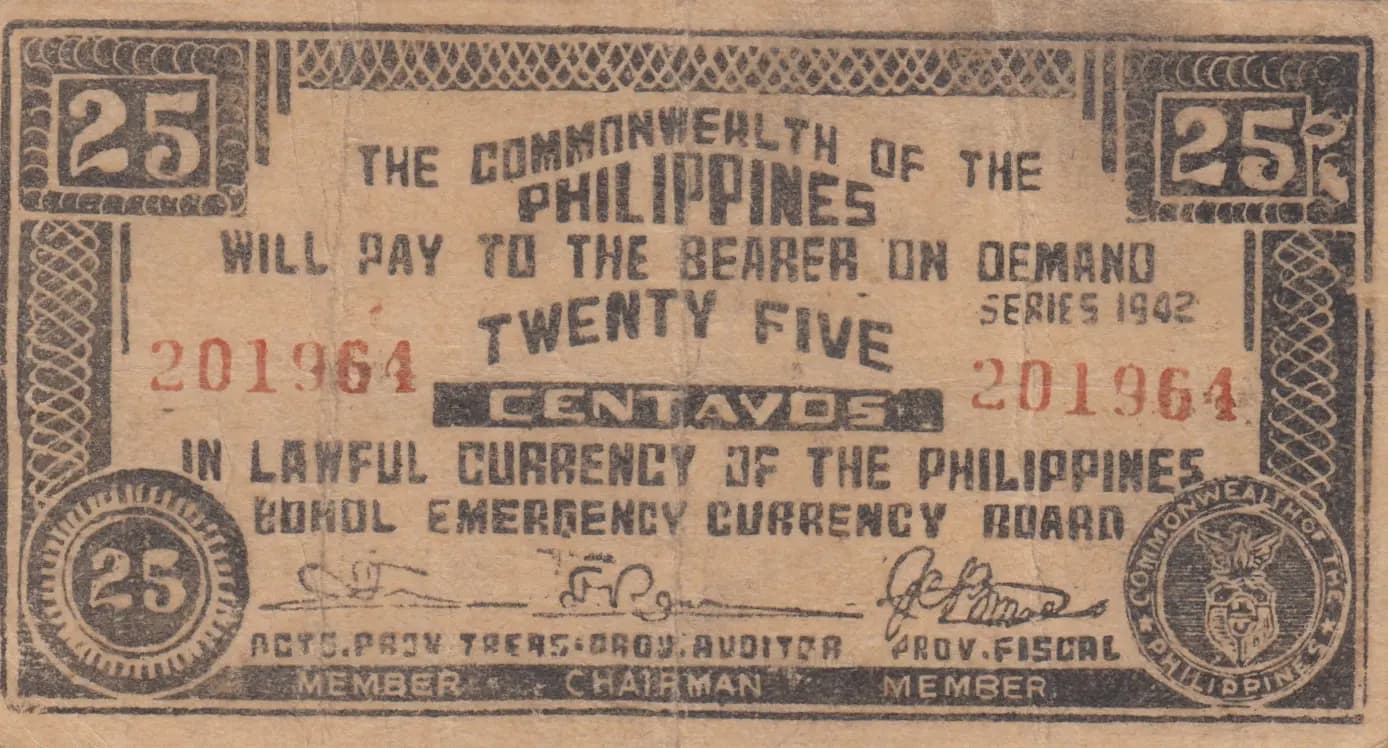
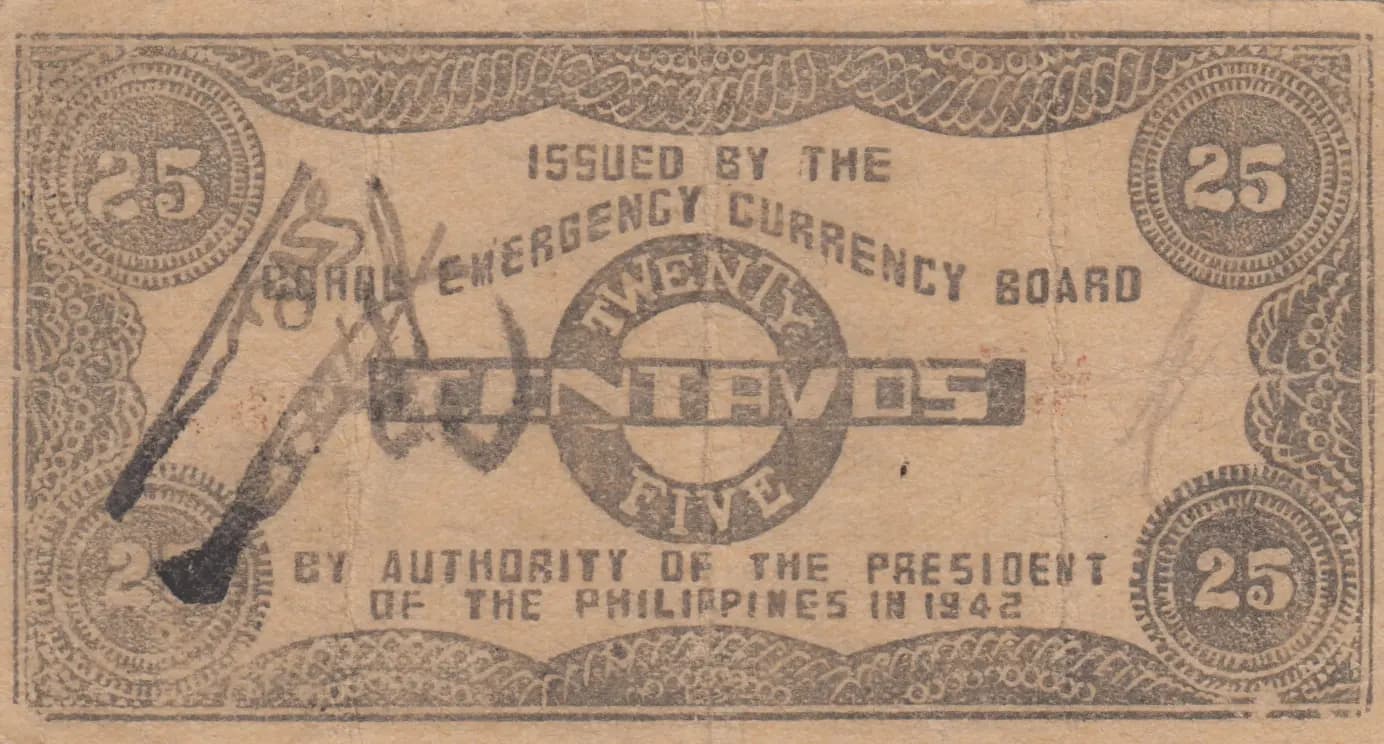
This Philippine Commonwealth 25 centavos emergency currency note from 1942 represents a fascinating piece of World War II-era monetary history. Issued by the Bohol Emergency Currency Board under presidential authority, the note displays typical characteristics of wartime emergency scrip with its text-heavy, minimalist design on aged beige paper. In VF condition with visible patina from over 80 years of circulation, the note remains legible and shows the wear patterns consistent with genuine period use during the Japanese occupation of the Philippines.
Common. eBay market data shows consistent pricing in the $3.99–$40.48 USD range with the majority of sales under $20, indicating steady collector demand but no scarcity premium. Bohol emergency notes from 1942 were issued in sufficient quantities to circulate during the occupation period and remain accessible to collectors today. VF condition examples are typical finds in the market, suggesting adequate survival rates and no recall or destruction that would artificially limit supply.
Issued in 1942 during the Japanese occupation of the Philippines, this emergency currency was authorized by the Philippine Commonwealth president as a practical necessity when normal monetary supply was disrupted. The Bohol Emergency Currency Board represents a decentralized response by provincial authorities to maintain local commerce during wartime chaos. The note's English-language inscriptions and Commonwealth imagery reflect the Philippines' status as a Commonwealth territory with promised independence, though the emergency circumstances forced provincial boards to issue their own currency backed by local authority rather than central banking institutions.
This emergency currency note employs a utilitarian design typical of wartime scrip, lacking the portraiture and elaborate vignettes of standard banknotes. Instead, the design relies on ornamental geometric border patterns featuring repeating circular motifs framing the left and right margins. The denomination '25' appears in circular seal designs positioned in the bottom corners (front) and all four corners (reverse). The reverse features a prominent central circular seal with radiating text, flanked by wing-like decorative patterns. The absence of named portraits or specific landmarks reflects the expedient nature of emergency currency design—the authority and legitimacy derive from textual declarations of Commonwealth backing and presidential authorization rather than symbolic imagery.
FRONT SIDE: 'THE COMMONWEALTH OF THE PHILIPPINES' / 'WILL PAY TO THE BEARER ON DEMAND' / 'TWENTY FIVE CENTAVOS' / 'SERIES 1942' / 'IN LAWFUL CURRENCY OF THE PHILIPPINES' / 'POHOL EMERGENCY CURRENCY BOARD' / Serial number: '201964' (appears twice) / 'ACTS FROM TREAS. OROB. AUDIT'N' / 'MEMBER' / 'CHAIRMAN' / 'MEMBER' / 'PROV. FISCAL' (Provincial Fiscal). REVERSE SIDE: 'ISSUED BY THE POHOL EMERGENCY CURRENCY BOARD' / 'TWENTY FIVE CENTAVOS' / 'BY AUTHORITY OF THE PRESIDENT OF THE PHILIPPINES IN 1942'
Letterpress printing on commercial bond paper stock. The uniform dark brown/black ink impression, consistent line weights in text and borders, and the characteristic mechanical precision of geometric pattern registration are all consistent with traditional letterpress production. The aged paper with visible foxing and darkening is typical of untreated fiber-based currency stock from the 1940s. No security features beyond ornamental design complexity were employed, which is standard for emergency provincial currency issues of this period.
Serial number 201964 is visible on this example. The 'POHOL' spelling (representing Bohol) is consistently applied across both sides, confirming this as the standard Bohol Emergency Currency Board issue rather than a different provincial variant. The 'SERIES 1942' designation and presidential authority statement are standard for this Pick number. No overprints, date varieties, or signature variations are evident on this specimen. This represents the standard, common variety of Pick P-S132f for the 25 centavos denomination.