20 piso 1969
Market Prices
14 salesAbout This Note
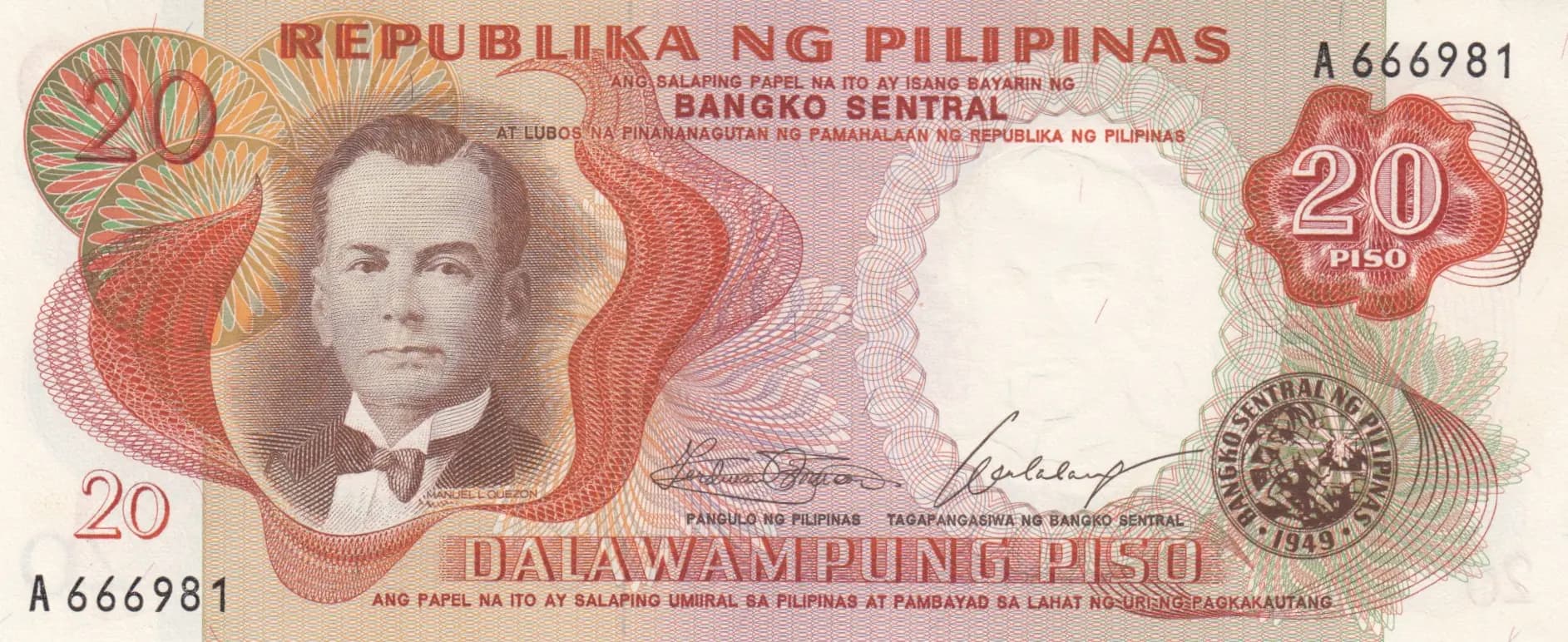
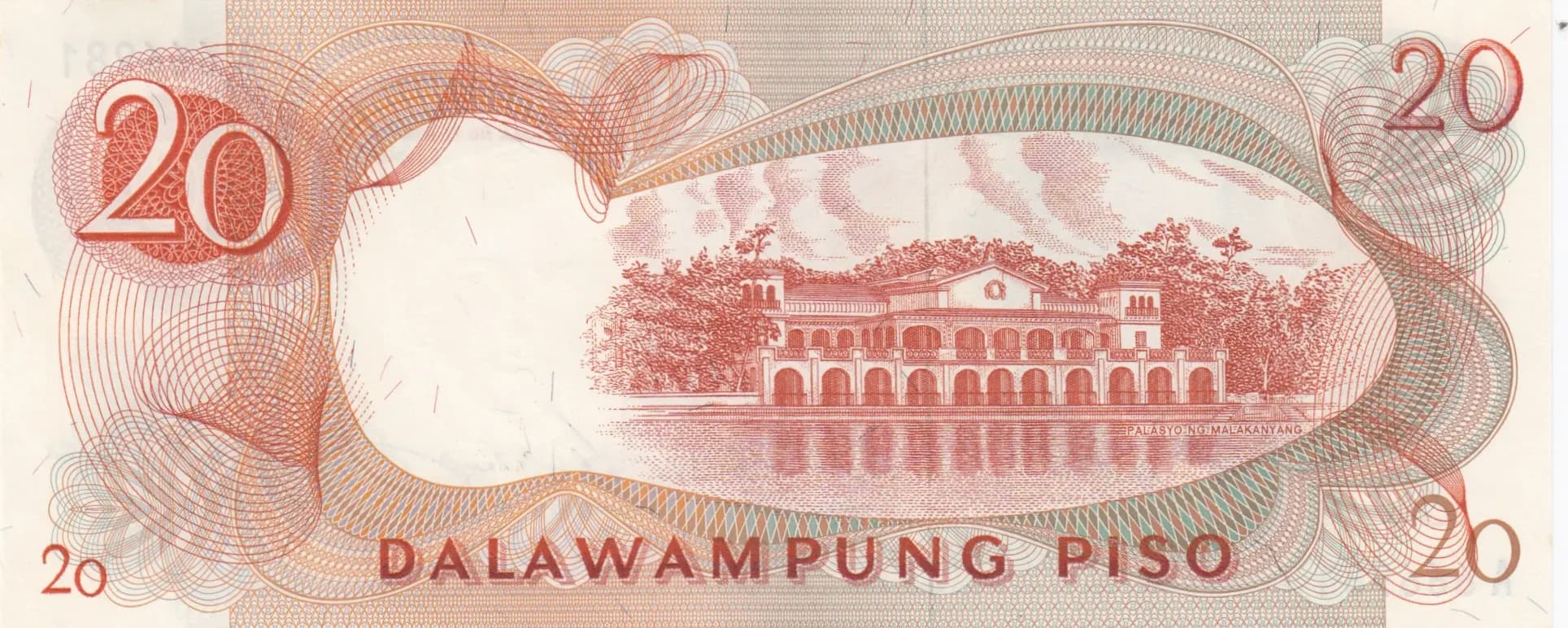
This is a well-preserved Philippine 20 Piso banknote from 1969 (Pick P-145a) in uncirculated condition, featuring Manuel L. Quezon's portrait on the obverse and the iconic Malacañan Palace on the reverse. The note displays vibrant multicolored engraving in red, orange, and green tones with crisp, clear impressions and no visible signs of circulation, making it an attractive example of mid-20th century Philippine currency design.
Common. This note appears with moderate to high frequency in the collector market, as evidenced by consistent eBay sales data spanning 2014-2021, with recent UNC specimens selling for $1.50-$6.00. The 2019 catalog value of $4 UNC reflects its common status. The 1969 issue had a substantial print run, and this Pick number (P-145a) was widely distributed in regular circulation, making it readily available to collectors today. No significant scarcity factors are present.
Issued during the presidency of Ferdinand Marcos by the Central Bank of the Philippines in 1969, this banknote commemorates Manuel L. Quezon, the Commonwealth's first president, whose portrait appears alongside the official seal dated 1949. The reverse depicts Malacañan Palace, the official residence of the Philippine president since the Spanish colonial period, symbolizing the continuity of government authority through the independent Philippine republic.
The obverse features a formal three-quarter portrait of Manuel L. Quezon, the first president of the Philippine Commonwealth, depicted in a business suit and tie positioned center-left. A prominent rooster symbol appears in the upper left corner, a traditional Filipino motif. The right side displays the Central Bank Seal dated 1949. The entire design is framed by ornate decorative borders with elaborate scrollwork and geometric patterns rendered in red, orange, and green. The denomination appears in decorative cartouches in both the upper right and lower left corners. The reverse presents a detailed engraving of Malacañan Palace, the official presidential residence, depicted as a grand colonial-era building with multiple stories and arched architecture situated along a waterfront with mountainous background. Both sides feature complex fine-line work and ornamental flourishes typical of high-security banknote engraving.
{"front":{"REPUBLIKA NG PILIPINAS":"Republic of the Philippines","BANGKO SENTRAL":"Central Bank","DALAWAMPUNG PISO":"Twenty Pesos","PANGULO NG PILIPINAS":"President of the Philippines","TAGAPANGASIWA NG BANGKO SENTRAL":"Governor of the Central Bank","ANG SALAPING PAPEL NA ITO AY ISANG BAYARIN NG BANGKO SENTRAL AT LUOS NA PINAHAHALAGUHAN NG PAMAHALAAN NG REPUBBLICA NG PILIPINAS":"This paper currency is a liability of the Central Bank and is backed by the Government of the Republic of the Philippines","ANG PAPEL NA ITO AY ISALAPING UMIIRAL SA PILIPINAS AT PAMBAYAD SA LAHAT NG URING PAGGAKAUTANG":"This currency is legal tender in the Philippines and is accepted for payment of all kinds of obligations"},"back":{"DALAWAMPUNG PISO":"Twenty Pesos","PALASYO NG MALAKANYANG":"Malacañan Palace"}}
Steel plate intaglio engraving (also called recess or gravure printing), which produces the raised, tactile line work and fine details visible throughout the note. The printer was Giesecke & Devrient (G&D), as indicated by the catalog reference noting '(without imprint)' — a characteristic of G&D Philippine notes of this era where printer attribution appears in specialized catalogs rather than on the note itself. The multicolor printing was achieved through successive passes of different colored inks on the same plate.
This note corresponds to the standard 1969 issue (ND/No Date in international catalogs). The visual analysis shows serial number 'A 666981' with a standard single-letter prefix, indicating a regular issue note. The catalog reference notes that replacement notes for this series carry a '+' prefix in the serial number. The note displays the standard Central Bank Seal Type 3 and lacks any overprints or special markings. Minor variations may exist in signature combinations and seal variations across the print run, but no major documented varieties are noted for Pick P-145a beyond the replacement note designation indicated by the '+' prefix.