20 pesos 1936
Market Prices
3 salesAbout This Note
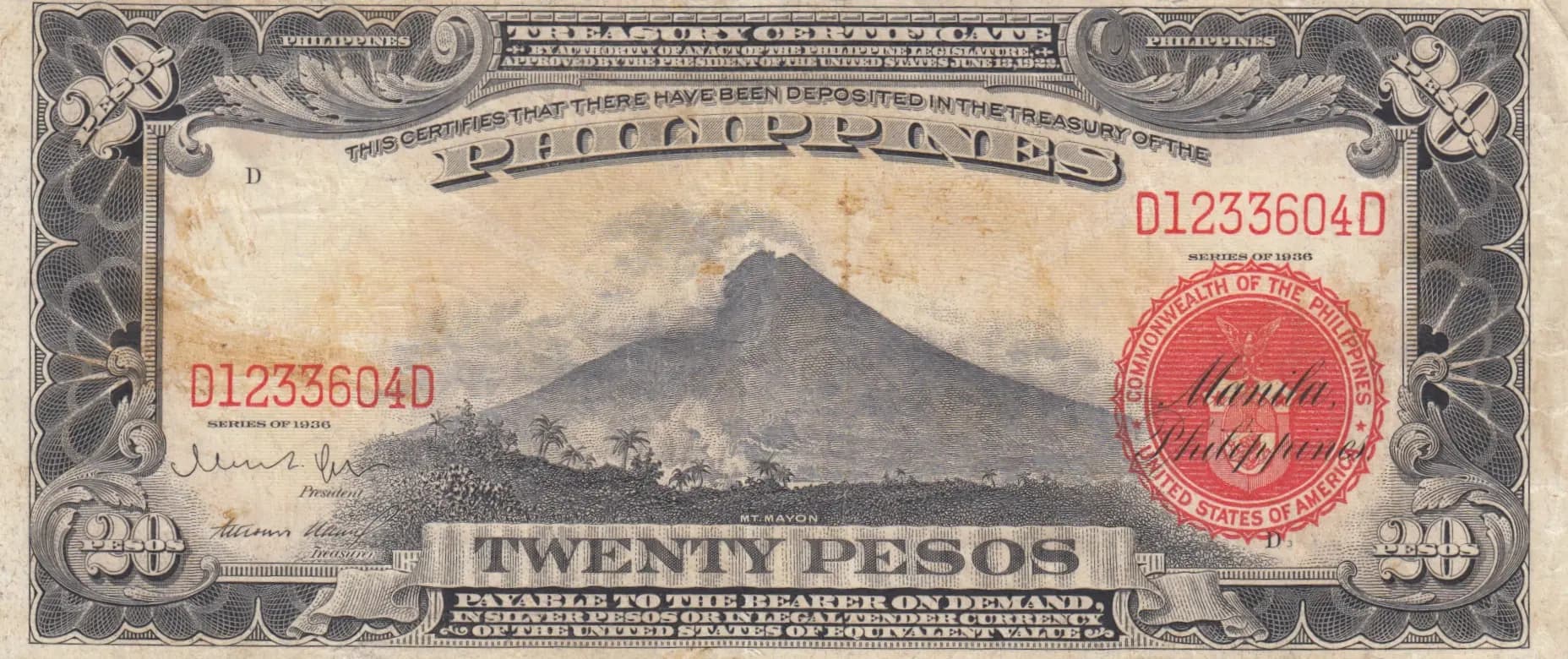
This Philippine Islands 20 Pesos banknote from 1936 (Pick P-85a) features a striking central vignette of Mount Mayon, the iconic conical volcano, flanked by portraits and surrounded by ornate baroque-style decorative borders. The note displays moderate age-related wear including foxing, discoloration, and creasing consistent with VF condition, with the characteristic black-on-yellow front and tan reverse design typical of this Commonwealth-era issue. The red Commonwealth seal with eagle emblem and dual serial number (D1233604D) represent the security features of this regular issue, which represents an important transitional period in Philippine currency following the 1933 authorization act.
Common. While this note is from 1936 and shows significant age, the eBay pricing data and catalog values indicate steady, affordable availability in the collector market. VF examples catalog at $150 according to 2016 values, with market sales consistently ranging from $77 to $158 depending on exact condition and auction competition. The regular issue status, substantial original print run (serial range D1D to D1 664,000D indicates high volume production), and steady availability in the numismatic market all confirm common status. Notes in this denomination and condition appear regularly in collections and auctions.
This 1936 banknote was issued under the Commonwealth of the Philippines, established following the Tydings-McDuffie Act and the June 13, 1933 authorization referenced on the note itself. Mount Mayon, depicted at the center of the obverse, is one of the Philippines' most recognizable natural landmarks and symbolized national identity during this period of increasing Filipino autonomy. The note's imagery and Commonwealth seal reflect the transitional governance structure between American colonial administration and Philippine independence, a theme reinforced by the prominent 'Treasury of the United States' references and the prominent COMMONWEALTH OF THE PHILIPPINES designation.
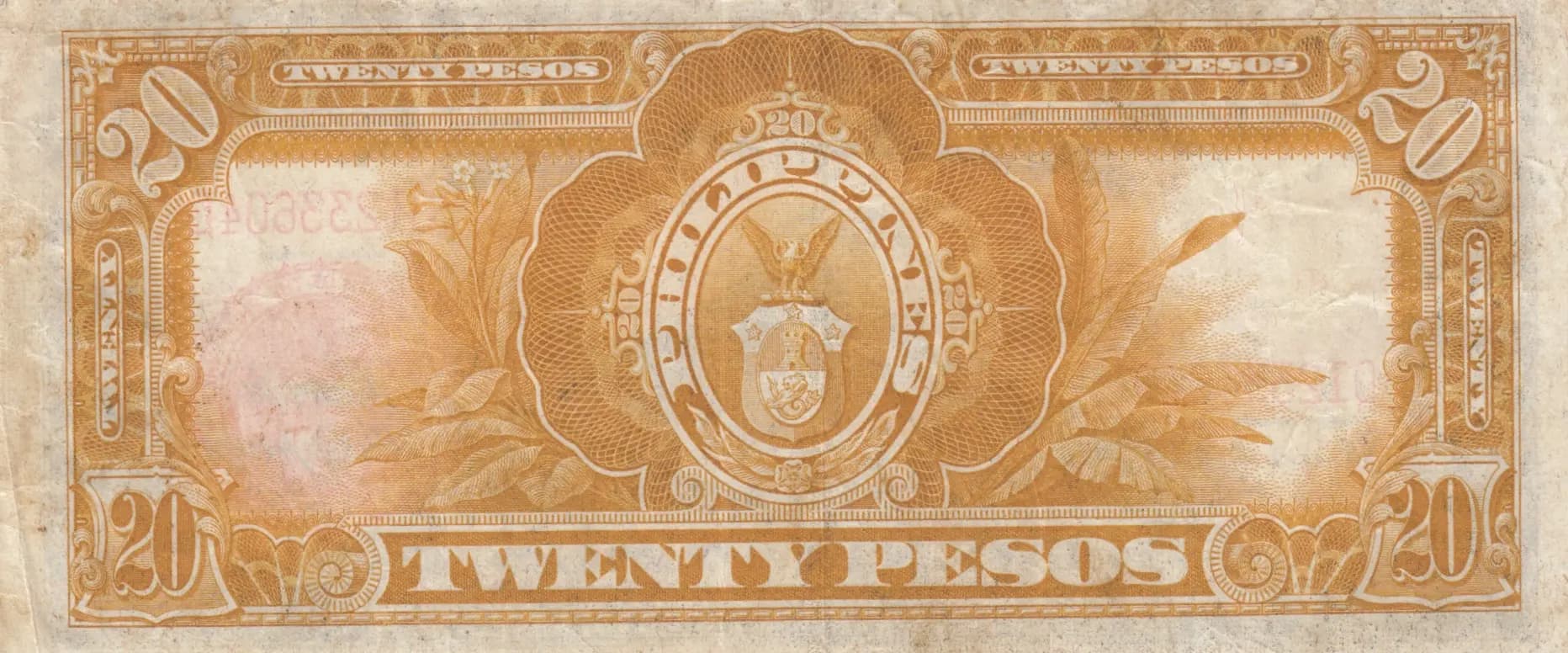
The obverse features Mount Mayon as the dominant central element—a beautifully rendered engraved vignette of the distinctive conical volcanic peak surrounded by tropical vegetation including palm trees in the foreground, capturing the natural majesty of this Philippine landmark. Flanking the mountain are two portrait medallions labeled 'President' (left) and 'Treasurer' (right), representing the dual authorization structure of the Commonwealth government. The design is framed by elaborate baroque-style ornamental borders with scrollwork in the corners and geometric patterns along the edges. The reverse presents a large shield-shaped coat of arms of the Commonwealth of the Philippines featuring an eagle emblem at the top and heraldic elements within an ornamental frame, surrounded by intricate floral and scroll border designs in the tan/golden color scheme. The color scheme of black-on-yellow for the front and tan for the back are signature design characteristics of this issue, with the prominent red Commonwealth seal with eagle emblem providing visual security emphasis.
FRONT SIDE: 'PHILIPPINES' (country designation); 'TREASURY OF THE UNITED STATES AUTHORIZING THE DISBURSEMENT OF MONEYS AND PHILIPPINES PRESCRIBED BY THE PRESIDENT OF THE UNITED STATES JUNE 13, 1933' (legislative authority); 'THIS CERTIFIES THAT THERE HAVE BEEN DEPOSITED IN THE TREASURY OF THE [COMMONWEALTH OF THE PHILIPPINES]' (certificate language); 'SERIES OF 1936' (issue date); 'MT. MAYON' (landmark identification); 'TWENTY PESOS' (denomination); 'PAYABLE TO THE BEARER ON DEMAND, AS SILVER PESOS OR AN EQUIVALENT IN LEGAL TENDER CURRENCY AT THE RATE OF 2 PESOS OF MANILA VALUE' (redemption clause); 'COMMONWEALTH OF THE PHILIPPINES' (issuing authority); 'Manila' (place of issue); Serial number 'D1233604D' (printed in red, appearing twice). BACK SIDE: 'TWENTY PESOS' (denomination, appears twice); Numeric denomination '20' (appears twice in corners).
Intaglio engraving (also called copperplate engraving), the standard security printing method for banknotes of this era. Printed by the United States Bureau of Engraving and Printing (USBEP), as indicated by catalog references, though without imprint marking on the note itself. The fine detail visible in the ornamental borders, the mountain vignette, and heraldic imagery, along with the precise serial number application in red, are characteristic of high-quality intaglio production. The two-color printing (black/yellow front, tan back) was achieved through successive passes through the intaglio press.
This example is identified as Pick P-85a, the regular Commonwealth issue with the red Commonwealth seal. The signatures visible are Manuel Quezon (President) and Antonio Ramos (Treasurer), representing the authorized signatories for this issue period. The serial number D1233604D falls within the documented regular production range (D1D to D1 664,000D), confirming this as a standard production note rather than a special printing or variety. The 'SERIES OF 1936' designation and the 'NEW red Commonwealth seal' referenced in catalog data distinguish this from earlier P-77 related issues, making this a well-documented mainstream variety of the 1936 Philippine Commonwealth series.