20 centavos 1942
“Culion Leper”
Market Prices
About This Note
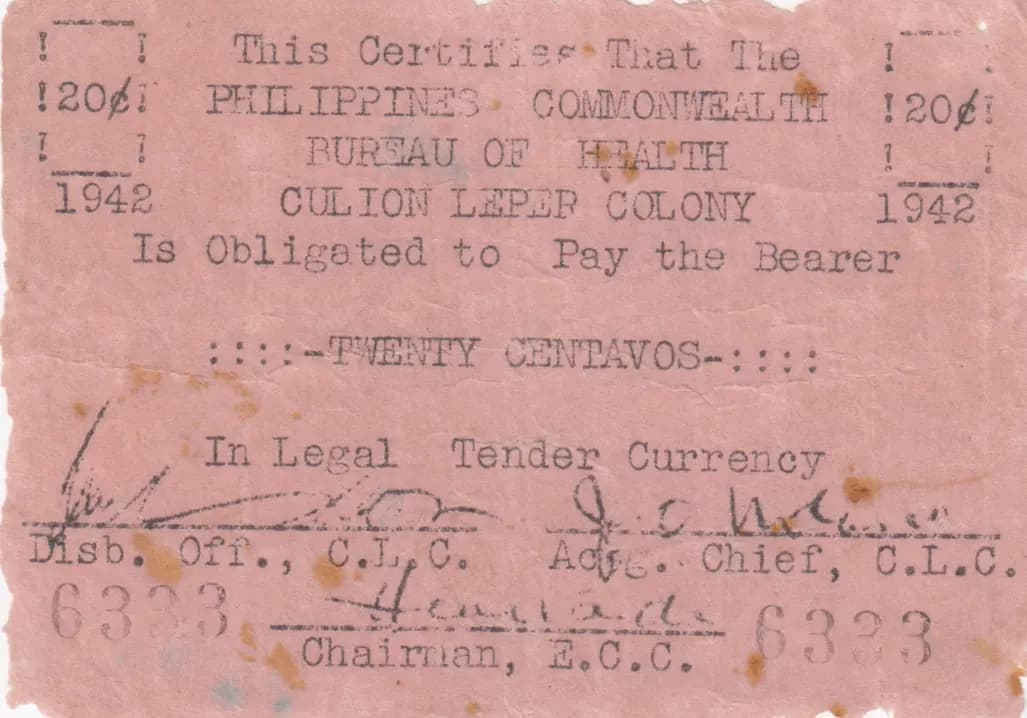
This is a remarkable emergency currency certificate issued by the Culion Leper Colony, part of the Commonwealth of the Philippines Bureau of Health in 1942. The pink paper certificate certifies an obligation to pay the bearer twenty centavos in legal tender currency and bears handwritten signatures from disbursing and administrative officials. In Fair condition with age-related foxing and ink staining throughout, this note represents a fascinating piece of Philippine numismatic history from the Commonwealth period, particularly valuable to collectors interested in emergency issues and institutional scrip.
Rare. This is an institutional emergency issue from a specialized facility (Culion Leper Colony) with necessarily limited circulation. The Pick catalog number P-S243 indicates this is cataloged as a supplementary issue. The specific historical context—wartime Commonwealth period, isolated island medical facility, and institutional scrip use—suggests a restricted original print run. The severe fading of the back side and condition issues indicate this note has survived decades of aging in difficult conditions. While eBay pricing data shows wide variation ($7.99 to $165.00), such emergency colonial and Commonwealth issues from specialized institutions are genuinely scarce in the collector market, particularly in identifiable, cataloged examples.
Issued in 1942 during the Commonwealth of the Philippines period, this certificate represents emergency currency used within the Culion Leper Colony, a remote quarantine facility located on an island in Palawan. The Commonwealth of the Philippines (1935-1946) was a transitional government leading toward independence, and this institutional scrip reflects the practical monetary solutions employed during wartime isolation at specialized medical facilities. The presence of multiple official signatories (Disbursing Officer, Acting Chief, and Chairman positions) indicates a formal administrative structure managing currency circulation within the isolated colony.
This is an institutional emergency currency certificate printed on pink paper stock. The front features centered text-based design with the Commonwealth of the Philippines seal or stamp marks visible. The certificate displays official typography with the denomination and issuing authority prominently featured. Multiple blank signature lines indicate spaces for authorized officials to validate the certificate. The design is purely typographic with no portraits or traditional banknote imagery, reflecting its nature as emergency scrip rather than regular currency. The back appears to have contained additional printing, now severely faded, possibly regulatory text or further official markings. The overall layout is formal and document-like, consistent with government-issued certificates.
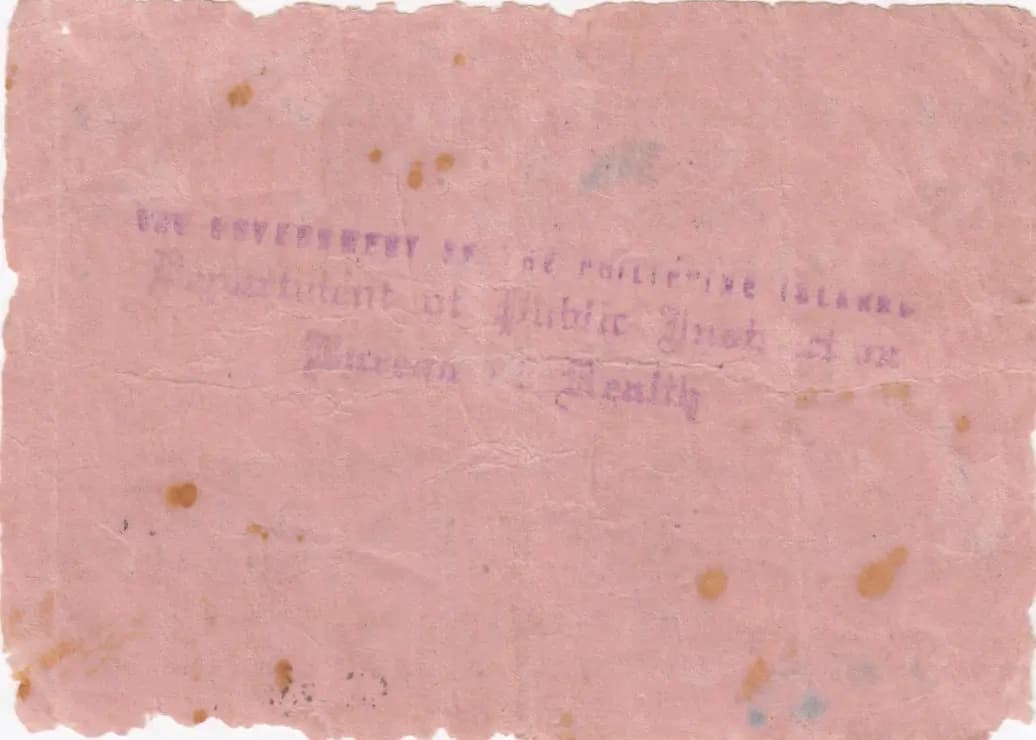
Front side: 'This Certifies That The / PHILIPPINES COMMONWEALTH / BUREAU OF HEALTH / CULION LEPER COLONY / Is Obligated to Pay the Bearer / ::::TWENTY CENTAVOS:::: / In Legal Tender Currency' followed by signature lines for 'Disb. Off., C.J.O.' (Disbursing Officer), 'Acg. Chief, C.L.C.' (Acting Chief, Culion Leper Colony), and 'Chairman, E.C.C.' (likely Executive or Emergency Control Committee). Serial number 6333 is present. Back side: Largely faded with only very faint embossed or light-printed text that is illegible due to age and deterioration.
Letterpress printing on pink paper stock, common for official certificates and emergency currency of the period. The primary text is printed in dark brown or black ink with clear, sharp impressions characteristic of letterpress. Handwritten signatures and possible stamp impressions supplement the printed text. The back side exhibits very faint printing or embossing, possibly in a lighter ink or secondary press run, which has faded significantly over eight decades.
Serial number 6333 is visible on this example. As an institutional emergency certificate, varieties likely exist based on signature combinations, date variations, and printing differences. The presence of specific officer titles (C.J.O., C.L.C., E.C.C.) suggests different administrative periods or organizational structures may have resulted in varying signature line labels. Without access to comprehensive institutional records from the Culion Leper Colony, specific documented varieties cannot be definitively established, but collectors should note the serial number and signature combinations when cataloging examples.