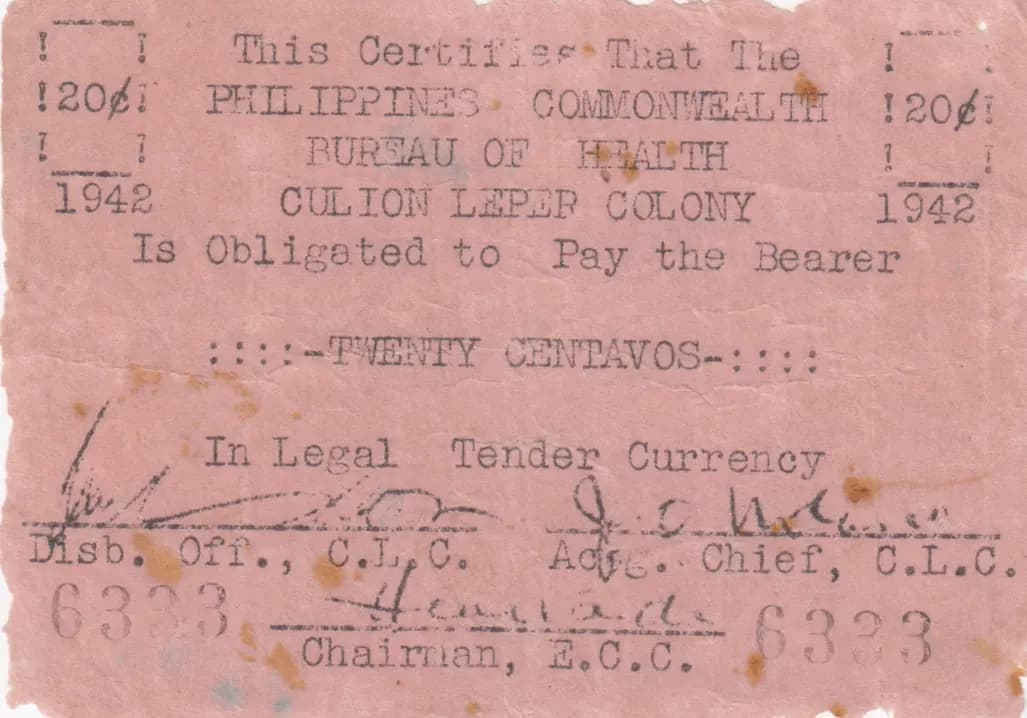
20 centavos 1942
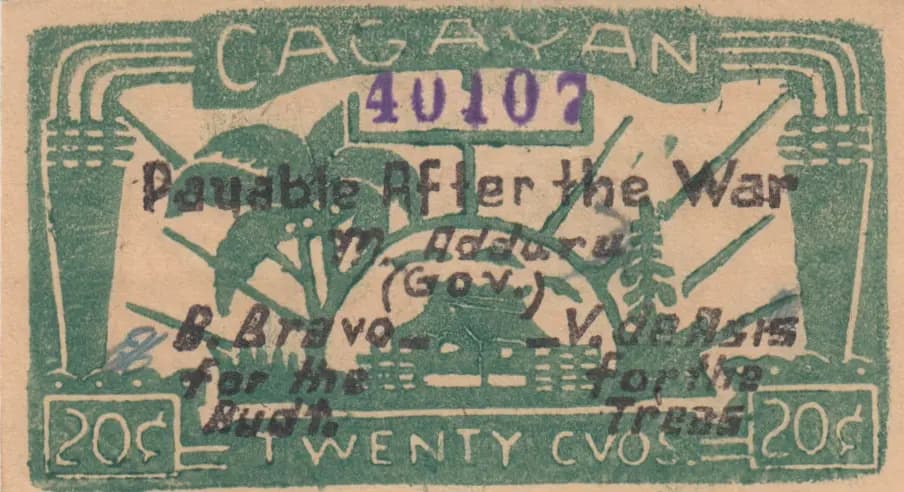
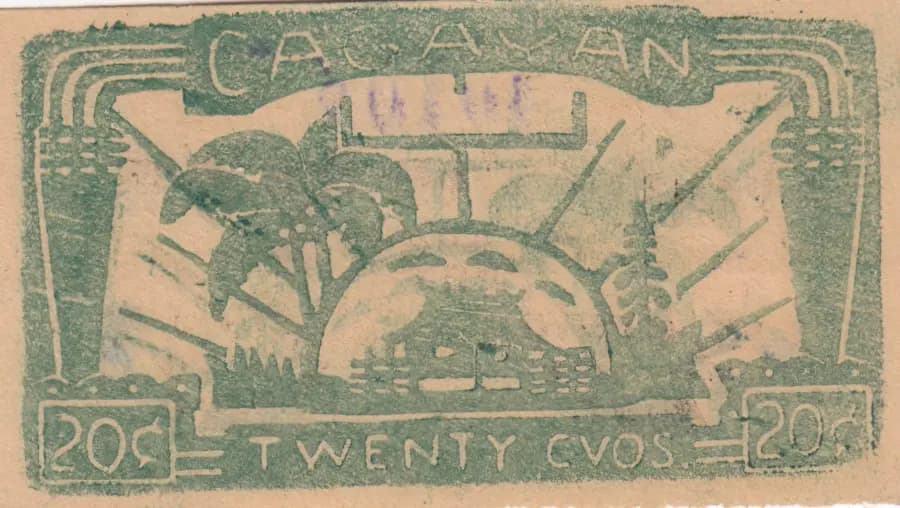
“Cagayan”
Market Prices
1 saleAbout This Note
This 1942 Commonwealth of the Philippines 20 centavos note (Pick S183a) presents an attractive example of wartime Philippine currency featuring allegorical female figures and industrial maritime imagery in a distinctive green color scheme. The note shows clear circulation wear with foxing and age-related discoloration, though the design remains visible; notably, the front side bears archival stamps and handwritten reference notations suggesting this specimen passed through institutional collections, likely related to the 'Cagayan' collector notation in the catalog data.
Common. The eBay market data provided shows comparable grade notes (EF condition) selling for approximately $23, indicating strong collector interest but typical circulation for the issue. The 1942 Commonwealth series had substantial print runs designed for wartime circulation throughout the Philippine islands. While the inscription 'Republic After the War' makes this politically interesting, the denomination and issue date place it among the standard wartime emergency currency rather than a scarce or rare issue. Institutional handling and archival stamps noted on this specimen further suggest these notes are encountered with reasonable frequency in collections.
Issued during 1942 under the Japanese-occupied Commonwealth of the Philippines regime, this banknote reflects the transitional period between pre-war Philippine independence (granted 1934-1946) and the upheaval of World War II. The allegorical imagery depicting industrial and maritime progress, combined with the sunburst radiating design, symbolized the Commonwealth's aspirations for modernization and development. The inscription 'Republic After the War' explicitly references the anticipated post-war restoration of full independence, demonstrating how Philippine currency of this period carried both economic and political messaging about national sovereignty.
The note features a symmetrical allegorical composition with two female figures representing virtues or national ideals positioned on the left and right sides, likely depicting concepts such as Liberty and Progress or Labor and Commerce typical of Commonwealth-era Philippine design. Between these figures stands a central industrial or maritime structure with geometric styling, possibly representing a ship, factory, or port facility—reflecting the Philippines' economic focus on trade and development. Behind this central element radiates a prominent sunburst design with stylized rays, a common motif in 1940s currency symbolizing enlightenment and national awakening. Decorative corner ornaments in geometric patterns and bordered frames with curved linear designs complete the composition, characteristic of the Art Deco influence prevalent in Philippine banknote design of the era.
Front/Back: 'CALAUAN' (place name, likely reference to production or design origin); '20¢' (denomination in cents); 'TWENTY CVOS' (English denomination spelled out as twenty centavos); Front only: '40102' (reference or catalog number); 'Republic After the War' (political inscription referencing post-war independence aspirations). All inscriptions appear on both obverse and reverse with similar placement and formatting.
This note exhibits characteristics of intaglio (engraved) printing typical of security banknote production, evidenced by the fine detail in the allegorical figures, the sharp geometric precision of the border frames and corner ornaments, and the dimensional quality of the design elements visible even through circulation wear. The green color scheme was applied through standard multi-color banknote printing processes of the 1940s. Based on the Pick catalog designation S183a, this issue was produced by the Bureau of Printing (Philippine government printer) or under Commonwealth authorization; specific security printers for 1942 Philippine currency varied, with some notes produced under Japanese occupation oversight.
This specimen is cataloged as Pick S183a, indicating it represents variety 'a' of the 1942 20 centavos issue. The presence of archival stamps and reference notation '40102' on the front suggests this particular note may have been part of an institutional collection, possibly a central bank or government archive. The notation 'Cagayan' in the collector notes likely indicates either provenance from that region or classification within a thematic collection. Standard varieties for this issue typically involve serial number prefixes, signature variations, or overprint differences; without clear serial number visibility in the analysis, further variety identification would require direct examination. The S-prefix in the Pick number itself indicates this as an emergency or wartime issue distinct from regular pre-war Commonwealth coinage.