20 centavos 1949
Market Prices
5 salesAbout This Note
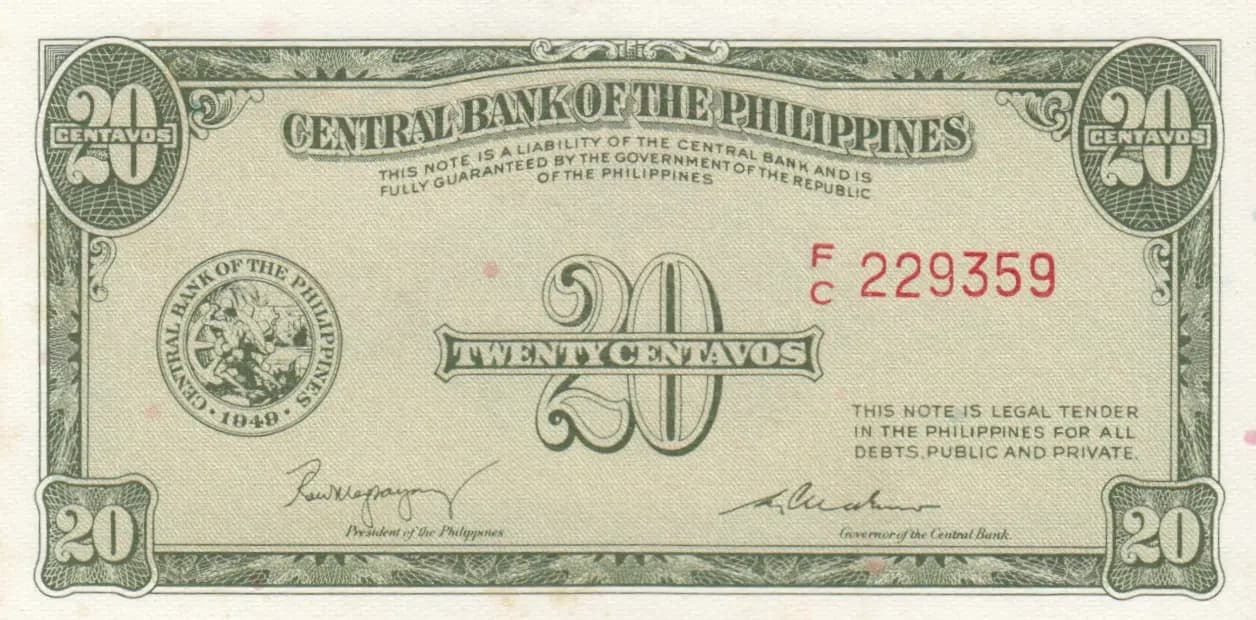
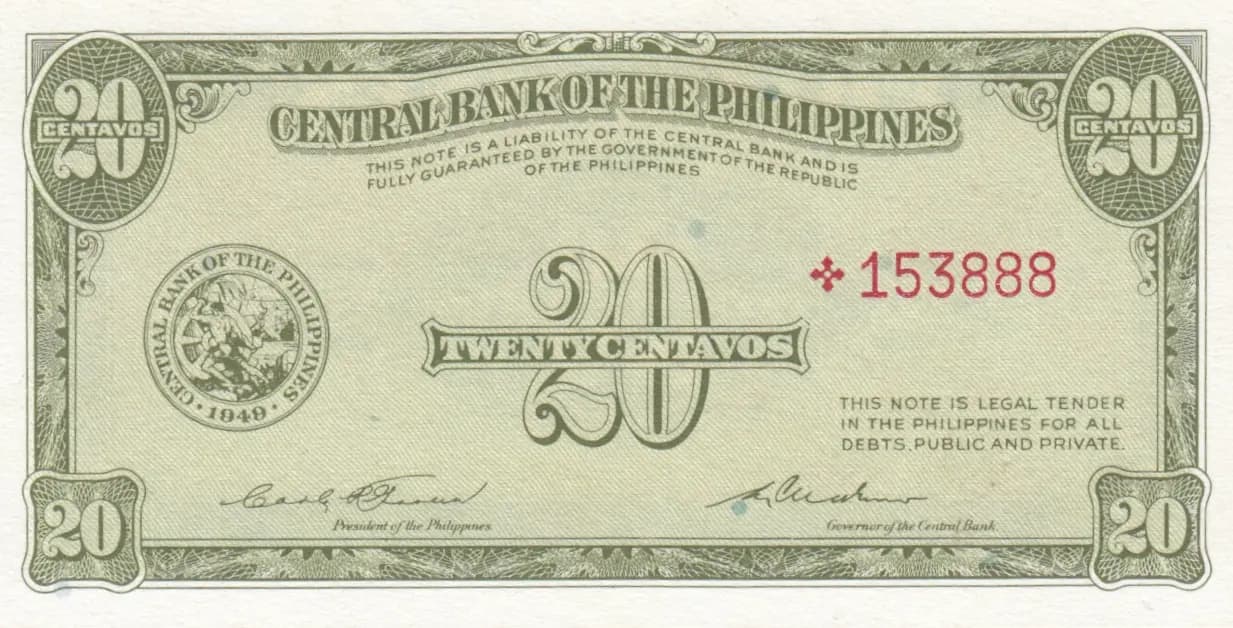
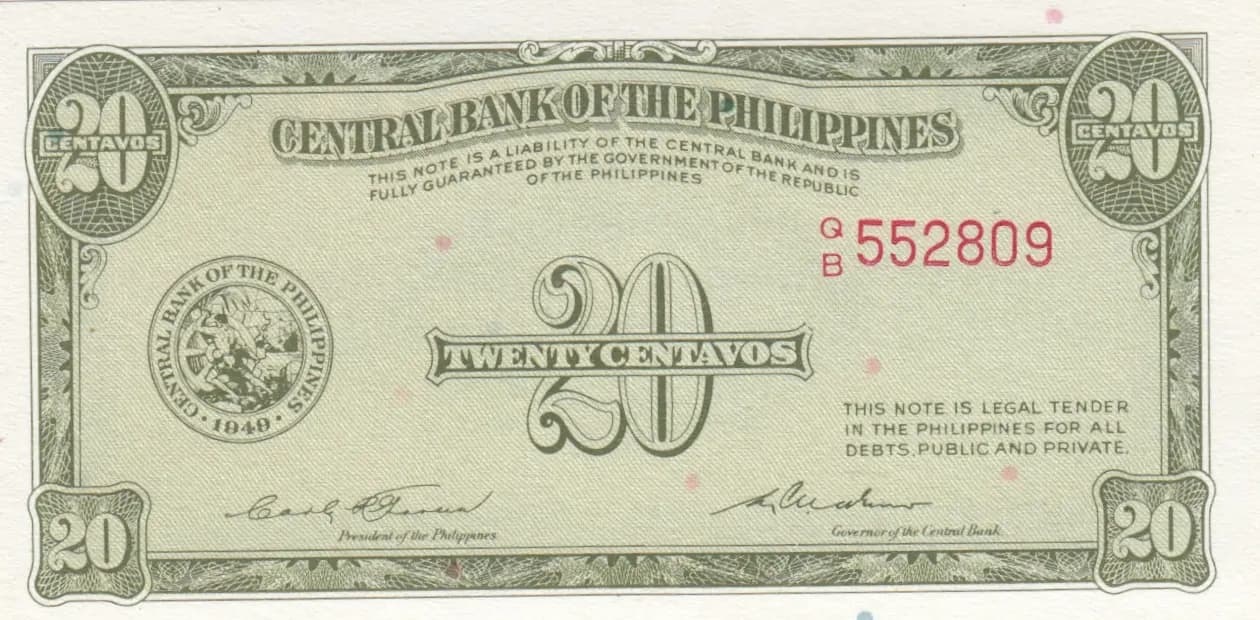
This is a lovely example of the 1949 Philippine 20 centavos note issued by the Central Bank of the Philippines, graded UNC. The note displays the characteristic green-on-light-green color scheme with ornate engraved borders, corner medallions, and the Republic's seal dated 1949. Despite its UNC grade, the note shows honest aging with some foxing and age spots visible, particularly in the upper right corner, which is typical for a 75-year-old banknote and actually adds to its authentic appeal for collectors.
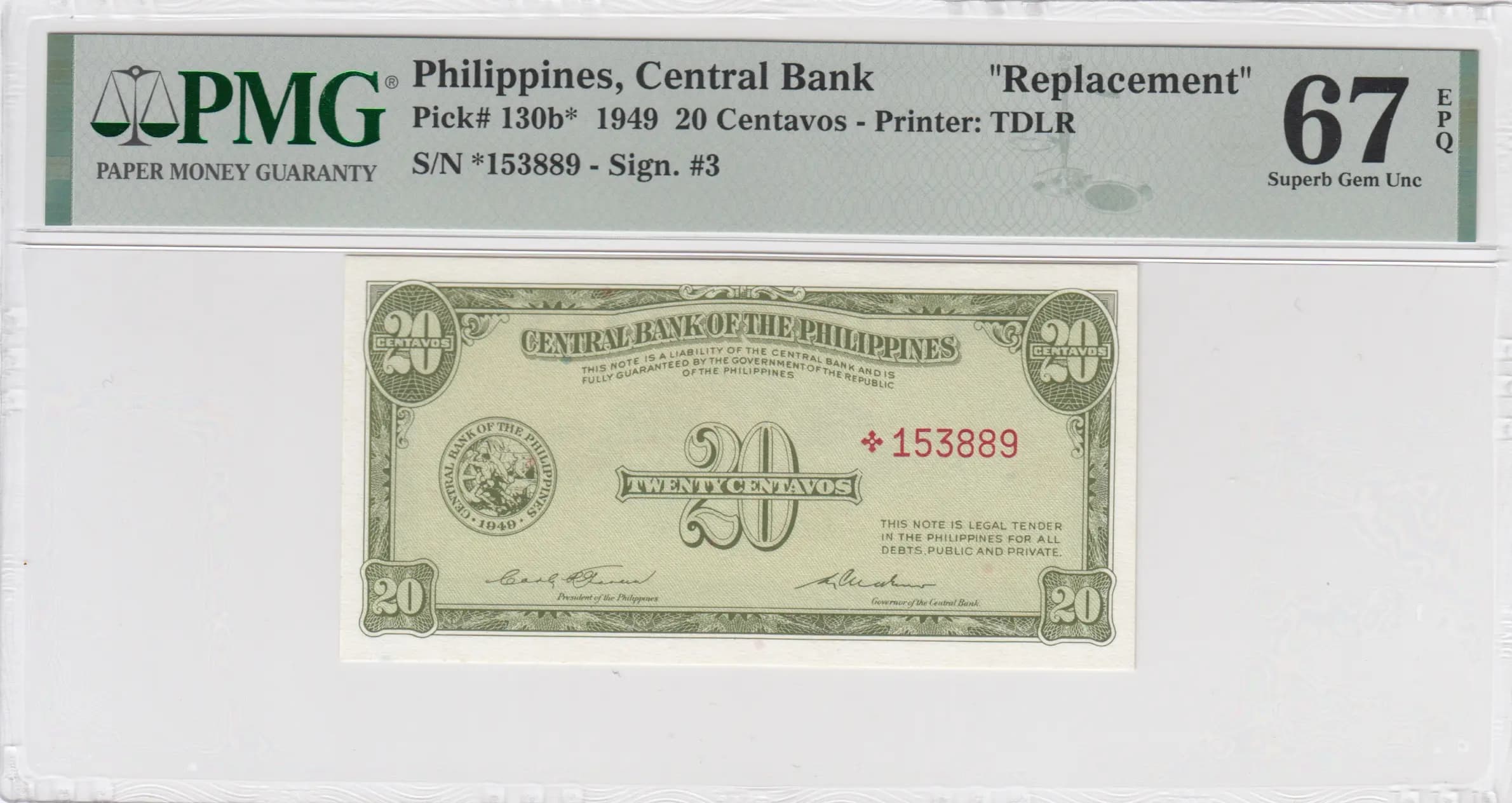
Common. While this is a pre-decimal Philippine note from the early years of the Central Bank, the denomination and printing history make it relatively common in the collector market. eBay sales data shows multiple examples trading regularly, with UNC examples selling for $2-3 according to 2019 catalog values, and recent sales in the $3.50-$26 range depending on condition and grading (PMG-graded examples command premiums). The note was part of a regular issue, not a short-lived or recalled series. The abundance of examples available in the secondary market and the modest price points indicate this is a readily obtainable note for collectors of Philippine currency or early Central Bank issues.
This note was issued in 1949, the pivotal year when the Philippines gained full independence from American administration, which is reflected in the prominent display of the Republic of the Philippines seal and 1949 date on the obverse. The dual signatures of the President of the Philippines and Governor of the Central Bank underscore the newly sovereign nation's monetary authority. The legal tender declaration emphasizes the fledgling Central Bank's role in establishing the nation's financial independence during the early post-war period.
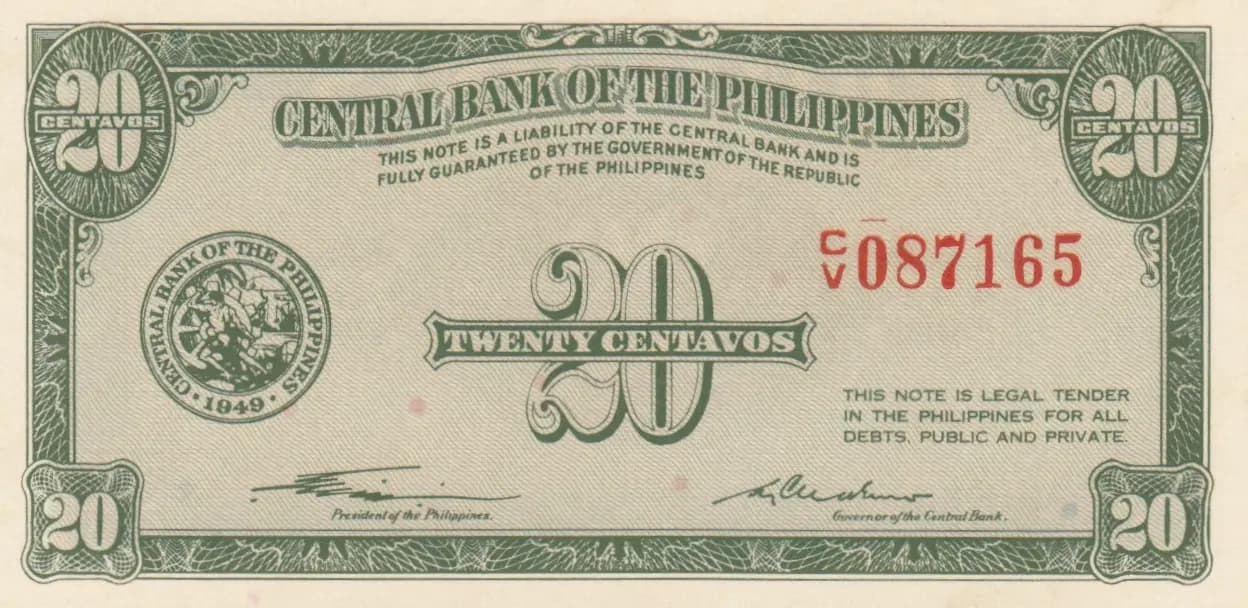
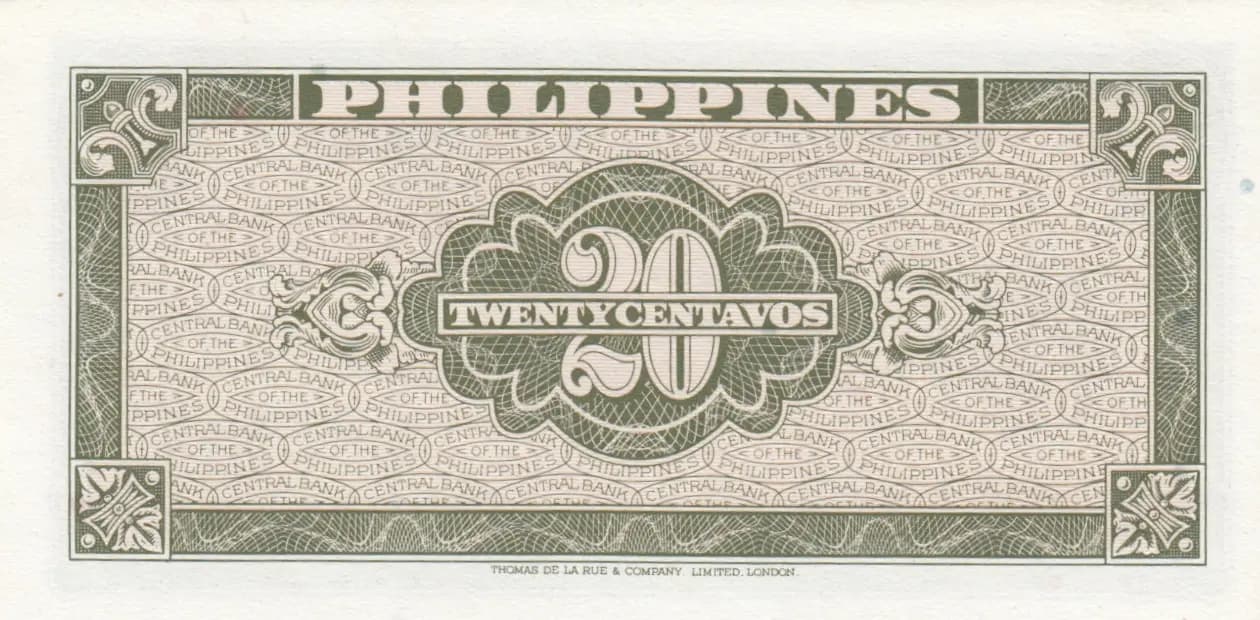
The front features a symmetrical, highly ornate design typical of Thomas De La Rue's security printing expertise. Four corner medallions contain the denomination '20' within circular frames with fine geometric patterning. The center displays 'TWENTY CENTAVOS' within a decorative rectangular banner, flanked by elaborate scrollwork and filigree. The Republic of the Philippines seal—a circular emblem with the state coat of arms—is positioned prominently on the left side with '1949' clearly marked, establishing the issue date and national authority. Signature lines for the President and Central Bank Governor appear at the bottom, allowing for multiple signature varieties within the series. The back presents an innovative security design featuring a large quatrefoil/rosette medallion at center containing the denomination, surrounded by a repeating microtext pattern of 'OF THE PHILIPPINES' and 'CENTRAL BANK' that creates a dense background security element. Corner ornaments with floral and scrollwork designs frame the composition. The printer's mark 'THOMAS DE LA RUE & COMPANY LIMITED, LONDON' appears at the bottom of the reverse.
FRONT SIDE: 'CENTRAL BANK OF THE PHILIPPINES' (header); 'THIS NOTE IS A LIABILITY OF THE CENTRAL BANK OF THE PHILIPPINES AND IS FULLY GUARANTEED BY THE GOVERNMENT OF THE REPUBLIC OF THE PHILIPPINES' (legal guarantee text); 'TWENTY CENTAVOS' (denomination in decorative banner); 'THIS NOTE IS LEGAL TENDER IN THE PHILIPPINES FOR ALL DEBTS, PUBLIC AND PRIVATE' (legal tender declaration); 'G B 552809' (serial number); Signature lines for 'President of the Philippines' and 'Governor of the Central Bank'. BACK SIDE: 'TWENTY CENTAVOS' (central denomination); 'OF THE PHILIPPINES' and 'CENTRAL BANK' (repeating security pattern text); 'THOMAS DE LA RUE & COMPANY LIMITED, LONDON' (printer attribution).
This note was produced using intaglio (engraved) printing by Thomas De La Rue & Company, the renowned London-based security printer. The visual evidence of fine line work, detailed geometric patterns, intricate scrollwork, and the elaborate corner medallions are all hallmarks of intaglio engraving. The repeating microtext pattern on the reverse, which serves as an anti-counterfeiting security feature, was achieved through fine engraving. The sharp definition of the filigree patterns and the crisp appearance of text throughout indicate the high-quality steel plate engraving process that De La Rue was famous for during this period.
The Pick catalog lists this as P-130b, indicating there is at least a P-130a variety, likely distinguished by different signatures (different President or Central Bank Governor combinations). This specific example bears the serial number 'G B 552809' printed in red, consistent with catalog descriptions for this variety. The signature combination on this note would identify which specific variant within the P-130b designation this represents. Collectors should note that multiple signature varieties exist within this denomination and year, as the positions of President and Central Bank Governor changed during the 1949 issue period, creating collectible sub-varieties.