20 centavos 1949
Market Prices
1 saleAbout This Note
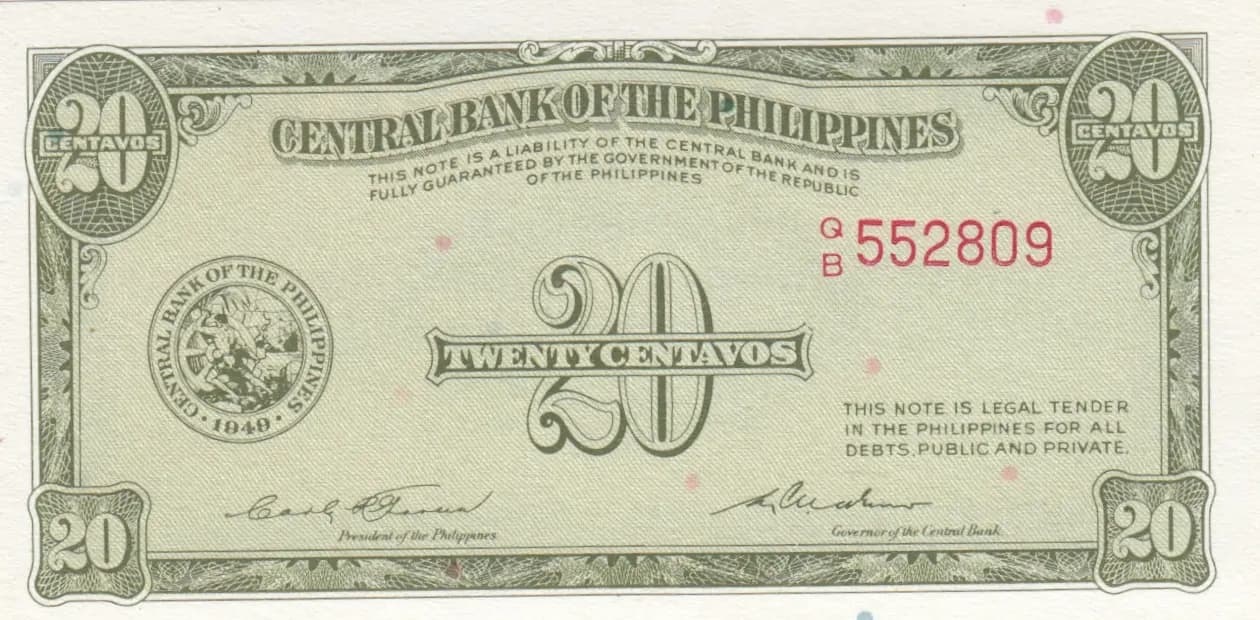
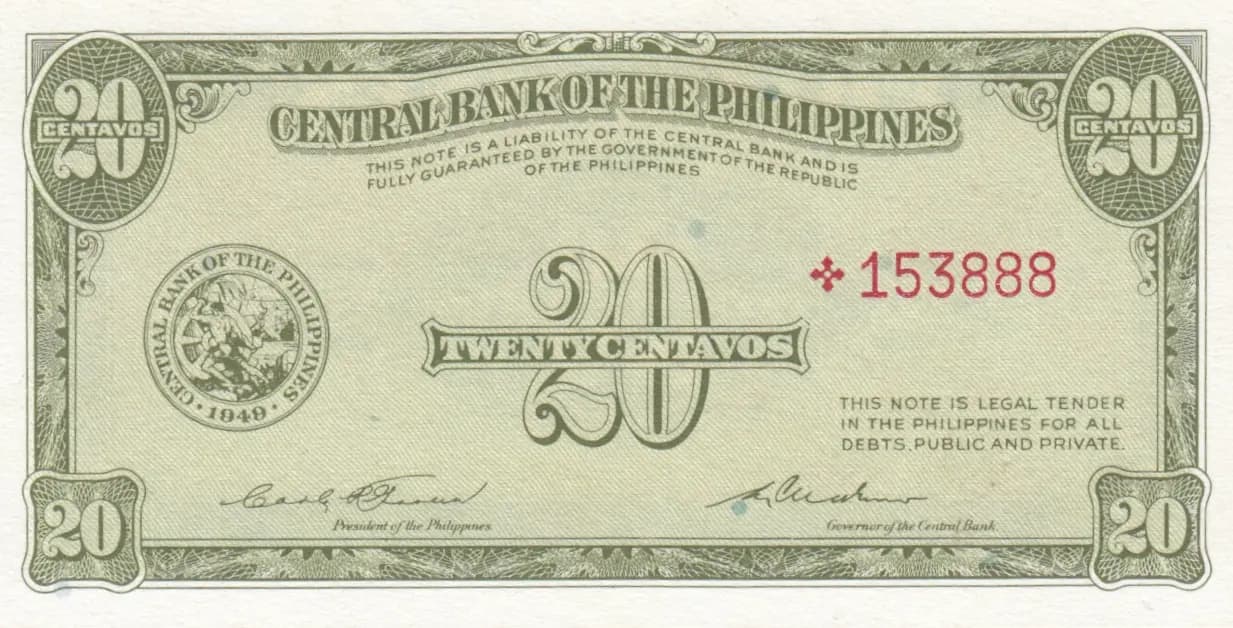
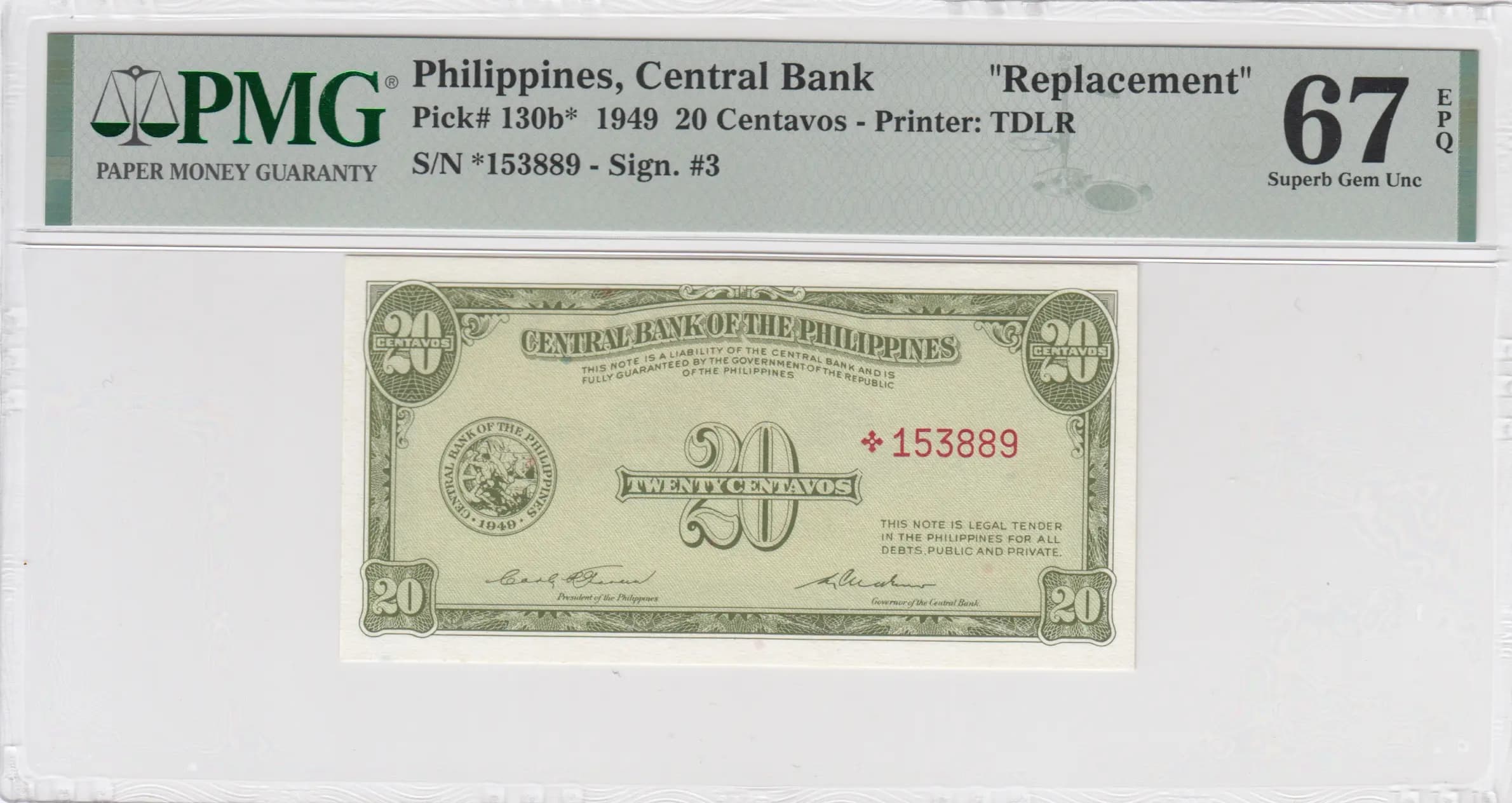
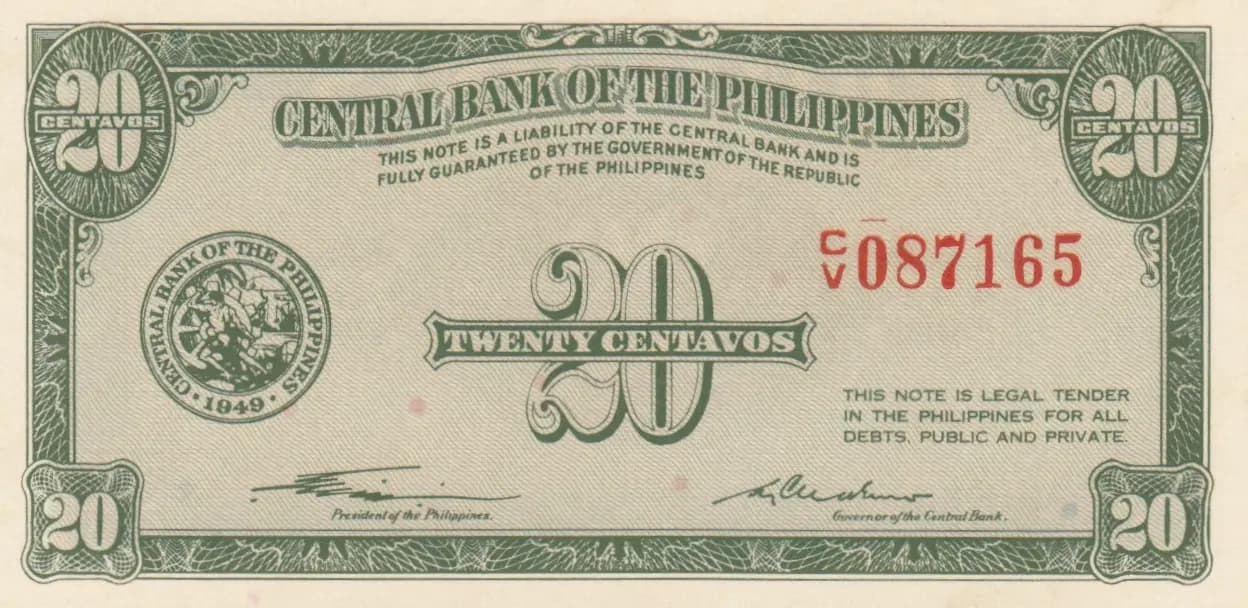
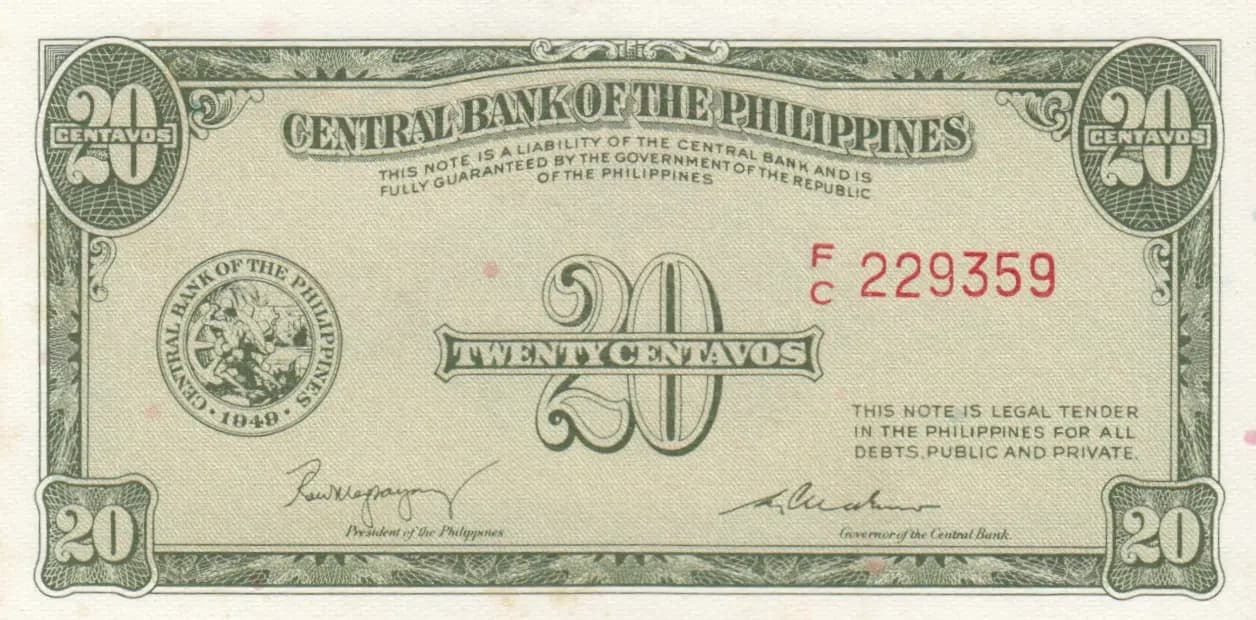
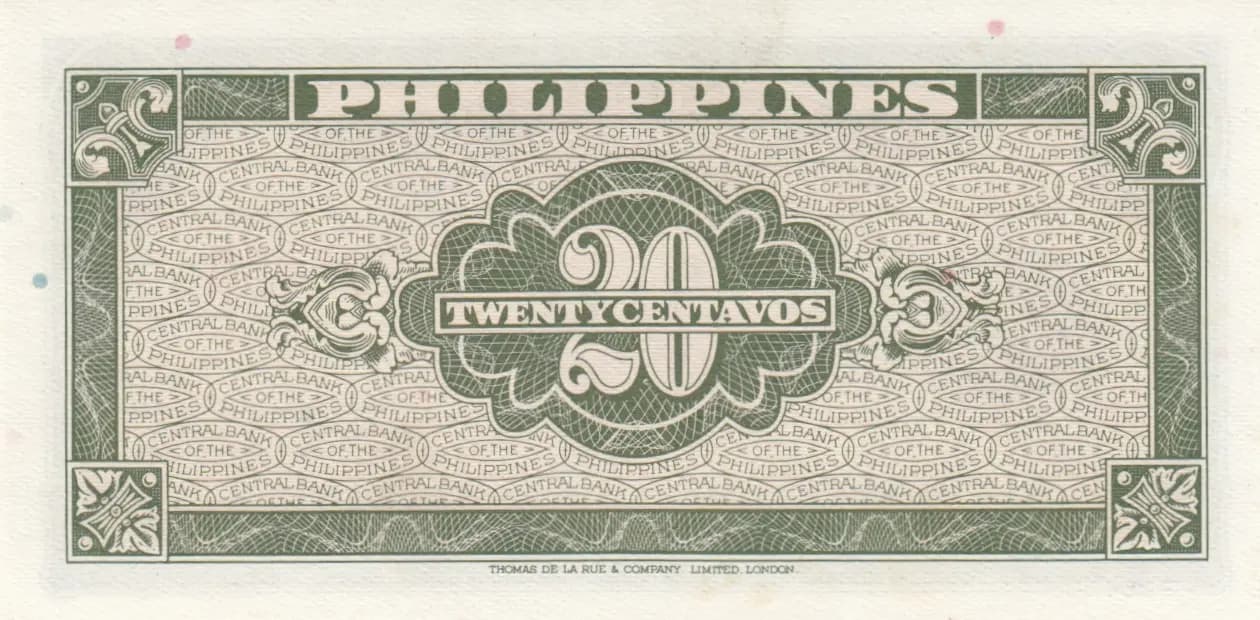
This is a 1949 Philippine 20 centavos note in uncirculated condition, issued by the Central Bank of the Philippines and printed by Thomas de la Rue in London. The note displays excellent preservation with only minimal age-related discoloration, crisp intaglio printing throughout, and well-defined security patterns. The vibrant green and cream color scheme, ornate corner denominations, and intricate ornamental design make this an attractive example of early Philippine currency from the post-independence era.
Common. The catalog value of $2.25 for UNC examples (2019) and the modest eBay transaction prices ($3.51 for a Fine specimen in 2013) indicate this is a readily available note in the collector market. The 1949 issue was a regular production release by the Central Bank, not a limited or special printing, and these notes exist in reasonable quantities in collections today. No print run restrictions or recall issues are documented for this Pick number.
Issued in 1949, this note represents the newly independent Philippines' early monetary system under the Central Bank, established in 1949. The design emphasizes national sovereignty with the prominent 'CENTRAL BANK OF THE PHILIPPINES' inscription and the government guarantee statement, reflecting the nation's commitment to stable currency in the immediate post-World War II period. The use of London's prestigious Thomas de la Rue printing house demonstrates the Philippines' reliance on established international security printers for currency production during this formative period.
The obverse features a classical security banknote design with a cream/beige field and green intaglio printing. Ornate ovals containing the numeral '20' occupy the top left and right corners, with the denomination 'TWENTY CENTAVOS' displayed prominently in an ornamental banner in the center. The Central Bank seal with the date 1949 appears on the left side. The note includes comprehensive text identifying the issuer and guarantor, along with signature lines for the President and Central Bank Governor. The reverse presents a highly symmetrical design dominated by a central rosette medallion containing the denomination, surrounded by repeating security text spelling out 'CENTRAL BANK OF THE PHILIPPINES' as an integrated security pattern. Fine line crosshatch (guilloche) patterns and intricate ornamental borders frame all elements. The printer's attribution to Thomas de la Rue & Company Limited, London appears at the base of the reverse. No portraits or specific landmarks are depicted; the design relies entirely on ornamental and typographic elements typical of mid-twentieth-century security currency design.
Front side: 'CENTRAL BANK OF THE PHILIPPINES' (header); 'TWENTY CENTAVOS' (center denomination); '20' (corner denominations); 'THIS NOTE IS A LIABILITY OF THE CENTRAL BANK AND IS FULLY GUARANTEED BY THE GOVERNMENT OF THE REPUBLIC OF THE PHILIPPINES' (government liability statement); 'THIS NOTE IS LEGAL TENDER IN THE PHILIPPINES FOR ALL DEBTS, PUBLIC AND PRIVATE' (legal tender declaration); 'President of the Philippines' and 'Governor of the Central Bank' (signature line identifications); Serial number 'F C 229359'. Back side: 'PHILIPPINES' (top); 'CENTRAL BANK OF THE PHILIPPINES' (repeating security pattern); 'TWENTY CENTAVOS' (center ornamental banner); 'THOMAS DE LA RUE & COMPANY LIMITED, LONDON' (printer attribution).
Intaglio (engraved) printing on a banknote substrate. The fine line work, detailed crosshatch security patterns, and crisp definition of ornamental elements visible throughout both sides indicate professional security printing by Thomas de la Rue & Company Limited, London, one of the world's premier banknote security printers. The complex repeating security text pattern integrated into the background, along with the intricate ornamental designs, demonstrates advanced anti-counterfeiting techniques employed at the time.
The observed specimen shows serial number prefix 'F C' with number 229359. Pick P-130a represents one variety of the 1949 20 centavos issue; P-129 (printed by Security Banknote Company with different signatures) represents an alternative variety. The specific signature lines visible on this specimen would indicate which authorized officials were in office at the time of printing, but the actual signatures are not legible in the visual analysis. This specimen appears to be a standard regular-issue variety without overprints or special markings.