20 centavos 1949
Market Prices
3 salesAbout This Note
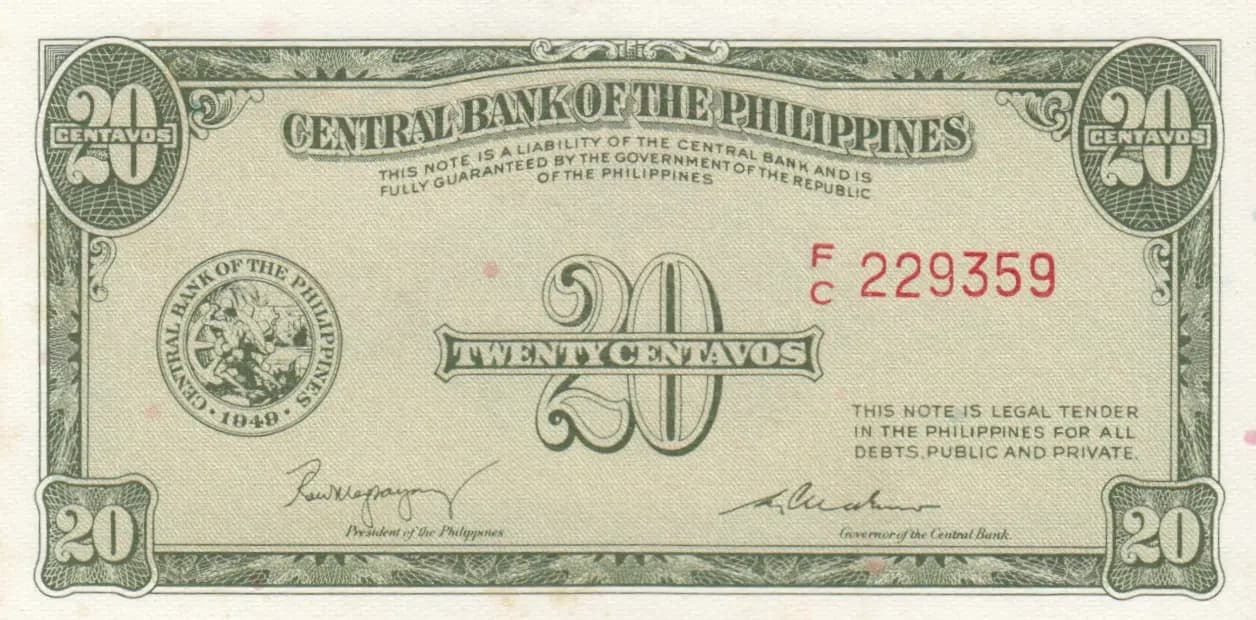
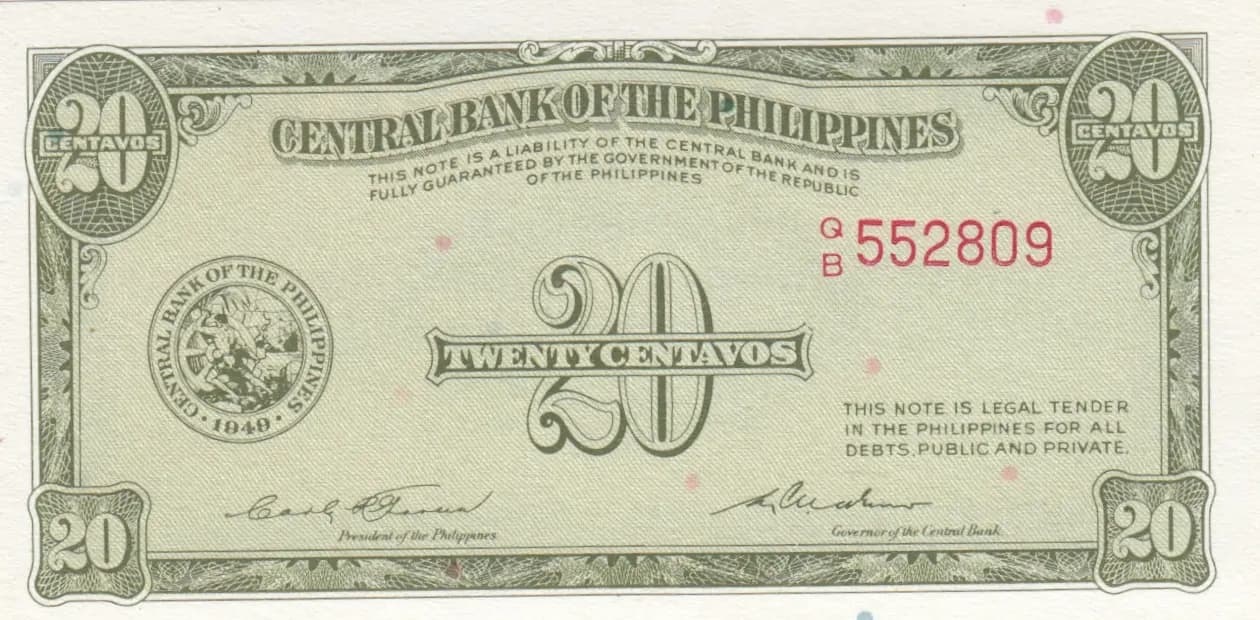
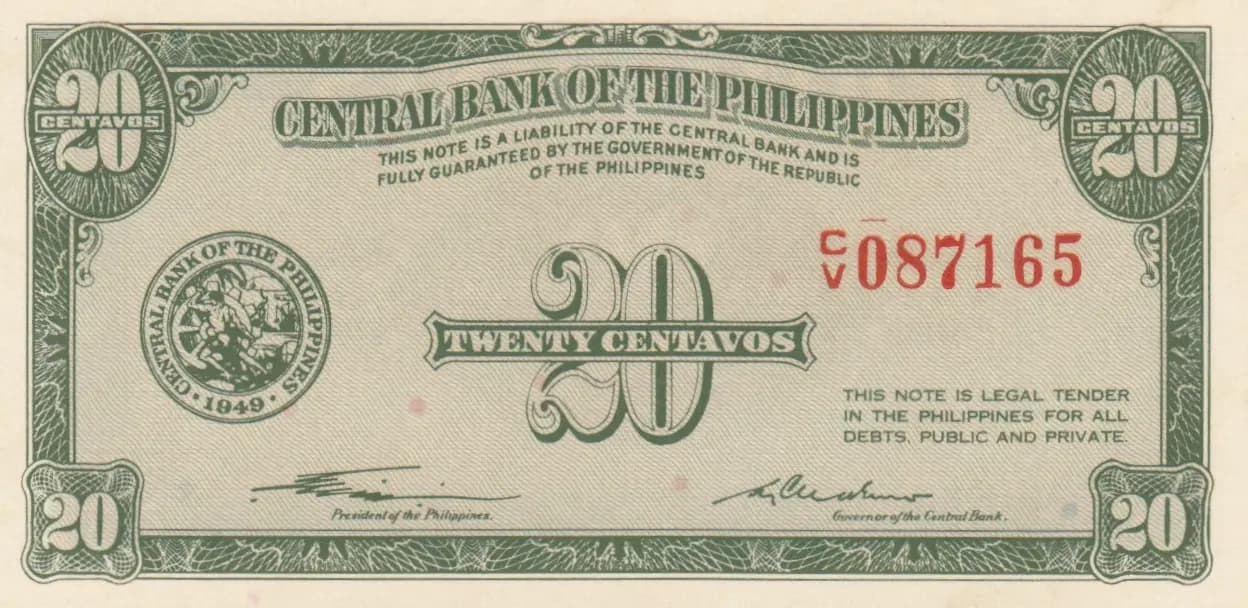
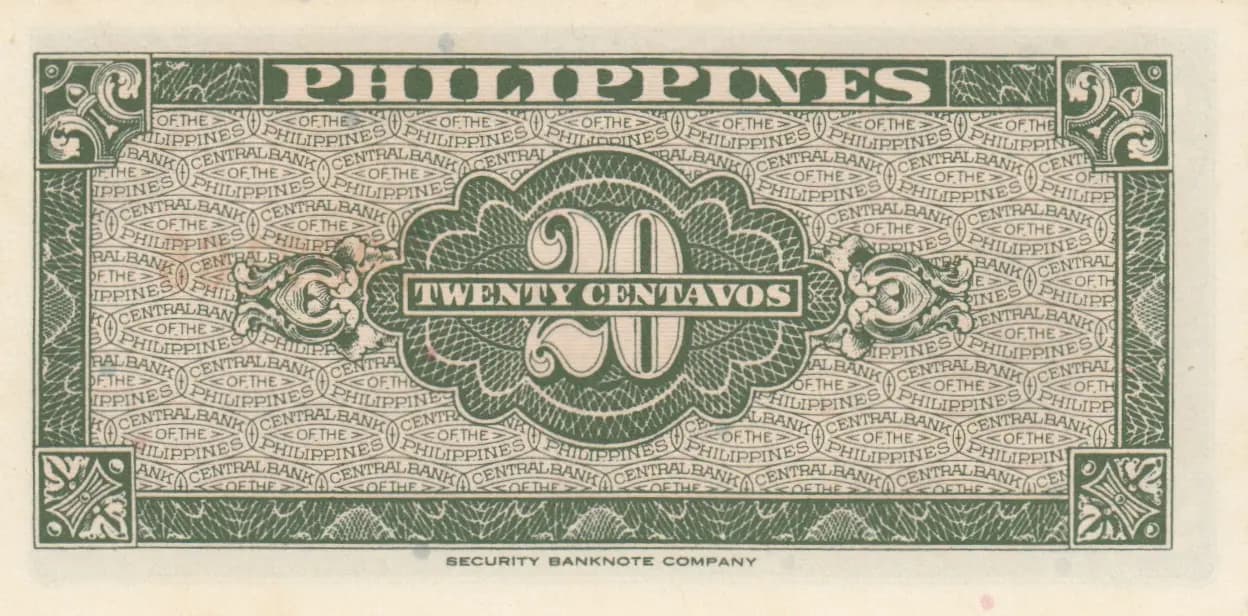
This 1949 Central Bank of the Philippines 20 centavos note (P-129) is presented in excellent Uncirculated condition with crisp, clean margins and no visible wear or circulation damage. The note features a distinctive green color scheme with ornate security printing throughout, including the prominent Central Bank Seal dated 1949 on the obverse and repeating microtext security patterns on the reverse. As an early postwar Philippine currency issue from the nascent Central Bank era, this note represents an important transitional period in Philippine monetary history and remains highly collectible for its historical significance and pristine condition.
Common. This note is a regular-issue Central Bank note from a major post-independence period with substantial print runs typical of widely-circulated low-denomination currency. Market evidence from realbanknotes.com confirms commonality: VF examples consistently sell for $1–4 USD, and the 2019 catalog values list UNC at only $2, placing it among the most affordable Philippine banknotes. While the 1949 date and early Central Bank era hold historical interest for Philippine currency collectors, the high availability of surviving examples in all conditions indicates no scarcity in the collector market.
Issued in 1949, this note reflects the Philippines' early years following independence in 1946 and the establishment of the Central Bank in 1949. The Central Bank Seal Type 1 featured on the obverse symbolizes the newly sovereign nation's modern monetary authority, while the government guarantee statement emphasizes the stability and legitimacy of the new republic's currency. This particular denomination and design represents a critical period in Philippine economic reconstruction and nation-building in the immediate postwar era.
The obverse features a formal, symmetrical design centered on the Central Bank of the Philippines' institutional authority. Large denomination numerals '20' appear in the upper left and right corners, with 'TWENTY CENTAVOS' displayed prominently in a decorative cartouche at center. The circular Central Bank Seal dated 1949, positioned on the left side, serves as the primary identifying symbol of the note's issuing authority. Signature lines for the President of the Philippines and Governor of the Central Bank appear at the bottom, establishing official authentication. The reverse displays 'PHILIPPINES' in large decorative letters with scrollwork, and repeats the '20' and 'TWENTY CENTAVOS' denomination in an ornate central cartouche. The entire reverse background is filled with sophisticated repeating microtext security patterns reading 'CENTRAL BANK OF THE PHILIPPINES' and 'OF THE' in various orientations. All four corners feature elaborate decorative flourishes and ornaments. The printer credit 'SECURITY BANKNOTE COMPANY' appears at the bottom reverse. The green color scheme (green on light green underprint) with cream/beige highlights creates a classical, institutional appearance appropriate to the Central Bank's authority.
OBVERSE: 'CENTRAL BANK OF THE PHILIPPINES' — Central Bank of the Philippines; 'THIS NOTE IS LIABILITY OF THE CENTRAL BANK AND IS FULLY GUARANTEED BY THE GOVERNMENT OF THE REPUBLIC OF THE PHILIPPINES' — This note is a liability of the Central Bank and is fully guaranteed by the Government of the Republic of the Philippines; '20' and 'TWENTY CENTAVOS' — Denomination; 'THIS NOTE IS LEGAL TENDER IN THE PHILIPPINES FOR ALL DEBTS, PUBLIC AND PRIVATE' — This note is legal tender in the Philippines for all debts, public and private; 'President of the Philippines' and 'Governor of the Central Bank' — Signature designations. REVERSE: 'PHILIPPINES' — Philippines; '20' and 'TWENTY CENTAVOS' — Denomination; 'CENTRAL BANK OF THE PHILIPPINES' (repeating security text) — Central Bank of the Philippines; 'SECURITY BANKNOTE COMPANY' — Printer identification.
This note was produced using intaglio/offset combination printing by the Security Banknote Company (SBNC), a technique standard for high-security currency production of the era. The intricate border designs, ornate cartouches, and repeating microtext security patterns visible throughout both sides are characteristic of intaglio engraving, which produces the subtle raised texture and fine line work evident in the visual analysis. The consistent registration and color application across both sides indicates professional offset printing capabilities. The red serial number was likely applied through a separate letterpress or offset application after primary printing.
This note represents the SBNC printing variant (Pick P-129). A related variety exists with different signatures printed by Thomas de la Rue, catalogued as P-130, indicating at least two distinct printings from different security printers during this issue period. The serial number observed (C087165) uses the prefix 'C,' which may indicate a specific printing series; however, without comprehensive serial number documentation, the significance of this prefix cannot be definitively established. No overprints or other notable varieties are apparent in the visual analysis of this specimen.