2 piso 1970's
Market Prices
16 salesAbout This Note
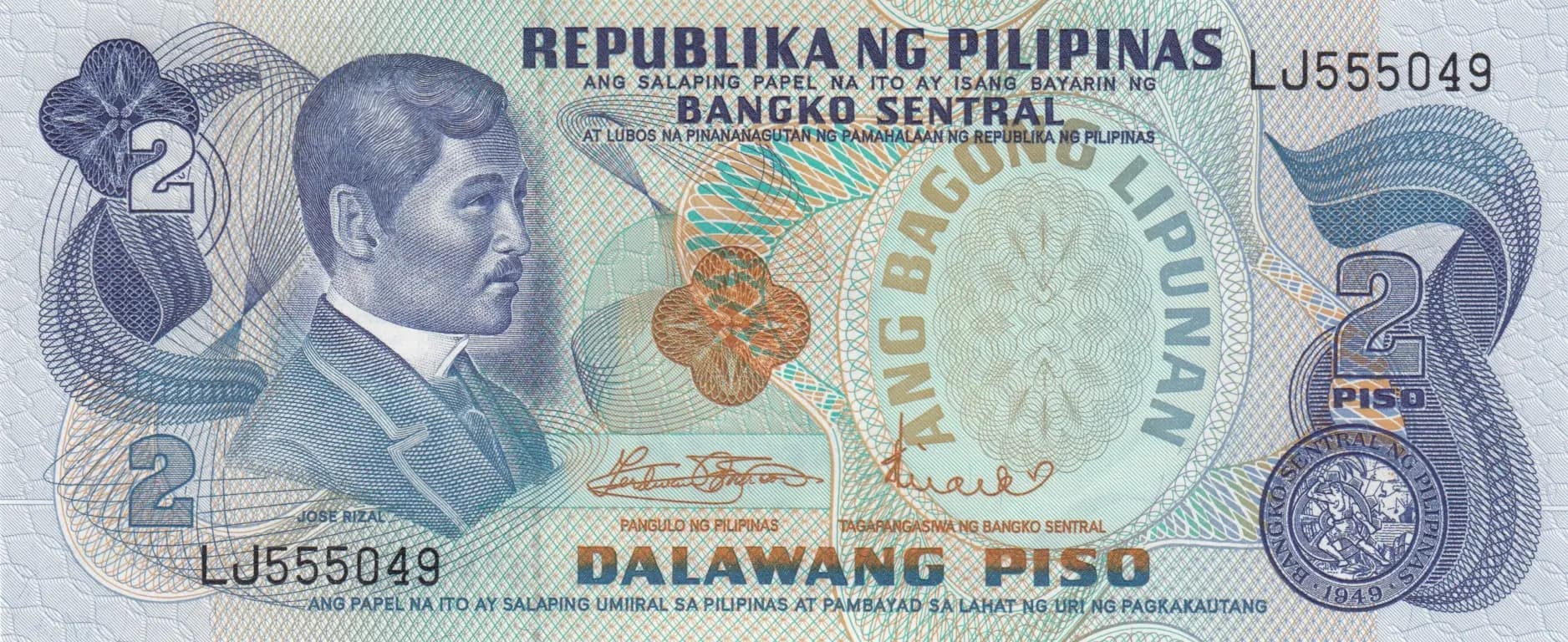
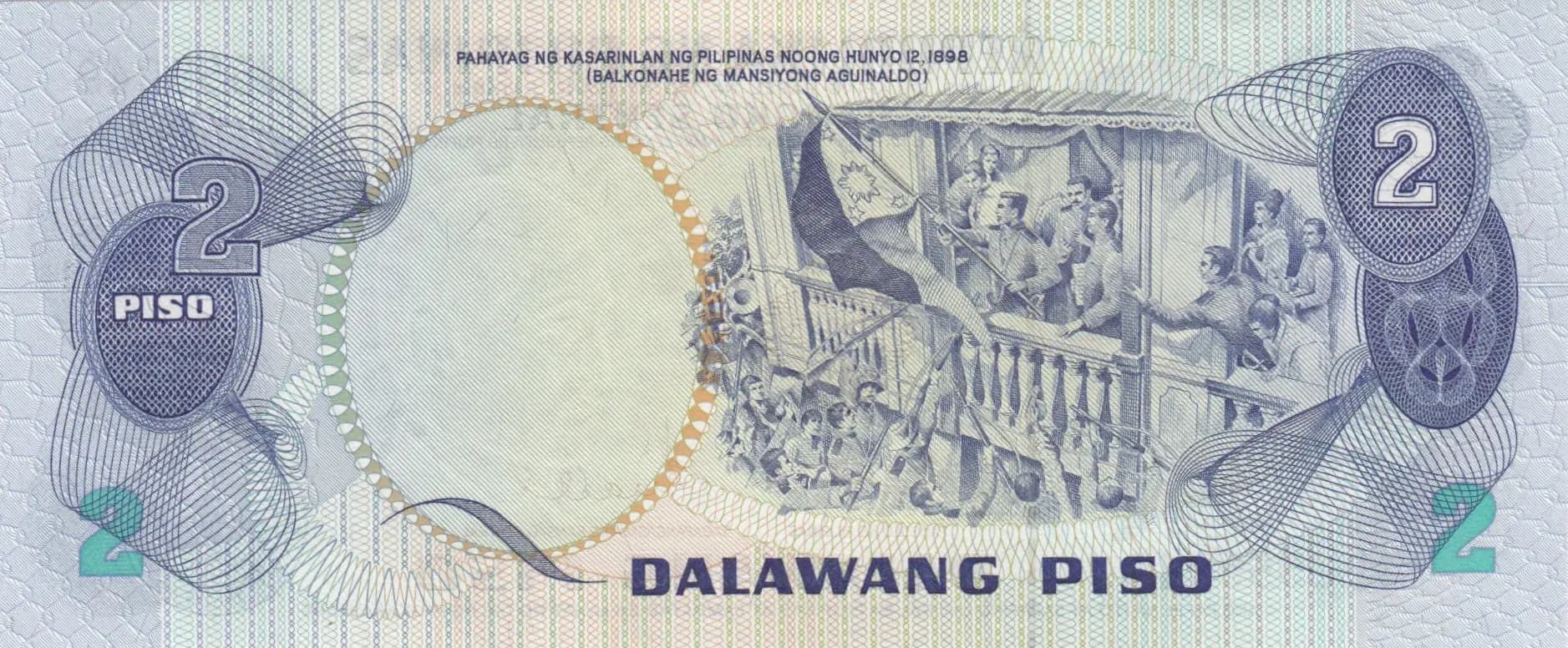
A pristine uncirculated example of the Philippine 2 Piso note from 1970, featuring the iconic left-facing portrait of national hero Jose Rizal on the obverse rendered in fine detail against a light blue-green background. The reverse depicts the historical Declaration of Independence of June 12, 1898, shown as a colonial-era scene on the balcony of Aguinaldo's Mansion with multiple figures in period dress. The note exhibits excellent preservation with sharp impressions, crisp colors, and no signs of wear, fold marks, or circulation.
Common. This is a regular-issue banknote from a major circulation series with substantial print runs typical of low-denomination currency in a nation of over 40 million people during the 1970s. Market evidence strongly supports this assessment: eBay transaction data shows consistent sales in the $0.99–$2.25 range for UNC examples from 2015–2024, with catalog values listed at $1.25 for UNC condition (2019). Even PMG-graded examples (PMG 55–67) sold for $11.99–$20.50, which remains modest for any rare banknote. The note remains widely available in the current collector market at minimal premiums, confirming its status as a common circulation issue.
This banknote commemorates two pivotal moments in Philippine history: the portrait of Jose Rizal, the national hero and reformer executed in 1896 whose writings inspired the Philippine Revolution, and the reverse depicting the actual Declaration of Independence proclaimed on June 12, 1898, at Emilio Aguinaldo's residence in Kawit. The Central Bank of the Philippines issued this series during the early post-independence period to reinforce national identity and historical consciousness among Filipino citizens. The bilingual design (Filipino and English) reflects the Philippines' linguistic heritage and its status as a newly sovereign nation establishing its own monetary authority.
The obverse features a dignified left-profile portrait of Jose Rizal (1861-1896), the Philippine national hero, rendered in classical engraving style with fine detail showing him in formal Western business attire (suit and tie). The portrait is positioned at the left of the note against an ornate background of guilloche and floral decorative elements rendered in light blue and green tones. The denomination numeral '2' appears prominently in the upper left and lower right corners, with 'DALAWANG PISO' inscribed below. The Central Bank of the Philippines seal (Seal Type 2 per catalog notation) is positioned on the right side as a circular emblem. The reverse depicts a significant historical scene—the proclamation of Philippine independence on the balcony of Emilio Aguinaldo's mansion in Kawit on June 12, 1898. Multiple figures dressed in late 19th-century colonial clothing are shown gathered on a covered balcony with classical architectural columns, commemorating this pivotal moment in Philippine history. The entire design is rendered in light green and dark blue engraving with ornamental borders and elaborate corner flourishes.
FRONT SIDE: 'REPUBLIKA NG PILIPINAS' (Republic of the Philippines); 'ANG SALAPIANG PAPEL NA ITO AY ISANG BAYARIN NG BANGKO SENTRAL AT LIBOS NA PINANAGUTANG NG PAMAHALAAN NG REPUBLIKA NG PILIPINAS' (This paper money is legal tender of the Central Bank and is backed by the Government of the Republic of the Philippines); 'JOSE RIZAL' (Jose Rizal); 'PANGULO NG PILIPINAS' (President of the Philippines); 'TAGAPANGASIWANG BANGKO SENTRAL' (Governor of the Central Bank); 'DALAWANG PISO' (Two Pesos); 'PISO' (Peso); Serial number 'LU555049'. BACK SIDE: 'PAHAYAG NG KASARINLAN NG PILIPINAS NOONG HUNYO 12, 1898' (Declaration of Independence of the Philippines on June 12, 1898); '[BALKONAHE NG MANSIYONG AGUINALDO]' ([Balcony of Aguinaldo's Mansion]); 'DALAWANG PISO' (Two Pesos); 'PISO' (Peso).
Intaglio engraving (line engraving and steel plate printing), evidenced by the fine detail work, complex guilloche patterns, intricate crosshatch shading, and the characteristic crisp, raised impression visible throughout both sides of the note. The security features including fine line engraving patterns and elaborate decorative elements are consistent with high-security banknote production standards of the 1970s. The note was produced by the Central Bank of the Philippines' designated security printer, likely utilizing traditional steel-plate intaglio technology standard for Philippine currency of this era.
This example exhibits Central Bank Seal Type 2, as noted in catalog references. The serial number prefix 'LU' indicates a standard regular-issue note; replacement notes (which command slightly higher collector interest) are identified by a '+' prefix before the serial number. The note is from the ND (No Date) 1970s printing period. No overprints, special markings, or other significant varieties are evident in this specimen. Collectors should note that this Pick-152 variety is distinct from the related P-159 and P-166 issues, which feature different seal types as referenced in banknote.ws catalog remarks.