2 pesos 1936
Market Prices
12 salesAbout This Note
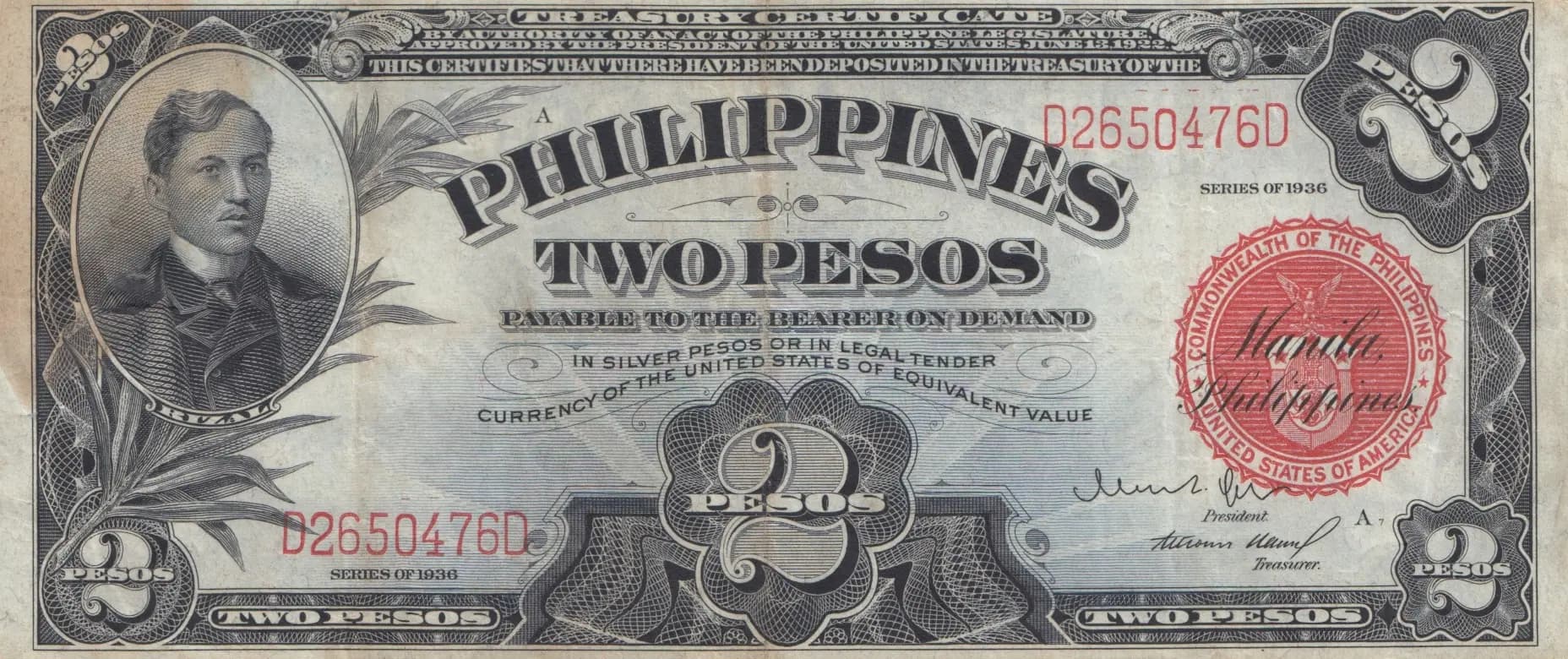
A well-circulated example of the Philippine Islands 2 Pesos note from 1936, featuring the iconic portrait of national hero José Rizal on the obverse and ornate denomination-focused design on the reverse. The note displays the characteristic red Commonwealth seal introduced with this series and shows moderate aging consistent with historical circulation, including visible creasing and slight foxing, making it a genuine artifact of early Commonwealth-era Philippine currency.
Common. eBay market data demonstrates consistent availability with multiple sales over a 12-year period (2010-2022), with VF-graded examples selling in the $13.50-$60 range and ungraded F-VF examples regularly trading for under $20. The 2016 catalog valuation of $10 for VF condition further confirms this as a readily available note in the collector market. The 1936 2 Pesos issue appears to have had a substantial print run, and examples in VF condition are not difficult to acquire, making it a common date and denomination in Philippine numismatics.
Issued in 1936 during the early years of the Philippine Commonwealth (established 1935), this note represents a transitional period in Philippine monetary history when the islands were moving toward independence from American colonial administration. The prominent red 'Commonwealth of the Philippines' seal and signatures of President Manuel Quezon and Treasurer Antonio Ramos reflect the newly sovereign status of the nation. The note's design featuring José Rizal—the martyred national hero executed by Spanish colonial authorities in 1896—underscores the post-independence emphasis on Filipino national identity and historical memory.
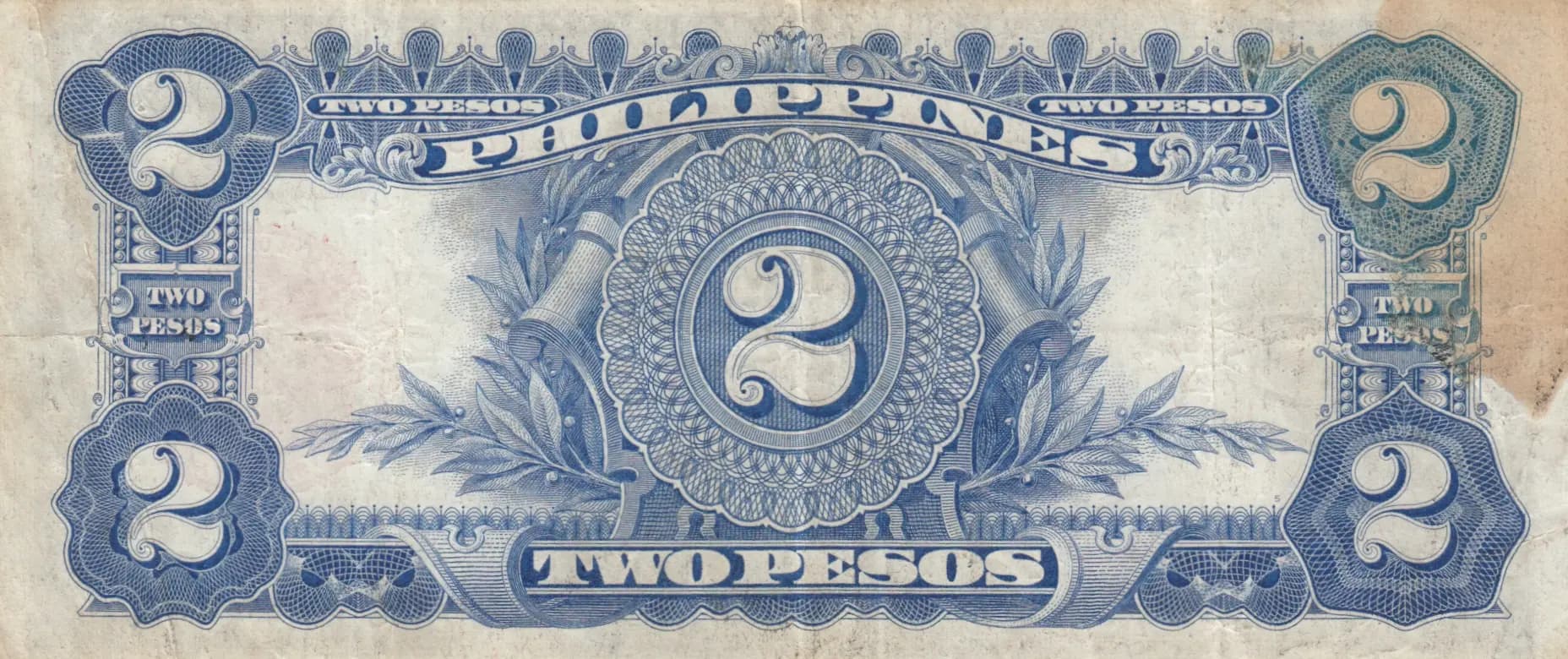
The obverse features a left-facing profile portrait of José Rizal within an oval frame positioned on the left side of the note. The central design emphasizes the denomination through large text reading 'TWO PESOS' and 'PHILIPPINES,' surrounded by ornate geometric and floral border patterns executed in black and gray. A red circular security seal bearing 'COMMONWEALTH OF THE PHILIPPINES' appears prominently on the right side. An elaborate decorative numeral '2' in an ornamental frame anchors the center-bottom. The reverse employs a completely different design philosophy, with a symmetrical, purely ornamental layout in blue ink featuring a large central circular rosette pattern containing a prominent '2', corner ornaments in each quadrant also displaying the numeral '2', and repeated denomination text. The overall aesthetic reflects early 20th-century bank note engraving conventions with emphasis on intricate line work and anti-counterfeiting security through design complexity.
FRONT: 'PHILIPPINES' and 'TWO PESOS' appear as primary denomination markers. The certificate text reads: 'THIS CERTIFIES THAT THERE HAVE BEEN DEPOSITED IN THE TREASURY OF THE COMMONWEALTH OF THE ISLANDS' (note: original text appears incomplete in inscription). Additional text states: 'PAYABLE TO THE BEARER ON DEMAND IN SILVER PESOS OR IN LEGAL TENDER CURRENCY OF THE UNITED STATES OF EQUIVALENT VALUE.' The note is identified as 'SERIES OF 1936' with signatures labeled 'President' (Manuel Quezon) and 'Treasurer' (Antonio Ramos). Serial number shown: D2650476D. The red seal reads 'COMMONWEALTH OF THE PHILIPPINES.' BACK: Primarily decorative with inscriptions 'PHILIPPINES PESOS' at top and 'TWO PESOS' at bottom, with repeated 'TWO' and 'PESOS' text in corner ornaments.
Intaglio (engraved) printing, the standard security printing method for banknotes of this era. The detailed line work, fine geometric patterns, and three-color printing (black on front with red seal; blue on back) are characteristic of intaglio production. The note was printed by the United States Bureau of Engraving and Printing (USBEP), as documented in the catalog data, though the visual analysis does not show an USBEP imprint on this specimen. The security features including intricate border engraving and repeated denomination elements were designed to prevent counterfeiting through production complexity.
Pick catalog P-82 with USBEP as printer. This note represents the standard variety with the new red Commonwealth seal introduced in 1936, distinguishing it from earlier P-74 issues which lacked the Commonwealth seal. The signatures of Manuel Quezon (President) and Antonio Ramos (Treasurer) are standard for this series. Serial number D2650476D appears to follow standard numbering conventions for the series. No major varieties (such as overprints or signature variants) are evident from the visual analysis or referenced catalog data for this Pick number.