1000 pesos 1945
Market Prices
About This Note
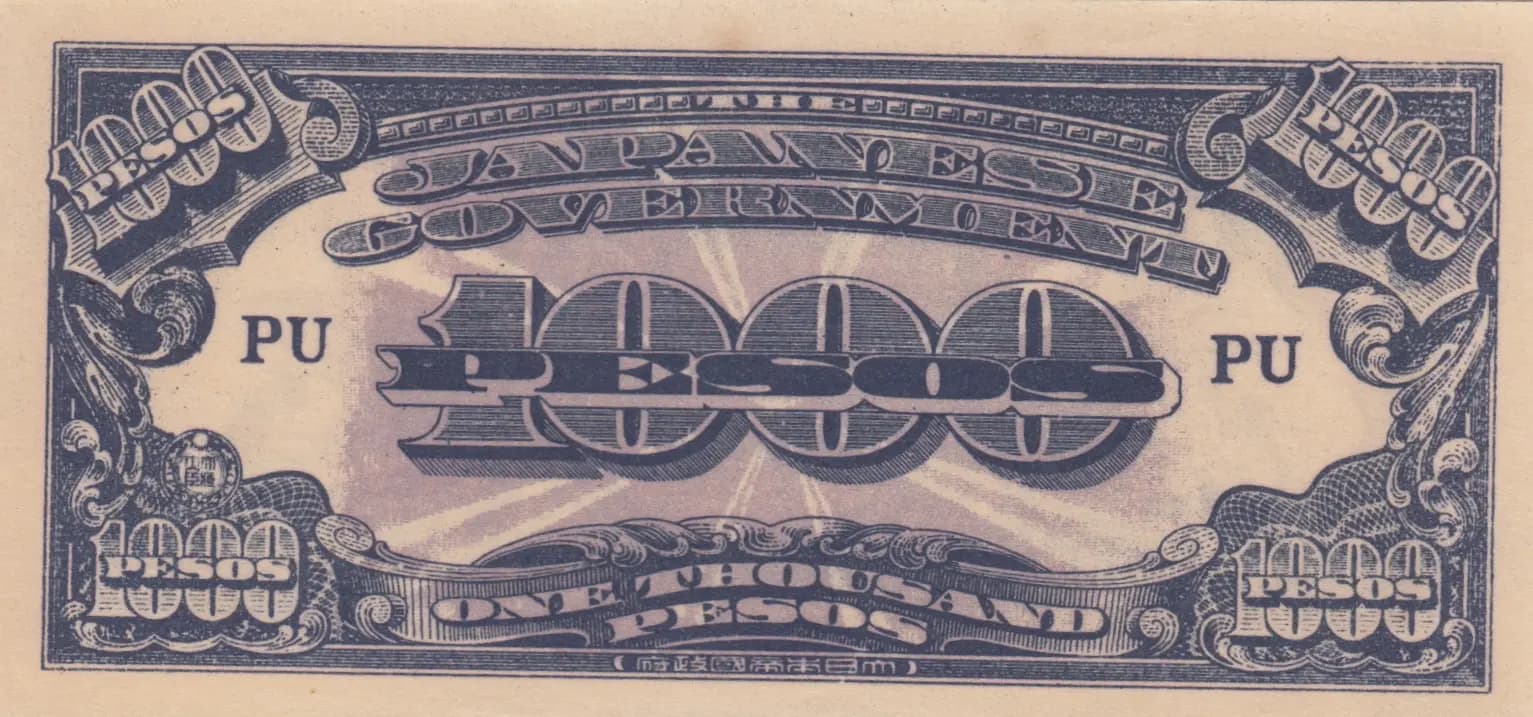
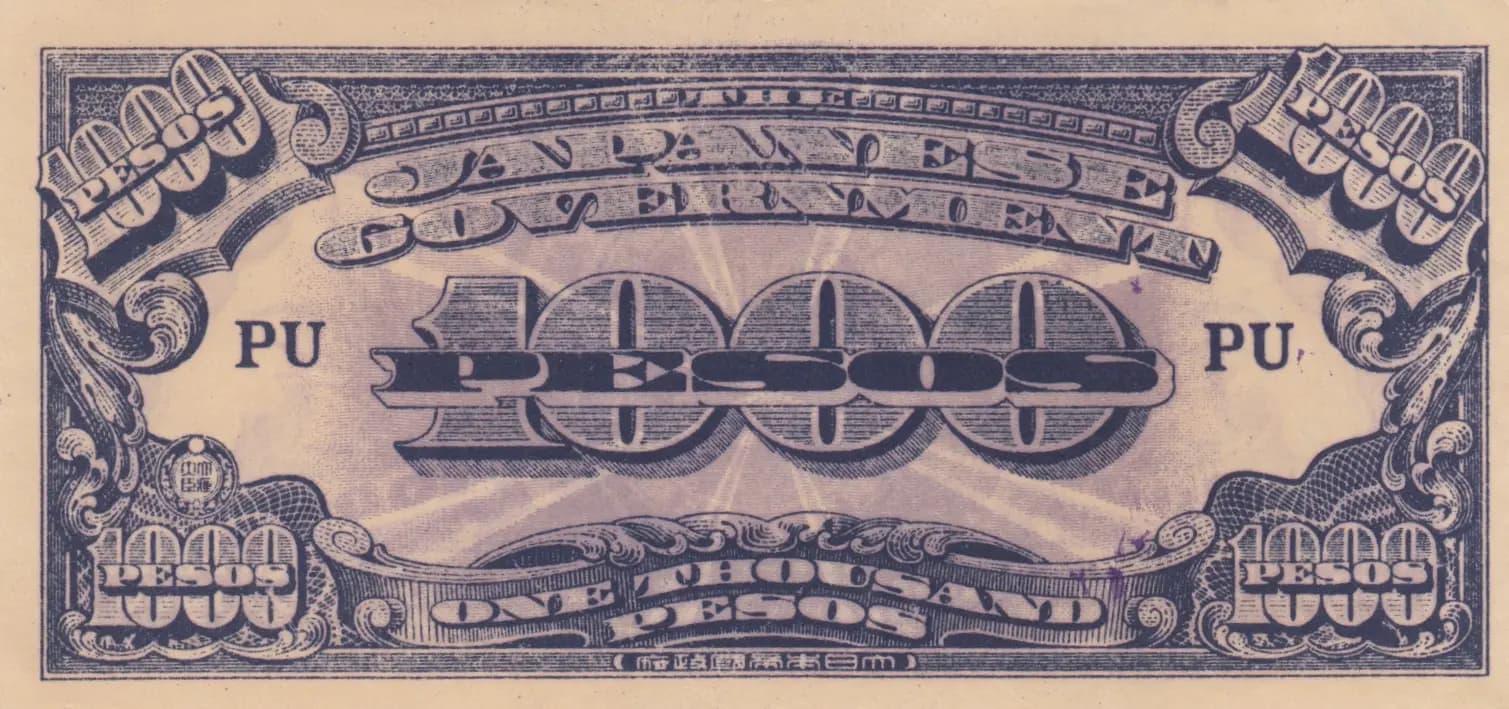
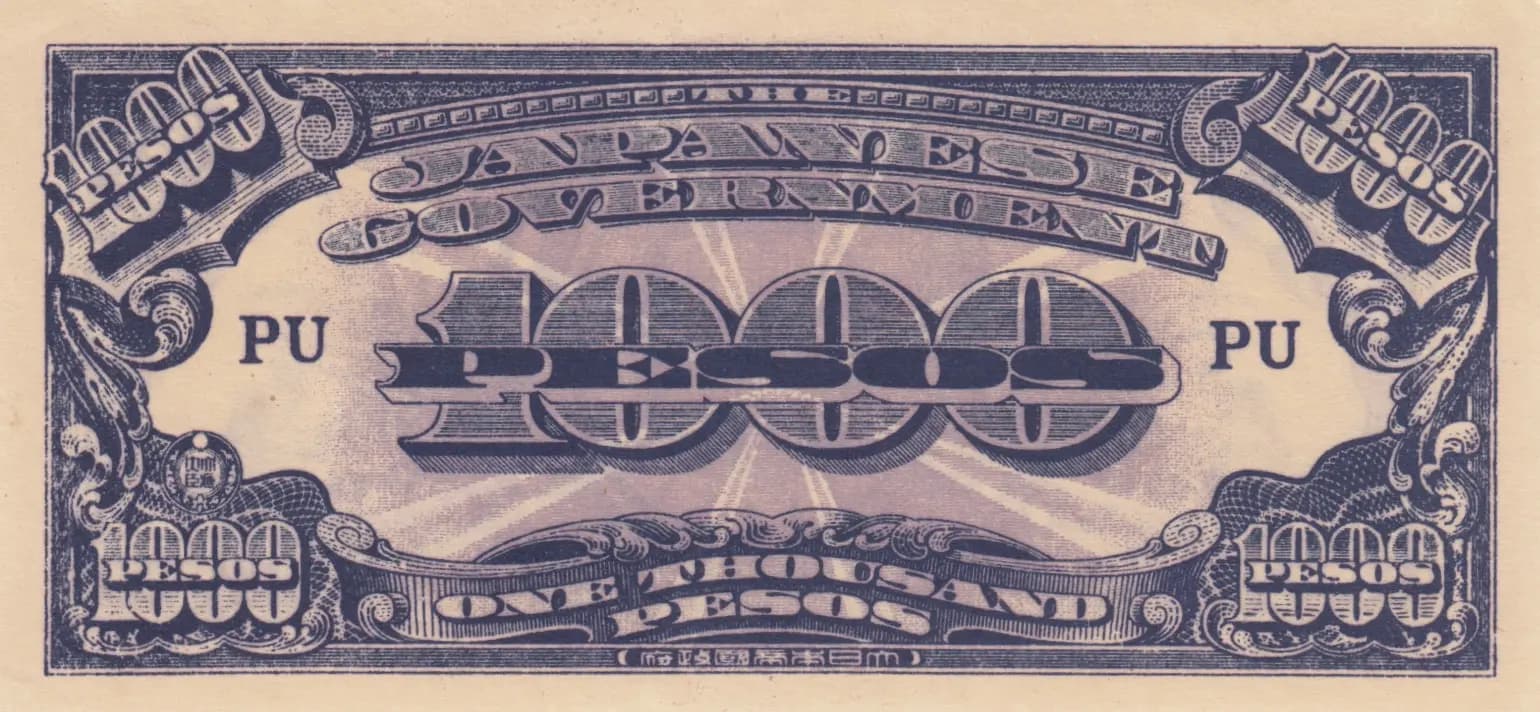
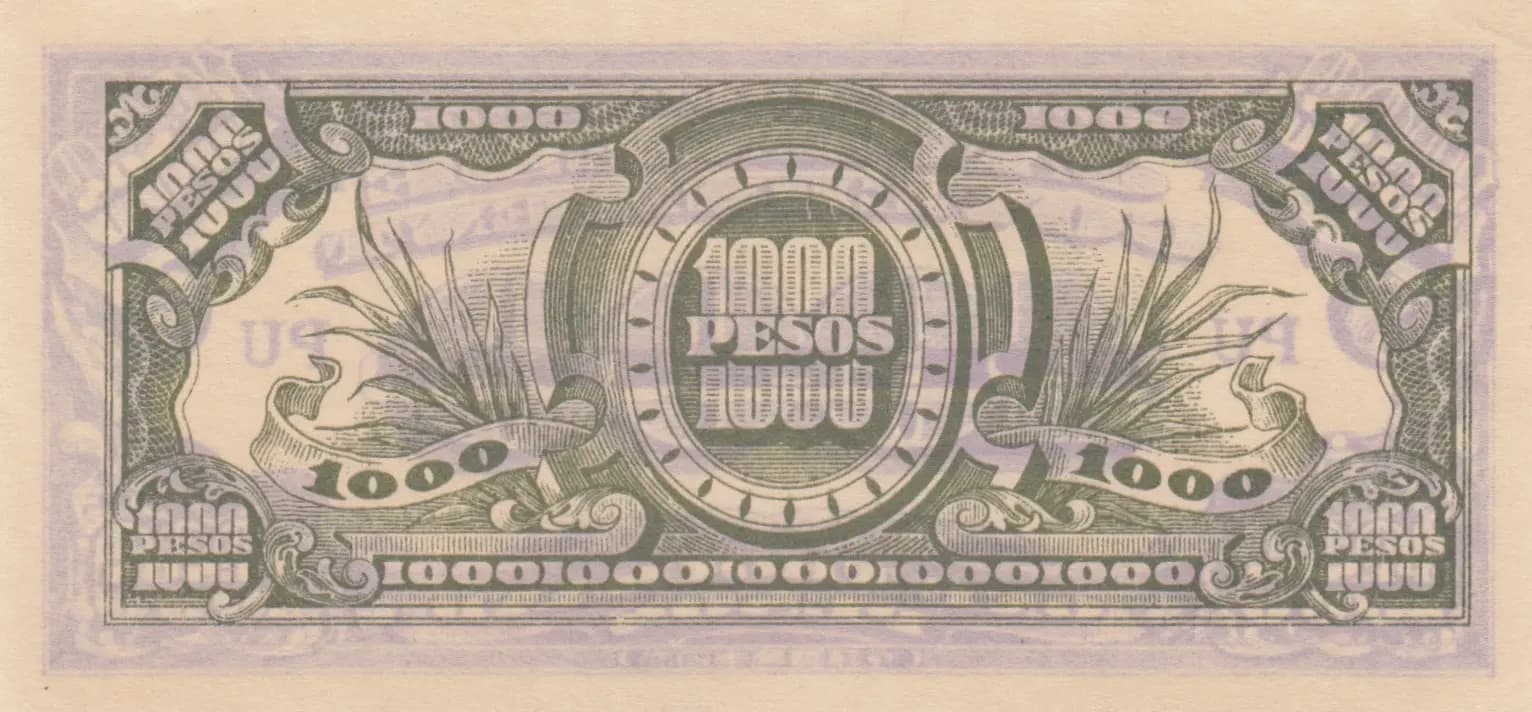
This Philippine 1000 pesos note from 1945, issued by the Japanese Government during occupation, is presented in AU condition with excellent preservation evident from both obverse and reverse sides. The note features intricate baroque-style engraving with four circular medallions on the reverse and a prominent central circular design on the obverse, both displaying fine line-work security patterns characteristic of high-denomination Japanese occupation currency. The block letters 'PU' appear prominently on both sides, and the note exhibits the expected color palette of dark green/blue-purple with cream underprinting typical of this series.
Common. This note trades regularly on secondary markets with eBay listings showing consistent availability at modest prices ranging from approximately $2.99 to $35.00 USD depending on condition grade. Current catalog valuations (2016) place it at $5 USD in UNC condition, indicating sustained but limited collector demand. Japanese occupation Philippine currency was produced in relatively large quantities during 1945 and survives in significant quantities. The AU condition grade noted in this catalog entry is desirable but not exceptionally scarce for this denomination and issue type.
This note was issued during Japan's occupation of the Philippines in World War II (1942-1945), when the Japanese Government replaced Philippine Commonwealth currency with their own occupation scrip. The ornate baroque scrollwork and agricultural imagery (wheat stalks or palm fronds flanking the central medallion) reflect the propaganda aesthetic of Japanese occupation currency, which often emphasized agricultural productivity and imperial prosperity. These notes became largely worthless after the Philippines' liberation and the return to Philippine Commonwealth currency, making surviving examples in AU condition historically significant artifacts of the Pacific War period.
The obverse features a large central circular medallion containing concentric circular lines and the word 'PESOS,' flanked by botanical elements interpreted as wheat stalks or palm fronds symbolizing agricultural prosperity. Four corner cartouches in baroque scrollwork frames display the denomination '1000 PESOS.' The reverse displays four circular medallions or seal designs arranged horizontally, each containing intricate concentric circular and vertical line patterns creating a geometric security design. Both sides feature elaborate baroque-style ornamental borders with decorative scrollwork at all four corners. The block letters 'PU' appear symmetrically on the reverse, likely designating a printing block or series variant. No portraits or specific landmarks are depicted; the design is purely ornamental and symbolic.
Front side: Multiple instances of 'PESOS' (Spanish/English denomination word) and '1000' (Arabic numerals indicating denomination value). Back side: 'PU' (block letters, likely a series or block designation), '1000' (denomination numerals), and 'PESOS' (denomination word, repeated in corner cartouches). All text appears to be in English and Spanish numerals without additional native language inscriptions visible in the analysis.
Intaglio (engraved) printing on banknote paper, evident from the fine detailed line-work, intricate circular pattern work in medallions, and the precise botanical engravings visible throughout both sides. The depth and clarity of the engraved lines, particularly in the security patterns within the circular medallions and the baroque scrollwork, indicate professional security printing techniques employed by Japanese occupation authorities. The consistent fine line density and absence of blurring suggests high-quality copper plate or steel die engraving.
This note is identified as Pick P-115b, indicating it is a variant of the P-115 series. The 'PU' block letters visible on both sides are a key identifier for this specific variety. The catalog reference notes it is 'similar to p113' with the distinguishing feature of block letters 'PU.' Color variations noted in external references (blue-purple obverse with olive/purple on lilac underprint on reverse; light olive-green back without imprint) are consistent with observed visual characteristics. This appears to be the standard 'PU' block variety of the 1000 pesos occupation note.